
When your child’s future is on the line, understanding your rights matters most. For unmarried parents, custody laws in Texas create a very different starting point compared to married couples, and navigating this path can feel confusing and emotional. We're here to bring clarity and confidence to your journey.
It's a common misconception, but the legal reality is this: a mother’s rights are established automatically at birth, but a father’s rights are not. They have to be legally created. This guide will walk you through what that means for your family and empower you with the knowledge to protect your relationship with your child.
How Texas Determines Custody for Unmarried Parents

For an unmarried mother in Texas, the law is straightforward. You are automatically granted sole legal and physical custody of your child from the moment they are born. This gives you the immediate authority to make all major decisions for their health, education, and general welfare.
But for unmarried fathers, the situation is completely different. Without taking specific legal action, a father has no enforceable rights to custody or visitation. It doesn't matter if his name is on the child's birth certificate.
This initial imbalance isn't meant to be unfair. It’s simply a legal default that requires a father to take a crucial first step: establishing paternity.
The Foundation: Why Paternity is Everything
Think of establishing paternity as the key that unlocks all other parental rights for a father. It is the non-negotiable legal process of being formally recognized as the child’s father. Until this is done, a father can't ask a court for custody, a possession schedule, or the right to make decisions for his child. He has no legal standing.
Here’s a plain-English breakdown of how Texas law views each parent initially:
Legal Standing Of Unmarried Parents In Texas
| Parent | Initial Legal Rights | Crucial First Step |
|---|---|---|
| Mother | Automatic sole legal and physical custody. | No initial action required; rights are established at birth. |
| Father | None. No automatic right to custody or visitation. | Must legally establish paternity to gain any rights. |
Once paternity is established, the legal playing field is leveled. A father gains the right to go to court and ask for conservatorship (decision-making rights) and possession (parenting time), just like the mother.
In Texas, there are two primary ways to make this happen:
-
Acknowledgment of Paternity (AOP): This is a simple legal form, usually offered at the hospital right after birth, that both parents can sign. Once it’s filed with the Bureau of Vital Statistics, it has the same legal weight as a court order and officially establishes the father-child relationship.
-
Court Order: If there's any disagreement or uncertainty, either parent can file a "Suit to Adjudicate Parentage" with the court. A judge will then typically order genetic (DNA) testing to confirm the biological relationship and issue a formal order establishing paternity.
After paternity is established, both parents are on equal legal footing to pursue their rights and responsibilities. To learn more, read our comprehensive guide on establishing paternity in Texas.
Understanding Texas Custody Terms
When you start digging into custody laws in Texas for unmarried parents, you'll quickly run into a set of terms that sound like they were pulled straight from a law school textbook. Words like "conservatorship" and "possession" might seem intimidating, but they’re just the court's way of talking about things you already understand: parental rights and parenting time.
Let's break this down. Texas law essentially splits "custody" into two separate pieces. The first piece is about who gets to make the big decisions, and the second is about who has the child and when.
Conservatorship: Who Makes The Big Decisions?
Conservatorship is what most people mean when they say "legal custody." It’s all about which parent has the legal right and responsibility to make the major calls in a child's life—the kinds of choices that will shape their future, health, and overall well-being.
Texas law has a strong preference for keeping both parents involved in these decisions. This usually results in what the court calls a Joint Managing Conservatorship (JMC).
Under a Joint Managing Conservatorship, both parents share the rights and responsibilities of raising their child. This is the default arrangement and the most common outcome in Texas because judges firmly believe it's in a child's best interest to have both parents actively participating in their life.
Even when parents are named joint conservators, one parent is usually designated as the "primary" parent. This person has the exclusive right to decide where the child lives (usually within a certain geographic area). The other parent is then the "non-primary" parent. You can get a much deeper look into these roles in our guide to conservatorship in Texas.
While a JMC is the standard, it’s not guaranteed. If one parent has a history of family violence, substance abuse, or other serious issues that could put the child in danger, a court can name the other parent as the Sole Managing Conservator. This gives one parent the exclusive power to make most of the major decisions on their own.
Possession and Access: Who Has The Child And When?
The second piece of a custody order is possession and access. This is the practical, day-to-day part of the puzzle—it's the parenting time schedule. You can think of it as the calendar that lays out exactly when your child will be with each of you. This schedule is often called a "possession schedule."
This schedule is all about giving kids stability and predictability. For unmarried parents, having a formal, court-ordered possession schedule is absolutely critical for preventing confusion, arguments, and unnecessary stress on your child.
To create some consistency, Texas has a default schedule called the Standard Possession Order (SPO). The SPO is a detailed calendar that sets out the minimum amount of time the non-primary parent gets with the child. It typically includes:
- Weekends: Time with the child on the first, third, and fifth weekends of a month.
- Holidays: Alternating major holidays like Thanksgiving and Christmas each year, so they are split fairly.
- Summer: An extended block of time during the summer break, usually 30 days.
The SPO is presumed to be in the child’s best interest and serves as the starting point for nearly every possession schedule in Texas. From there, parents can always agree to changes or customizations that work better for their family's unique situation.
How Courts Decide: The "Best Interests of the Child"
Every single custody decision a Texas judge makes boils down to one powerful, guiding principle: what is in the best interests of the child. This isn't just a legal catchphrase; it's the heart of Texas Family Code Chapter 153 and the standard against which every piece of evidence and argument is measured.
The court's mission isn't to pick a "winner" or punish one parent. Instead, the judge takes a hard look at the entire family dynamic to figure out which environment will best support a child's physical, emotional, and developmental needs moving forward. This comprehensive review is the bedrock of any custody order a judge signs.
The Holley Factors: What Judges Look For
To bring some clarity to this broad "best interest" standard, Texas courts rely on a set of guidelines called the "Holley Factors." Think of these less as a rigid checklist and more as a series of questions a judge considers to get a complete, 360-degree view of the child's life and each parent's capabilities.
Some of the most critical factors include:
- The Child's Needs: What are the child's emotional, physical, and developmental needs right now and in the future? The judge will consider the child's age, unique personality, and any special requirements they might have.
- Parental Abilities: Which parent has shown they can provide a stable, loving, and consistent home? This covers everything from daily care and feeding to offering emotional support and guidance.
- Stability of the Home: Is the proposed living situation stable and safe? The court cares about consistency and predictability for the child.
- Potential Dangers: Is there any evidence of physical or emotional danger to the child, either now or in the future? This is a big one and includes any history of abuse, neglect, substance use, or family violence.
- The Child's Preference: For children 12 years of age or older, a judge may interview them privately in chambers to hear their wishes. It's important to know, however, that the child’s preference is just one factor among many and is not binding on the court's final decision.
The diagram below breaks down the two main conservatorship outcomes a court can order.
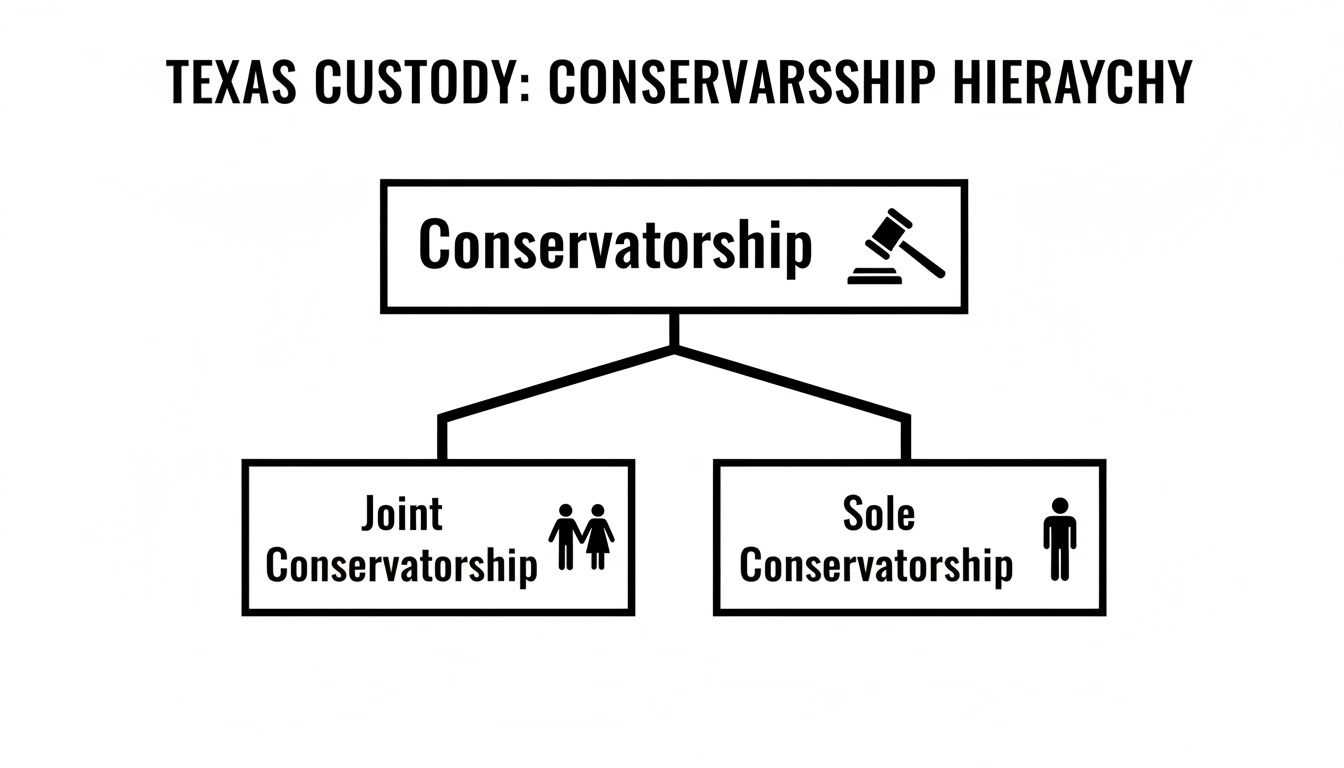
As you can see, while Texas law does allow for one parent to have sole conservatorship, there's a strong legal preference for a joint arrangement that keeps both parents deeply involved in their child's life.
No Bias Based On Gender Or Marital Status
It’s a common and understandable fear, especially for unmarried fathers, that the court will automatically side with the mother. Let me be clear: that is not the law in Texas.
Texas Family Code Section 153.003 explicitly prohibits a judge from making decisions based on a parent's gender or marital status. Your rights as a parent are determined by your ability to be a safe, stable, and supportive presence in your child's life—period. It has nothing to do with whether you were ever married to the other parent.
A judge’s decision must be based solely on the evidence presented about each parent's ability to care for the child. Proving you can provide a safe, nurturing, and consistent environment is the key to a successful outcome.
While the law is crystal clear, statistics do show lingering disparities. Nationally, about 80% of custodial parents are mothers. The good news is that fathers in Texas tend to fare better than the national average, securing around 33% of parenting time. This places our state 22nd in the nation for shared parenting equity. You can discover more insights about these custody statistics.
What this data really tells us is how critical it is for fathers to actively and effectively present their case in court.
Creating A Texas Parenting Plan That Protects Your Child

Think of a parenting plan as the detailed roadmap for your co-parenting journey. It’s so much more than just a calendar—it’s the legally binding court order that spells out the rights, duties, and logistics of raising your child from two separate homes. For unmarried parents, a strong, clear plan is the single best tool for providing stability and heading off future conflicts.
This document takes all those verbal agreements and "we'll-figure-it-out-laters" and turns them into enforceable rules. When disagreements pop up—and they will—you won't be left guessing or arguing. You'll just turn to your court-ordered plan for the answer, saving you and your child a world of stress.
Core Components Of A Strong Parenting Plan
While every family's situation is a little different, any solid Texas parenting plan needs to cover a few essential bases to make sure everyone is on the same page. Leaving details vague is just asking for friction down the road.
Your plan needs to clearly define:
- Possession Schedule: This is the detailed calendar. It outlines who has the child and when during the regular school year, including specific pickup and drop-off times and locations.
- Holidays and Vacations: How will you split major holidays like Thanksgiving, Christmas, and spring break? The plan should get specific, often stating which parent has the child in odd or even years.
- Summer Breaks: Summer is a whole different ballgame. You'll need a clear plan for how the long summer vacation will work, as it's often different from the school-year schedule.
- Decision-Making Rights: This part details who gets to make the big calls about your child’s education, non-emergency medical care, and psychological treatment.
This isn't about micromanaging; it's about creating predictability and security for your child.
A well-drafted parenting plan is proactive, not reactive. It anticipates future challenges—from school choices to holiday arrangements—and provides a clear, court-ordered solution before they can become emotionally charged disputes.
A well-crafted parenting plan is the instruction manual for your co-parenting relationship. The table below outlines the non-negotiable items you'll want to include to ensure everything is covered.
Essential Elements Of A Texas Parenting Plan
| Category | Key Decisions to Include |
|---|---|
| Possession & Access | Detailed school-year schedule (weekdays, weekends). Specific holiday schedule (Thanksgiving, Christmas, Spring Break). Summer vacation possession schedule. Transportation details (who drives, pickup/drop-off locations). |
| Parental Rights & Duties | Who has the right to determine the child’s primary residence (often with a geographic restriction). Who makes decisions about education and healthcare. Who can consent to medical, dental, and surgical treatment. |
| Child Support & Finances | Amount and frequency of child support payments. Who is responsible for providing health and dental insurance. How uninsured medical expenses will be divided. How extracurricular activity costs will be handled. |
| Communication & Logistics | Communication protocols between parents (e.g., co-parenting app, email). Right of First Refusal clause (offering time to the other parent before using a babysitter). Rules for out-of-state or international travel with the child. |
Getting these details hammered out now prevents misunderstandings and court battles later, letting you focus on raising your child.
Thinking Ahead With Forward-Looking Provisions
A great parenting plan doesn't just cover the here and now. It anticipates the future and includes smart provisions that can save you headaches as your child grows and life changes.
Consider adding clauses that cover:
- Geographic Restrictions: This is a big one. A geographic restriction clause defines the area where the primary parent can establish the child's residence, usually limiting it to a specific county or its neighbors. This prevents one parent from moving far away with the child without the court's permission.
- Communication Protocols: Set clear rules for how you and the other parent will communicate about the child. Will you use a co-parenting app? Stick to email? Clear strategies for improving communication can make any parenting plan work better and truly protect your child's best interests.
- Dispute Resolution: What happens when you disagree on something not explicitly covered in the plan? You can include a requirement to try mediation before running back to court, which can save a lot of time, money, and stress.
- Right of First Refusal: This common-sense clause requires one parent to offer the other the chance to watch the child before calling a babysitter or another relative if they need childcare for a certain amount of time.
Negotiating these fine points can feel tough in the moment. But the clarity they provide is absolutely priceless. A detailed, written agreement is the foundation of a successful co-parenting relationship, allowing both of you to focus on what matters most: raising a happy, healthy child.
Navigating Child Support and Legal Updates
In Texas, child support and parenting time aren't separate issues—they're two sides of the same coin. Both are designed from the ground up to ensure your child has the financial, physical, and emotional support they need to thrive. For unmarried parents, a court order is what brings clarity to these obligations, creating a predictable framework that ultimately benefits everyone involved.
Think of child support not as a payment to see your child, but as your direct financial contribution to their well-being. Texas keeps it relatively straightforward with a percentage-based model. The calculation hinges on the net monthly resources of the non-primary parent (the parent who doesn't decide where the child lives). This model also accounts for health and dental insurance, making sure a child's medical needs are always covered.
Since the numbers are so dependent on income, it's critical to know how to verify employment history to make sure the calculation is fair and accurate.
Major 2025 Updates To Texas Family Law
The legal landscape is always shifting, and for unmarried parents, staying informed isn't just a good idea—it's essential. The Texas Legislature recently passed some significant updates that are already reshaping possession schedules and child support guidelines.
Major changes to the Texas Family Code in 2025 will have a big impact on custody laws in Texas for unmarried parents, with a clear focus on strengthening biological ties and expanding access for both parents. One of the biggest changes, under SB1936, makes the Expanded Standard Possession Order (ESPO) the new default schedule for parents living within 50 miles of each other. This move gives the non-primary parent significantly more time with their child—roughly 20-30% more time than the old standard.
On top of that, as of September 1, 2025, the child support cap will jump from $9,200 to $11,700 in net monthly resources. For high-earning parents with multiple children, this could mean an increase of $500-$1,000 a month in support payments.
These updates send a clear message: Texas is committed to making sure both parents stay actively and meaningfully involved in their children's lives, both through financial support and direct, hands-on parenting time.
Understanding The Expanded Standard Possession Order
So what exactly is this new default schedule? The Expanded Standard Possession Order (ESPO) is now what Texas courts presume is in a child's "best interest" when parents live 50 miles apart or less. It takes the old, traditional schedule and adds more parenting time where it counts.
Here’s what the ESPO adds to the mix:
- Thursday Overnights: The non-primary parent's weekend now starts when the child gets out of school on Thursday, not Friday.
- Monday Mornings: The weekend ends when the child is dropped off at school on Monday morning, not Sunday evening.
These changes might seem small, but they create more consistent contact during the school week. This allows the non-primary parent to be much more involved in daily routines like homework, dinner, and bedtime stories.
Of course, this isn't a one-size-fits-all rule. A parent can still argue to a judge that the traditional schedule would be better for their child's specific situation. It's also crucial to know how to handle situations where payments aren't being made. For more on that, check out our guide on Texas child support enforcement.
Key Takeaways and Your Next Steps
You’ve learned the fundamentals of custody law for unmarried parents in Texas. Now it’s time to turn that knowledge into confident action to protect your child’s future. It’s easy to feel overwhelmed by the legal journey, but understanding these core principles is your first step toward making the best decisions for your family.
Navigating this process alone can feel like an uphill battle, and the stakes are just too high to leave things to chance. Reaching out for professional legal guidance isn’t a sign of conflict; it’s a proactive move to protect your rights and secure a stable, predictable future for your child.
Your Checklist for Moving Forward
As you move forward, keep these essential truths in mind. They are the bedrock of every single custody case involving unmarried parents in Texas.
- Paternity is Always the First Step: For an unmarried father, all parental rights begin with legally establishing paternity. Without it, you have no legal standing to ask a court for custody or visitation. Simple as that.
- The Child's Best Interest is the Only Standard: Every decision a judge makes—every single one—will be based on what is best for your child’s emotional and physical well-being. Marital status and gender do not factor in.
- Joint Conservatorship is the Goal: Texas law has a strong preference for keeping both parents actively involved in a child’s life. Joint Managing Conservatorship is the most common and favored outcome for a reason.
- Your Parenting Plan is Your Roadmap: A detailed, court-ordered parenting plan is your best tool for preventing future conflict. It provides the consistency and stability your child needs to truly thrive.
The choices you make today will shape your child's tomorrow. An experienced family law attorney doesn't just represent you in court; they provide the support, strategy, and compassionate advocacy your family deserves during this critical time.
This journey requires both clarity and courage. Taking the step to get a formal court order is the most loving and responsible thing you can do for your child. It replaces uncertainty with stability and makes sure your relationship with them is protected, now and for years to come.
If you need help with a child custody or visitation case in Texas, our experienced attorneys can guide you every step of the way. Contact The Law Office of Bryan Fagan, PLLC today for a free consultation.
Common Questions from Unmarried Parents in Texas
Walking into the family court system for the first time can be a lot to handle, especially when all you can think about is protecting your child. We get it. To help clear up the confusion and give you the confidence you need, here are some straight answers to the questions we hear most often from unmarried parents.
Who has custody if we were never married?
In Texas, the law has a default setting for this. From the moment the baby is born, the unmarried mother automatically has sole managing conservatorship, meaning she has the immediate legal power to make all major decisions for the child (like medical care and schooling) and the child lives with her full-time. An unmarried father has zero legal rights—even if his name is on the birth certificate—until a judge signs a court order officially establishing his paternity and parental rights.
Does it matter if the father is on the birth certificate?
This is probably one of the biggest points of confusion. Putting a father’s name on the birth certificate is a huge step, and it’s usually done by signing a form called an Acknowledgment of Paternity (AOP). But here's the critical part: that piece of paper does not give him any custody or visitation rights.
Think of the AOP as the key that starts the engine. It legally establishes that he is the father, which is the first, non-negotiable step. But to actually have parenting time or decision-making rights, he still needs a court-ordered possession schedule from a judge.
Can we just make our own agreement without going to court?
It’s always a good idea for parents to try and work together, but a handshake deal or an informal written plan isn’t legally enforceable. If one of you decides to stop following the agreement, there’s absolutely nothing the other can do to enforce it.
A court order is your family’s safety net. It transforms your agreed-upon parenting plan into a legally binding document that a judge can enforce, protecting both parents’ rights and, most importantly, giving your child the stability and predictability they need to thrive.
Without that order, a father has no guaranteed time with his child, and a mother has no way to legally enforce child support. Getting a formal order is the only way to make sure everyone’s rights and responsibilities are locked in and protected.
Can an unmarried parent move out of state with the child?
Moving a child across state lines is a huge deal in the eyes of the law. If there are no court orders in place, the mother (as the sole legal custodian) might be able to move. However, the second a custody case is filed, temporary orders almost always kick in, preventing either parent from taking the child out of the county or nearby areas without the court's permission.
Most final custody orders also include a geographic restriction. This clearly defines the specific area—like a certain county and its neighbors—where the primary parent is required to live with the child. Trying to move a child in violation of that order can land a parent in serious legal trouble.
If you need help with a child custody or visitation case in Texas, our experienced attorneys can guide you every step of the way. Contact The Law Office of Bryan Fagan, PLLC today for a free consultation.