
When your child’s future is on the line, understanding your rights matters most. Facing a separation or divorce can make that future feel incredibly uncertain. You might hear terms like "shared custody," but what does that actually mean for your family here in Texas? In the eyes of the law, what most of us call shared custody is officially known as Joint Managing Conservatorship.
It’s a legal term, but the idea behind it is simple and powerful: it’s a framework designed to keep both parents actively and meaningfully involved in their child’s life, long after a relationship ends. It’s about building a stable, cooperative future where your child can thrive.
How Texas Determines Custody

Walking into a custody case can feel overwhelming, but you don’t have to do it alone. This guide is here to translate dense legal jargon into clear, practical guidance for mothers, fathers, and caregivers navigating this difficult time. This isn’t about winning or losing; it's about building a supportive co-parenting environment for your child.
In fact, the Texas Family Code starts with the presumption that a joint managing conservatorship is in a child’s best interest. This legal structure empowers both parents to share in the major decisions that will shape their child's life.
What This Guide Will Cover
Think of this article as your roadmap. We'll walk you through the key pieces of shared custody in Texas so you can feel more confident and prepared for the road ahead. We’ll break down:
- The "Best Interest of the Child" Standard: This is the North Star for every Texas judge. We’ll explain this critical legal principle and the specific factors a court considers, giving you a clear window into the court’s perspective.
- Standard Possession Schedules: You'll get familiar with the Texas Standard Possession Order (SPO), the detailed calendar that outlines visitation, holidays, and summer breaks.
- Child Support in Shared Custody: We'll explain the connection between parenting time and financial obligations and how child support is calculated when you share custody.
Our goal is to give you the information you need to make the best decisions for your family. By understanding your rights and options under Texas Family Code Chapter 153, you can take control of the process and work toward an outcome that protects your child’s future.
What Shared Custody Really Means in Texas
When you hear "shared custody," you might picture a calendar split perfectly 50/50. While that’s possible, it’s not the primary focus of Texas law. Let’s break down the legal terms so you know exactly what this means for your family.
Here in Texas, the law starts with a strong preference for naming both parents as Joint Managing Conservators. This legal term is the foundation of shared custody in our state. It has two equally important parts: sharing rights and duties, and sharing physical time.
The Two Pillars of Joint Conservatorship
First is the sharing of parental rights and duties. This is the "co-parenting" piece. As joint managing conservators, both of you have a say in the major decisions shaping your child's life. It's a collaborative approach designed to keep both parents deeply involved.
These shared responsibilities typically cover major decisions like:
- Education: Where your child goes to school and decisions about any special needs.
- Healthcare: Making non-emergency medical and dental choices.
- Religious Upbringing: Guiding your child’s moral and spiritual life.
The second part is physical possession—the legal term for the schedule of when and where your child lives. This is where a common myth about shared custody comes up. Being joint managing conservators does not automatically mean a 50/50 time split.
Texas law is more concerned with keeping both parents involved in making key life decisions. The focus is on shared responsibility, not just splitting time on a calendar.
Decision-Making vs. Parenting Time
The court treats your legal authority to make decisions and the physical possession schedule as two separate issues. Even when you're named joint managing conservators, one parent is usually designated as the "primary" parent. This means they have the exclusive right to decide where the child lives, though this is typically restricted to a certain geographic area.
This is a critical distinction because while Texas law presumes joint legal custody is best for the child, the division of physical time can look very different. In reality, even with a "shared custody" label, the time isn't always equal. Statistics show that fathers often get around 33% of parenting time, which is close to the national average of 35%. This highlights that mothers are still frequently awarded the majority of physical possession. For a closer look at these trends, you can check out the data behind Texas divorce and custody statistics on familylaw-tx.com.
Understanding these nuances is your first step toward a better outcome. By knowing how joint managing conservatorship works in Texas, you can more effectively advocate for an arrangement that truly serves your child’s needs and keeps you an active, engaged parent.
The Best Interest of the Child Standard
When your child’s future is on the line, every decision a Texas family court makes comes back to one guiding principle: the best interest of the child. This isn’t just a legal catchphrase; it’s the bedrock standard under Texas Family Code Chapter 153 that judges use to evaluate every part of a shared custody case.
Think of it as the judge's North Star. Their job is to look past parental conflict and focus completely on what environment will help a child thrive—emotionally, mentally, and physically.
What Are the Holley Factors?
To make fair and consistent decisions, judges use a checklist known as the "Holley Factors." These criteria come from a landmark Texas Supreme Court case and provide a framework for determining what’s truly in a child’s best interest. While the list isn’t exhaustive, it gives you a clear window into what the court values most.
The court will consider a wide range of factors, including:
- The emotional and physical needs of the child, now and in the future.
- Any emotional or physical danger the child might face.
- The parental abilities of each parent.
- The stability of the homes being offered.
- The child’s own wishes, if they are old enough (usually 12 or older) to have a clear preference.
- A parent's actions or inactions that might suggest an unhealthy parent-child relationship.
For instance, a judge will want to know which parent has consistently taken the child to doctor's appointments, helped with homework, and attended parent-teacher conferences. They’ll also look closely at each parent’s willingness to encourage a positive relationship between the child and the other parent—a cooperative attitude is highly valued by the court.
It’s crucial to understand that the court doesn't just listen to what parents say; it looks for evidence. The parent who can demonstrate a consistent history of prioritizing the child's needs often presents a stronger case.
Proving Your Case to the Court
Your job is to show the court how the custody arrangement you want directly supports these factors and serves your child's well-being. This requires more than just saying you’re a great parent; you have to prove it with concrete examples. Documenting your involvement in everything from school activities to medical care can be incredibly powerful. If you're looking for guidance, you can learn more about how to prove best interest of the child in our detailed article.
By understanding the Holley Factors, you can start to see your case through the judge’s eyes. This perspective is empowering. It helps you build a case focused on what truly matters: your child's happiness, stability, and secure future.
Understanding Texas Possession Schedules
When parents separate, one of the first questions is always, "When will I see my kids?" It’s a natural and emotional concern. In Texas, the answer is found in a possession schedule—the legal term for the parenting calendar that outlines how you and the other parent will share physical time with your child.
To provide a consistent starting point, Texas law offers a default template: the Standard Possession Order (SPO). Think of the SPO as the standard calendar for most families. It lays out weekends, holidays, and summer visits for the non-primary parent, with the goal of giving children predictable, quality time with both parents.
The Standard Possession Order Explained
The court generally presumes the SPO is in a child's best interest, making it the most common schedule. However, the details of the SPO change depending on how far apart the parents live. The 100-mile rule is a major factor that shapes the schedule, affecting everything from weekend exchanges to how summer vacation is divided.
While the SPO is a solid framework, it's not a one-size-fits-all solution. You and your co-parent have the freedom to create a custom possession schedule that better fits your child's needs, your work schedules, and your co-parenting dynamic.
The infographic below highlights the core factors a court considers when approving any possession schedule, always returning to what's best for the child.
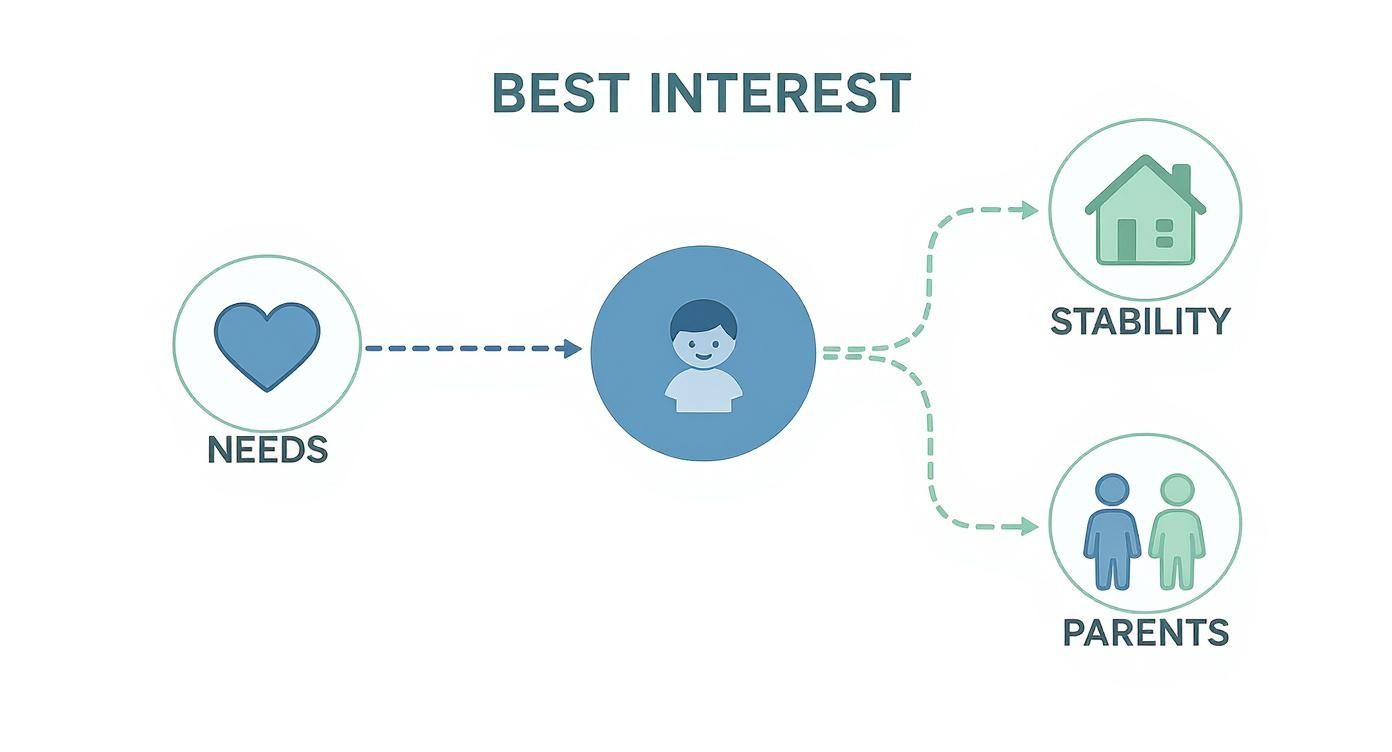
This shows that whether you use the standard plan or create your own, the judge's main focus is ensuring the child’s need for stability and support from both parents is met.
For a clearer picture of how the Standard Possession Order works, let's look at the key differences based on distance.
Standard Possession Order (SPO) at a Glance
| Provision | Parents Under 100 Miles Apart | Parents Over 100 Miles Apart |
|---|---|---|
| Weekends | 1st, 3rd, and 5th weekends of the month. | Can choose one weekend per month or stick to the 1st, 3rd, and 5th. |
| Holidays | Thanksgiving and Christmas are alternated each year. | Same as under 100 miles—holidays are alternated. |
| Summer | 30 days of possession, which can be broken up. | 42 days (6 weeks) of possession. |
| Spring Break | The non-primary parent gets Spring Break in even-numbered years. | Same as under 100 miles—Spring Break is alternated. |
The biggest changes are designed to make long-distance co-parenting more manageable by consolidating time, especially during the summer.
Exploring 50/50 and Custom Schedules
Many parents today are interested in a more equal division of parenting time. These arrangements, often called 50/50 possession schedules, are gaining popularity in Texas, reflecting a modern focus on both parents staying deeply involved in their children's daily lives.
A few popular 50/50 schedules include:
- Week-On/Week-Off: Each parent has the child for a full seven days at a time.
- 2-2-5-5 Schedule: One parent gets Monday and Tuesday, the other gets Wednesday and Thursday, and they alternate weekends.
A successful custom schedule requires good communication and cooperation. Whether you agree on the standard order or a unique 50/50 plan, the most important thing is having a detailed, reliable schedule that gives your child the stability they need.
For a deeper dive into the SPO, you can explore our guide to understanding child visitation and standard possession orders in Texas.
How Child Support Works with Shared Custody

A common question we hear is, “If we share custody, does that mean neither of us pays child support?” It’s a logical question, but in Texas, the answer is almost always no. The law treats parenting time (possession) and financial support as two related but separate issues.
The state’s primary goal is to ensure a child’s needs are met consistently. Child support is considered a fundamental right of the child, not a bargaining chip for parents. Because of this principle, even when custody is shared, one parent is typically ordered to pay child support to the other.
Calculating Guideline Child Support
Texas courts use a specific formula to set a baseline for child support, known as guideline support. This calculation is based on the net monthly resources of the non-primary parent—the parent who doesn't have the exclusive right to designate the child's residence.
Here’s a plain-English explanation of how it works:
- The court determines the parent's total annual income from all sources.
- It subtracts taxes, the child's health insurance premiums, and other approved deductions to find their net monthly resources.
- A set percentage is applied to that net amount based on the number of children the support order covers.
This standardized formula creates a consistent starting point. However, life and finances are complex, which is why judges have the discretion to adjust the amount.
How a 50/50 Schedule Affects the Calculation
This is where the details matter. While a 50/50 possession schedule doesn't automatically eliminate a child support obligation, it can be a strong reason for a judge to deviate from the standard guideline amount.
If both parents have nearly equal time and very similar incomes, a court might order a much lower amount of support or, in rare cases, none at all. But if one parent earns significantly more, they will almost certainly still pay support. The goal is to ensure the child has a similar standard of living in both homes and avoid a "rich house, poor house" situation.
The court's primary concern is always the child's financial stability. A judge has the authority to adjust the guideline support amount if they believe it's in the child’s best interest, especially when considering the time and resources each parent dedicates to raising their child.
It’s also important to know that Texas law is adapting to the rising cost of living. As of September 1, 2023, the state increased the cap on a parent's net monthly resources used in the support calculation from $9,200 to $11,700. This major change helps ensure that support obligations keep up with the economic realities Texas families are facing. You can read more about these important updates in the Texas Family Code changes on thetxattorneys.com.
Understanding how support works is crucial for setting realistic financial expectations for your family’s next chapter. It empowers you to plan ahead and focus on providing a stable, supportive environment for your child.
Key Takeaway: Your Next Steps
Navigating a custody case in Texas can feel like a maze, but you have more control than you think. You can take proactive steps right now to build a stable and loving future for your child.
Remember, shared custody in Texas is about more than a 50/50 split. It’s about sharing the responsibility of decision-making and learning to parent cooperatively, even when you’re no longer together. Every court order is built on one foundation: your child’s best interest. Let that be your guide.
Actionable Steps You Can Take Today
To build a strong foundation for your case and your future as co-parents, focus on these key actions:
- Document Everything. Keep a journal detailing your involvement in your child's daily life. Log school pickups, doctor visits, and homework help—it all paints a clear picture for the court.
- Communicate Professionally. Keep conversations with the other parent centered on the children. Aim for calm, business-like communication, even when it’s tough. This shows the court you can put your child first.
- Consider Mediation. Mediation isn’t about giving in; it’s about taking control. It offers a collaborative path where you and the other parent can create a custom parenting plan that truly works for your family, avoiding a decision being forced on you by a judge.
“The most effective parenting plans are born from cooperation, not conflict. When parents work together, they create a foundation of stability that benefits their child for years to come.”
These are powerful steps that empower you to move forward with purpose and confidence.
If you need help with a child custody or visitation case in Texas, our experienced attorneys can guide you every step of the way. Contact The Law Office of Bryan Fagan, PLLC today for a free consultation.
Got Questions About Shared Custody? We’ve Got Answers.
As you consider what shared custody means for your family, it’s normal to have questions. This journey is full of legal and emotional challenges, and getting clear answers can bring much-needed peace of mind. Here are some of the most common questions we hear from parents like you.
Can We Create Our Own Custody Plan?
Absolutely. In fact, Texas courts encourage it. Working out your own parenting plan, either through direct discussion or with a mediator, allows you to build a schedule that fits your family’s unique life. It’s a custom-fit solution instead of a one-size-fits-all court order.
Once you reach an agreement, an attorney can help formalize it into a legally binding order that protects you, your co-parent, and your child.
What if One of Us Needs to Move?
This is a major concern for many parents. Most Texas custody orders include a geographic restriction. This establishes a boundary—usually the county where the child lives and its surrounding counties—where the child’s primary home must be located.
If a parent wants to move with the child outside of that area, they must first get written permission from the other parent or approval from the court. This rule exists to prevent one parent from moving the child far away, ensuring the other parent can remain actively involved in their life.
A geographic restriction is a critical tool for maintaining stability and ensuring both parents can remain actively involved in their child's life. It is a standard and enforceable part of most Texas possession orders.
How Can We Change an Existing Custody Order?
Life changes, and custody orders can change with it. What works for a four-year-old may not work for a fourteen-year-old. To modify an existing order, you must return to court and prove two things:
- There has been a "material and substantial change" in the circumstances of the child or one of the parents.
- The modification you are requesting is in the child’s best interest.
What counts as a "material and substantial change"? It could be a major career shift, a necessary relocation, or significant changes in your child's developmental or educational needs.
If you need help with a child custody or visitation case in Texas, our experienced attorneys can guide you every step of the way. Contact The Law Office of Bryan Fagan, PLLC today for a free consultation.