
When your child’s future is on the line, understanding your rights isn't just important—it's everything. In Texas, a sole managing conservatorship is a specific type of custody order that gives one parent the exclusive right to make most major decisions for a child. While Texas courts strongly prefer to share parental duties, sometimes this arrangement is the only way to ensure a child's safety and well-being.
This guide will walk you through what this means for your family, why a court might order it, and how you can advocate for your child's best interests with confidence and clarity.
How Texas Determines Custody: What Sole Managing Conservatorship Means for Your Family
After parents separate, one of the toughest hurdles is figuring out who calls the shots on important decisions for the children. In Texas family law, this is known as “conservatorship.” And in every single case, the court's one and only goal is to protect the best interest of the child. That is the guiding principle behind every decision a judge makes.

The law starts with a strong preference that Joint Managing Conservatorship is what's best. This means both parents share the rights and responsibilities of raising their child. However, in certain serious situations, a judge will decide that one parent needs to be the sole decision-maker. This is what's known as a sole managing conservatorship, or SMC.
The Power of Exclusive Decision-Making
Think of a Joint Managing Conservatorship like two co-captains steering a ship. They must consult each other and agree on the direction. A sole managing conservatorship, on the other hand, makes one parent the sole captain.
The other parent is still a vital part of the child's life and has rights to see them, but the sole managing conservator has the ultimate authority to chart the course for the child's future.
A parent who is named the Sole Managing Conservator holds the exclusive power to:
- Decide where the child lives, without any geographic restrictions unless the court specifically orders them.
- Consent to all medical and dental care, including invasive procedures and mental health treatment.
- Make all decisions about the child's education, from school enrollment to special programs.
- Give consent for the child to get married or to enlist in the military.
- Act on the child's behalf in legal matters and make other legally significant choices.
To see how these rights are divided in the more standard arrangement, here’s a quick comparison.
Sole vs. Joint Managing Conservatorship at a Glance
| Decision-Making Right | Sole Managing Conservator (SMC) | Joint Managing Conservator (JMC) |
|---|---|---|
| Primary Residence | Exclusive Right: Can decide where the child lives without geographic limits. | Exclusive Right: One parent is designated to establish the child's residence, usually within a specific area. |
| Medical/Dental Care | Exclusive Right: Makes all decisions independently. | Shared Right: Both parents must consult, but one may have the final say if they can't agree. |
| Psychological/Psychiatric | Exclusive Right: Makes all decisions independently. | Shared Right: Both parents must consult each other on treatment decisions. |
| Education | Exclusive Right: Makes all schooling decisions independently. | Shared Right: Both parents are involved, though one may be given the tie-breaking vote. |
| Legal Representation | Exclusive Right: Can represent the child in legal actions. | Shared Right: Both parents have the right to act on the child's behalf. |
| Consent to Marriage | Exclusive Right: Has the sole authority to give consent. | Shared Right: Both parents have this right. |
| Consent to Military | Exclusive Right: Has the sole authority to give consent. | Shared Right: Both parents have this right. |
This table shows just how much authority shifts from a shared model to a single decision-maker under an SMC order.
Why This Isn't the Standard Arrangement
It's critical to understand that Texas courts don't award sole managing conservatorships lightly. There has to be powerful, compelling evidence showing that giving one parent this much control is the only way to protect the child's physical or emotional well-being.
A judge will only deviate from the standard joint arrangement if there’s a documented history of family violence, substance abuse, severe parental conflict, or neglect that makes co-parenting impossible or downright dangerous for the child.
The court’s decision isn't about punishing one parent; it's about protecting the child. The entire legal framework is built to create a safe, stable, and nurturing environment where a child can thrive, even when their parents no longer live together.
To get a better handle on the implications, exploring the differences between joint custody vs sole custody can offer more context. While the terms vary from state to state, the fundamental ideas of shared versus exclusive decision-making are similar and highlight why a court might choose one path over the other.
Ultimately, whether you're a mother, father, or grandparent, knowing the specifics of this legal tool is crucial for advocating effectively for the child you love. It provides a powerful legal shield in situations where a child’s safety and stability are genuinely at risk.
Why a Texas Court Would Award Sole Custody
Texas family courts walk into every custody case with one fundamental belief, straight from the Texas Family Code: kids do best when both parents are actively involved in their lives. This is exactly why joint managing conservatorship is the default, the starting point for nearly every family.
So, what could possibly convince a judge to set aside that standard and give one parent the immense responsibility of sole managing conservatorship?
It’s never a decision made on a whim. A judge needs to see compelling, hard evidence that making one parent the sole decision-maker is absolutely critical for the child's physical safety or emotional health. We're not talking about typical disagreements over bedtime or screen time. The circumstances have to be serious enough to directly threaten the child's well-being.
The "Best Interest of the Child" Standard
Every single decision a Texas family judge makes is viewed through one powerful lens: the “best interest of the child.” This isn't just a legal catchphrase; it's the gold standard that forces judges to put a child's needs above everything else—parental wants, egos, and arguments included.
When a judge is weighing a request for sole managing conservatorship, they have to figure out if a joint setup would be damaging or simply impossible. They do this by looking at a specific set of criteria known as the Holley Factors. Our firm put together a detailed guide on understanding Texas custody and the Holley Factors that dives deep into what a court is really looking for when making these life-changing calls.
At its core, the court is asking one tough question: would forcing these two people to share parental duties expose this child to danger, instability, or emotional trauma? If the evidence points to "yes," then awarding sole managing conservatorship shifts from an option to a necessary shield for the child.
Grounds for Awarding Sole Managing Conservatorship
A court won’t strip one parent of their rights just because the other asks. To get a sole managing conservatorship, you have to prove there are specific, dangerous behaviors or circumstances that make co-parenting a risk to the child. These are the deal-breakers, not minor frustrations.
Some of the most common reasons a judge will issue an SMC order include:
- A History of Family Violence: This is one of the most significant factors. If one parent has a documented history of physical, sexual, or emotional abuse toward the child or the other parent, the court will almost always step in to protect the child by limiting that parent's rights.
- Substance Abuse: This refers to a parent with an ongoing, untreated addiction to drugs or alcohol that clouds their judgment and makes them incapable of providing a safe home. You have to show how the substance abuse directly creates a dangerous environment for the child.
- Severe Neglect or Abandonment: If a parent has been absent from their child's life—providing no financial support, no emotional connection, and failing to meet basic needs—a court may conclude that the actively involved parent should be the one in charge.
- Extreme Parental Conflict: All co-parents disagree. But when the conflict is so toxic that parents can't make a single decision together without it causing emotional harm to the child, a judge may decide the only way to create peace and stability is to put one parent in the driver's seat.
A judge’s decision to award sole managing conservatorship is not a punishment. It is a protection. It is a legal shield put in place when the evidence clearly shows that a child needs one stable, reliable parent at the helm to ensure their safety and guide their future.
For example, imagine a father who has been a consistent, responsible parent. The mother, however, is battling an untreated addiction that results in erratic behavior and an unsafe home. A judge in that situation would likely name the father as the Sole Managing Conservator, not to punish the mother, but to give the child the stable, safe harbor they desperately need.
Ultimately, the parent asking for sole managing conservatorship has to prove their case. You must walk into that courtroom with clear, convincing evidence that shows why this drastic step isn't just a preference, but an absolute necessity for your child's well-being.
What Are Each Parent's Rights and Duties?
When a judge orders a sole managing conservatorship, it's a major legal shift. But let's be clear about one thing right away: this order doesn't erase one parent from the picture. Instead, it carefully redefines each parent's role to build a stable and safe foundation for the child.
Both parents still hold important rights and responsibilities. The law simply divides them differently to give one parent the final say on big decisions, while ensuring the other stays an active, involved part of their child's life.
The Role of the Sole Managing Conservator
The parent named the Sole Managing Conservator (SMC) is handed the exclusive authority to make most of the critical decisions that will shape their child's future. This isn't about winning or losing; it's about creating a consistent environment, free from the conflict or danger that likely led the judge to this decision in the first place.
This parent has the final, independent say on several key life issues. The exclusive rights of a Sole Managing Conservator usually include:
- Deciding Where the Child Lives: The SMC has the sole right to choose the child's residence, often without the geographic restrictions that are common in joint custody cases.
- Consenting to Medical Care: This covers everything from routine check-ups and therapy to major surgical procedures.
- Making Educational Decisions: The SMC picks the child’s school and has the authority to make all other decisions about their education.
- Receiving Child Support: As the primary caregiver, the SMC is the parent who receives child support payments on behalf of the child.
These exclusive powers are laid out clearly in the court order, creating a roadmap for who is in charge of these fundamental parts of a child's upbringing. To see how these responsibilities stack up against other arrangements, check out our guide comparing sole custody vs. joint custody.
The Rights of the Possessory Conservator
The other parent is known legally as the Possessory Conservator. While this parent doesn't have the final word on the major decisions listed above, their role is anything but minor. The Texas Family Code makes sure they can maintain a meaningful relationship with their child and stay in the loop about their life.
A Possessory Conservator's rights are legally protected and just as enforceable as the SMC's. These core rights include:
- The Right to Possession and Access: The court will issue a possession order, which is simply a detailed visitation schedule that outlines exactly when the child will be with the Possessory Conservator.
- The Right to Information: This parent has the right to get the child’s medical, dental, psychological, and educational records directly from the providers themselves.
- The Right to Consult: The Possessory Conservator can talk with the child's doctors, dentists, and school officials about the child's progress and well-being.
- The Right to Be Notified of Emergencies: The SMC has a legal duty to inform the Possessory Conservator promptly of any major events or emergencies affecting the child's health or safety.
It's a huge myth that a Possessory Conservator loses all their parental rights. That's just not true. The law ensures you have the right to see your child, stay informed, and participate in their life, even if you don't hold the ultimate decision-making power.
On top of these rights, the Possessory Conservator has a legal duty to financially support the child. This means they will almost always be ordered by the court to pay monthly child support to the Sole Managing Conservator, reinforcing their ongoing parental role.
How to Navigate the Texas Court Process
Walking into a Texas courtroom can feel overwhelming, but when your child's future is on the line, understanding the path forward can give you the confidence to take each step. Seeking a sole managing conservatorship isn’t a single event; it's a structured legal journey, and knowing the map is the first step toward advocating effectively for your child.
This process is designed to give the court a complete and accurate picture of your family's situation. Every step, from filing the first document to presenting evidence, is there to ensure that a monumental decision like awarding sole conservatorship is based on solid facts and what will truly serve your child's best interests.
The Initial Filing and First Steps
The whole process officially kicks off when one parent files an Original Petition with the court. This is a critical document. It lays out exactly what you are asking the judge to do—in this case, name you as the sole managing conservator—and explains why you believe it's necessary for your child's well-being.
Once that petition is filed, the other parent must be officially notified through a legal process called "service." This is a non-negotiable step that ensures they know about the lawsuit and have a fair chance to respond. Our guide on how to file for custody in Texas takes a much deeper dive into these initial, but absolutely vital, first moves. From there, the case moves into its next important phase: setting up temporary rules to protect your child while the case unfolds.
Temporary Orders and Gathering Evidence
Custody cases don't resolve overnight—they can take months. Because of this, the court will hold a temporary orders hearing very early in the process. The entire point is to put temporary rules in place for custody, visitation, and child support that will stand until a final decision is made. For a parent seeking sole managing conservatorship because of immediate safety worries, this hearing is a crucial first opportunity to ask the judge for protective measures.
Right after this hearing, the case moves into the discovery phase. This is the formal, structured process of gathering evidence. It’s your chance—and your attorney's—to collect the specific facts, documents, and proof needed to build a powerful, convincing case.
The kind of evidence that really matters in a sole managing conservatorship case often includes:
- Text messages and emails that reveal a pattern of instability, threats, or neglect.
- Police reports or protective orders that document instances of family violence.
- School and medical records which might show the negative impact of the other parent's behavior on the child.
- Testimony from witnesses, like teachers, counselors, or family members who have seen the situation with their own eyes.
This flow chart gives a simple visual of how the court's decision on conservatorship directly connects to the specific rights a parent is granted.
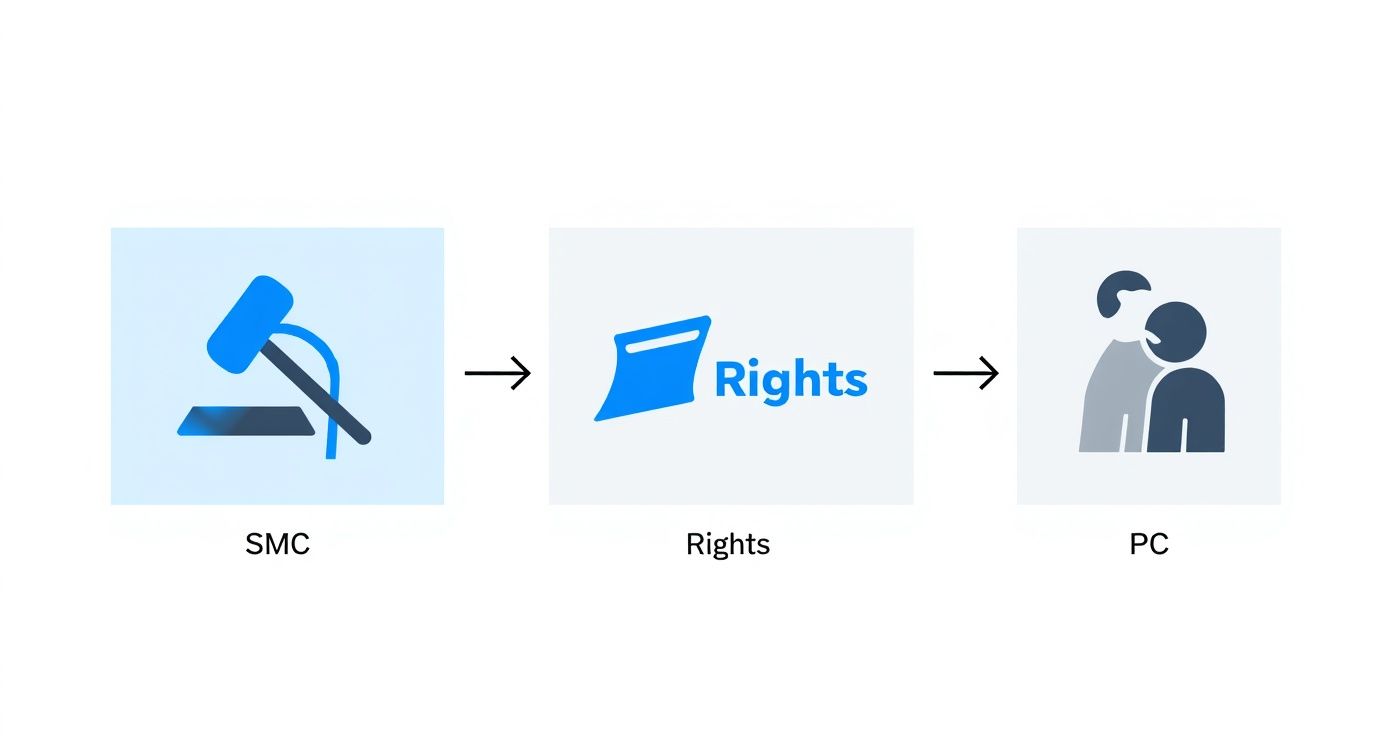
As you can see, the process flows from the court's decision on conservatorship (SMC) to the specific rights granted, which ultimately defines the parent-child relationship (PC). This fundamental structure is the backbone of every single custody order in Texas.
The table below breaks down these key stages so you can see how a typical case progresses from start to finish.
Key Stages in a Sole Managing Conservatorship Case
| Legal Stage | What Happens | Key Goal for Your Case |
|---|---|---|
| Initial Filing | An Original Petition is filed with the court, officially starting the lawsuit. | Clearly state your request for SMC and the reasons why it's in the child's best interest. |
| Service of Process | The other parent is formally served with the lawsuit papers. | Ensure the other parent is properly notified so the case can move forward legally. |
| Temporary Orders Hearing | A hearing is held to set temporary rules for custody and support while the case is pending. | Secure a safe and stable environment for your child immediately; obtain protective orders if needed. |
| Discovery | Both sides exchange information and evidence through formal requests. | Gather all necessary proof (texts, reports, records, witness info) to build your case. |
| Mediation | A neutral mediator helps parents try to reach a settlement agreement. | Attempt to resolve the case on terms that protect your child, avoiding the uncertainty of trial. |
| Final Trial | If no agreement is reached, a judge hears evidence from both sides and makes a final ruling. | Present a clear, evidence-backed argument showing why SMC is necessary for the child’s well-being. |
Understanding this sequence helps you anticipate what's next and prepare for each phase with your attorney, turning a confusing process into a manageable one.
Mediation and Preparing for Trial
Before you can ever get to a final trial, Texas courts almost always require parents to attend mediation. This is a confidential meeting where a neutral third-party mediator helps you and the other parent try to find a resolution you can both live with. It’s a powerful tool because it gives you a voice in the final outcome, rather than leaving the decision entirely in a judge's hands.
If you can hammer out an agreement that keeps your child safe and stable, it can be written up as a final order and signed by the judge. This is often the best-case scenario, as it saves emotional energy, time, and legal fees.
"Even in the most high-conflict cases, mediation is a chance to find a sliver of common ground. The goal is always to create a stable, predictable future for the child, and sometimes, a structured agreement is the clearest path there."
But what if mediation fails? If the other parent just won't agree to terms that ensure the child's safety, the case will be set for a final trial. This is where both sides present all their evidence and witnesses to the judge. After hearing everything, the judge will make a final, binding decision on conservatorship, visitation, and child support based on one thing and one thing only: what they believe is in the child’s best interest.
Using Custody Orders to Protect Your Child
When you're dealing with a high-conflict co-parent or a genuinely dangerous situation, a custody order is so much more than a piece of paper—it's a shield. A sole managing conservatorship can be an absolutely critical tool for protecting your child’s physical and emotional safety, especially when serious concerns like family violence or abduction are on the table. In these tough spots, a court order provides real, enforceable protection designed to give you peace of mind.
A judge's number one job is to protect the child. When they are shown solid evidence of risk, a Texas court can build specific, powerful protective measures directly into the custody order. These aren’t one-size-fits-all solutions; they are carefully tailored to address the unique dangers your family is facing.

Specific Protective Measures in a Custody Order
When a parent's behavior poses a threat, the court has several tools in its toolbox to keep a child safe. Think of these not as punishments, but as practical safeguards designed to prevent harm before it happens.
Common protective provisions include:
- Supervised Visitation: If there are worries about a parent's substance abuse, instability, or history of violence, the court can order that every single one of their visits with the child must be supervised by a neutral third party or a trusted family member.
- No Alcohol or Drug Use: An order can flat-out prohibit a parent from consuming alcohol or illegal drugs within a certain window before or during their time with the child, often for 24 hours.
- Psychological Evaluations or Counseling: A judge has the power to order a parent to undergo a psychological evaluation or attend counseling or anger management classes as a condition of their visitation.
These measures create a controlled environment where the parent-child relationship can continue, but only under conditions that put the child's well-being first.
Preventing International Abduction
One of the most terrifying nightmares for any parent is the threat of international child abduction. This is where a sole managing conservatorship becomes a powerful preventative tool. Texas courts can and will assign sole managing conservatorship to the parent less likely to abduct the child, while severely restricting the other parent's access through things like supervised visitation or requiring them to post a financial bond.
Legal frameworks like the Texas Family Code and the Hague Convention on the Civil Aspects of International Child Abduction give these orders teeth, all aimed at ensuring child safety and parental accountability.
A court can take concrete steps to prevent a parent from leaving the country with a child. This could mean ordering the parent to surrender the child’s passport to you or the court, or requiring them to post a significant financial bond that they’d lose if they violate the order.
Beyond the courtroom, modern parenting also means being proactive. Your role as a protector extends to every part of your child’s life, which today includes implementing effective strategies for protecting children online to ensure their digital safety.
Ultimately, these legal tools are in place because the law recognizes that some situations require more than just a standard visitation schedule. They require a fortress of legal protection, and a carefully crafted custody order is exactly how that is built.
Common Questions About Sole Conservatorship
When you're facing a custody dispute, it feels like you're trying to navigate a fog of legal terms and high-stakes emotions. It’s completely normal to have questions, and we hear them every day from parents just like you. Let's clear up some of the most common ones about sole managing conservatorship in Texas.
Does Texas Favor Mothers Over Fathers?
Absolutely not. This is probably the most persistent myth in all of family law, but let’s be crystal clear: it's completely false.
The Texas Family Code is gender-neutral. A judge is legally forbidden from making a custody decision based on whether a parent is a mom or a dad. What the court does care about is evidence related to the best interest of the child. Things like who provides a stable and safe home, who has been the primary caregiver, and whether there's a history of family violence are what truly matter—not gender.
Can a Sole Managing Conservatorship Order Be Changed?
Yes, it certainly can. A custody order isn't set in stone forever. Life changes, and the law recognizes that. An order can be modified, but only if two things are proven to the court:
- There has been a "material and substantial change" in the circumstances of the child or one of the parents.
- Changing the order is in the child's best interest.
For example, imagine a parent lost custody due to a substance abuse problem. If that parent completes treatment, demonstrates years of sobriety, and builds a stable life, a court might agree to modify the order from sole to joint managing conservatorship. The key is that the change has to be significant and lasting.
A modification isn't about giving a parent a "do-over." It’s about the court re-evaluating the family’s current reality to ensure the custody arrangement still fits the child’s needs as their life evolves.
Does This Order Terminate Parental Rights?
No, and this is a critical point to understand. Sole managing conservatorship does not terminate the other parent's rights. It simply reallocates who has the final say on major decisions.
The other parent is named the Possessory Conservator, and they still have legally protected parental rights. These almost always include the right to visitation (a possession schedule), the right to access the child’s school and medical records, and the duty to pay child support.
Terminating parental rights is a completely separate and far more drastic legal action. It has an incredibly high burden of proof and is reserved only for the most extreme cases, like severe abuse or long-term abandonment.
Next Steps to Protect Your Child's Future
Knowing your options is the starting point, but taking decisive action is what will actually protect your child. We've walked through what sole managing conservatorship is and why it’s a rare measure, reserved only for situations where it's absolutely necessary for a child’s best interest. This isn’t about “winning” a custody case; it’s about creating a safe, stable life for your child.
As you figure out what to do next, keep your child’s well-being—both physical and emotional—at the very center of every decision. The best thing you can do right now is empower yourself by focusing on what you can control.
Key Takeaway
To build the strongest case and give your child the protection they need, you should be laser-focused on these four things:
- Document Everything. Keep a detailed log of every incident, conversation, or concern that shows why you believe sole managing conservatorship is necessary. Your most powerful tools are dates, times, specific quotes, and photos.
- Prioritize Safety Above All. If you have any reason to believe your child is in immediate danger, your first move should always be to get them to a safe place. Legal steps come second to their physical and emotional security.
- Understand Your Rights. Get familiar with the fine print. Know the difference between a Standard Possession Order and the specific rights that come with being a Sole Managing Conservator versus a Possessory Conservator.
- Seek Professional Guidance. You do not have to do this alone. Texas family law is complicated, and you need a skilled advocate in your corner who can turn your valid concerns into a clear, compelling legal strategy.
Your child's future is what this is all about, and having the right attorney fighting for you can make all the difference.
If you need help with a child custody or visitation case in Texas, our experienced attorneys can guide you every step of the way. Contact The Law Office of Bryan Fagan, PLLC today for a free consultation.