Skip to content
When your child’s future is on the line, understanding your rights matters most. A temporary restraining order (TRO) for custody in Texas is a powerful legal tool designed to press pause on a chaotic situation, acting as your first line of defense to protect your child before a judge can hear from both sides. It’s about creating stability when everything feels uncertain.
How Texas Determines Custody: Understanding Your First Line of Defense

When you feel like your child’s world is spiraling, it’s easy to feel powerless. But the Texas Family Code gives parents powerful tools to act decisively. A Temporary Restraining Order, or TRO, is one of the most important first steps you can take to regain control and advocate for your child's well-being.
A TRO isn't about deciding final custody. Instead, it sets immediate ground rules at the very start of a custody case. Think of it as a set of guardrails designed to keep everything stable and prevent a bad situation from getting worse before a formal hearing can happen. It validates your concerns while emphasizing your legal options to protect your family.
What a TRO Can Do for Your Family
A well-drafted TRO can stop specific, disruptive actions that could destabilize your child's life or take away your parental rights. A judge can sign a TRO that immediately prohibits the other parent from:
- Pulling the child out of their current school or daycare.
- Taking the child out of the county or the state of Texas without your agreement or a court order.
- Hiding the child from you or cutting off your communication.
- Speaking negatively about you in front of the child (known as "disparaging remarks").
- Harassing or threatening you or other family members.
This order creates the breathing room you need and helps keep your child's environment as normal as possible while the legal process gets underway. It’s an essential tool for any parent—mother or father—who fears the other might act impulsively or destructively.
Practical Guidance: A TRO is an emergency measure, not a final custody decision. It typically lasts for 14 days and is meant to keep the peace and prevent harmful actions until the court can hold a temporary orders hearing where both parents get to present their side of the story.
TRO vs. Emergency Ex Parte Order
It's critical to know the difference between a standard TRO and other, more powerful orders. A TRO sets preventative rules—the "thou shalt nots"—but it usually doesn't change who has physical custody of the child.
For situations involving immediate physical or emotional danger, you may need an Emergency Ex Parte Order.
An ex parte order is granted without notifying the other parent first. To get one, you must provide sworn testimony showing that your child is in immediate danger of harm. These orders can do what a standard TRO cannot: temporarily change who has possession of the child. For instance, if you have proof the other parent’s substance abuse is putting your child at risk right now, you would seek an ex parte order to get temporary custody.
Our attorneys can help you figure out which path makes sense for your specific crisis. To learn more about this urgent process, you can find valuable information in our guide on what to expect with an ex parte custody order in Texas.
Whether you need a TRO or a more aggressive ex parte order, the goal is the same: to act swiftly to protect your child. Understanding these options is the first step toward advocating for your child's best interests—the legal standard that guides every single custody decision in Texas.
When to Seek a Temporary Restraining Order for Custody
When you believe your child is in danger, a million worries can flood your mind. But fear alone isn't enough to get a court's attention—you need to know when and how to take legal action. A temporary restraining order (TRO) isn't handed out lightly in Texas. A judge needs to see clear evidence of a real, immediate risk before they will step in.
Let’s set aside the legal jargon for a moment and focus on the situations that keep parents up at night. These are the real-world circumstances that often justify asking a court for immediate protection.
Scenarios That May Justify a TRO
Certain actions from the other parent don’t just cause stress; they create a level of instability or a direct threat that can trigger the need for a temporary restraining order for custody in Texas.
Here are some of the most common red flags we see:
- Relocation Threats: The other parent threatens to pack up and move the child out of state, cutting you off without your consent or a court order.
- Substance Abuse: You have proof or have witnessed the other parent’s drug or alcohol abuse, putting the child in a dangerous environment.
- Family Violence: There have been credible threats of violence, or actual family violence has occurred against you or your child.
- Parental Alienation: The other parent is actively trying to destroy your relationship with your child by making false claims or blocking all of your attempts to communicate.
If any of this sounds familiar, you may have grounds to seek a TRO. The court's primary objective is to stop any actions that could cause lasting harm before a full hearing can be scheduled.
Understanding "Imminent and Irreparable Harm"
Walking into court and saying you're "worried" won't get you a TRO. You have to prove "imminent and irreparable harm." This is the legal standard a judge will use to determine if your situation is a true emergency.
Let's break that down into plain English:
- Imminent: The danger isn't a vague future possibility. It's about to happen right now. A text from the other parent saying, "We're leaving for Florida tonight and you'll never see us again," is imminent.
- Irreparable: The damage, once done, can't be easily undone. If a parent abducts a child to another country, the legal nightmare and emotional trauma are nearly impossible to reverse.
The key is to demonstrate that without the court's immediate intervention, your child's safety, stability, or your relationship with them will suffer damage that a later court order can't simply mend.
Sadly, the need for these orders is all too common. A temporary restraining order can provide a critical 14-day shield during a custody crisis. This protection is vital, especially when you consider that 1 in 3 Texans will experience domestic violence. By issuing an order based on solid proof of imminent harm, a judge can stop dangerous behavior like child removal or harassment in its tracks. You can read an in-depth analysis of TROs in Texas to learn more about how these protections work.
The Power of Documentation
Your word alone, no matter how sincere, often isn't enough. To persuade a judge to sign off on a TRO, you have to show them, not just tell them. This is where solid documentation becomes your most powerful ally. Start gathering your proof before you even think about filing.
Your evidence file should include things like:
- Communications: Save every single text, email, voicemail, and social media post that contains threats, admissions of substance abuse, or plans to violate your rights.
- Witnesses: Make a list of people—grandparents, teachers, neighbors, friends—who have seen the concerning behavior and can provide a credible statement.
- Photos and Videos: Visual proof is incredibly powerful. A photo of drug paraphernalia left out in the house or a video of an aggressive outburst can speak volumes.
- Official Records: Police reports, CPS case files, or medical records detailing injuries from family violence are rock-solid pieces of evidence.
This collection of proof is what you'll use to build your sworn affidavit—the formal, detailed statement you submit to the court. A strong affidavit packed with specific, factual examples of imminent harm is what compels a judge to take immediate action and protect your child.
Steps to File a Temporary Restraining Order for Custody in Texas
When you realize a temporary restraining order is the only way to protect your child, the path forward can seem murky and intimidating. Let's clear away the confusion and walk through the real-world process for filing a temporary restraining order for custody in Texas.
This isn’t about just one form; it’s about putting together a legal package that tells your story to the court, quickly and effectively. Understanding what goes into that package is the first step toward taking back control.
Assembling Your Initial Legal Filings
To get a TRO, you first have to start a lawsuit. In family law, this is usually done by filing an Original Petition in Suit Affecting the Parent-Child Relationship. This is the formal document that asks the court to step in and make critical decisions about custody, visitation, and child support.
But the petition alone isn’t enough for an emergency order. You’ll also need two other vital documents:
- Application for Temporary Restraining Order and Temporary Orders: This is your direct request. You’re asking the judge not only to sign the TRO but also to schedule a full hearing to sort things out.
- Sworn Affidavit: This is your story, told under oath. It’s your chance to explain to the judge, in your own words, exactly why the court needs to act now. This is the heart of your request.
Many parents seek a TRO when faced with a direct threat, an immediate danger, or a clear act of sabotage against the parent-child relationship.
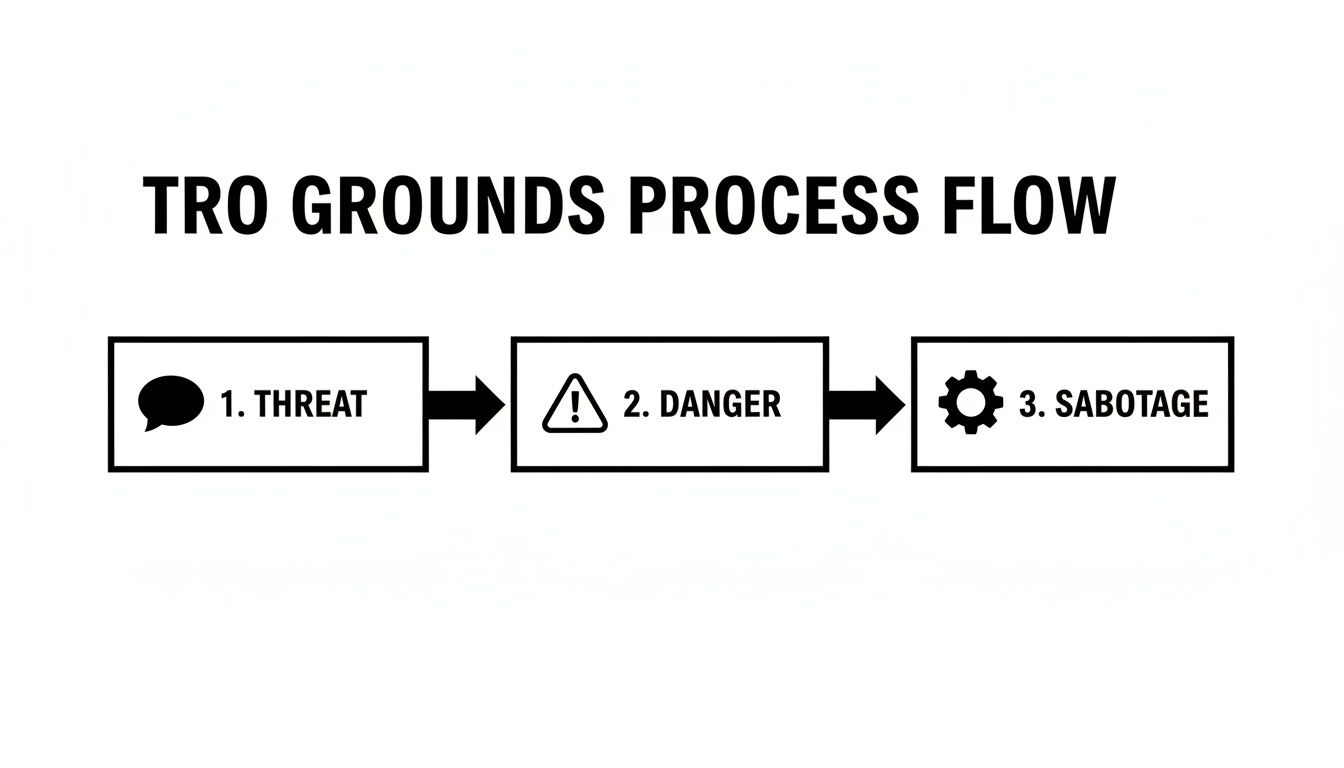
As you can see, the grounds for a TRO go far beyond simple disagreements. It's about demonstrating a clear and present risk to your child’s safety, well-being, or your fundamental relationship with them.
What Goes into a Powerful Affidavit?
Your affidavit is where you connect the dots for the judge. It needs to be factual, hyper-specific, and laser-focused on the best interest of the child—the single most important standard in all Texas custody matters. This is not the place to vent about the other parent's personality or list every frustration you've ever had.
Instead, your affidavit must lay out the cold, hard facts.
- Use specific dates, times, and direct quotes whenever you can.
- Describe concrete actions, not just your feelings or interpretations.
- Clearly explain how the other parent’s behavior puts your child at risk of imminent and irreparable harm.
For example, don't just say, "He's irresponsible and I'm worried." That's too vague for a judge.
Try this instead: "On Tuesday, May 21, 2024, at 8:15 PM, the child’s father sent me a text stating, 'I'm taking Johnny to my cousin's in Oklahoma this weekend and there's nothing you can do about it.' He has previously refused to return our child on time, which caused Johnny to miss two days of school last month." See the difference?
A strong affidavit focuses on facts, not emotions. It provides the judge with the concrete evidence needed to justify signing an order without first hearing from the other parent.
A Temporary Restraining Order includes standard prohibitions to maintain the status quo and protect the child. Below are some of the most common actions a TRO will prevent either parent from taking.
Key Actions Prohibited by a Standard Texas Custody TRO
| Prohibited Action | Why It's Important For Child Custody |
|---|---|
| Removing the child from their current school or daycare | This prevents one parent from disrupting the child's educational and social stability without a court order. |
| Hiding the child or taking them out of state | This protects against parental kidnapping and ensures both parents know the child's whereabouts. |
| Making disparaging remarks about the other parent | This shields the child from parental alienation and emotional harm caused by being caught in the middle of conflict. |
| Destroying, altering, or hiding financial records | This ensures all assets and debts are transparent for fair child support and property division calculations. |
| Changing the child's health insurance or beneficiaries | This maintains the child's access to medical care and protects their financial security during the legal process. |
| Incurring unusual debts or making large expenditures | This prevents one parent from draining the community estate or creating financial instability before the court can divide property. |
These "rules of the road" are designed to keep things calm and predictable for your child until the court can hold a full hearing.
Filing the Paperwork and Getting the Judge's Signature
Once all your documents are prepared, they need to be filed with the district clerk in the county where your child lives. After filing, your attorney will take the proposed TRO and your affidavit to a judge for their review.
The judge will read your affidavit to determine if you’ve met the high legal bar for an ex parte order—an order granted on an emergency basis with only your side of the story. If the judge agrees that a risk of imminent and irreparable harm exists, they will sign the TRO. From that moment on, it is a legally binding court order.
Our guide on filing a restraining order in Texas offers more detail on this critical initial phase.
The Clock Is Ticking: Service and the Hearing
A signed TRO is a huge first step, but it’s just the beginning. The order is only a temporary fix, typically lasting just 14 days.
Two things have to happen immediately:
- Serve the Other Parent: The law demands that the other parent be officially notified of the lawsuit and the new restrictions. This is called "service of process." A constable or private process server will hand-deliver a copy of all the filed documents, including the signed TRO, to them. This ensures they have legal notice.
- Prepare for the Temporary Orders Hearing: The TRO itself will contain the date, time, and location of a follow-up court hearing. This is your chance to present evidence, call witnesses, and argue why the temporary rules should be extended and your requests for custody and support should be granted while the case moves forward.
How to Prepare for Your Temporary Orders Hearing
A Temporary Restraining Order (TRO) is a powerful but very short-term solution. It typically only lasts for 14 days. Think of it as the emergency brake; its real purpose is to get you to the temporary orders hearing safely.
This court date is your first and best chance to argue your case before a judge. Here, you'll ask for enforceable rules that can protect your child and your rights for the entire time your custody case is active. This hearing is critical—the orders set here often become the blueprint for the final custody arrangement, so being prepared is non-negotiable.
This isn't just another meeting. It’s where the judge will make crucial decisions about your child's immediate future, mapping out the road ahead while your case unfolds.
Understanding the Court's Focus: The Best Interests of the Child
Every decision a judge makes in a custody case comes back to one single principle: the “best interest of the child.” This isn't just a casual phrase; it's the legal standard defined in the Texas Family Code that governs everything.
The court will look at your child's physical and emotional well-being, their need for a stable environment, and any potential danger they might be in. Your job is to prove that the orders you’re asking for serve your child’s best interests. This means shifting the narrative away from your personal disputes and focusing squarely on how the other parent's actions impact the child.
Gathering Your Evidence for the Hearing
Just as when you filed for the TRO, evidence is everything. At the hearing, you must be ready to back up the claims made in your affidavit and prove why your proposed orders are the best path forward for your child.
Get your evidence organized so your attorney can tell a clear, compelling story. Your evidence file should be ready to go with things like:
- Communication Logs: A complete record of texts, emails, and phone logs showing the other parent’s behavior, threats, or refusal to co-parent.
- Financial Records: Bring your pay stubs, bank statements, and recent tax returns. This is essential for determining child support.
- School and Medical Records: Report cards, attendance records, and notes from doctor visits can paint a picture of how a child is doing and which parent is more involved in their day-to-day life.
- Witnesses: Keep a list of credible people—teachers, family friends, or counselors—who can testify about what they have personally seen or heard. Make sure they are willing and available.
Practical Guidance for Mothers and Fathers: The temporary orders hearing is your chance to turn the temporary protections of a TRO into a stable, court-ordered plan. Strong, organized evidence is what will convince the judge that your requests are in your child's best interest.
Key Custody Concepts the Judge Will Consider
During the hearing, you’ll hear legal terms that can feel confusing. Here are plain-English explanations of concepts you need to know:
- Joint Managing Conservatorship: This is the standard arrangement in Texas and the court's default preference. It means both parents share the rights and duties of raising their child. It does not automatically mean a 50/50 possession schedule, but it does mean you share decision-making power on big issues like education and healthcare.
- Possession Schedules: This is the legal term for the visitation calendar. It spells out exactly when the child will be with each parent, covering everything from weekends and weeknights to holidays and summer breaks. The Standard Possession Order is a common starting point, but it can be customized to fit your family's unique situation.
The evidence you bring to this hearing has a huge impact. For example, solid proof of family violence can disqualify a parent from being a joint managing conservator under Texas Family Code §153.004. For fathers, who statistically secure less parenting time, a well-prepared hearing can be a game-changer in establishing their critical role and countering outdated biases. You can explore trends in Texas divorce and custody outcomes for more background on these statistics.
Presenting Yourself Confidently in Court
The way you act in the courtroom speaks volumes. The judge isn't just listening to your lawyer; they are watching you, judging your credibility and demeanor. Whether you're a mother or a father, your focus must remain entirely on your child.
Here’s some simple, practical advice:
- Dress Professionally: Show the court you take this seriously. Business casual is a safe and respectful choice.
- Stay Calm and Respectful: This is critical. Never interrupt the judge, the other attorney, or the other parent. Let your lawyer do the talking. An emotional outburst will only damage your case.
- Be Child-Focused: If asked to speak, frame every answer around your child's needs, not your own anger or frustration. Instead of saying, "He's always late," try explaining the impact: "When Dad is late for exchanges, it makes our son anxious and he has a hard time settling down for the rest of the evening."
This hearing truly sets the tone for your entire custody case. By being prepared, organized, and focused on what really matters—your child’s well-being—you give yourself the best chance at a positive outcome that provides stability when your family needs it most.
Next Steps: After the Hearing and Enforcing Court Orders
Walking out of the courtroom after a temporary orders hearing can feel like you've just run a marathon. Whether the judge’s ruling brought relief or a fresh set of worries, one thing is for sure: that initial TRO is gone, and you now have a new, legally binding court order to follow.
This new order is the rulebook for your family while the custody case is pending.
This signed document, called Temporary Orders, is much more comprehensive than the TRO it replaces. It lays out a detailed roadmap of rights and responsibilities that could be in place for months. Knowing exactly what it says and how to make sure it's followed is essential for protecting your child and your rights.
From TRO to Temporary Orders
The hearing is where the judge sorts through the emergency issues raised in your initial TRO request. After hearing from both sides, the judge makes decisions based on the evidence and what they see as being in the best interest of the child.
These new orders will likely cover several key areas:
- A Temporary Possession Schedule: This is the official custody and visitation calendar. It spells out who the child lives with and exactly when the other parent has access, including specific weekends, holidays, and school breaks.
- Temporary Child Support: The judge will use Texas guidelines to calculate and order one parent to pay temporary child support, making sure the child's financial needs are covered.
- Supervised Visitation: If there are still legitimate concerns about a parent’s behavior—like substance abuse or a history of violence—the court might order that their time with the child be supervised by an approved third party.
- Parental Rights and Duties: The order will formally name the parents as conservators (often Joint Managing Conservators) and clarify who has the final say on major decisions like school and healthcare.
These are not suggestions. They are legally enforceable rules designed to create stability for your child.
Why Enforcement Is Everything
A court order is just a piece of paper if it isn't enforced. It’s a frustrating reality that some parents will ignore or try to find loopholes in what the judge has ordered. When that happens, you are not powerless. The Texas Family Code gives you a direct path to hold the other parent accountable.
The need for court intervention in family conflicts is substantial. Between 2021 and 2023, Texas courts issued an estimated 162,497 protective orders. These numbers show just how often courts must step in to provide immediate relief in high-stakes family disputes. You can see a full breakdown of these protective order statistics to get a clearer picture of the legal landscape.
When the other parent starts violating the temporary orders, your first move is to document everything.
Key Takeaway: Don't get drawn into arguments or try to solve it yourself. Instead, start a detailed log of every single violation. Write down the date, time, what happened, and who else was there. Meticulous notes are the foundation of any successful enforcement action.
Filing a Motion for Enforcement
If the violations are serious or become a recurring problem, it's time to file a Motion for Enforcement. This is a formal legal action that asks the judge to compel the other parent to follow the order.
The process involves a few key steps:
- Drafting the Motion: Your attorney will prepare a legal document that clearly lists every violation, pointing to the exact part of the order that was disobeyed.
- Requesting a Remedy: You can ask the court for specific relief. This might include ordering make-up visitation time, levying fines, or even making the non-compliant parent pay your attorney’s fees.
- The Enforcement Hearing: The court will set a hearing where you present your evidence of the violations. If the judge finds the other parent willfully disobeyed the order, they can be held in contempt of court—which carries serious penalties, including jail time in extreme cases.
It’s empowering to know you have this legal recourse. It confirms that the court’s decisions have teeth and gives you a tool to protect the routine and stability your child needs. You can learn more by checking out our guide on what to expect when filing a motion to enforce a custody order.
Common Questions About Texas Custody TROs
Facing a situation that might require a temporary restraining order for your child is incredibly stressful. You're bound to have questions, and you need straight answers, not legal jargon. Let's tackle some of the most common concerns we hear from parents in your shoes.
How Much Does It Cost to Get a Custody TRO?
There’s no single price tag for a TRO, as the total cost depends on a few moving parts. You’ll have standard court filing fees, which vary by county, plus the cost to have a process server formally deliver the lawsuit to the other parent. The largest variable is typically the attorney's fees needed to expertly draft the order, present your case to a judge, and represent you at the hearing.
While it's an investment, you can't put a price on your child’s immediate safety or on securing your parental rights during a crisis. We offer free consultations so you can get a clear and honest assessment of the potential costs for your specific case. You deserve to move forward with your eyes wide open.
Will Filing a TRO Hurt My Chances of Getting Custody?
This is a very common fear, but when a TRO is filed for the right reasons, it will not hurt your custody case—in fact, it often strengthens it. It shows the judge that you are a vigilant parent who takes threats to your child’s safety seriously. It proves you’re willing to take swift, decisive action to protect them.
That’s exactly what the court wants to see, as its primary focus is always on the best interest of the child.
However, filing a frivolous TRO—one without a solid, factual basis—can absolutely wreck your credibility with the judge. This is why getting sound legal advice is so critical. You need to be sure your situation meets the high legal standard of "imminent and irreparable harm" before you step into the courthouse.
What Happens If the Other Parent Hides From Being Served?
A parent can't just duck and dodge a process server to make a lawsuit disappear. If the other parent is actively hiding to avoid being served with the TRO and custody suit, your attorney can file a motion asking the judge to authorize "substituted service."
This is a legal workaround that provides alternative ways to give them official notice of the lawsuit. A judge might authorize service by:
- Leaving the documents with anyone over 16 years old at the parent's home or workplace.
- Posting the notice on the courthouse door.
- In some cases, even using social media or email if it's reasonably likely to give them notice.
The bottom line is, the case will move forward, even if the other parent is trying to obstruct it.
Can a TRO Force the Other Parent Out of the House?
A standard TRO in a custody suit usually can't be used to kick a spouse or parent out of the family home. Its main purpose is to freeze the situation—maintain the status quo—and prevent anyone from making rash moves, not to evict someone.
To have a parent removed from the home on an emergency basis, you typically need a Protective Order, which requires evidence of family violence. That said, a judge can award one parent exclusive use of the home at the temporary orders hearing, which happens within 14 days of the TRO being signed. An experienced attorney can help you determine which legal tool is the right one for your specific goal.
If you need help with a child custody or visitation case in Texas, our experienced attorneys can guide you every step of the way. Contact The Law Office of Bryan Fagan, PLLC today for a free consultation.