
When your child’s future is on the line, understanding your rights matters most. Life never stands still, and when your family's circumstances change, your child's custody order might need to change right along with them. Kicking off this process means knowing when to file and, just as importantly, using the right Texas custody modification forms to officially ask the court for an update. The good news is that Texas law gets it—what worked for your family last year might not be what's best for your child today.
How Texas Determines Custody: The Core Principles
That feeling in your gut—the one telling you the current custody arrangement no longer fits your child’s life—is often the first sign that it's time for a change. Life is anything but static. A new job, a necessary move, or a child's own evolving needs can make an old court order feel impractical or even unfair. It’s a stressful realization, but it’s also your cue to explore your legal options with confidence.

The Legal Hurdle: A "Material and Substantial Change"
Before a judge will even consider updating your order, you have to prove one key thing: a “material and substantial change in circumstances” has occurred since the last order was signed. This isn't just legal jargon. It’s a plain-English way of saying that something significant and lasting has shifted in your family's life, directly impacting your child. Minor, temporary hiccups won't be enough.
The numbers show just how common this is. In 2025, for example, Tarrant County family courts processed a staggering 1,023 child custody modification cases. That accounted for 54.3% of all post-divorce family law litigation that year. This flood of cases highlights why getting this first step right is so critical. You can explore more about Tarrant County family law cases to see the trends for yourself.
Generally, you must wait at least one year after your last order to file for a modification, unless your child's physical or emotional safety is in immediate danger.
Valid Reasons for Custody Modification in Texas
This table helps you see if your situation aligns with what Texas courts consider a "material and substantial change" for modifying a custody order.
| Change in Circumstance | Why It Matters to the Court |
|---|---|
| Parent Relocation | A significant move can make the current possession schedule impossible to follow and disrupt the child's life. |
| Change in Work Schedule | A new job or drastically different hours may affect a parent's ability to handle school pickups or be present for the child. |
| Child's Safety Concerns | Evidence of neglect, abuse, substance abuse, or an unsafe environment in one parent's home is a top priority. |
| Child's Preference (12+) | A child aged 12 or older can state their preference to the judge, which the court will consider. |
| Parent's Remarriage | Introducing a new stepparent and potentially stepsiblings into the home is a significant change to the child's daily life. |
| Parental Alienation | If one parent is actively trying to damage the child's relationship with the other parent, courts take this very seriously. |
| Child's Evolving Needs | As kids get older, their educational, medical, or social needs change, sometimes requiring a new schedule. |
Seeing your situation on this list is a good start, but it's only half the battle. You also have to convince the judge that your proposed change is the right move for your child.
The Guiding Principle: The Best Interest of the Child
Even if you prove a major change has happened, the judge’s final decision will always come down to one single, powerful principle: the “best interest of the child.” This is the North Star of Texas family law.
The court isn't focused on which parent "wins." Instead, the judge will look at everything and ask, "Will this modification create a safer, more stable, and more supportive life for this child?" Your job as a mother or father is to show them that the answer is a clear and confident "yes."
Key Takeaway:
Modifying a custody order isn't just about your circumstances changing. It’s about proving that the change is significant and that your proposed new arrangement is genuinely better for your child's well-being. Using the proper Texas custody modification forms is the official first step to presenting your case to the court. You are not alone in this. Acknowledging that your family's needs have evolved is the first step toward building a better future.
Finding and Understanding the Right Legal Forms
When you decide it’s time to modify your custody order, the paperwork alone can feel like the first major hurdle. It’s completely normal to feel intimidated by legal documents. But think of them as the tools you need to tell your story to the court in a language it understands. Getting the forms right is a critical first step toward a smoother, less stressful process for you and your family.

The main document you’ll work with is the Petition to Modify the Parent-Child Relationship. This is the official request you file with the court to kick off the modification. It’s where you formally state who you are, who the other parent is, and—most importantly—what has changed and what you want the new order to look like.
The Key Forms You Will Need
Along with that main petition, you'll need a few other documents to get your case started. These forms work together to give the court and the other parent a complete picture of why you’re filing.
- Civil Case Information Sheet: This is a standard cover sheet used in Texas courts. It gives the clerk basic details about your case, like the names of the parties and the type of lawsuit, so they can categorize and manage your file correctly.
- Petition to Modify the Parent-Child Relationship: This is the heart of your filing. It’s where you’ll explain the “material and substantial change” in your circumstances and clearly outline the specific changes you’re requesting for custody, visitation, or child support.
- Service of Process Forms: You have to formally notify the other parent that you've filed a case. If they’re cooperative, they can sign a Waiver of Service. If not, you’ll need a Citation, which is the document a constable or private process server delivers to them.
You can almost always find the latest, state-approved Texas custody modification forms on the Texas Law Help website. It’s a reliable, go-to resource that offers fillable forms and instructions specifically for parents representing themselves. Using the official forms is the best way to ensure you’re meeting the court's basic requirements.
Decoding the Legal Language on Your Forms
Let’s be honest, legal forms are filled with confusing terms. Getting a handle on them is key to filling out the paperwork accurately and with confidence. Think of it as learning a few key vocabulary words to empower you on this journey.
- Petitioner: This is you—the parent who is filing the lawsuit and asking the court for a change.
- Respondent: This is the other parent, who will "respond" to your petition.
- Conservatorship: This is the Texas legal term for custody. It outlines parents’ rights and duties, like making decisions about the child’s education and healthcare. A modification often seeks to change which parent has the primary right to decide where the child lives. We often see parents file to become the Joint Managing Conservator with the right to establish the child's residence.
- Possession and Access: This refers to the physical custody or visitation schedule, what we call a Possession Schedule. It spells out exactly when the child will be with each parent. When you file a modification, you'll propose a new schedule that you believe is in your child's best interest.
To get a better grip on these core concepts, you might find it helpful to read our guide on the Suit Affecting the Parent-Child Relationship (SAPCR).
Taking the time to find and understand these documents is an empowering first step. It transforms what feels like an overwhelming process into a series of manageable tasks, putting you back in control of your family’s future.
Steps to Modify a Custody Order: Filling Out Your Petition
Staring at a blank legal form is enough to make anyone’s head spin. But the Petition to Modify the Parent-Child Relationship isn’t just paperwork—it’s your first, best chance to tell the court your story. This is where you calmly and clearly explain what has changed since your last order and why a new arrangement is in your child's best interest.
Getting this document right is one of the most important things you can do. It sets the tone for your entire case. Let's walk through it, step by step. This isn't about fancy legal language; it's about being direct, honest, and completely focused on your child.
Step 1: Gather Your Information
A little prep work now will save you a ton of headaches later. Think of it like gathering your ingredients before you start cooking—it just makes the whole process run smoothly.
Pull together a quick checklist for yourself:
- Your Original Case Details: Find the cause number and the court that handled your last custody order. You'll find this information right at the top of your current order.
- The Date of Your Last Order: Jot down the exact date the judge signed your last order. This is the starting line. You have to show that a "material and substantial change" happened after this date.
- Everyone's Info: Collect the full legal names, current addresses, and contact details for you (the Petitioner) and the other parent (the Respondent).
- The Kids' Details: You'll need the full name, birth date, and current address for each child involved in the modification.
Having all this ready means you can focus on the parts that really matter without stopping to dig through old files.
Step 2: Describe the "Material and Substantial Change"
This section is the heart of your petition. It’s where you explain to the judge why you’re asking to change the custody order. The goal here is to be specific, factual, and always, always child-centered. Steer clear of vague complaints or emotional jabs that don't connect to a real, legal reason for the change.
A common mistake we see is people writing things like, "The other parent is just being difficult and I hate the current schedule." That’s an emotional statement, not a legal one, and it won't get you very far.
Instead, be factual and connect the dots for the judge.
Here’s an effective example: "Since the Court signed the last order on June 15, 2023, the Petitioner has secured a new job with a stable 8:00 a.m. to 4:00 p.m. schedule. This change means the Petitioner can now handle all school pickups and be more involved in the child's daily homework and after-school activities, which was impossible under the previous work schedule."
See the difference? It shows a specific change (the new job) and ties it directly to a tangible benefit for the child (more parental involvement). That’s what a judge needs to see.
Step 3: Be Crystal Clear About the Changes You Want
It’s not enough to point out what’s wrong. You have to tell the court exactly what you want the new order to say. Don't be vague and just ask for "more time." If you don't ask for it specifically, the court can't give it to you.
We often see petitions fail because they forget to request specific changes to conservatorship, the possession schedule, or child support.
To avoid this, list out your requests so they are impossible to misunderstand:
- Conservatorship: "Petitioner requests the exclusive right to designate the primary residence of the child."
- Possession Schedule: "Petitioner requests the Standard Possession Order be modified to grant the Petitioner possession of the child on the first, third, and fifth weekends of each month."
- Child Support: "Petitioner asks the Court to recalculate child support based on the Respondent's recent and significant increase in income."
Making sure your petition is filled out properly is about more than just filling in blanks; you have to grasp the fundamentals of What Makes a Document Legally Binding for it to stand up in court. The level of detail you provide gives your requests the legal weight they need.
This document truly sets the stage for everything to come. Take your time, be thorough, and remember that clarity is your best friend. You’re telling the court not just that a change is needed, but that you have a thoughtful, concrete plan for your child's future.
Filing Your Forms and Starting the Court Process
You’ve done the hard work of completing your Texas custody modification forms, and that’s a huge milestone. But now the action moves from your kitchen table to the courthouse. This is where the legal process officially kicks off, and knowing the logistics can make a world of difference for your peace of mind.
You've laid the groundwork with your petition. The next step is getting it filed and formally notifying the other parent that a case has started.
How to E-File and Pay Fees
Texas has gone almost entirely digital for court filings. You'll use the state’s e-filing system to submit your Petition to Modify the Parent-Child Relationship and any other initial paperwork. This gets filed with the District Clerk in the same county that issued your last custody order.
Filing isn't free. Expect to pay a filing fee, which changes from county to county but usually falls somewhere between $250 and $350.
If that fee presents a genuine financial hardship, you can ask the court to waive it by filing a "Statement of Inability to Afford Payment of Court Costs." You’ll have to provide detailed financial information, and a judge will decide if you qualify. Just make sure you're filing in the right place—filing in the wrong county is a common mistake that causes unnecessary delays. For more on that, check out our guide on filing for custody in the correct Texas county.
Notifying the Other Parent The Right Way
Once the clerk officially accepts your filing, you have to give the other parent (the Respondent) formal legal notice. This isn’t optional; it’s a critical constitutional requirement known as “service of process.” Simply handing them the paperwork or shooting them an email won't cut it. It has to be done by the book.
You’ve got a couple of options here:
- Waiver of Service: If you and the other parent are on reasonably good terms, this is the best route. They can sign a Waiver of Service form in front of a notary, which acknowledges they’ve received the lawsuit and waives the need for formal service. It’s the fastest, cheapest, and least confrontational way to handle it.
- Personal Service: If the other parent isn't cooperative or won't sign a waiver, you’ll need to have them formally "served." This is typically handled by a constable, sheriff's deputy, or a private process server. They will physically deliver a copy of your filed petition along with a formal summons from the court, called a Citation.
This infographic boils down the core process of getting your petition ready for the court.
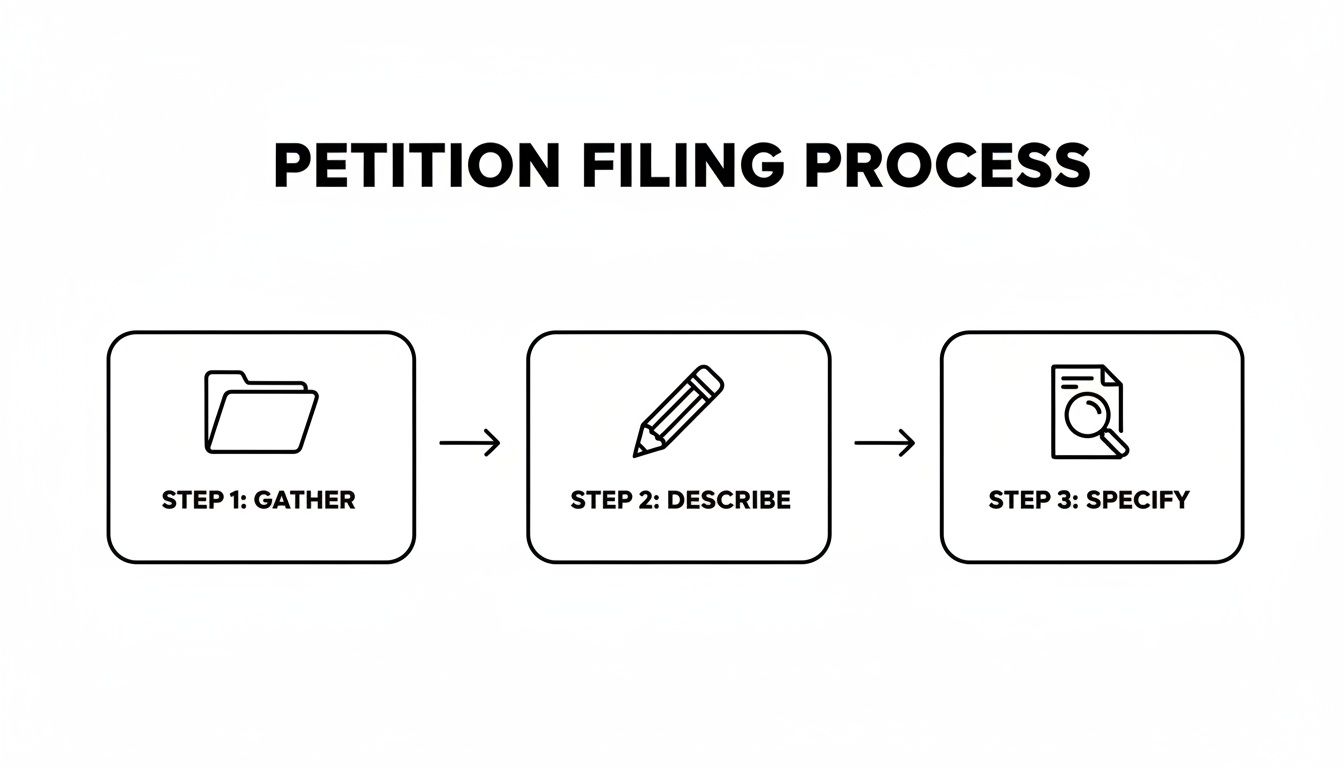
These three actions—gathering your facts, clearly describing the change in circumstances, and specifying the new orders you’re asking for—are the absolute backbone of a strong modification case.
What Happens After Filing and Service
Once the other parent has been served, a legal clock starts ticking. The Respondent has until the Monday following 20 days from the date they were served to file a formal answer with the court. From there, the path your case takes will depend heavily on whether you and the other parent can reach an agreement.
These cases are incredibly common. In Fiscal Year 2023 alone, Texas courts handled 65,319 post-judgment family law cases, which includes modifications and enforcements. That’s a huge slice of the 216,499 new family law cases filed that year. These numbers show just how many families, like yours, find themselves needing to update court orders as life changes.
A Note on Mediation: Before you ever see a judge for a final trial, most Texas courts will require you to attend mediation. This is where you and the other parent sit down with a neutral third-party mediator to try and hash out an agreement. A surprising number of cases settle right here, saving everyone time, money, and a lot of emotional stress.
If you can’t agree, your attorney will likely push for a temporary orders hearing. Think of it as a mini-trial where a judge can put temporary rules in place for custody, visitation, and support while the full case moves forward. This creates crucial stability for your child during what can be a lengthy process. The road ahead might seem complicated, but each step is there to ensure the final outcome is fair and just for your family.
Special Circumstances in Custody Modification
Not all custody modifications are straightforward. Sometimes, life throws a curveball that doesn't fit neatly into the standard legal boxes. Things like a military deployment, a sudden and necessary move, or a true emergency involving your child’s safety demand a more specialized approach. It’s natural to feel overwhelmed, but the Texas Family Code has specific pathways for these complex situations.
When your family's circumstances feel anything but standard, knowing these rules is your first step toward protecting your child.
For Military Families Facing Deployment and Relocation
If you or the other parent is a service member, a custody modification isn't just a state issue—it involves federal law, too. The Servicemembers Civil Relief Act (SCRA) is a federal law that protects active-duty military members from being at a legal disadvantage simply because of their service. In a custody case, the SCRA can be used to pause the proceedings if a parent's deployment makes it impossible for them to participate.
The Texas Family Code also adds a layer of protection. A parent's military service and deployment cannot be used as the sole reason to justify changing a custody order. This ensures that parents don't risk losing their rights just because they are serving our country.
When an Emergency Modification is Necessary
What happens when you believe your child is in immediate physical or emotional danger? The standard modification process can feel agonizingly slow. In these critical moments, Texas law provides a fast track: the emergency modification. This usually means asking the court for a Temporary Restraining Order (TRO) at the same time you file your modification petition.
A TRO is a short-term order that a judge can grant very quickly—sometimes without the other parent even being in the room—to prevent immediate and irreparable harm to your child.
- What it does: A TRO can stop the other parent from taking specific actions, like removing the child from the county. It can also grant you the temporary exclusive right to have your child live with you.
- What you need: To get a TRO, you can't just make vague claims. You must provide a sworn statement (an affidavit) with specific, concrete facts showing that your child is in real danger.
- What happens next: The court will schedule a hearing, usually within 14 days. At that hearing, the judge will listen to both sides and decide whether to issue temporary orders that will stay in place while the rest of the modification case moves forward.
These urgent situations require immediate and precise action. For a detailed breakdown of this fast-tracked process, our guide on how to file for emergency custody in Texas walks you through every step.
Grandparents Seeking Conservatorship or Visitation
Grandparents often become a crucial safety net for their grandchildren, especially when a family is in crisis. While Texas law strongly prioritizes the rights of parents, it does create a path for grandparents to seek legal custody (conservatorship) or court-ordered visitation. But it's a high bar to clear.
To file for conservatorship, a grandparent has to prove that the child's current home environment with their parent(s) presents a serious risk of physical or emotional harm to the child. Simply believing you could provide a better home isn't enough; you must show the court that the child’s well-being is genuinely at risk.
Creating Long-Distance Possession Schedules
When a parent is moving away, the entire focus of the modification shifts to creating a new possession schedule that works across the miles. The goal is to replace frequent, short visits with longer, more substantial blocks of time that help maintain a strong parent-child bond.
A lot of modifications are driven by a parent—often the non-primary one—seeking a more balanced schedule. National statistics show that mothers, on average, receive around 65% of custody time, while fathers get about 35%. In Texas, this can translate to dads getting around 120.5 days a year compared to 245 for moms. This kind of imbalance is a powerful motivator for parents to seek a change using the official Texas custody modification forms. You can see more on these national child custody statistics to understand the broader context.
A solid long-distance possession plan will often include:
- Giving the non-primary parent possession for most of the summer break.
- Alternating major holidays like Thanksgiving and Christmas every year.
- Granting possession for the child's entire spring break.
You have to prove to the court that the change you're asking for isn't just for your benefit—it's a tangible improvement for your child and is truly in their best interest.
Preparing Your Evidence for Court
You’ve filed your Texas custody modification forms, which is a huge step forward. But as we tell our clients, the paperwork is just the beginning. Now comes the most critical part: proving your case to the judge. Your focus needs to shift from filling out forms to gathering the hard facts that support your claim of a "material and substantial change."
This is where you build the foundation for arguing why your proposed new order is truly in your child's best interest.

Gathering Your Proof
Think of yourself as building a case file for your child’s well-being. Your job is to collect concrete proof that shows the judge exactly what has changed since the last order was signed. Remember, judges make decisions based on evidence, not just emotional appeals. Vague statements won't cut it; you need tangible records and documents.
Your evidence needs to paint a clear, undeniable picture. Start collecting anything relevant, such as:
- Communications: Emails, co-parenting app messages, and text messages between you and the other parent can be incredibly powerful. Just be sure you understand the rules for how and when are text messages admissible in court.
- School Records: Report cards, attendance logs, and emails from teachers can show how the current situation is affecting your child’s academic performance or behavior.
- Employment Verification: Pay stubs, a new job offer letter, or work schedules can provide solid proof of a change in income or a parent's availability.
- Photos and Videos: Visuals can effectively document a parent’s living conditions, document concerning behavior, or show positive involvement in a child’s life.
A key piece of practical guidance we give every parent is this: organize everything. Keep all your evidence in a dedicated binder or digital folder, sorted by date or category. This not only helps your attorney build the strongest case but also demonstrates to the judge that you are a prepared, credible, and responsible parent.
Understanding the Court Hearing
Walking into a courtroom can be nerve-wracking, but knowing what to expect helps. A modification hearing is a formal proceeding where you and the other parent will present your arguments and evidence. The judge will listen to testimony from you, the other parent, and any witnesses you’ve asked to speak on your behalf.
Your attorney will be your guide, helping you present your evidence and tell your story calmly and professionally. The focus must always, always remain on your child. How you conduct yourself in court speaks volumes. A parent who is respectful and child-focused makes a far better impression than one who comes across as angry or vindictive.
Seeking legal guidance isn't a sign of weakness; it’s a strategic move to protect your child and your rights as a parent. You don’t have to go through this complex process alone. An experienced attorney can help you gather the right evidence, prepare you for tough questions, and advocate powerfully on your behalf.
Common Questions About Modifying Texas Custody Orders
When you’re looking at changing a custody order, it’s completely normal for your mind to start racing with questions. As you get ready to use your Texas custody modification forms, you're probably wondering about timelines, how much say your child gets, and the big one: what happens if you and your ex just can't agree?
We get it. These are the same questions we hear from families every single day. Let's walk through some clear, straightforward answers.
How Long Does a Custody Modification Take in Texas?
This is the million-dollar question, and the honest answer is: it depends. If you and the other parent are on the same page and can sign off on an uncontested modification, things move much faster. In many cases, you can have a final, signed order in just a few months. That’s the ideal path, both for your wallet and your peace of mind.
But if you’re heading into a contested case—where disagreements require hearings, evidence, and mediation—the timeline stretches out considerably. Depending on how busy the court is and how complex your issues are, these cases can take anywhere from six months to over a year. The best thing you can do to avoid unnecessary delays is to make sure your initial petition is filled out perfectly from the start.
Can My Child Choose Who to Live With?
We hear this all the time, especially from parents with pre-teens and teenagers. Here’s how it works in Texas: once a child is 12 years of age or older, they have the right to talk to the judge in private (in chambers) and state their preference.
A judge will absolutely give a mature child's wishes serious consideration. But it’s critical to understand that their preference is just one piece of the puzzle, not the final word. The court's decision will always come down to the child's overall “best interest,” and the judge will weigh what the child wants against all the other evidence about their physical and emotional well-being.
What if the Other Parent Disagrees?
If the other parent pushes back on the changes you’re asking for, your case is officially “contested.” You still move forward by filing the Petition to Modify, but the road ahead gets more complicated. You can almost guarantee the judge will order you both into mediation to see if a neutral third party can help you find common ground.
When mediation doesn't work, your case moves toward a final hearing where the judge will make the decision for you. This is the exact moment when having a seasoned family law attorney in your corner to fight for your child's best interests isn't just a good idea—it's essential.
Next Steps:
Navigating a custody modification can feel daunting, but you don’t have to do it alone. The most important next step is to get clarity on your specific situation.
- Gather Your Documents: Locate your current custody order and start collecting any evidence of the "material and substantial change."
- Outline Your Goals: Clearly write down the specific changes you want to make to the custody, visitation, and support orders.
- Seek Professional Guidance: Every case is unique. A consultation with a family law attorney can provide a clear roadmap and answer your personal questions.
If you need help with a child custody or visitation case in Texas, our experienced attorneys can guide you every step of the way. Contact The Law Office of Bryan Fagan, PLLC today for a free consultation.