
When your child’s future is on the line, understanding your rights as a parent matters most. The legal world can feel overwhelming, filled with confusing terms. In Texas, what most of us call "joint custody" is legally known as a Joint Managing Conservatorship. It’s a formal-sounding phrase, but its goal is simple: to ensure both parents remain central, loving figures in their child's life through shared decision-making.
What Texas Joint Custody Really Means for Your Family

If you hear "Texas joint custody" and immediately picture a calendar split perfectly 50/50, you're not alone. But the reality under Texas law is a bit different—and for many families, a lot more practical. The official term, Joint Managing Conservatorship, is the standard arrangement in Texas courts. Why? Because the law starts with the belief that having both parents actively involved is what’s best for a child.
Think of it this way: you and your co-parent are partners in the most important venture imaginable—raising your child. A Joint Managing Conservatorship is the legal framework that gives you both the authority to weigh in on the big decisions, ensuring you both have a voice.
Shared Rights and Responsibilities
This partnership role means you share a bundle of rights and responsibilities. Your court order will spell these out, but they almost always include the right to make joint decisions about:
- Education: Choosing schools, agreeing on educational programs, and having full access to school records.
- Healthcare: Making non-emergency medical and dental decisions and being able to access your child's medical information.
- Well-being: Key decisions about your child's religious upbringing and their participation in extracurricular activities.
This entire setup is designed to keep both of you engaged and working as a team for your child's benefit.
Primary Conservator vs. Possessory Conservator
Even in a joint arrangement, one parent is typically designated as the primary managing conservator. This doesn't mean they're the "better" parent. It simply means they have the exclusive right to decide where the child lives, usually within a certain geographic area. This is also the parent who typically receives child support payments.
The other parent is then known as the possessory conservator. They have a court-ordered visitation schedule, legally called a "possession schedule," that lays out when they have the children. This distinction is really important because it separates the authority to make major decisions from the physical time each parent spends with the child.
Let’s break down these roles in a more straightforward way.
Joint Managing Conservatorship at a Glance
This table simplifies the key parts of a Joint Managing Conservatorship, showing how the rights and roles are divided.
| Concept | What It Means for Parents |
|---|---|
| Shared Rights & Duties | Both parents are like "co-CEOs," making joint decisions about school, health, and general welfare. |
| Primary Conservator | This parent has the exclusive right to determine the child's residence and usually receives child support. |
| Possessory Conservator | This parent has a set visitation schedule (possession order) and pays child support. |
| Possession Schedule | This is the calendar that dictates when the child is with each parent. It is separate from decision-making rights. |
Ultimately, this structure validates the vital role that both parents play and reassures you that your parental rights are protected.
Texas law prioritizes keeping both parents involved. Joint Managing Conservatorship is the state's way of ensuring that even after separation or divorce, you both continue to have a meaningful voice in your child's upbringing and future.
While the legal side of things is shared, it's important to remember that physical custody—the actual time the child spends with each parent—is not always a 50/50 split. The law is designed to foster a continued connection and provide the stability your child needs most. You can learn more about how Texas courts view shared parenting responsibilities and rights on the official state site.
How Texas Courts Decide Your Child's Best Interest
Every decision a Texas judge makes about your child—from who handles doctor’s appointments to where they spend Christmas morning—hinges on a single, powerful phrase: the best interest of the child. This isn’t just a nice idea from the Texas Family Code; it’s the legal standard that every single ruling must meet. But what does that really mean for you and your family?
It’s not some vague gut feeling or a judge’s personal opinion. Instead, Texas courts use a specific roadmap called the “Holley Factors.” These factors grew out of a landmark Texas Supreme Court case, giving judges a framework to look at a child’s life from every possible angle. Think of it as the court’s official checklist for protecting a child’s physical and emotional health above all else.
The Holley Factors in Plain English
A judge won't just focus on one or two things; they need to see the whole picture of your child’s world. They’ll carefully weigh several key areas to figure out what kind of arrangement will truly help your child thrive.
Here are the kinds of questions a judge will be asking:
- What does this child need? A judge looks at the child's emotional and physical needs, both right now and for the future. They'll pay close attention to which parent has historically been the primary caregiver.
- Is this child safe? The court’s number one job is to protect the child from any potential emotional or physical danger, today and down the road.
- What are the parents capable of? This involves looking at each parent’s stability, their ability to provide a safe home, and their general parenting skills.
- What help is available? The court considers programs or resources available to help parents do what's best for their child.
- What is each parent’s plan? A judge wants to see that each parent has a thoughtful plan for the child's future.
- How stable are the homes? Consistency is key for kids, so the stability of each proposed home is a major factor.
- How have the parents behaved? The court will look at any actions—or failures to act—that might signal an unhealthy parent-child relationship.
It's crucial to understand that no single factor automatically outweighs the others. The judge considers all of them together to make a decision that supports your child's total well-being.
What Does This Mean for Your Case?
When you understand the Holley Factors, it changes everything. Your focus shifts from trying to "win" against your co-parent to proving you can provide a stable, loving, and supportive home for your child.
For instance, instead of just listing your co-parent’s flaws, you can build a stronger case by showing the court:
- You’re actively involved in your child’s school and medical care.
- You’ve created a safe and predictable home environment.
- You’re willing to co-parent effectively and encourage a healthy relationship between your child and their other parent.
This kind of proactive approach demonstrates that your priorities align with the court's: your child’s happiness and security. You can dive deeper into these considerations in our detailed guide on determining the best interest of the child in Texas custody cases.
The Court's Preference for Joint Custody
Right out of the gate, Texas law presumes that a Joint Managing Conservatorship is in a child’s best interest. This is written directly into Texas Family Code Section 153.002. This legal starting point sends a clear message: the court believes kids do best when both parents are actively involved in their lives.
But while the law favors joint decision-making, it’s also focused on what is practical and stable for each family. The "best interest" standard is applied uniquely to every family’s specific situation, which is why a 50/50 time split isn't automatic.
A judge’s goal isn’t to reward one parent or punish the other. Their only mission is to craft a court order that gives your child the most stable, nurturing, and safe environment to grow up in.
At the end of the day, successfully navigating a Texas joint custody case means showing the court—through your actions, your plans, and your attitude—that you are completely focused on your child's best interest. It’s about proving you can give them the consistency, love, and support they need to flourish, no matter how your family structure has changed.
Understanding Standard Possession Schedules in Texas
Once a judge decides both parents will be Joint Managing Conservators, the conversation shifts from legal rights to the real-life rhythm of your child's week. This is where the possession schedule comes in—it’s the practical, day-to-day roadmap that dictates when your child will be with each parent.
For most families, the starting point is the Texas Standard Possession Order (SPO). Think of the SPO as the default calendar the Texas Legislature created to give kids a consistent, predictable routine. It’s built to provide stability while making sure the non-primary parent stays deeply involved in the child’s life. While you and your co-parent can always agree on a custom schedule, you need to understand the SPO, because it's what a judge will likely order if you can't agree.
The timeline below gives you a bird's-eye view of how a Texas court gets to a final custody order, which is where this possession schedule is finalized.
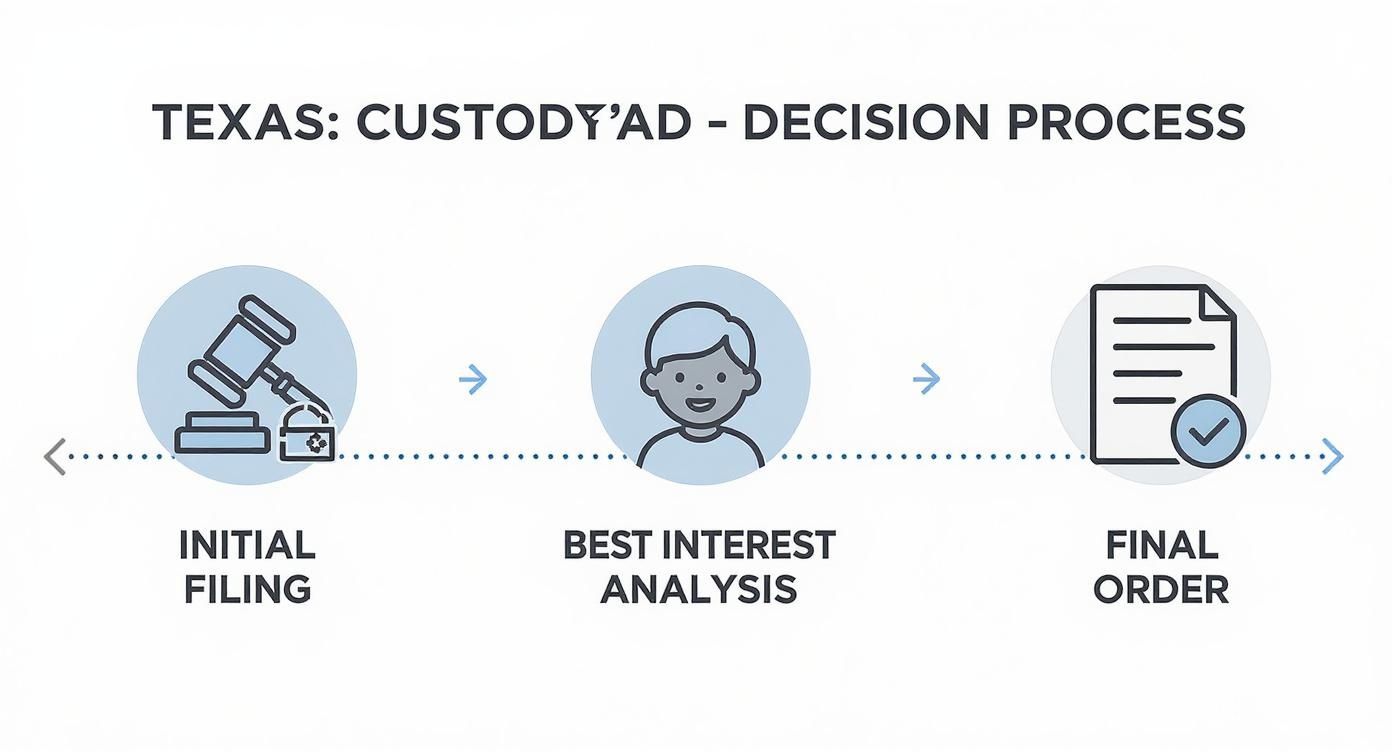
As you can see, creating the final possession order isn't a quick decision. It's a deliberate process, and every step is guided by one thing: your child's best interests.
What a Standard Possession Schedule Looks Like
The specifics of an SPO really hinge on one main factor: how far apart the parents live. The most common setup is for parents who live 100 miles or less from each other. In that case, the non-primary parent's time with the child (what the court calls possession) usually includes:
- Weekends: Time with the child on the first, third, and fifth weekends of any given month.
- Holidays: Alternating major holidays like Thanksgiving and Christmas each year, which ensures both parents get to build those special memories.
- Summer Break: A solid 30-day chunk of time during the summer, which can be taken all at once or split into shorter periods.
This structure gives kids a clear and dependable routine they can count on. It guarantees that even though one parent has the right to decide where the child lives, the other parent maintains frequent, meaningful contact.
To give you a clearer picture, here is a simplified breakdown of what a Standard Possession Order often looks like for parents living relatively close to one another.
Example of a Standard Possession Order (SPO) Schedule
| Time Period | Non-Primary Parent's Possession |
|---|---|
| School Year Weekends | First, third, and fifth weekends of the month. |
| Thanksgiving | Alternates annually (e.g., Parent A has odd years, Parent B has even years). |
| Christmas/Winter Break | Split, with each parent getting roughly half the break, alternating who gets Christmas Day. |
| Spring Break | Alternates annually. |
| Summer Vacation | 30 days of possession, which can be continuous or broken up with notice. |
This table is just a starting point, of course. Every family's order will have unique details, but this shows the basic framework a court will use.
When the Standard Schedule Changes
While the SPO is the go-to for Texas courts, it’s not a rigid, one-size-fits-all mandate. A judge can—and will—tweak the schedule to fit a family’s unique situation.
The goal of any possession schedule isn't just about splitting up time. It's about creating a stable, loving environment that truly supports a child’s well-being, and the Texas Family Code allows for the flexibility to make that happen.
There are a few common scenarios where a judge is likely to deviate from the standard order:
- Children Under Three: For infants and toddlers, the standard long weekends away from their primary caregiver might not be what's best for their development. Courts often order shorter, more frequent visits to help nurture the bond with both parents.
- Parents Living Over 100 Miles Apart: When there's significant distance, the regular weekend back-and-forth just isn't practical. In these cases, the non-primary parent often gets to choose one weekend a month, always gets spring break, and enjoys a longer summer possession period—usually 42 days.
The most important takeaway here is that you and your co-parent have the power to design a schedule that works for your family. If you can agree on a custom plan that you both believe is in your child's best interest, a judge will almost always sign off on it. To dive deeper into how these orders work in practice, check out the comprehensive guide on child visitation and Standard Possession Orders in Texas on our blog.
How to Create or Modify a Custody Agreement
When you’re facing the task of creating or changing a custody order, it’s easy to feel overwhelmed. But you have options. The route you take can make a huge difference not just for the final agreement, but for the emotional health of your entire family.
Essentially, there are two main roads you can take to establish or alter a Texas joint custody agreement: working it out together, usually with a mediator, or letting a judge decide in court. Knowing the difference empowers you to pick the path that best fits your family's needs, whether you're building a parenting plan from the ground up or tweaking an old one to match your new reality.
The Collaborative Path: Mediation and Agreement
For many parents, mediation is a saner, more empowering way to build a custody agreement. It’s a process where you and your co-parent sit down with a neutral third-party mediator, whose entire job is to help you have a productive conversation. The goal isn’t for one person to “win.” It’s about finding common ground and crafting a plan that you both genuinely believe is best for your child.
The whole process is confidential, almost always cheaper than a drawn-out court battle, and—most importantly—it keeps you in control. Instead of a judge who doesn't know your family imposing a cookie-cutter solution, you and your co-parent get to design a custom possession schedule that actually fits your family’s life. To get a better feel for the details involved, take a look at our parenting plan template, which breaks down the key components of a solid agreement.
The Court Path: When Agreement Isn't Possible
Let's be real: sometimes, even with the best intentions, parents just can’t see eye to eye. When you’ve hit a wall and an agreement is off the table, the decision-making power shifts to a judge. The court process, known as litigation, is much more formal and, frankly, can be more adversarial.
Each parent, usually through their attorney, will present their case. This involves evidence, testimony, and arguments explaining why their proposed plan is in the child's best interest. The judge will listen to both sides and analyze everything through the lens of the Holley Factors to create a final, legally binding order.
The key difference is control. In mediation, you and your co-parent hold the power to shape your child's future. In court, that power is handed to a judge who will make the final decision for you.
How to Modify an Existing Custody Order
Life moves on, and a custody order that worked perfectly when your child was a toddler might be totally impractical now that they're a teenager. Texas law gets this. It allows parents to modify existing orders for custody, visitation, or child support, but you can't just change it on a whim. There’s a legal standard you have to meet.
To get a court to modify a custody order, you have to prove that there has been a material and substantial change in circumstances since the original order was signed.
So, what counts as "material and substantial"? It’s a broad category, but common examples include:
- A Parent's Relocation: One parent is moving a significant distance away.
- Job Loss or Major Income Change: A parent's financial situation has shifted dramatically, affecting their ability to provide for the child.
- Change in a Parent's Lifestyle: This could be anything from a remarriage to serious concerns about substance abuse or a dangerous living situation.
- The Child's Needs Evolving: As kids get older, their schedules, activities, and even their own preferences can change, requiring an updated plan.
- A Parent Not Following the Order: If one parent consistently ignores the current possession schedule, that can be a reason to ask for a change.
The process for a modification mirrors the process for creating the first order. You can try to work out an agreement with your co-parent and submit it to the court, or you'll have to file a formal Petition to Modify and let a judge decide.
Whether you're starting from scratch or adapting to life's curveballs, understanding your options is the first step toward protecting your child’s best interests with confidence.
Navigating Special Custody Circumstances
Family life is rarely a straight line, and custody orders have to be flexible enough to handle unexpected turns. When something major comes up—a long-distance move, a military deployment, or a sudden safety concern—it can feel like the ground is shifting beneath your feet.
It's completely normal to feel anxious, but you can find peace of mind in knowing the Texas Family Code has a roadmap for these exact situations. Your existing Texas joint custody order is the foundation, but it’s built to adapt. The key is knowing the legal steps for each unique challenge so that every decision continues to put your child first.
Parental Relocation and Geographic Restrictions
One of the most common curveballs is when one parent wants or needs to move. Most Texas custody orders have what’s called a geographic restriction. This is just a legal term for the specific area—usually a county and its neighbors—where the primary parent has to live with the child. The whole point is to make sure the other parent can stay actively and consistently involved in the child's life.
If you're the primary parent and want to move outside that designated area, you can't just pack the moving truck. You have two options: get the other parent to agree in writing, or get a judge's permission. To get a court order, you’ll need to prove two critical things:
- The move is in the best interest of the child.
- There's been a material and substantial change in the family's circumstances since the last order was signed.
A judge will look very carefully at how the move would affect the child’s stability and, just as importantly, their relationship with the parent who isn't moving.
Special Rules for Military Families
For military families, the already complex world of custody gets another layer of difficulty with deployments and frequent relocations. Thankfully, Texas law has specific protections in place so that service members don't lose their parental rights just because they're fulfilling their duty.
For instance, a deployment can't, on its own, be used as the sole reason to permanently change a custody order. Instead, courts can create temporary orders that are only active while a parent is deployed. These orders often let a designated family member, like a stepparent or grandparent, step in to handle visitation on the service member's behalf. It’s a practical solution that helps the child stay connected while their parent is away serving our country.
A parent's service to our nation should never be used against them in a custody case. Texas law recognizes the unique sacrifices of military families and provides tools to protect the parent-child bond during periods of deployment and relocation.
When Grandparents Can Step In
The bond between a grandparent and a grandchild is incredibly special. While Texas law always prioritizes the rights of parents, there are very specific times when grandparents can go to court to ask for visitation or, in more serious situations, even custody (conservatorship).
For a court to grant a grandparent visitation rights when a parent objects, the grandparent has to prove that cutting off access would significantly harm the child's physical or emotional well-being. That’s a very high bar to clear. Grandparents can only really seek full custody in dire situations, like when a child’s current home life puts them at serious risk of harm.
Emergency Orders to Protect a Child
When a child is in immediate physical or emotional danger, there's no time to wait for a standard court hearing. In these true emergencies, Texas law allows a parent to ask for a Temporary Restraining Order (TRO) with Extraordinary Relief. This is an emergency court order designed to protect a child from immediate harm.
A judge might grant a TRO if there’s evidence of family violence, child abuse, neglect, or serious substance abuse that puts the child in danger. These orders can immediately give one parent temporary exclusive custody and stop the other parent from having any contact with the child until a full hearing can be held, which is usually within 14 days. It's a powerful legal tool, but it's reserved for genuine crises where a child's safety is the absolute top priority.
Common Questions About Texas Joint Custody
When you’re facing a custody case, it feels like a thousand questions are running through your mind at once. The uncertainty can be one of the most difficult parts of the process. That’s why we want to provide clear, practical answers to the questions we hear most often from parents just like you. Our goal is to cut through the confusion and help you feel more grounded and prepared for what’s ahead.
Does Joint Custody Mean We Split Our Child's Time 50/50?
This is probably the single biggest myth about Texas joint custody. The short answer? No, it doesn't automatically mean a 50/50 split. The legal term, Joint Managing Conservatorship, is really about sharing the power to make big decisions—having a say in your child’s education, healthcare, and religious upbringing.
While you and your co-parent are absolutely free to agree on a 50/50 possession schedule, it’s not the default setting in a Texas courtroom. Judges typically lean on the Standard Possession Order (SPO). This order names one parent as the “primary” conservator (the one who establishes the child's main residence) and the other as the “possessory” conservator, who gets a set visitation schedule. The court's main job is to create a stable, predictable routine that's in the child’s best interest, and that doesn't always look like an even 50/50 split.
Can My Child Decide Which Parent They Want to Live With?
A child’s opinion definitely matters in court, but it isn’t the final word. In Texas, once a child is 12 years of age or older, they have the right to speak privately with the judge about their preference. The judge is required to interview the child if asked.
However—and this is a big however—the judge’s final decision must always be based on the best interest of the child standard. The court will look at the child's maturity level, the reasons for their preference, and all the other Holley Factors before making a call. A child's wish is just one piece of a much larger puzzle; it's rarely the single thing that decides the case.
What Happens if the Other Parent Doesn't Follow the Custody Order?
It is incredibly frustrating when a co-parent ignores a court order and denies you time with your child. It can feel helpless, but you have powerful legal options. The first thing you need to do is document every single violation—write down the dates, times, and exactly what happened.
With that documentation, you can file a Motion for Enforcement with the court. A judge can then step in and enforce the order in a few different ways:
- Ordering make-up visitation to give you back the time you lost.
- Ordering the non-compliant parent to pay fines.
- Requiring the other parent to pay your attorney’s fees.
- For serious or repeated violations, a judge can even find the parent in contempt of court, which could result in jail time.
It’s crucial to go through the legal system and not take matters into your own hands. A family law attorney can walk you through the proper enforcement process to make sure your rights are protected.
"A court order is not a suggestion—it is a legally binding directive. When a co-parent ignores its terms, they are violating the law, and the court provides a clear path to hold them accountable and protect your relationship with your child."
Do I Still Have to Pay Child Support with Joint Custody?
Yes. In the eyes of Texas law, child support and your time with your child are two completely separate issues. Having a Joint Managing Conservatorship almost always comes with a child support order.
Typically, the parent who does not determine the child's residence (the possessory conservator) will be ordered to pay child support to the primary parent. The purpose is to ensure the child’s financial needs are covered consistently, no matter which home they’re in. The amount is calculated using state guidelines, and the duty to pay is completely independent of the right to see your child. You cannot withhold one because of a problem with the other.
Understanding these key issues can help take some of the mystery out of the process and empower you as you advocate for your child's future.
Key Takeaway: Your Next Steps

Navigating a Texas joint custody case can feel like a marathon, but you don't have to run it alone. Understanding your rights and how the court prioritizes your child's well-being is the first, most powerful step you can take toward securing a stable, loving future.
Remember, Texas law wants both parents in the picture. Every decision a judge makes will always come back to one guiding principle: what is truly in the best interest of your child. Whether you're creating a parenting plan for the first time or need to modify an existing one, approaching the situation with a clear, child-focused strategy is the key to protecting your parental rights and your child’s well-being.
You have the power to build a positive path forward for your family. Taking informed, proactive steps with a trusted advocate can make all the difference.
If you need help with a child custody or visitation case in Texas, our experienced attorneys can guide you every step of the way. Contact The Law Office of Bryan Fagan, PLLC today for a free consultation.