Skip to content
When your child’s future is on the line, understanding your rights matters most. Here in Texas, the courts almost always start with the idea of shared custody. It’s not just a trend; it's a core belief baked into our laws that kids do best when both parents are actively involved in their lives. The official legal term for this is Joint Managing Conservatorship, a phrase designed to frame you and your co-parent as partners—not opponents—in raising your child.
What Texas Shared Custody Really Means for Your Family

Walking into a custody case can feel like learning a new language. It's emotional, confusing, and full of unfamiliar terms. You’ll notice that Texas law intentionally avoids the word “custody” and uses “conservatorship” instead. This isn’t just legal jargon; it’s a fundamental shift in perspective.
Instead of creating a "winner" and a "loser," the law views both parents as essential "conservators" of their child's well-being. The entire process is built around one guiding principle: the “best interest of the child,” a standard laid out in Texas Family Code Chapter 153. This means every decision a judge makes is aimed at supporting your child’s emotional, physical, and developmental health above all else.
Let's clear up some of the confusing language right away. Texas family law has its own vocabulary, which can be a little different from the terms you see on TV or in other states.
Key Custody Terms in Texas Explained
| Common Term | Texas Legal Term (Conservatorship) | What It Means for Parents |
|---|---|---|
| Joint Custody | Joint Managing Conservatorship | Both parents share the right to make major decisions for the child. This is the default in Texas. |
| Sole Custody | Sole Managing Conservatorship | One parent is given the exclusive right to make most decisions. This is rare and usually only happens in specific situations like family violence. |
| Physical Custody | Possession and Access | This refers to the parenting time schedule—who has the child and when. |
| Legal Custody | Rights and Duties | This covers the authority to make decisions about education, healthcare, and general welfare. |
Understanding these terms helps you see what the court is actually trying to accomplish: creating a stable, predictable future for your child where both parents can play a meaningful role.
The Foundation of Joint Managing Conservatorship
In Texas, the starting point for every custody case is the strong presumption that a Joint Managing Conservatorship is what's best for the child. This is the legal framework for shared custody, and it means both parents get a say in the big decisions that will shape their child’s life.
These shared responsibilities usually cover the big-ticket items:
- Education: Weighing in on school choices and staying involved in your child's academic life.
- Healthcare: Making medical and dental decisions together, from yearly checkups to more serious procedures.
- General Welfare: Guiding things like religious upbringing and deciding which extracurriculars they can join.
By focusing on conservatorship, Texas law nudges parents away from conflict and toward a more cooperative, business-like co-parenting relationship. The system is built to help you work together for your child.
Even though decision-making is shared, the court will typically designate one parent as the "primary" conservator. This parent has the exclusive right to decide where the child lives (usually within a specific geographic area) and is typically the parent who receives child support payments. If you want to dive deeper, you can find a complete guide to how Joint Managing Conservatorship works and what it means for your family.
How Courts Decide the Best Interest of the Child
Every single decision a Texas judge makes about your family comes down to one powerful, guiding principle: the best interest of the child. While that phrase might sound a little vague, it's the absolute bedrock of Texas family law. It’s a legal standard that forces the court to look past the parents’ disagreements and focus completely on what will create a safe, stable, and nurturing environment for the child to thrive.
This standard ensures that rulings aren't based on which parent has a stronger personality or makes a better argument in court. Instead, the judge acts like a careful investigator, piecing together a complete picture of your child’s life and needs. Understanding how a judge sees your family is the key to presenting your case in a way that highlights your strengths as a dedicated and loving parent.
The Holley Factors a Judge Considers
To give some structure to that "best interest" standard, Texas courts lean on a set of guidelines known as the Holley Factors. These aren't a rigid checklist, but rather a series of questions a judge will consider when looking at your family’s unique situation. They were established in a landmark Texas Supreme Court case, Holley v. Adams, and remain the foundation of custody decisions to this day.
These factors help a judge get a 360-degree view of a child's well-being, including:
- The emotional, physical, and developmental needs of the child, both now and in the future.
- Any emotional or physical danger the child may face, now or in the future.
- The parental abilities of each individual seeking custody.
- The stability of the home environment each parent can provide.
- The plans and resources each parent has for the child.
- The acts or omissions of a parent that may indicate an improper parent-child relationship.
- Any explanations for those acts or omissions.
The court examines these factors to figure out how a Texas shared custody arrangement can best support your child's happiness and healthy development.
A judge’s goal isn’t to punish one parent or reward the other; it is solely to build a legal framework that allows the child to flourish. Proving you can provide a stable, loving home is far more persuasive than trying to prove the other parent cannot.
Demonstrating Your Child's Best Interests
Knowing what the court looks for allows you to proactively show that you are a parent focused on your child's well-being. The judge will be observing your conduct, your communication, and your ability to co-parent effectively. It’s about showing, not just telling, the court that you are a stable and positive force in your child's life.
For instance, a judge will consider the historic involvement of each parent. Who has been the primary caregiver? Who takes the child to doctor's appointments, attends parent-teacher conferences, and helps with homework? Your consistent presence and involvement speak volumes about your commitment. For a deeper look, you can review the top considerations for determining the best interest of the child and see how they apply to your situation.
The Child's Wishes and Other Considerations
A common question we get is whether a child gets a say in the matter. In Texas, once a child is 12 years or older, they can speak with the judge in private to express their wishes about which parent they want to live with.
However, it's crucial to understand that the child’s preference is just one piece of the puzzle. A judge will weigh the child’s maturity and reasons for their preference, but the final decision will always come back to the child’s overall best interest. The court is also required to investigate any history of family violence, substance abuse, or neglect, as protecting the child from harm is always the highest priority. Your ability to create a safe and predictable home environment is paramount.
Creating a Practical Possession Schedule
If joint conservatorship is the "what" of your custody agreement, then the possession schedule is the "how." Think of it as the real-world calendar that maps out when your child will be with each parent. Creating a predictable and stable schedule is one of the most loving things you can do for your child, especially when everything else feels like it's changing.
The goal here is to find a rhythm that actually fits your family. What works for a toddler who needs frequent contact with both parents is going to look very different from the schedule for a teenager juggling school, sports, and a part-time job. The good news is that while Texas law provides a solid starting point, it also gives parents the freedom to craft a custom plan that genuinely serves their child’s best interests.
The Texas Standard Possession Order
For parents living within 100 miles of each other, Texas law starts with the assumption that a Standard Possession Order (SPO) is in the child’s best interest. This is the default schedule that countless families use as the foundation for their co-parenting lives. It's designed to give both parents consistent, predictable time with their child.
So, what does a typical SPO look like? The non-primary parent usually has the child on:
- The first, third, and fifth weekends of a month.
- Alternating major holidays, like Thanksgiving and Christmas.
- A solid chunk of time in the summer, usually about 30 days.
This schedule creates a clear and enforceable framework, which is why judges often lean on it. But it’s not your only option. For a much deeper dive into the nuts and bolts, you can explore our guide to Texas Standard Possession Orders.
The following infographic illustrates the core factors a court considers when determining the best schedule for a child's needs, stability, and relationships.
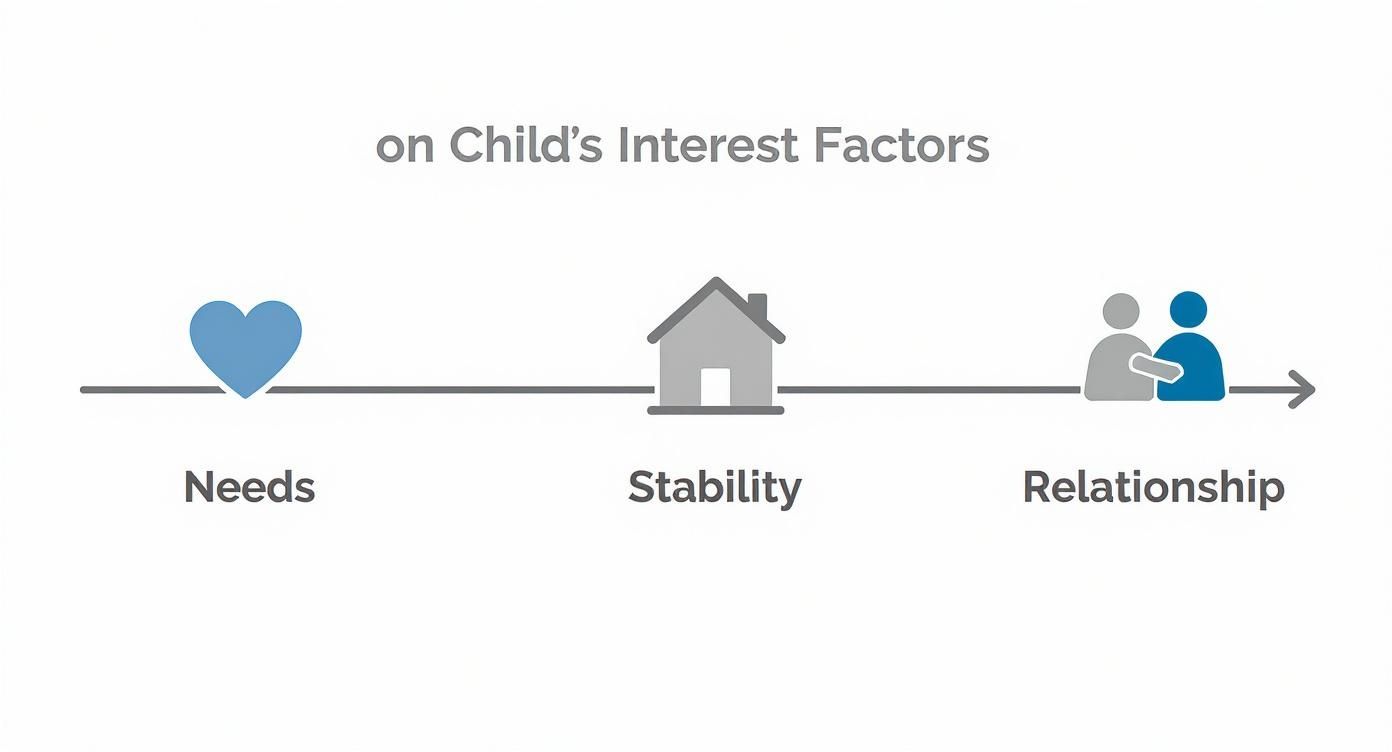
This visual really drives home the point that a judge’s decision is about more than just a calendar. It’s about how that schedule will support a child’s emotional well-being and their connection with both parents.
Exploring 50/50 Shared Custody Schedules
While the SPO is common, we're seeing more and more parents push for a more balanced schedule, often called 50/50 shared custody. These arrangements are all about giving each parent roughly equal time with the kids. Now, Texas law doesn't automatically default to a 50/50 split, but these schedules are gaining a lot of traction, especially when parents can show they can co-parent effectively.
Equal parenting time can be incredibly beneficial for a child’s development, allowing them to form deep, secure bonds with both parents. It requires excellent communication and a commitment to putting the child’s needs first.
Some of the most common 50/50 schedules we see are:
- Week-On/Week-Off: This one is straightforward. The child spends one full week with Parent A, then switches to Parent B for the next week. It's great for minimizing transitions, which can be a huge plus for older kids.
- 2-2-5-5 Schedule: With this schedule, the child is with Parent A for two days, then Parent B for two days, followed by five days with Parent A, and then five days with Parent B. This rotation ensures that neither parent goes too long without seeing their child.
At the end of the day, the "best" schedule isn't about winning or losing time. It’s the one that allows your child to feel secure, loved, and supported by both of you.
Recent Changes to Texas Shared Parenting Laws
As your family changes and your kids get older, the laws meant to support them have to keep up. In Texas, we're seeing a real shift in how the legal system views parenting. Courts and lawmakers are finally catching up to what parents have known for a long time: children do best when both parents are deeply involved in their lives.
This isn't just a trend; it's a fundamental change in direction. The move is clearly toward more balanced, equitable parenting time. For parents going through a Texas shared custody case, this opens up new doors for creating possession schedules that look a lot closer to a true 50/50 split, moving away from the old, rigid models of the past. It’s all about giving parents the tools to build strong, consistent relationships with their kids.
A Legislative Push Toward More Equal Parenting Time
One of the biggest moves in this direction is Senate Bill 1936. This new law, which goes into effect on September 1, 2025, gives a real boost to non-primary parents who live within 50 miles of their child. It gives them a much stronger legal footing to ask for expanded parenting time.
Now, this doesn't mean a 50/50 schedule is automatic. It's not a mandate. But it does send a clear signal to judges that the legislature wants to see more equal time-sharing between parents. It gives the court a solid reason to approve an Expanded Standard Possession Order or other balanced schedules. This law is a powerful new tool for any parent who has been consistently involved and can show that a more equal schedule is what's best for their child. You can learn more about how this strengthens shared custody in Texas and what it could mean for your family.
Does More Parenting Time Eliminate Child Support?
It’s a fair question we hear all the time: if we’re splitting parenting time down the middle, does child support just go away? It makes sense to ask, but the short answer is no.
In Texas, child support and possession schedules are treated as two separate, though related, issues. The law sees child support as a right that belongs to the child, not a payment to the other parent. It's there to make sure their financial needs are met consistently, no matter which home they're in.
Here’s a quick look at how it generally works:
- Both Parents Have a Duty of Support: First, the court will calculate the guideline amount of child support for each parent based on their income.
- The "Offset" Method: In many 50/50 situations, the judge will look at what each parent would owe and then order the higher-earning parent to pay the difference to the other.
- The Child's Best Interest is Still #1: The main goal is to ensure the child has a similar standard of living in both homes. This prevents money from becoming a source of disruption in the child's life.
Even in a 50/50 possession schedule, child support ensures that the child's financial stability isn't compromised. It’s about providing for the child, not paying the other parent.
This approach keeps the focus right where it should be—on the child’s needs. The way Texas law is evolving shows a real commitment to creating both emotional and financial stability for children whose parents live apart.
How to Modify a Texas Shared Custody Order

Life doesn't stand still, and neither do the needs of your family. The custody order that worked perfectly when your child was three might feel completely unworkable now that they're a teenager with a driver's license and a part-time job.
When your family's reality shifts, the law allows you to adapt your legal orders to match. This ensures they continue to serve your child's best interests instead of becoming an outdated source of conflict. This legal tune-up is called a modification, and it’s the formal process for updating your existing orders for custody, visitation, or child support.
The Legal Standard for a Modification
Here's the thing: you can't change a court order just because you feel like it or had a minor disagreement with your ex. To successfully modify a Texas shared custody order, you first have to prove two critical things to the court:
- There has been a material and substantial change in circumstances since the judge signed the last order.
- Changing the order is in the best interest of the child.
This two-part test acts as a gatekeeper. It’s designed to prevent constant, disruptive legal battles that would throw a child’s life into chaos. The change must be significant—not just a minor inconvenience or a small shift in routine. A judge will always, always view your request through the lens of what provides the most stability and support for your child.
What Qualifies as a Material and Substantial Change?
So, what kind of life event is big enough to clear that first hurdle? It can be a wide range of situations that fundamentally alter the family dynamic. The key is that the change is major and directly impacts the child's well-being, making the old order impractical or even harmful.
A "material and substantial change" isn't just a small shift in routine. It's a significant life event that makes the current custody order unworkable or no longer in the child's best interest.
Life is unpredictable, and Texas courts understand that. A variety of events can justify modifying a custody order. Below are some common examples we see in our practice that often meet the legal standard.
Common Reasons for Custody Modification
| Type of Change | Example Scenario | Potential Impact on Custody Order |
|---|---|---|
| Parent Relocation | The primary parent gets a job offer and needs to move out of the school district, or even out of state. | This almost always requires a brand-new possession schedule and could even change who is the primary conservator. |
| Change in Work Schedule | A parent who worked a standard 9-to-5 job now works overnight shifts, making it impossible to care for the child during their scheduled time. | The possession schedule will need a serious overhaul to reflect the new work reality and ensure the child has proper supervision. |
| Child's Evolving Needs | A teenager becomes heavily involved in competitive sports or other extracurriculars that constantly clash with the current weekend exchange schedule. | A new, more flexible schedule might be needed to support the child's passions and development, rather than forcing them to choose. |
| Endangerment Concerns | One parent develops a substance abuse problem or begins a relationship with someone who poses a risk to the child's safety. | This is an urgent situation that could lead to a change in conservatorship, supervised visitation, or other protective measures. |
These are just a few examples, but they illustrate the kinds of significant shifts that can prompt a judge to reconsider the existing orders.
The Process for Seeking a Modification
If you believe you have solid grounds for a modification, the process generally follows a clear path. Your first step, if possible, should be talking it over with your co-parent. An agreement saves everyone time, money, and a whole lot of stress.
-
Try to Reach an Agreement: If both parents are on the same page, you can work with an attorney to draft an Agreed Order to Modify. You submit it to the judge, and if it's in the child's best interest, the judge will likely sign it without you ever stepping foot in a courtroom for a contested hearing.
-
File a Petition to Modify: If you can’t agree, you must file a formal Petition to Modify the Parent-Child Relationship with the court. This legal document spells out the substantial change in circumstances and explains exactly why the change you’re asking for is in your child's best interest.
-
Mediation and Litigation: Once the petition is filed, most Texas courts will order you to attend mediation to try and resolve the dispute with a neutral third party. If mediation doesn't work, your case will proceed to a final hearing where a judge will listen to evidence from both sides and make the decision for you.
Navigating a modification requires careful preparation and a strong legal strategy. Gathering the right evidence and presenting a clear, compelling case is absolutely essential for success.
Key Takeaways and Next Steps
Navigating a shared custody case in Texas can feel overwhelming, but you've already taken the most important step: seeking clarity. Remember, Texas law is built around a simple idea—doing what’s best for your child—and it provides a flexible framework for co-parenting that can work for your family's unique situation.
The real work starts now, turning those legal concepts into a stable, predictable reality for your child. You don't have to figure it out on your own. The whole point of a custody order is to give your child a secure and loving environment, even if it’s spread across two homes. An experienced family law attorney can help you:
- Build a smart legal game plan that fits your family's specific circumstances.
- Negotiate a fair and realistic possession schedule that genuinely works for your child.
- Protect your parental rights at every single turn.
Your goal isn't just to get a court order—it's to secure a stable, peaceful future for your child. Hiring a professional is an investment in that future, giving you clarity and confidence when you need it most.
Frequently Asked Questions About Texas Shared Custody
When you’re trying to build a stable future for your child, questions are going to pop up. The world of Texas shared custody has its own language and rules, and it’s completely normal to feel a bit lost at times. We’ve put together clear, straightforward answers to some of the most common questions we hear from parents just like you, so you can move forward with confidence.
How Is Child Support Calculated in a 50/50 Schedule?
This is easily one of the most common questions we get. In Texas, even with a perfectly balanced 50/50 possession schedule, child support is almost always still a factor. The court doesn't see it as a payment to the other parent; it's a right that belongs to the child.
So, how does it work? A judge will first figure out what each parent would owe under the state’s standard guidelines based on their income. From there, the court typically orders the higher-earning parent to pay the difference to the other parent. This approach helps ensure the child’s financial needs are met consistently across both homes, providing a similar standard of living no matter which parent they’re with.
At What Age Can a Child Decide Who to Live With?
In Texas, a child’s voice definitely matters, but it isn’t the final word. Once a child turns 12 years or older, they have the legal right to speak with the judge in private chambers. They can also file a document with the court stating their preference on which parent they want to have the exclusive right to decide where they live.
While a judge is required by law to consider the child's wishes, this preference is just one of many factors. The final decision will always be based on the child's overall best interest, not just their stated desire.
The court will weigh the child's maturity and their reasons for the preference, but the ultimate goal is to ensure they are in a safe, stable, and nurturing environment.
What Happens if the Other Parent Violates the Custody Order?
A court order is not a suggestion—it's a legally binding directive. If the other parent is not following the possession schedule or is breaking another part of your custody order, you have legal options. You can file a formal enforcement action with the court.
If a judge finds the other parent in violation, they have several tools to set things right. A judge can order:
- Makeup parenting time to compensate for the time you lost.
- The non-compliant parent to pay for your attorney’s fees and court costs.
- Fines or, in serious or repeated cases, even jail time for contempt of court.
It's critical to document every single violation with dates, times, and specific details. This evidence will be the backbone of your case.
Do We Need a Formal Order if We Agree on Everything?
Absolutely, yes. It's fantastic that you and your co-parent are on the same page, but a verbal or informal agreement is simply not legally enforceable. Life is unpredictable; what works today might fall apart tomorrow.
A formal, signed court order protects you, the other parent, and most importantly, your child. It creates clear, predictable rules that prevent future confusion and conflict. If a disagreement does pop up down the road, the court order provides a clear legal path to resolve it.
If you need help with a child custody or visitation case in Texas, our experienced attorneys can guide you every step of the way. Contact The Law Office of Bryan Fagan, PLLC today for a free consultation.