Skip to content
When your family's financial stability feels at risk, facing the threat of wage garnishment can be terrifying. But here’s something you need to know: in Texas, your paycheck has some of the strongest protections in the country. For most everyday debts, like credit card bills or personal loans, Texas law prohibits creditors from taking money directly from your paycheck.
While that shield is powerful, it’s not absolute. It's critical for parents, grandparents, and caregivers to understand the specific exceptions, especially when it comes to something as important as child support. This guide will provide the clarity you need to protect your family and navigate your responsibilities with confidence.
Understanding Texas Wage Garnishment Rules

When your family's financial stability feels like it's on shaky ground, understanding your rights is the first step toward getting back in control. The thought of a creditor snatching your hard-earned money before it even hits your bank account is a major source of stress for any parent. In many states, that’s a common reality for consumer debts.
But Texas is different. The state's laws offer some of the most robust wage protections nationwide, specifically designed to shield families from this aggressive collection tactic. Think of it as a constitutional safeguard for your household’s income.
The Foundation of Wage Protection in Texas
This protection isn't just a random policy; it's baked right into the state's legal DNA. Article 16, Section 28 of the Texas Constitution explicitly says that your current wages are not subject to garnishment.
What does that mean in plain English? For ordinary debts—like medical bills, credit card balances, or personal loans—a creditor can't just get a court order to force your employer to withhold a chunk of your pay. This unique legal stance provides a critical buffer for Texas families trying to make ends meet. You can find more details about these powerful Texas wage garnishment facts on trusted legal resource sites.
This core principle ensures that a financial stumble doesn't immediately put your ability to provide for your children in jeopardy. But this powerful protection isn’t a free pass. It's vital to recognize the specific, limited circumstances where the law does allow wages to be garnished.
"When your child’s future is on the line, understanding your rights matters most. Texas law is designed to protect your wages, but knowing the exceptions, especially for child support, is key to navigating your responsibilities and options."
When Wage Garnishment Is Allowed
To help clarify things, here is a quick overview of what can and cannot lead to wage garnishment in Texas.
Texas Wage Garnishment At a Glance
| Type of Debt | Can Wages Be Garnished in Texas? | Key Consideration |
|---|---|---|
| Credit Card Debt | No | Texas law protects wages from private creditors. |
| Medical Bills | No | Considered a private debt, so wages are shielded. |
| Personal Loans | No | Protected under the Texas Constitution. |
| Child Support | Yes | This is a primary exception to the rule. |
| Spousal Support (Alimony) | Yes | Court-ordered spousal maintenance is garnishable. |
| Federal Income Taxes | Yes | The IRS has federal authority that overrides state law. |
| Federal Student Loans | Yes | Federally-backed loans are an exception. |
As you can see, while your wages are safe from most creditors, Texas law carves out specific exceptions for certain high-priority obligations. These aren't seen as typical consumer debts but as legal duties that the state and federal governments take very seriously. The main exceptions include:
- Court-Ordered Child Support: This is the most common reason for wage garnishment in Texas family law. It’s a tool used to make sure children get consistent financial support from both parents.
- Spousal Support (Alimony): Just like child support, court-ordered spousal maintenance can be collected through wage withholding.
- Federal Income Taxes: The IRS operates under federal law, which gives it the authority to garnish wages to collect unpaid taxes.
- Federally Guaranteed Student Loans: If you default on a federal student loan, the government has the power to garnish your wages to get that money back.
Getting this distinction right is the most important part of the puzzle. The protection is for private debts, while the exceptions are for family and federal obligations.
The Four Major Exceptions to Wage Protection
When your kid’s future is on the line, the last thing you want to worry about is a creditor seizing your paycheck. Texas law is famous for its strong shield protecting wages, but that shield isn't bulletproof. Think of it as a fortress with four specific, heavily guarded gates that can only be opened for very serious legal obligations.
For Texas families, it's critical to know what these exceptions are. They aren’t random financial attacks; they're structured legal processes designed to enforce duties that the law considers paramount. Knowing who can garnish wages in Texas and why is the first step toward getting a handle on the situation.
1. Child Support Withholding Orders
By far the most common reason for wage garnishment in Texas family law is to make sure kids get consistent financial support. This is done through a child support withholding order, which is a standard feature in nearly every single Texas child support case.
It’s important to see this not as a punishment, but as a practical tool. A withholding order is simply the most reliable way for a parent to meet their obligation to provide for their children. The process is usually started by a court or the Office of the Attorney General of Texas, which handles child support enforcement statewide.
The legal logic is simple: a child's right to financial support comes first. The Texas Family Code gives judges the power to order employers to deduct these payments directly from a parent’s paycheck. This ensures the money gets where it needs to go, either to the other parent or through the state’s disbursement unit.
When a court issues an order to withhold income for child support, it is acting in the “best interest of the child.” This is the legal standard that guides every custody and support decision in Texas. It prioritizes a child's well-being and stability above everything else, and consistent financial support is a huge part of that.
2. Spousal Maintenance or Alimony
Much like child support, court-ordered spousal maintenance (what most people call alimony) is another major exception. If a judge orders one spouse to provide financial support to the other after a divorce, those payments can be collected directly from their wages.
Again, this isn't something a typical creditor can do. The process has to be based on a judge's ruling in a family law case. The whole point is to enforce the court’s decision and provide the necessary financial help to a former spouse as the law requires.
3. Delinquent Federal Income Taxes
Here's where state law hits a wall. The powerful wage protections in Texas don't apply to the federal government. If you owe back taxes to the Internal Revenue Service (IRS), they have the federal authority to garnish your wages through a process known as a federal tax levy.
The IRS plays by a different set of rules and doesn't need a state court judgment to start garnishing. They have their own distinct legal procedures, but the good news is they are required to send several notices before a levy actually kicks in. This gives you a window to try and resolve the debt through other options, like a payment plan.
4. Defaulted Federal Student Loans
The last big exception involves defaulted student loans that are backed by the federal government. If you get behind on payments for federal student loans, the U.S. Department of Education or its collection agencies can step in and garnish your wages.
This is another area where federal power overrides state-level protections. This type of garnishment can take up to 15% of your disposable earnings. The process is administrative, which means it doesn't require a court order like child support does. However, you will get clear warnings and information about your rights to fight it before it starts. Knowing these exceptions demystifies the process and helps you prepare to tackle your obligations head-on.
How Much of Your Paycheck Can Legally Be Taken
When you’re worried about money, not knowing is the hardest part. The question of exactly how much someone can take from your paycheck can cause more than a few sleepless nights, but the law actually provides some pretty clear answers. Once you understand these rules, you can feel confident that any withholding is correct and fair.
First thing’s first: the amount that can be garnished is not based on your total gross pay. Instead, it’s all calculated from your disposable earnings. That’s the money you have left after legally required deductions—like federal income tax, Social Security, and Medicare—are taken out. Things you choose to deduct, like health insurance premiums or 401(k) contributions, don’t lower this amount.
The Legal Limits on Child Support Withholding
Child support is the most common reason to garnish wages in Texas, and the rules are set up to strike a balance between a child's right to support and a parent's ability to cover their own living expenses. Texas follows federal law, which puts specific caps on the percentage of your disposable earnings that can be withheld for child support.
The limits all depend on your family situation:
- Up to 50% of your disposable earnings can be withheld if you are currently supporting another child or spouse who isn't part of this particular support order.
- Up to 60% of your disposable earnings can be withheld if you are not supporting another child or spouse.
- An extra 5% can be tacked on to these limits (bumping them to 55% and 65%, respectively) if you are more than 12 weeks behind on your payments.
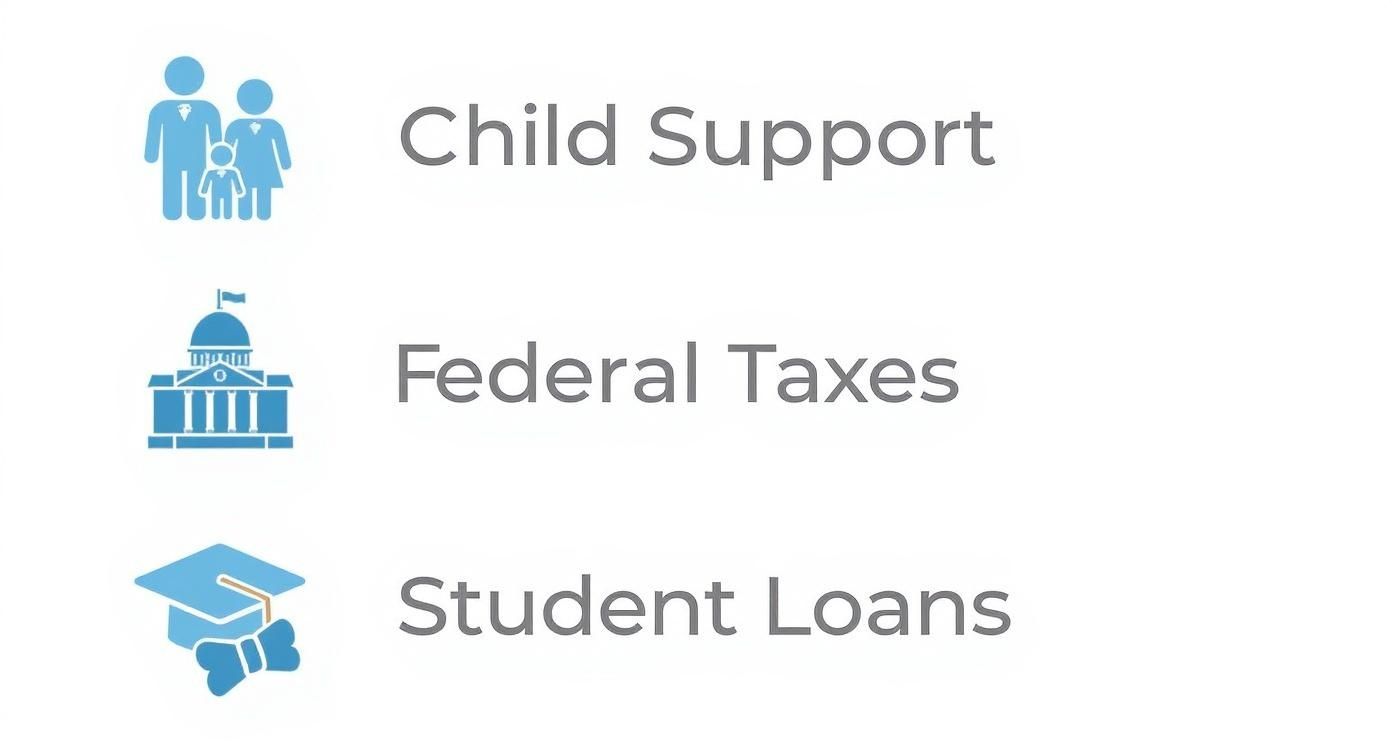
As you can see, these types of obligations are in a totally different category than regular consumer debts like credit cards or personal loans. They get special treatment because they involve family responsibilities and are governed by federal law.
Putting the Numbers into Perspective
Let's walk through a quick example to see how this plays out in the real world. Imagine a parent in Texas has disposable earnings of $1,000 per two-week pay period.
- Scenario 1: The parent is paying child support for one child and is not supporting another family. In this case, the absolute maximum that could legally be taken is 60%, or $600 out of that paycheck.
- Scenario 2: Now, let's say that same parent is also supporting a new spouse and another child from their current marriage. Because they're supporting a second family, the maximum withholding drops to 50%, which comes out to $500 per paycheck.
It's important to remember that these percentages are the legal maximums. The actual amount in a Texas child support order is usually calculated using the Texas Family Code guidelines—for example, 20% of your net monthly resources for one child. These higher federal caps typically only kick in when someone has a significant amount of past-due support, known as arrears.
At the end of the day, the goal of these legal limits is to make sure children get the financial support they deserve, while still leaving the paying parent with enough income to meet their own basic needs.
Limits for Federal Debts Like Taxes and Student Loans
The rules for other types of federally allowed garnishments are a different ballgame. These debts have their own unique caps, completely separate from the child support limits.
- Federal Student Loans: If you've defaulted on a federal student loan, the garnishment is capped at 15% of your disposable earnings.
- Federal Taxes: The IRS has a more complex formula for tax levies. The amount they can take depends on your filing status and the number of dependents you claim, as they are required by law to leave you with a certain amount of exempt income.
Texas law really tries to balance protecting a worker's paycheck with making sure legal obligations are met. For the few garnishments that are allowed, like child support, the maximum can feel high. However, the actual withholding amount typically stays well below that cap to ensure an employee’s income isn't pushed below the federal minimum wage. If you want to dig deeper into these compliance rules, you can discover more insights about employer responsibilities at Ogletree.com.
Navigating the Wage Garnishment Process
Getting a notice that your wages are about to be garnished can feel like the ground is shifting beneath your feet. It’s a scary moment, and it’s completely normal to feel anxious. But here’s the thing: this isn’t some random, out-of-the-blue action. It’s a structured legal process with a clear path and rules designed to protect your rights.
When you garnish wages in Texas, especially in family law cases, there's a formal process that has to be followed. Knowing what to expect at each stage can help you regain a sense of control, prepare a smart response, and make sure your family is protected.
The Initial Court Order
The road to wage garnishment almost always starts with a court order. For child support, this isn't a surprise—it's a standard part of nearly every custody and support case from the get-go. In fact, the Texas Family Code requires an income withholding order to be included in the final orders to ensure kids get consistent, reliable support.
This isn’t meant to be a punishment. Think of it more like a payment system built to make life easier for everyone. It helps the paying parent stay current with their obligations automatically and gives the receiving parent a predictable source of funds to care for the kids.
You'll definitely come across a document called the "Order/Notice to Withhold Income for Child Support." This is the court's official instruction telling an employer exactly how much to deduct from a paycheck for child support.
This legally binding order is issued by the court or the Office of the Attorney General. It's critical to understand every detail in this document. You can learn more about how an income withholding order works in our detailed guide.
Notifying Your Employer
Once the court issues the withholding order, it doesn't just magically start affecting your paycheck. The next step is sending that official notice to your employer. Your employer’s part in this is purely administrative; in legal terms, they are the "garnishee."
Their only legal duty is to follow the court's instructions to the letter. This means they must:
- Withhold the exact amount specified from your disposable earnings.
- Send the payment directly to the Texas Child Support Disbursement Unit.
- Start the withholding no later than the first pay period after they get the notice.
It's also important to know that your employer is legally barred from firing you, disciplining you, or refusing to hire you because of a single child support withholding order. These protections are in place so you don't have to worry about professional fallout for meeting your family obligations.
Your Right to Receive Notice and Contest Errors
One of the most important parts of this whole process is your right to be kept in the loop. You are legally entitled to receive your own copy of the withholding order. This isn't just a courtesy—it’s your chance to review it for mistakes.
And believe me, mistakes can happen. Maybe the calculation for past-due support (arrears) is wrong, or the order doesn’t account for payments you’ve already made directly. If you find a factual error, you have the right to fight it.
To do this, you can file a legal action with the court that issued the order, like a "Motion to Stay Issuance of Writ of Withholding." This gets you in front of a judge to present your evidence and get the discrepancy reviewed. It’s a crucial protection that ensures the amount being garnished is accurate and fair, safeguarding both your income and your child’s support.
How to Legally Stop or Reduce a Garnishment

Watching a big chunk of your paycheck vanish before it even hits your bank account can throw your family's budget into chaos. It’s easy to feel backed into a corner, but the truth is, you have more options than you might think to fight back, lower the amount, or even stop the garnishment altogether.
The key is to act quickly. Your game plan will look very different depending on why your wages are being garnished. The steps for dealing with a child support order aren't the same as those for federal taxes or student loans. Figuring out your specific situation is the first real step toward finding a solution.
Addressing Child Support Withholding Orders
For parents in Texas, the most common reason for a wage garnishment is child support. If the amount being taken out is causing a serious financial strain, or if you're convinced the numbers are just plain wrong, you have clear legal paths you can take.
Filing a Motion to Modify Child Support
Life happens, and Texas law gets that. If you’ve had a material and substantial change in circumstances since your child support order was put in place, you can go back to court and ask for a modification. This is a formal way of asking a judge to take a fresh look at the support amount based on your new reality.
What counts as a major life change?
- Losing your job or taking a significant, involuntary pay cut.
- Your child’s needs have changed, like new medical bills or different living arrangements.
- Your income has gone up, and you’re able to provide more support.
- The custody schedule has shifted, and you now have the kids more of the time.
Just filing the motion won’t stop the current withholding right away. But if you're successful, it will result in a new order that’s actually manageable. We break down the entire process in our detailed guide on how to modify child support in Texas.
Contesting Errors in Arrears
Sometimes, the problem isn't the current monthly payment—it's the calculation of past-due support, known as arrears. Simple clerical mistakes can and do happen. If you think the arrears amount is wrong, maybe because you made payments directly that never got recorded, you have the right to challenge it. This means gathering your proof—bank statements, canceled checks, anything you have—and presenting your case to the court to get the record corrected.
Solutions for Federal Debts
When you’re up against federal debts like back taxes or student loans, you’re no longer dealing with the family court. Your focus shifts to negotiating directly with government agencies.
Negotiating with the IRS
The IRS actually has several programs for taxpayers who simply can't afford to pay what they owe. You might be able to negotiate an Offer in Compromise (OIC), which lets you settle your tax debt for less than you owe. Another option is setting up a formal payment plan that fits your budget. Taking either of these steps can stop a tax levy in its tracks or get an existing one lifted.
Student Loan Rehabilitation
If you've defaulted on federal student loans, you may qualify for a loan rehabilitation program. This usually means making nine on-time payments over a ten-month period. Once you complete the program, your loan is brought out of default, and the wage garnishment stops.
A garnishment can feel like a heavy weight on your family's shoulders. Nationally, the average garnished worker loses around 11% of their gross earnings each month, a financial burden often equivalent to a household's entire food budget. Understanding your options is the first step to lifting that weight. Discover more insights about the impact of garnishment from NBER research.
At the end of the day, the best long-term fix is tackling the debt at its source. Putting strategies to pay off debt faster into practice—even if you can't increase your income—can help you get back in control of your finances and avoid future garnishments.
Next Steps: Protecting Your Family's Financial Future
When you get a notice about wage garnishment, it’s easy to feel like you’ve lost control. But knowledge is the first step toward getting that control back. Really understanding the rules that govern when and how someone can garnish wages in Texas is how you equip yourself to protect your family’s financial stability.
Key Takeaways
Let's quickly go over the most important takeaways. While Texas law acts as a strong shield for your wages against most creditors, it's the exceptions you really need to watch out for.
- Your Wages Are Largely Protected: For everyday private debts like credit cards or medical bills, your paycheck is generally off-limits from garnishment in Texas.
- Key Exceptions Exist: The law carves out specific allowances for things like court-ordered child support, spousal maintenance, federal taxes, and federal student loans. These debts can break through that shield.
- There Are Strict Legal Limits: Even when your wages can be garnished, the amount they can take is capped by law. It's usually a percentage of your "disposable earnings," not your entire check.
- You Have a Right to Fight Back: If you think there's a mistake in the amount owed, or if your financial life has taken a hit, you have legal options to contest the order or ask for a modification.
While this guide gives you a solid foundation, every family’s situation has its own unique wrinkles and deserves personal attention. Your next step is to move from general knowledge to specific action. Part of protecting your family’s financial well-being also means thinking ahead and mitigating other potential risks, like the financial risks of medical emergencies without adequate health insurance.
An experienced attorney can dig into the details of your case, from the original court order to your current financial picture. They can help you double-check the accuracy of any claimed arrears, make sure payments are being processed correctly through the Texas Child Support Disbursement Unit, and walk you through the modification process if it’s needed. Getting professional legal support isn't just a smart move—it's the most empowering step you can take.
Common Questions About Wage Garnishment in Texas
When a wage garnishment hits, it’s not just a financial problem—it’s a personal one. The worries can spiral fast, touching everything from your job security to your family’s stability. When so much is on the line, getting straight, honest answers is the first step toward regaining control.
Can My Employer Fire Me for a Wage Garnishment?
This is one of the first questions on everyone’s mind, and thankfully, the answer is usually no. You’ve got strong legal protection on your side. Federal law, specifically the Consumer Credit Protection Act (CCPA), makes it illegal for your employer to fire you over a single wage garnishment order.
But here’s the fine print: that protection doesn’t always extend to multiple garnishments. If you start getting hit with several orders from different creditors, that federal shield might not cover you anymore. The good news is that Texas law backs up these protections, especially when it comes to child support withholding.
What if I Have Multiple Garnishment Orders?
When an employer gets more than one order to garnish wages in Texas, they don’t get to pick and choose. They have to follow a strict "first-come, first-served" rule.
Basically, they’ll process the first garnishment order they received up to its legal limit. Only then can they move on to the next one in line. What’s crucial to remember is that the total amount taken from your paycheck across all garnishments can never go above the legal caps (like the 50-65% limit for child support). The law is designed to ensure you're never left with nothing.
I Lost My Job. Does Child Support Garnishment Stop?
Losing your job is stressful enough, but it doesn’t stop a child support order. The legal obligation to pay is still active, and any missed payments will start piling up as arrears—which is just a legal term for past-due support you still owe.
This is where you have to act fast. The minute your income changes significantly, you need to file a formal petition to modify your child support order with the court.
Just telling the other parent or hoping for the best isn't enough. Only a new court order can legally adjust your payment amount and protect you from falling into a deeper financial hole.
Can My Bonus or Commissions Be Garnished?
Yes, they absolutely can. In Texas, the term "earnings" is defined very broadly and covers a lot more than just your regular salary or hourly pay. It also includes other forms of compensation like:
- Bonuses and commissions
- Overtime pay
- Severance pay
- Retirement benefits
In short, just about any money you receive from your employer is considered part of your earnings and is fair game for a valid withholding order. Your entire compensation package gets factored in when they calculate what can be garnished.
If you need help with a child custody or visitation case in Texas, our experienced attorneys can guide you every step of the way. Contact The Law Office of Bryan Fagan, PLLC today for a free consultation.