
When your child's future is on the line, understanding your rights matters most.
If you've been told there's a temporary orders hearing coming up, you're probably feeling two things at once. You want the judge to hear the truth, and you're afraid there won't be enough time to explain everything. That reaction is normal.
In Texas custody cases, this hearing often becomes the first real courtroom decision about where your child will live, when each parent will have time, and who will handle important responsibilities while the case is pending. If you're searching for what happens at a temporary orders hearing in texas custody cases, the short answer is this: the court holds an early hearing, listens to both sides, reviews admissible evidence, and sets temporary rules your family must follow until the case ends.
Your First Step in Court The Temporary Orders Hearing
You arrive at court expecting a chance to tell the whole story. Instead, you may have only a short window to show the judge what your child needs right now, and why your plan is the safer, more workable one.
That is the practical reality of a temporary orders hearing in a Texas custody case. It is an early court hearing where the judge hears testimony, considers admitted documents, and puts rules in place for the family while the case is pending. In that limited time, the court may address conservatorship, possession and access, child support, health insurance, and the exchange of financial information tied to support.
Some legal terms sound more complicated than they are. Conservatorship refers to custody and decision-making authority. Possession and access refers to the parenting schedule. Judges are focused on the child's best interests, which usually means stability, safety, consistency, and each parent's ability to meet the child's day-to-day needs.
What the judge is trying to accomplish
A temporary orders hearing is about creating a workable structure fast. The judge is usually trying to answer a basic question. What arrangement will protect the child and keep life functioning until the case is resolved?
That often includes decisions about:
- Where the child will primarily live
- How parenting time will be divided
- Who will pay child support
- Who will provide health insurance
- What records or information must be exchanged
The court is not looking for every grievance from the relationship. The court is looking for facts it can act on.
That is where many parents lose ground. They spend valuable hearing time explaining why the other parent has been unfair, disrespectful, or difficult. Those facts may matter if they directly affect the child. If they do not, they usually distract from the points the judge has to decide that day.
Practical rule: Center your presentation on facts that show what schedule, decision-making arrangement, and support plan best protect your child's routine, safety, and well-being.
Why this first hearing deserves serious preparation
Parents sometimes treat temporary orders as a preliminary skirmish. In practice, this hearing often sets the first real court-ordered structure your family must live under. If you walk in without a clear plan, organized proof, and witnesses who can speak to the child's needs, the other side may define the case before you do.
I tell clients to prepare for this hearing like it matters, because it does. You may only have 20 to 30 minutes to make your record. In that short period, the judge is forming an early impression of your credibility, your judgment, and whether your proposal sounds realistic enough to put into an order today.
That applies whether the dispute is between parents or involves grandparents or another caregiver seeking a defined role in the child's life.
Why These Temporary Orders Have Long-Term Impact
Some of the hardest conversations in family court involve decisions that are called short-term but don't feel short-term at all. That's exactly why temporary orders matter so much.
Texas courts can leave temporary orders in place until a final judgment is entered, which can take many months, and some courts require mediation before the hearing itself. Because these rulings are legally binding and can become the practical baseline for later negotiations, they can shape school placement, parenting patterns, and financial pressure in a very real way, as discussed in this Texas temporary orders hearing explanation.

Temporary orders often become the working status quo
Once a judge signs an order and the family starts living under it, that arrangement can begin to look like the child's routine. If a schedule appears to be functioning, changing it later may become harder than many parents expect.
That doesn't mean temporary orders decide the final case automatically. It does mean early decisions can influence later settlement talks and the way each side frames the final hearing. A parent who accepts an unworkable temporary structure without a plan may spend months trying to undo it.
What this means in practical terms
Parents often focus only on what they want the final order to say. A better question is this: Can you live with this temporary arrangement if it lasts longer than you hoped?
Think about the actual effects:
| Issue | Why it matters early |
|---|---|
| School routine | A temporary residence decision can affect morning logistics, homework structure, and consistency. |
| Parenting pattern | Repeated exchange schedules create habits that may later be described as the child's normal routine. |
| Financial strain | Temporary support and insurance obligations can affect rent, bills, and basic stability. |
| Negotiation leverage | The parent doing better under the temporary setup may have less reason to compromise later. |
Temporary orders are often the point where a case stops being theoretical and starts governing daily life.
Mediation can matter before the hearing
In some counties, mediation may happen before the judge hears the case. That changes the strategy. You may be negotiating from the shadow of a hearing that could create a months-long baseline if no agreement is reached.
If you're a father worried about being edged out of frequent time, or a mother concerned about day-to-day stability, specific details matter here. The same is true for grandparents and caregivers trying to protect a meaningful role in the child's life. Preparation isn't just about trial skills. It's also about avoiding a temporary arrangement that eventually becomes the default.
A Step-by-Step Walkthrough of the Hearing
The courthouse feels less intimidating when you know the sequence. Most temporary orders hearings move quickly, but they still follow a recognizable pattern.
Early in the process, it also helps to understand what a temporary custody order means in Texas so you can connect the hearing to the order that may result.
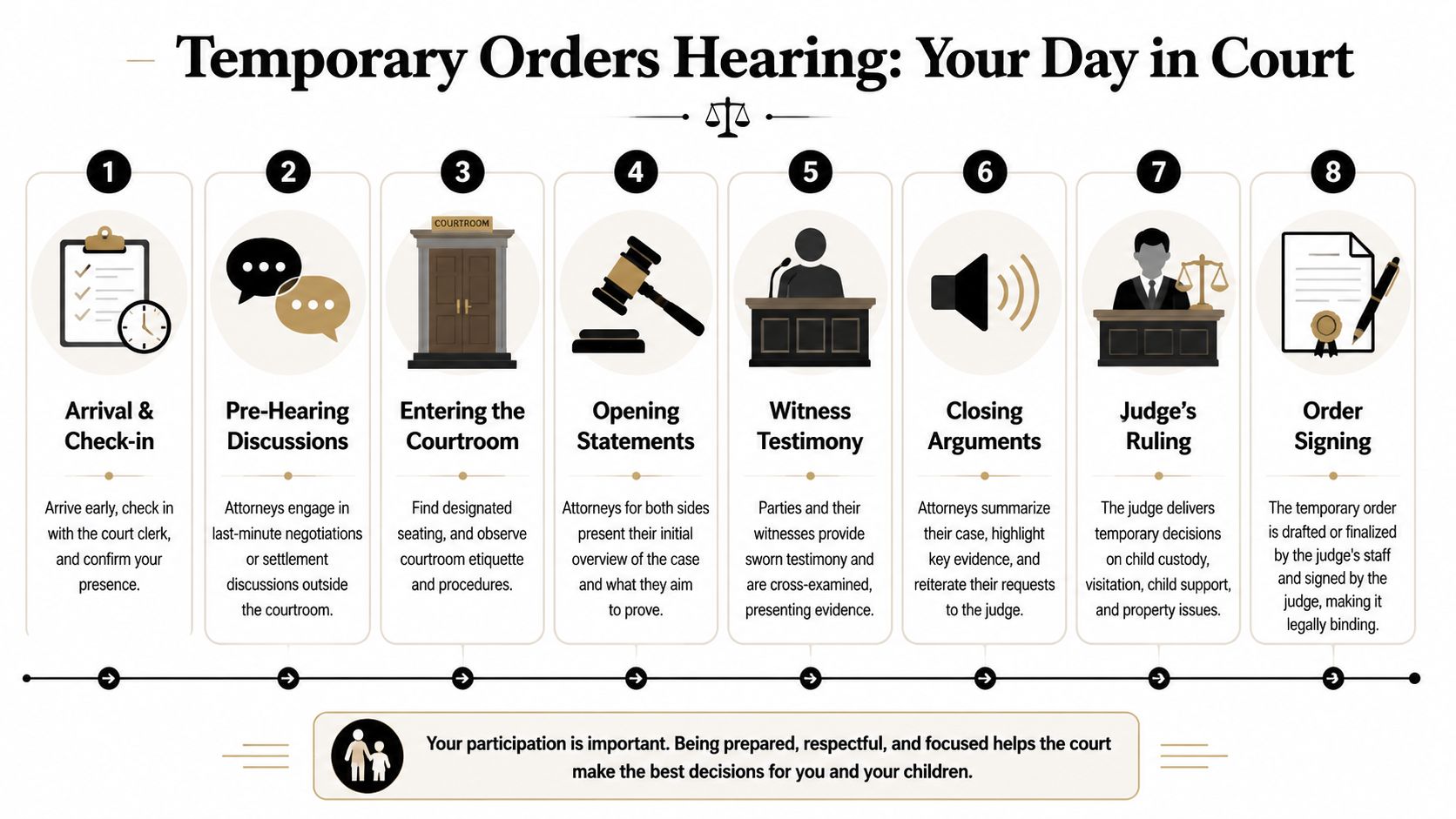
The usual flow of the day
A temporary orders hearing often unfolds in this order:
Check in and wait
You or your lawyer check in with the clerk or court staff. Be early. Rushing raises your stress and increases the chance of mistakes.Last-minute talks outside the courtroom
Many cases still involve hallway discussions before the hearing starts. Sometimes the parties narrow disputes. Sometimes they don't.The case is called
The judge calls your case. Everyone comes forward, and the court confirms who is present.One side presents first
The petitioner, meaning the person who filed the request, usually goes first. That side calls witnesses and offers documents.Cross-examination happens
The other side gets to ask questions. Under intense questioning, weak statements can unravel fast.The responding side presents
The respondent then presents testimony, witnesses, and exhibits.Lawyers make brief arguments
Each side explains what order the judge should sign and why.The judge rules
Sometimes the judge rules from the bench. Sometimes the written order is finalized shortly afterward.
A short video can also help make the process feel more familiar before court:
What works in the room and what does not
Good courtroom behavior is simple, but it matters. Speak only when it's your turn. Answer the question asked. Don't interrupt the judge, the other parent, or opposing counsel.
What usually helps:
- Direct answers that stay on point
- Calm body language even when the other side says something unfair
- Specific examples tied to the child's routine
- Respectful language about the other parent
What usually hurts:
- Long speeches that dodge the actual question
- Anger in the courtroom
- Trying to use the hearing to punish the other parent
- Bringing every grievance from the relationship
The strongest parent in a temporary orders hearing is usually the one who looks organized, child-focused, and realistic.
Presenting Evidence When Every Second Counts
Temporary orders hearings are often compressed. In some Texas counties, parties may have only 20 to 30 minutes per side, which means every document, witness, and answer has to earn its place in the courtroom, according to TexasLawHelp's temporary orders guidance. That time pressure changes everything.

A parent who brings a giant stack of papers but no clear theory often loses valuable time. A parent who brings a small, well-organized set of proof tied to the child's needs usually presents better.
For a deeper look at building proof around the court's main standard, review this guide on how to prove the best interest of the child.
Focus on the issues the judge is actually deciding
The court usually wants evidence that helps answer a specific temporary question.
Conservatorship
If the dispute is over decision-making or who can determine the child's primary residence, useful proof often centers on who has been handling school communication, medical appointments, daily supervision, and routine decisions.
Helpful evidence may include:
- School records showing involvement and consistency
- Medical records or appointment logs if relevant to care
- Parenting calendars showing who has been doing what
- Messages that show cooperation or the lack of it
Possession and access
When parenting time is contested, the judge often needs a realistic picture of the child's actual schedule and what arrangement is workable right now.
Often persuasive:
- A simple calendar showing overnights, pickups, and missed exchanges
- Neutral communication records about scheduling
- Evidence of practical logistics, such as school and transportation needs
Child support and related financial issues
Support issues require organized financial information. Sloppy math, missing records, and informal explanations tend to hurt credibility.
Bring what your lawyer asks for, such as:
- Income records
- Health insurance information
- Child-related expense documentation
- Any required financial disclosures
Choose witnesses carefully
Not every supportive witness helps. Some witnesses consume time without adding much value.
A stronger witness usually does one thing well. They personally observed a relevant fact and can explain it clearly. A teacher, counselor, coach, or childcare provider may carry more weight than a relative who mostly wants to defend you. Family members can still matter, especially if they observed exchanges, caregiving, or safety concerns firsthand. But “She's a great mom” or “He's a loving dad” usually isn't enough by itself.
Courtroom reality: Quality beats quantity. One clean exhibit and one credible witness can matter more than a binder full of accusations.
The Key Issues a Judge Will Decide
Parents often leave preparation too vague. They know the hearing matters, but they haven't broken down what the judge will order. That gap creates bad testimony. The court isn't deciding whether you've been the better spouse or the more frustrated parent. The court is deciding practical issues that will govern daily life.

Conservatorship and decision-making
In Texas, joint managing conservatorship generally means both parents share certain rights and duties. It does not always mean equal time. One major issue can be which parent has the right to determine the child's primary residence.
Before court, be ready to answer:
- Who has handled school and medical decisions recently
- How each parent communicates about the child
- Why your proposed arrangement serves the child's best interests
- Whether there are safety or stability concerns the judge needs to know
Possession schedules and visitation
Possession schedules are the court-ordered times each parent has with the child. Some parents use the word visitation, but Texas courts usually talk about possession and access. A judge may put a temporary schedule in place that resembles a standard structure or may tailor it to the child's needs, work schedules, distance, or safety concerns.
Practice explaining your proposal in practical terms:
| Question | Better answer |
|---|---|
| Why should this schedule be ordered? | “It keeps school mornings consistent and matches the child's current routine.” |
| Why not the other parent's schedule? | “It creates repeated late-night transitions on school nights.” |
| What's your goal? | “A stable routine and frequent, workable contact with both parents.” |
Child support and health insurance
A temporary orders hearing may also address child support, who covers health insurance, and what financial information must be exchanged. If support is in dispute, organization matters as much as fairness. Judges often make faster decisions when the records are clean and easy to follow.
Other courtroom rules that may appear in the order
Temporary orders sometimes include conduct rules that affect everyday parenting conflict. Depending on the case, the court may address communication, exchanges, access to the child's records, or limits on disruptive behavior.
A useful preparation habit is to sit down with your lawyer and build a short issue-by-issue file:
- One folder for parenting facts
- One for financial records
- One for school and medical information
- One timeline of major events
That kind of organization often matters more than dramatic testimony.
Your Preparation Checklist Before Court
Preparation is where many cases improve or fall apart. The most expensive mistakes are often preventable. Parents wait too long to gather records, bring disorganized screenshots, or assume the judge will “just see what's been happening.” Judges can only act on evidence that is properly presented.
If you need a broader pre-hearing roadmap, this article on how to prepare for a custody hearing in Texas is a useful starting point.
The checklist that actually helps
Use this list before your hearing:
- Build a short timeline: List the key events that affect the child, not every conflict in the relationship.
- Gather targeted records: Pull school records, medical information, communication logs, parenting calendars, and financial documents your lawyer requests.
- Organize exhibits clearly: Label documents in a way your attorney can use fast. If you've ever seen how professionals compare edits line by line in CatchDiff's redlining software guide, the lesson is similar. Clear version tracking and side-by-side organization reduce confusion.
- Practice your testimony: Rehearse concise answers to predictable questions, especially about routine, safety, communication, and your proposed schedule.
- Plan logistics: Arrange childcare, confirm your hearing time, and arrive early with everything you need.
- Dress for court: You don't need to look wealthy. You need to look respectful, steady, and prepared.
Mistakes parents make when they try to do this alone
Some parents overprepare in the wrong way. They bring every text message from the relationship but can't identify the five that matter. Others rely on emotion and think sincerity will carry the day.
Common errors include:
- Talking too much and answering too little
- Attacking the other parent instead of proving your own plan
- Using witnesses who are loyal but not persuasive
- Failing to connect exhibits to a legal issue
- Walking in without a realistic proposed order
Legal help matters here because strategy matters. A lawyer can help narrow the case to the strongest facts, prepare you for cross-examination, and make sure the court hears the points that matter most. One available resource for this kind of work is the Law Office of Bryan Fagan, PLLC, which handles Texas custody, visitation, support, and temporary orders matters.
The hearing rewards preparation, not volume. Parents who know their theory of the case usually present better than parents who simply know they're upset.
Key Takeaways and Your Next Steps
A temporary orders hearing can feel fast, formal, and emotionally draining. It's also one of the first moments when a Texas judge steps in and sets real rules for your family. If you remember only a few points, remember these:
- This hearing is not minor because it's called temporary.
- The judge is focused on the best interests of the child, not on punishing either parent.
- Clear, relevant evidence beats a large pile of unfocused material.
- Your proposed schedule and decision-making plan should be practical, stable, and child-centered.
- How you present matters. Calm, concise, and organized usually wins more trust than anger.
For mothers, fathers, grandparents, and caregivers, the same principle applies. The court needs a workable picture of what protects the child and keeps life stable while the case is pending. That means preparation has to be more than a checklist. It has to be a strategy.
If you're facing a hearing soon, don't wait until the last few days to get serious about your evidence, your testimony, and your proposed orders. Early planning gives you more options in negotiation and in court.
If you need guidance on a temporary orders hearing, custody dispute, visitation schedule, or child support issue, Law Office of Bryan Fagan, PLLC can help you understand your options and prepare for the decisions that may shape your case for months to come. If you need help with a child custody or visitation case in Texas, our experienced attorneys can guide you every step of the way. Contact The Law Office of Bryan Fagan, PLLC today for a free consultation.