Skip to content
When your child’s future is on the line, understanding every person involved in your custody case matters most. One of the key figures you might encounter is a Guardian ad Litem, or GAL. Think of them as a neutral, court-appointed professional—almost always an attorney—whose one and only job is to investigate your family's situation and give a judge an independent recommendation on what's in your child's best interest.
What a Guardian Ad Litem Means for Your Texas Custody Case

When parents in a Texas custody battle just can't see eye to eye, the court often needs an unbiased perspective to make a sound decision. That’s where a Guardian ad Litem (GAL) comes in. Appointed by the judge, they serve as the "eyes and ears of the court," giving the child a voice in a legal process that can feel overwhelming for everyone involved.
It's absolutely critical to understand that the GAL does not work for you or the other parent. In fact, their client isn't even the child—it's the child's best interest.
That's a subtle but massive distinction. A GAL will certainly listen to what a child wants, but their final recommendation is built on a deep-dive investigation into all the facts. Their job is to paint a full, unbiased picture for the judge, which is incredibly helpful when making decisions about parental rights and responsibilities, known in Texas as conservatorship.
The Core Purpose of a GAL
A GAL's primary goal is to help the court determine a possession schedule and living arrangement that truly supports the child’s physical and emotional well-being. Their work has a direct impact on the final court orders, including key parts of a Joint Managing Conservatorship, where both parents are meant to share in decision-making. A Guardian Ad Litem is vital in ensuring a child’s best interests are front and center in Texas custody cases, directly shaping the final child custody agreements.
Having a GAL appointed might feel intimidating, but it's also your opportunity to show how committed you are to being a responsible parent. They're looking at the whole picture, including things like:
- The emotional and physical needs of your child, both now and down the road.
- The stability of each parent's home environment.
- The quality of the relationship each parent has with the child.
- Any history of family violence or substance abuse that could pose a danger.
A GAL's recommendation is one of the most powerful pieces of evidence a judge will consider. While they don't make the final call, their report carries a ton of weight and heavily influences the outcome of your case.
This guide will walk you through exactly what a GAL does, how they get appointed, and—most importantly—how to interact with them effectively. Understanding these elements can empower you to face this part of your case with confidence.
How a Guardian Ad Litem Investigates Your Case

To understand what a Guardian ad Litem (GAL) does, think of them as the court's own private investigator. Their job is to gather the facts and paint a clear, unbiased picture of your child's world for the judge. This process is designed to cut through the emotional conflict that can make it tough for a judge to see what’s really going on.
A GAL won't rely on guesswork or take one parent's word for it. They conduct a thorough investigation into every aspect of the child's life to figure out what arrangement truly serves their best interests. This can actually take some pressure off you, because the case becomes less of a "he said, she said" fight and more of a fact-finding mission focused on your child. Their investigation gives them a 360-degree view of your child’s life, helping the judge make a smart, informed decision about conservatorship and possession schedules.
Gathering Information Through Interviews
The first step for any GAL is talking to people. These aren't just casual chats; they are structured interviews meant to uncover facts, understand relationships, and see how well each parent can meet the child’s needs. The GAL will set up separate, one-on-one interviews with you and the other parent. This is your chance to share your perspective, talk about your bond with your child, and lay out the parenting plan you believe is best.
They will also meet with your child—in an age-appropriate way—to get a sense of their feelings and daily life without putting them on the spot. But it doesn't stop with the immediate family. The GAL has the court's permission to talk to other key people in your child's world. These "collateral" interviews are crucial for getting a well-rounded view.
- Teachers and School Counselors: They offer an objective look at your child’s academic performance, social skills, and any behavioral changes.
- Therapists or Doctors: With the proper permissions, these professionals can share important information about your child's emotional or physical health.
- Family Members, Coaches, or Daycare Staff: Anyone who interacts with your child regularly might be contacted to help fill in details about their routines and relationships.
Key Responsibilities of a Guardian Ad Litem
This table breaks down the main jobs a GAL performs to determine what is truly in a child's best interest.
| Duty | What It Involves |
|---|---|
| Investigation | Conducting interviews with parents, the child, teachers, doctors, and others to gather information from all angles. |
| Observation | Performing home visits to see the child's living environment and observe parent-child interactions firsthand. |
| Document Review | Analyzing records like report cards, medical files, and any past court or police reports to verify facts. |
| Reporting | Compiling all findings into a detailed, unbiased report for the judge with a recommendation on custody and visitation. |
| Testimony | Being available to testify in court to explain their findings and answer questions from the judge and attorneys. |
Ultimately, each of these tasks helps the GAL build a comprehensive recommendation grounded in solid evidence.
Reviewing Important Documents
Interviews provide the personal stories, but documents provide the hard data. A GAL will ask for and review records to check facts and spot any patterns—good or bad—that might affect the child's well-being.
A core part of the GAL's job is to cut through emotional noise and focus on documented facts. They will meticulously examine records to build a timeline and understand the child's history, ensuring their recommendations are grounded in evidence, not just opinions.
This paper trail often includes school report cards, attendance sheets, medical and therapy records, and even past court filings or police reports involving the family. This evidence helps the GAL piece together an objective puzzle of your family’s situation.
Conducting Home Visits
Perhaps one of the most revealing parts of the investigation is the home visit. The GAL will schedule a time to visit each parent's house to see the environment where the child lives or will be living. This isn't a "white glove" test to check for dust; it's about observing the overall living situation.
The GAL wants to see where the child sleeps, plays, and does homework. More importantly, they want to see how you and your child interact in your own space. The goal is to confirm that each home is a safe, stable, and supportive place for a child. By weaving together what they learn from interviews, documents, and home visits, the GAL provides the judge with the clear, fact-based roadmap needed to protect your child’s future.
How a Guardian Ad Litem is Appointed in a Texas Case
A Guardian ad Litem (GAL) doesn’t just show up in a custody case out of the blue. Their appointment is a specific, deliberate step a judge takes when they believe an objective, third-party investigation is the only way to truly protect a child. It’s easy to see it as a setback, but it’s actually the court pausing to make sure they get things right for your family.
So, how does it happen? Typically, a GAL gets involved in one of two ways. First, a judge can appoint one on their own initiative—a power called sua sponte in the legal world. This usually happens when a judge hears initial arguments and realizes there are too many conflicting stories or serious allegations to make a sound decision based only on what the parents are saying.
The other route is when one of the parents' attorneys files a formal request, known as a Motion to Appoint a Guardian ad Litem. This is common in cases where one parent is deeply worried about the other’s behavior, living situation, or choices and feels an independent investigation is the only way to get the full, unbiased truth in front of the judge. After the motion is filed, the judge will hear from both sides before deciding if a GAL is truly necessary.
Common Triggers for a GAL Appointment
Certain situations almost always raise a red flag for a judge, signaling that a child’s best interest might be at risk without an independent voice. If your case involves any of these factors, the odds of a GAL being appointed go up dramatically.
- Serious Allegations of Abuse or Neglect: Any time claims of physical, emotional, or sexual abuse arise, a judge will almost always appoint a GAL to investigate impartially.
- Concerns About Substance Abuse: If there’s evidence that a parent's drug or alcohol use is putting a child in danger, a GAL is needed to get a clear picture of the situation.
- High Levels of Conflict: In cases where parents are so hostile they can’t communicate, a GAL can cut through the personal drama and refocus everyone on what the child actually needs.
- A Child with Special Needs: When a child has unique medical, developmental, or educational needs, a GAL can help determine which parent is better equipped to manage that specialized care.
- Relocation Disputes: If one parent wants to move far away with the child, a GAL can assess how that move would impact the child's stability and relationship with the other parent.
Under the Texas Family Code, a judge is given broad discretion to appoint a Guardian ad Litem in any suit where they feel it’s necessary to represent the best interest of the child. This gives the court the power to ensure a child’s safety and well-being are always the top priority.
The GAL Selection Process
Once a judge decides a GAL is needed, they don’t just pick a random name. Courts in counties like Harris, Fort Bend, and Montgomery maintain a list of attorneys who have completed specialized training in family law, child development, and investigative techniques. These are professionals qualified to handle the sensitive reality of custody disputes. The judge will almost always select a qualified attorney from this court-approved list, ensuring the person appointed has the right experience and understands their duties under Texas law.
Guardian Ad Litem vs. Attorney Ad Litem: Understanding the Difference
In a Texas courtroom, you’ll hear legal terms that sound confusingly similar. Two of the most important—and most often mixed-up—roles are the Guardian ad Litem (GAL) and the Attorney ad Litem (AAL). While both are appointed to help in a custody case, their jobs are fundamentally different.
Understanding this isn't just about vocabulary. It’s about knowing who represents which interests. One person acts as the court's investigator, while the other serves as your child's personal lawyer. Knowing who does what will empower you to navigate the process with less anxiety.
The Role of the Guardian Ad Litem (GAL)
As we've discussed, the Guardian ad Litem has one singular mission: to investigate every facet of a child's life and recommend what they believe is in the child’s best interest. A GAL is an impartial fact-finder for the judge.
Think of the GAL as a protector of the child's overall well-being. They're the ones interviewing parents, teachers, and counselors, conducting home visits, and digging through records to piece together the complete picture. Their final recommendation to the judge might line up with what your child says they want, but it doesn’t have to. If a GAL believes a child’s wishes aren't in their best interest—say, a teenager wants to live with a parent who can't provide a stable home—the GAL must recommend what they feel is safest.
The Guardian ad Litem answers one question: "What outcome will best serve this child's long-term physical and emotional health?quot; They represent the child’s best interests, which is a concept, not necessarily a person's stated desire.
The Role of the Attorney Ad Litem (AAL)
An Attorney ad Litem, on the other hand, works just like any other attorney, but their client is the child. An AAL’s job is to represent the child’s expressed wishes to the court. Plain and simple, they are the child’s legal voice.
Imagine your child as a client. The AAL meets with them, discusses their goals, and then advocates for those goals in court, just as your attorney advocates for you. If your 14-year-old tells their AAL they want to live with their father, the AAL's duty is to present that desire to the judge and make legal arguments to support it. The AAL does not substitute their own judgment for the child's. This is the critical difference:
- GAL: Investigates and recommends the child's best interests.
- AAL: Advocates for the child's stated wishes.
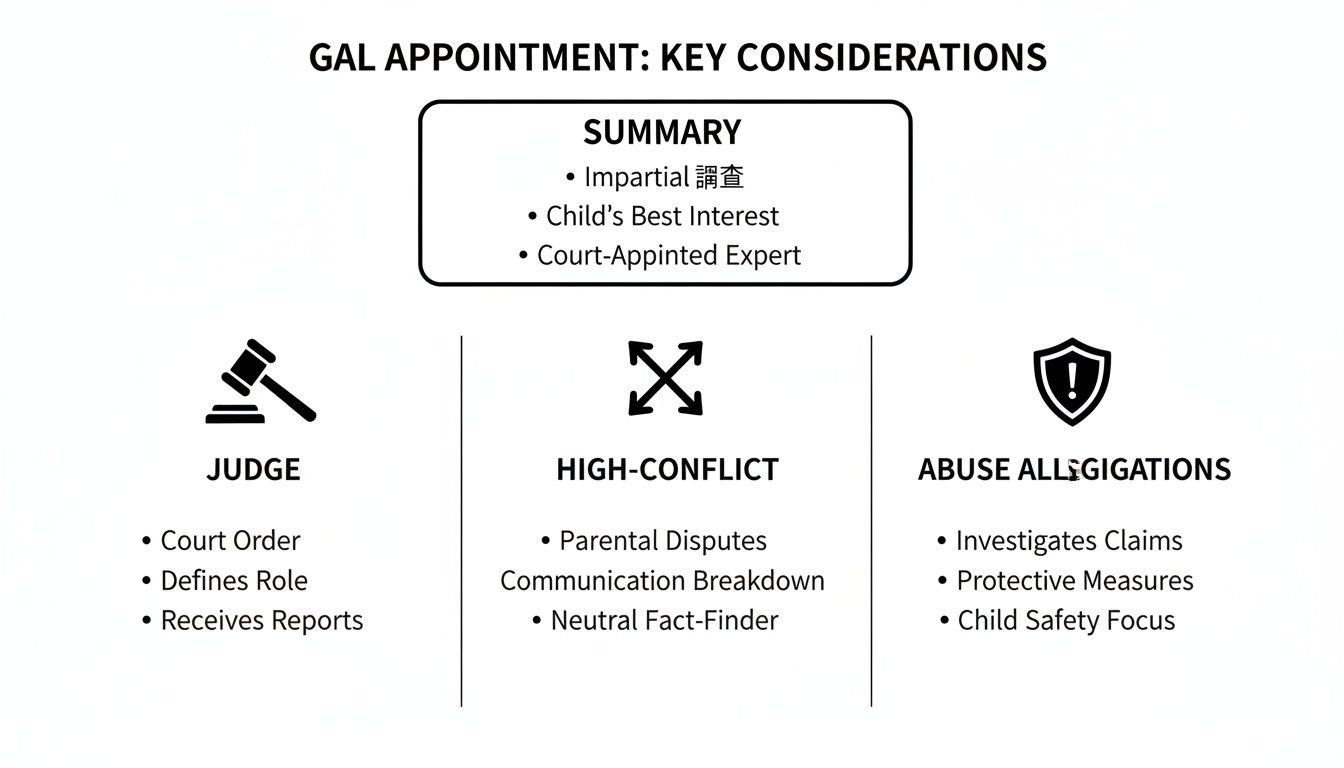
This diagram shows some common scenarios where a judge might appoint a Guardian ad Litem to help determine a child's best interests.
Guardian Ad Litem vs. Attorney Ad Litem at a Glance
| Aspect | Guardian Ad Litem (GAL) | Attorney Ad Litem (AAL) |
|---|---|---|
| Primary Goal | Determine and recommend the child's best interests to the court. | Advocate for the child's expressed wishes and legal objectives. |
| Who They Represent | The concept of the child's best interests. | The child, as their client. |
| Main Function | Investigator and fact-finder for the court. | Legal advocate and attorney for the child. |
| Key Activities | Interviews, home visits, record reviews, and making recommendations. | Client meetings, legal research, filing motions, and arguing in court. |
| Confidentiality | Communications are not privileged; the GAL reports findings to the court. | Communications are protected by attorney-client privilege. |
| Final Report | Submits a detailed report with recommendations to the judge. | Presents legal arguments and evidence on behalf of the child's goals. |
In Texas, a GAL is more commonly appointed in private custody cases between parents. Judges bring in a GAL when there are serious concerns about parental fitness, allegations of abuse, or such high conflict that the facts are lost in the noise. An Attorney ad Litem is often appointed in cases involving Child Protective Services (CPS) but can be appointed in any custody case if the judge believes a child is mature enough to have a clear opinion.
How to Navigate the Guardian Ad Litem Process
When a Guardian ad Litem (GAL) is appointed to your case, it’s normal to feel like your every move is under a microscope. The key is to reframe this in your mind. This isn't about being judged; it's your opportunity to show an objective third party why you're a responsible, loving, and child-focused parent. How you handle this process speaks volumes.
Your main objective should be to make the GAL’s job as straightforward as possible. Think cooperation, transparency, and organization. This isn’t a charm contest. It’s about giving them the clear, factual information they need to do their job right. Never forget that their final recommendation carries immense weight with the judge when it comes to decisions about your joint managing conservatorship and possession schedule.
Be Prepared and Professional
The best way to calm your nerves is to get prepared. Before your first meeting, start gathering documents that paint a clear picture of your child’s life and your role in it.
- Gather Your Documents: Start a file with your child's recent report cards, medical records, and photos of their bedroom or a recent family outing. Having this ready shows you’re organized and proactive.
- Create a List of Contacts: Type up a simple list with the names and contact information for your child's teachers, doctors, coaches, therapists, and other key adults.
- Stick to the Facts: When you talk to the GAL, keep the conversation centered on your child’s needs and how you meet them. Avoid bad-mouthing the other parent. It rarely helps and can make you look uncooperative.
It's also a smart move to run all communication through your family law attorney. They can help you frame concerns and present information in a constructive, legally powerful way.
The Home Visit and Child Interviews
The home visit is a standard—and often nerve-wracking—part of the GAL’s investigation. They aren't there to critique your decorating skills. They just need to see that the environment is safe, stable, and child-friendly. Make sure the house is tidy, your child has their own space, and there’s age-appropriate food available. Your goal is simply to present a calm, normal home life.
The GAL's time with your child is one of the most critical parts of their work. It is absolutely essential that you do not coach your child on what to say. This is a huge mistake that can destroy your credibility and do serious damage to your case.
Instead of scripting them, prepare your child by explaining things in simple, honest terms. You could say something like, "A nice person named [GAL’s Name] is going to chat with you to learn more about our family and help Mommy and Daddy. The most important thing is for you to just be yourself and tell the truth." This helps them feel safe enough to speak honestly.
Your Dos and Don'ts Checklist
Navigating the GAL process successfully boils down to a series of thoughtful choices. Keep these simple points in mind for every interaction.
Do:
- Always Be Honest: A lie or half-truth will almost always come back to hurt you. Credibility is everything.
- Be Cooperative and Punctual: Answer calls and emails promptly. Show up for meetings on time. It shows respect for the process.
- Focus on Your Child: Frame every answer around your child’s routines, well-being, and best interests.
- Maintain a Stable Home: A consistent, nurturing, and safe environment is the best evidence you can offer.
Don’t:
- Don't Bad-Mouth the Other Parent: The GAL is looking for the parent who can support the child’s relationship with both parents.
- Don't Coach Your Child: This is a massive red flag for any GAL and can backfire spectacularly.
- Don't Be Argumentative: Treat the GAL with respect, even when asked tough questions.
- Don't Forget the Big Picture: The GAL investigation is just one piece of the puzzle. For a complete overview, take a look at our guide on the typical Texas child custody case timeline and what to expect.
By approaching the GAL process with preparation and honesty, you empower yourself to make the strongest possible case for your role in your child's life.
The GAL Report and Its Role in Court
After weeks or months of interviews, home visits, and reviewing documents, the Guardian ad Litem’s investigation culminates in a formal, detailed written report that goes directly to the judge. This document is one of the single most important pieces of evidence in your entire custody case.
This isn’t just a quick summary. It’s a deep dive into your family’s life, laying out everything the GAL has learned. More importantly, it ends with their professional opinion on what custody arrangement would truly serve the best interest of the child. Your attorney and the other parent’s attorney will both get a copy, giving your legal team the chance to analyze it before a final hearing.
What the Report Recommends
The GAL’s recommendations are specific and direct. They give the judge a clear, actionable roadmap for the final court order. You can expect to see recommendations on the big-ticket items:
- Conservatorship: The GAL will state whether parents should be named Joint Managing Conservators or if one parent should have the final say as the Sole Managing Conservator.
- Possession Schedule: The report will lay out a specific visitation schedule, suggesting which parent the child should primarily live with and how often the other parent will have possession. This is often referred to as a Standard Possession Order or a custom schedule.
- Rights and Duties: It might also get into specifics, like recommending which parent gets to make key decisions about the child's schooling or non-emergency medical care.
A GAL’s report is powerful because it comes from a neutral third party appointed by the court. It gives the judge a perspective free from the emotional tug-of-war between parents, grounded solely in the facts gathered during the investigation.
The GAL's Role in the Courtroom
The written report is just the beginning. The Guardian ad Litem can be called to the witness stand during a trial or hearing. This gives the judge a chance to ask them questions directly, and it allows your attorney to dig deeper into their findings.
Your attorney has the right to cross-examine the GAL, and this is a critical moment. If your lawyer believes the GAL missed key facts, misinterpreted something, or made a recommendation that isn't right for your child, they can challenge those conclusions in open court. This reinforces a crucial point: the GAL’s report is compelling evidence, but it's still just one piece of the puzzle. Your attorney’s job is to present other evidence and arguments to make sure the judge sees the complete picture before making a final ruling.
Key Takeaways and Your Next Steps
When a Guardian ad Litem is appointed, it's natural to feel anxious. But remember, the GAL is not your adversary. They are a neutral tool the court uses to keep your child's best interests front and center. This process is your opportunity to demonstrate your strengths as a parent. Your honesty, cooperation, and unwavering focus on your child will speak volumes.
- Honesty is Your Best Policy: Your credibility is invaluable. Be truthful and transparent with the GAL at all times.
- Focus on Your Child: Frame every conversation around your child's stability, happiness, and well-being.
- Cooperate Respectfully: A calm, cooperative attitude shows maturity and your ability to co-parent effectively.
- Lean on Your Attorney: Let your lawyer guide you through the legal strategy and communication to ensure your case is presented in the best possible light.
The GAL's report is a powerful piece of evidence, but it is not the final word. The judge is the ultimate decision-maker and must consider all the facts presented. Your attorney will have the chance to challenge the report, present your evidence, and argue for the outcome you believe is right for your child. By walking through this process with integrity, you can help shape a positive and stable future for your family.
If you need help with a child custody or visitation case in Texas, our experienced attorneys can guide you every step of the way. Contact The Law Office of Bryan Fagan, PLLC today for a free consultation.