Skip to content
When your child’s future is on the line, understanding your rights matters most. The decision to terminate parental rights in Texas is one of the most permanent and profound actions a court can take. It’s a legal step, defined by the Texas Family Code, that completely and forever severs the legal ties between a parent and a child. This isn't something that happens lightly. A judge will only consider it when presented with clear and convincing evidence that doing so is in the absolute best interest of the child.
Understanding What It Means to Terminate Parental Rights

When your child's future is on the line, the idea of severing a parent-child bond is one of the most serious decisions a family can face. It’s an emotional and legally tangled journey, and our goal is to bring some clarity and support during what can be a confusing time. This isn't a tool for punishing a parent or resolving minor disputes; it is reserved for the most severe situations where a child’s safety, stability, and well-being are at genuine risk.
The Texas Family Code treats the parent-child relationship as sacred. Because of this, a judge won't terminate a parent's rights without an extremely compelling reason and a high standard of proof. A court order is always required to make it official—even if a parent agrees to give up their rights.
Voluntary vs. Involuntary Termination
Understanding how this process works starts with knowing the two different paths it can take. Each one comes with its own legal requirements and emotional weight for the family involved.
The two primary types of termination cases are voluntary and involuntary. Although both result in the same legal outcome, the circumstances leading to each are vastly different. Here’s a quick breakdown to help you see the distinction.
Key Differences Between Voluntary and Involuntary Termination
| Aspect | Voluntary Termination | Involuntary Termination |
|---|---|---|
| Parent's Position | The parent willingly agrees to end their rights. | A court ends a parent's rights against their will. |
| Common Scenario | Often part of an adoption, like a stepparent adoption where the other biological parent consents. | Usually involves serious issues like abuse, neglect, endangerment, or long-term abandonment. |
| Legal Burden | Must still be proven to be in the child’s best interest. | The person filing must prove specific harmful conduct and that termination is in the child’s best interest. |
| Initiating Party | Often initiated with the parent's cooperation. | Initiated by the other parent, a relative, or Child Protective Services (CPS) without the parent's consent. |
As you can see, even a "voluntary" termination isn't a simple sign-off. The court’s primary focus remains locked on the child’s welfare, ensuring the decision serves their future, not just the convenience of the adults.
Who Can Start a Termination Case
Not just anyone can walk into a courthouse and file a lawsuit to terminate parental rights in Texas. The law is very specific about who has the legal "standing" to begin this life-altering process. This isn't a free-for-all; it's a carefully controlled legal action.
Typically, the people or entities with the right to file include:
- The child’s other parent
- A legal guardian or conservator of the child
- A person who has court-ordered access to the child
- A foster parent who has cared for the child for a specific period
- The Texas Department of Family and Protective Services (often called CPS)
This legal framework is a critical safeguard. It protects families from unwarranted interference while ensuring that those with a significant, recognized relationship to a child can step in when that child's well-being is on the line.
The Legal Grounds for Involuntary Termination
When a court considers involuntarily terminating a parent's rights, it’s not a decision taken lightly. This is one of the most serious actions in family law, and it requires much more than just a judge’s opinion that it might be a good idea.
The Texas Family Code puts up a very high wall here, demanding clear and convincing evidence of specific, harmful conduct. This isn't some vague standard. It points directly to a list of legal grounds in Texas Family Code § 161.001 that the person filing the case must prove. This high standard exists for a simple reason: to protect the fundamental bond between a parent and child. A court won’t sever that tie without concrete proof that a parent’s behavior has put the child’s well-being in serious jeopardy.
What Constitutes Grounds for Termination
The law spells out several specific actions and patterns that can justify terminating parental rights. While the list is long, some of the most common grounds we see in court involve endangerment, abandonment, and a consistent failure to create a safe home for the child.
Let’s translate these legal terms into what they actually look like in real-world situations:
- Endangerment: This is one of the most serious grounds. It means the parent knowingly put the child in situations or surroundings that endanger their physical or emotional health. This could be anything from exposing them to domestic violence or substance abuse to severe, ongoing neglect.
- Abandonment: This happens when a parent leaves a child without providing the necessary care and has no plans to come back. It can also apply to a parent who simply shows a complete lack of interest in the child’s life over a long period.
- Failure to Support: If a parent has the means to support their child but fails to do so for a one-year period (ending within six months of the date the lawsuit is filed), it can be grounds for termination.
- Criminal Conduct: A parent’s criminal history, especially if it leads to imprisonment, can be a factor. This is particularly true if the crimes were committed against a child or the other parent, showing an inability to provide a safe environment.
Proving one of these grounds is just the first hurdle. To get a better sense of the evidence courts look for, you can explore our guide on how to prove a parent is unfit in Texas.
The Two-Prong Test for Termination
Every single involuntary termination case in Texas comes down to a critical two-part test. The person bringing the lawsuit has the heavy burden of proving both parts with clear and convincing evidence.
- Proof of a Statutory Ground: First, they have to prove at least one of the specific grounds laid out in the Texas Family Code, like the ones we just discussed.
- The Best Interest of the Child: After proving a ground, they must also prove that terminating the parent’s rights is in the child's best interest.
That second part is the ultimate tie-breaker. A judge could find that a parent engaged in endangering conduct but still decide that termination is not in the child’s best interest. The court has to look at the big picture—the child’s emotional needs, their need for stability, and what their future will look like. The judge will ask, "What outcome gives this child the safest, most positive environment to grow up in?" When evaluating a parent's fitness, understanding different parenting styles and their impact on children can offer important context about the child's environment.
The "best interest of the child" isn't just a legal catchphrase; it is the absolute guiding star of Texas family law. It forces a judge to weigh a whole range of factors, from the child's immediate safety to their long-term need for a stable, loving home.
The High Burden of Proof
Make no mistake, terminating parental rights is one of the most severe actions a court can take. The statistics reflect this gravity. In 2025, Tarrant County courts managed 413 termination cases, which accounted for 27.6% of all child protection lawsuits filed that year. Many of these actions were necessary steps to clear the way for adoptions, which made up 41.7% of such matters.
These numbers show just how seriously the courts treat cases under Texas Family Code §§ 161.001-161.003. They will always demand that high standard of clear and convincing evidence before making the permanent, life-altering decision to sever the parent-child relationship.
Ultimately, the goal is never to punish a parent but always to protect a child. The legal grounds and the best interest standard work hand-in-hand to ensure this decision is made with the greatest care and legal justification, putting the child's future first.
How the Court Process for Termination Works
Walking into a courtroom for a case involving your child is one of the most stressful things a person can go through. But knowing what to expect can give you back a sense of control. A lawsuit to terminate parental rights in Texas isn’t just one big event; it’s a journey with very specific stages, each with its own purpose. Once you understand the roadmap, it's a lot less intimidating.
The diagram below breaks down the three main phases you'll encounter in any termination lawsuit.
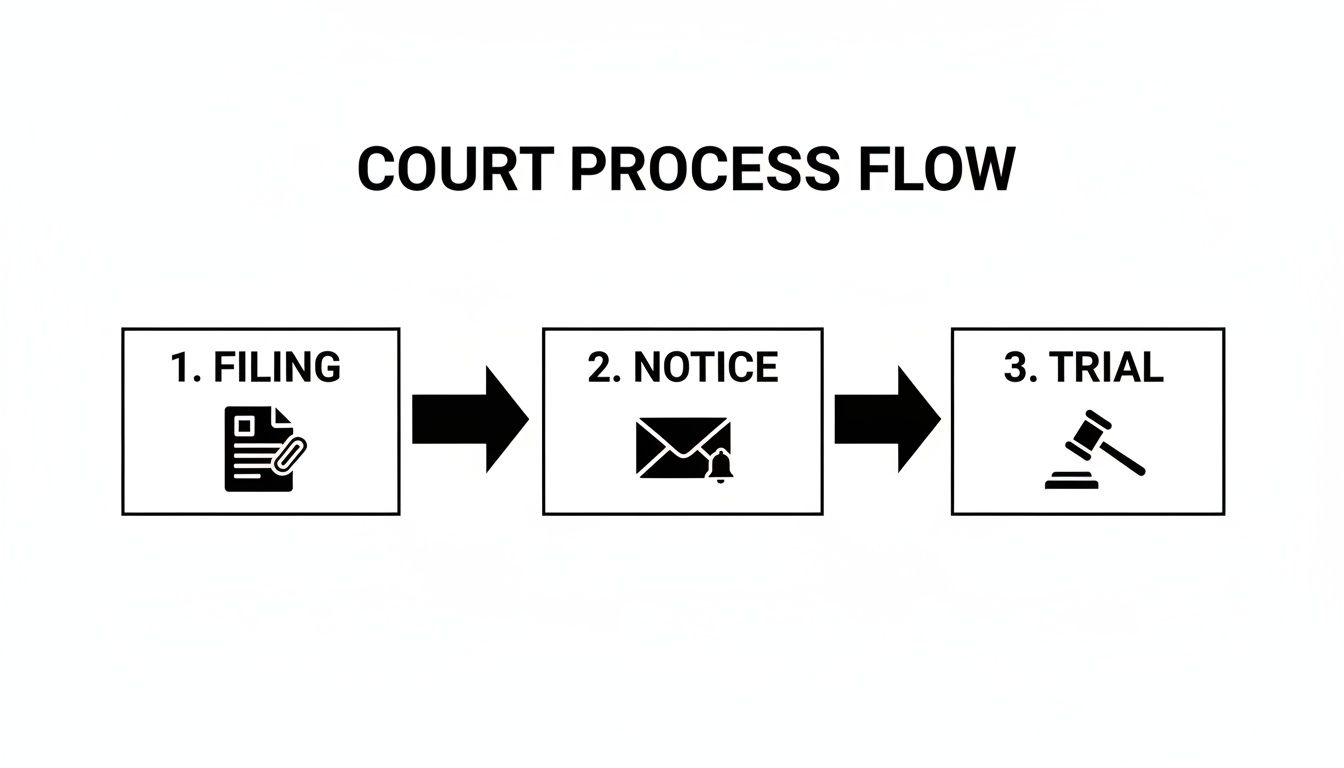
As you can see, every case follows a core path: it starts with filing the lawsuit, moves through a formal notification process, and ends with a trial where a judge makes the final, life-altering decision.
Who Can Start the Process
Not just anyone can walk into court and ask to sever a parent-child relationship. Texas law is very clear about who has the legal "standing" to file an Original Petition in Suit Affecting the Parent-Child Relationship that seeks termination.
This is an important safeguard. It ensures that only people with a real, significant connection to the child can ask a court to take such a drastic step. Typically, the people who can file include:
- The other parent, which we often see happen alongside a stepparent adoption.
- A court-appointed guardian or conservator who is already legally responsible for the child.
- A family member, like a grandparent, who has been caring for the child for some time.
- The Texas Department of Family and Protective Services (CPS), usually after an investigation into abuse or neglect.
Once the petition is filed, the legal wheels are officially in motion. The person who files is known as the "Petitioner," and the parent whose rights are being challenged is the "Respondent."
Key Stages of a Termination Lawsuit
From the moment that petition hits the clerk's desk, the case moves through several critical steps. Each one is designed to gather facts, protect the child, and make sure every party gets a fair chance to be heard. Hitting every single deadline during this process is absolutely crucial.
-
Serving Notice to the Parent: After filing, the Respondent parent must be formally notified of the lawsuit. This is called "service of process," and it’s not just a suggestion—it’s a constitutional right. It guarantees the parent knows about the case and has the opportunity to show up and defend their rights.
-
Appointment of an Ad Litem Attorney: A child can't hire their own lawyer. So, a judge will appoint an attorney ad litem. This is an independent lawyer whose only client is the child, and their sole job is to represent the child's best interests. They'll investigate by talking to the child, parents, teachers, and anyone else necessary to make a recommendation to the court.
-
Discovery and Evidence Gathering: This is the part of the lawsuit where both sides collect their proof. It can involve swapping documents, answering written questions under oath (interrogatories), or giving sworn testimony outside of court (depositions). This is when you'll be digging up documents, texts, emails, photos, and lining up witnesses to build your case.
-
Mediation and Temporary Orders: Before going to a full-blown trial, the court will almost always order the parties to mediation. It’s a chance to see if you can reach an agreement with the help of a neutral third party. The judge may also issue temporary orders to decide things like where the child will live while the case is pending.
-
The Final Trial: If you can't reach an agreement, the case is set for a final trial. Both sides present their evidence and witnesses to a judge (or sometimes a jury). The Petitioner has a very high bar to meet: they must prove with "clear and convincing evidence" that a legal ground for termination exists and that severing the parent's rights is in the child’s best interest.
The court process is methodical for a reason. Each step is a building block, ensuring that a final decision is based on a thorough review of the facts and a deep consideration for the child’s future.
This structured process exists to ensure fairness and allow a judge to make a fully informed decision based on evidence, not just emotion. Navigating it requires careful preparation and a solid understanding of your legal options at every single turn.
Navigating a Child Protective Services Investigation

A knock on the door from Child Protective Services (CPS) can send a shockwave through any family. That single moment often kicks off a stressful, confusing journey that, in the most severe cases, can end in a lawsuit for terminating parental rights in Texas. The first step to protecting your family is understanding how the system actually works.
When CPS gets a report of child abuse or neglect, they are legally required to investigate. This means interviews with you, your child, and others who know your family, like teachers or doctors. It's a deeply personal and often intimidating experience, but it’s crucial to remember that an investigation doesn't automatically mean your rights will be terminated.
The goal of CPS, especially in recent years, has shifted. The focus is now on preserving the family unit whenever it's safe to do so. However, if investigators believe a child is at immediate risk, the situation can escalate very quickly.
The Shift Toward Family Preservation in Texas
Fortunately, the child welfare system in Texas has seen significant changes aimed at keeping families together. In fact, there's been a remarkable 55% reduction in children removed from their homes by CPS, dropping from 20,685 in 2018 to just 9,220 in 2024.
This isn't a coincidence. It's the result of a dedicated effort to prioritize family stability while still ensuring child safety—a focus that has also seen child deaths from abuse and neglect fall by 53% in the same timeframe.
These positive trends are backed by specific legal reforms. A 2021 law, for example, narrowed the definition of 'neglect,' and a 2024 law banned anonymous CPS reports, which were often filed by vindictive sources. These changes mean more families get the chance to work through their challenges without being immediately pulled apart.
Responding to a CPS Service Plan
If CPS finds that a family needs support but doesn't believe immediate removal is necessary, they'll often create a service plan. Think of this as a formal agreement that outlines the steps you need to take to resolve the issues that triggered the investigation.
How you engage with this plan is critical. Common requirements include:
- Attending parenting classes
- Participating in counseling or therapy
- Submitting to drug and alcohol assessments or testing
- Making sure the home is clean, safe, and stable
Successfully completing a service plan is your best shot at showing the court and CPS that you're a capable and committed parent. But it's just as important to understand your rights. You aren't required to agree to a plan that is unreasonable or has nothing to do with the original concerns.
A CPS service plan can feel like a list of demands, but it's also a roadmap. It provides a clear, documented way to demonstrate your commitment to your child’s well-being and get your case closed.
When an Investigation Becomes a Lawsuit
If CPS decides that a child cannot safely stay in the home, they may file a lawsuit seeking emergency removal. This is the point where the process can rapidly shift toward the involuntary termination of parental rights. The agency has to prove to a judge that leaving the child in the home presents an immediate danger.
This is a critical moment where having a lawyer becomes absolutely essential. CPS has the full weight of the state behind it, and defending your rights alone is an overwhelming task. A CPS case is a serious legal matter with consequences that can last a lifetime. While the system has made strides to support families, the risk of termination is still very real in severe cases. Every action you take during the investigation—from that first interview to your compliance with a service plan—will heavily influence the outcome. Seeking immediate legal guidance is the most important step you can take to protect your family.
The Permanent Consequences and Possible Alternatives
Deciding to terminate parental rights—or agreeing to it—is one of the most profound moments a family will ever face. It's absolutely critical to understand this isn't a temporary fix or a decision you can walk back later. In Texas, a court order that terminates parental rights is permanent and final. It creates a clean legal break that echoes for generations.
This isn't just about visitation. This action dissolves the legal parent-child relationship forever. All rights to see the child, talk to them, or make decisions for them are gone. At the same time, future obligations end too, including the duty to pay child support. For the child, the legal tie is severed just as completely, which includes losing the right to inherit from that parent’s estate.
The Lifelong Impact of a Termination Order
The consequences ripple through every part of a family’s legal and emotional reality. A termination order is often the only way to give a child a safe, stable future, especially when it clears the path for an adoption.
Think about these permanent effects:
- End of All Legal Rights: The parent can no longer make decisions about the child's schooling, healthcare, or religious upbringing.
- No Right to Contact: All rights to possession and access (what most people call visitation) are completely extinguished.
- Cessation of Child Support: The obligation to pay future child support ends. However, any past-due amounts can still be collected.
- Loss of Inheritance Rights: The child will no longer have a legal right to inherit from the parent, and the parent loses the right to inherit from the child.
For parents considering this route, wrapping your head around these final outcomes is a must. Our firm has put together a complete guide to voluntarily terminating parental rights in Texas that dives deeper into this specific process.
Exploring Alternatives to Termination
Because termination is so absolute, Texas courts will always look for less drastic solutions if they can still keep the child safe. The state’s focus on preserving families is more than just talk; it's reflected in the data. For instance, in February 2025, 39% of conservatorship cases stemmed from a parent’s "Refusal to Accept Parental Responsibility," a complex issue that shows how the system tries to find solutions that stop short of termination. Trends like these, along with historically low rates of children re-entering foster care, show a clear preference for keeping family bonds intact when it's safe to do so. You can see this for yourself in recent DFPS performance reports.
The court's goal is always the child's best interest. If that can be achieved without taking the irreversible step of termination, a judge will almost always prefer an alternative that protects the child while keeping the family connected.
Before jumping to termination, it’s smart to look at other legal arrangements that can give a child stability. Exploring options like temporary guardianship can be a good starting point. Other powerful alternatives include:
- Naming a Relative as Managing Conservator: A judge can appoint a grandparent or another relative as the sole managing conservator. In plain English, this gives the relative the power to make major decisions for the child, but the parent’s rights remain intact, allowing for a continued relationship.
- Mediated Settlement Agreements: Sometimes, parents can work out a modified possession schedule (the court-ordered calendar for when each parent sees the child) that includes things like supervised visitation or other safety-focused restrictions. This protects the child without completely ending the legal relationship.
- Protective Orders: If domestic violence is the core problem, a protective order can legally restrict a parent's contact with the child, providing safety without the finality of termination.
Key Takeaway: What Comes Next?
Walking through a case involving parental rights can feel like an impossible climb, but you don't have to do it alone. The biggest takeaway is this: understanding just how serious this legal step is gives you the power to make the right decisions for your child's future. The process is complicated, but the goal is always the same.
Termination is permanent. A Texas court will only sever the parent-child bond if there is clear and convincing evidence that it’s truly in the child's best interest. That’s an incredibly high bar, and it’s there for a reason—to protect that sacred relationship unless absolutely necessary.
Shifting from Worry to Action
This is where you move from understanding the problem to actively working on a solution. Getting organized and being intentional can make a world of difference in your case. Your entire focus should be on proving stability and putting your child’s well-being ahead of everything else.
Here’s what you can start doing right now:
- Become a Document Collector: Gather every text message, email, photo, school report card, and doctor's note you can find. Organization is your best friend.
- Follow Every Single Court Order: If there are temporary orders or a CPS service plan, follow them to the letter. This shows the court you’re responsible and take this process seriously.
- Avoid Easy Mistakes: Stay off social media. Don’t get into fights with the other parent. Everything you do and say is being watched.
- Think "Best Interest" in Everything: Every action, every decision should be framed around one question: "What gives my child the most safety, stability, and love?"
The road ahead might seem overwhelming, but every step you take to protect your child matters. Your preparation and thoughtful actions are building the foundation for their secure future.
Frequently Asked Questions
When you're facing something as serious as terminating parental rights in Texas, it’s natural to have a million questions running through your mind. These aren't just legal questions; they're deeply personal ones that affect your child's future. Below, we’ve answered some of the most common and urgent questions we hear from families navigating this difficult journey.
Can a Parent Voluntarily Give Up Rights to Avoid Child Support?
No, a Texas court will not terminate a parent's rights just so they can get out of paying child support. The system is designed to make sure parents can't simply walk away from their financial obligations to their children.
Voluntary termination is almost always granted only when it is proven to be in the best interest of the child. This usually happens when another capable adult, like a stepparent, is ready and willing to adopt the child and legally take on all parental duties—including financial support. The court's primary goal is to ensure the child remains emotionally and financially secure, not to let a parent off the hook.
How Long Does the Termination Process Take in Texas?
The timeline for terminating parental rights can vary dramatically. There's no one-size-fits-all answer. A straightforward voluntary termination, where everyone is on the same page and it's part of a stepparent adoption, might wrap up in just a few months.
On the other hand, a contested involuntary termination can turn into a much longer battle, often lasting a year or more. If Child Protective Services (CPS) is involved, the case might move faster on a timeline set by law, because the state’s priority is to find a permanent, stable home for the child as quickly as possible. The complexity of the case, the amount of evidence, and the court's own schedule will all play a big part.
Is It Possible to Reverse a Termination Order?
An order terminating parental rights is considered permanent and final. Once it's done, it's incredibly difficult—and rare—to undo. The only real path to reversing the decision is through an appeal, which comes with very strict deadlines and requires proving that a major legal mistake or fraud happened during the original case.
A final termination order is meant to give a child a sense of permanence and stability. The incredibly high standard for reversing it highlights just how serious the court's decision is and why having experienced legal help from day one is so critical.
Because of this finality, you have to treat any termination case with the gravity it deserves. The outcome will have lifelong consequences for both you and your child, and there are no second chances.
If you need help with a child custody or visitation case in Texas, our experienced attorneys can guide you every step of the way. Contact The Law Office of Bryan Fagan, PLLC today for a free consultation.