
When your child’s future is on the line, understanding your rights and your role matters most. Staring at a court order filled with legal jargon like "conservator" can be overwhelming, leaving you feeling lost and uncertain. Let's clear things up: in Texas, a possessory conservator is the parent who has court-ordered time with the child—what many of us simply call visitation. While the other parent may have the right to decide where your child lives, your role as a possessory conservator is just as vital and legally protected.
How Texas Defines Custody: The Role of a Possessory Conservator

When a judge creates a custody order, their goal isn't to pick a "winner." They are creating a blueprint for how both parents will remain deeply involved in their child's life. Texas law intentionally uses the term "conservatorship" instead of "custody." This isn't just a technicality; it’s a powerful statement that both parents are considered conservators, entrusted with protecting their child’s well-being.
The Texas Family Code presumes that naming parents as Joint Managing Conservators is in the child's best interest. This arrangement means both parents share the rights and responsibilities of raising their child. However, even in a joint conservatorship, one parent is typically given the exclusive right to decide the child's primary home. The other parent is then named the possessory conservator.
The Key Distinction
So, what does being a possessory conservator truly mean for you? It means you have guaranteed, court-ordered time with your child. While you generally don't have the final say on major life decisions like where they attend school or non-emergency medical choices, your role is far from secondary. It's a legally defined status with specific rights and responsibilities designed to keep you at the heart of your child's life. The dynamic can change, of course, which is why it's also helpful to understand the role of a Sole Managing Conservator in Texas.
Even without being the "primary" parent, you are a critical piece of your child's world. The court orders are designed to make sure you maintain that strong, consistent relationship.
At its heart, the role of a possessory conservator is about ensuring a child benefits from the love, support, and guidance of both parents. The law recognizes that a child's stability depends on having two active and involved parents, regardless of where they sleep at night.
Understanding this framework is your first step toward confidently advocating for your rights and your child’s future. To make it even clearer, let's break down the key differences between the two roles.
Managing Conservator vs. Possessory Conservator At a Glance
Here’s a simple side-by-side look at how the rights and duties typically shake out between the two types of conservators in a Texas custody order.
| Right or Responsibility | Managing Conservator | Possessory Conservator |
|---|---|---|
| Child's Primary Residence | Establishes the child's primary home, often within a specific geographic area. | Does not determine the child's residence. |
| Possession & Access | Has possession of the child at all times not designated to the other parent. | Has possession of the child according to a court-ordered schedule (e.g., Standard Possession Order). |
| Child Support | Receives child support payments to assist with the child's daily needs. | Typically pays child support to the managing conservator. |
| Major Decisions | Usually has the exclusive right to make key decisions about education and non-emergency medical care. | Has the right to be informed and consulted but generally cannot make unilateral major decisions. |
| Access to Records | Has full access to all medical, dental, and educational records. | Also has the right to access the same records and consult with doctors and teachers. |
This table gives you a solid starting point, but remember that every family's situation is unique. Your specific court order will spell out the exact rights and responsibilities for you and your co-parent.
Your Rights as a Possessory Conservator
When you're named a possessory conservator, it can feel like you've been handed a lesser title. Many parents worry that not being the "primary" parent means they’ll be sidelined, shut out of the big decisions and important moments. It’s a completely understandable fear. But in Texas, that’s not how the law sees it at all.
Your court order isn’t just a visitation schedule; it’s a legal document that protects your role as a parent. The Texas Family Code is built to make sure you stay a deeply involved, influential figure in your child's life, arming you with specific rights that go way beyond just picking them up for the weekend.
More Than Just a Weekend Parent: Your Right to Information and Access
The heart of your rights as a possessory conservator beats around one thing: information. The law starts with the belief that it’s in your child’s best interest for both parents to be fully in the loop about their health, education, and well-being. This isn't just a friendly suggestion—it’s a legal mandate designed to help you co-parent like a team.
This means you have the independent right to get your child's important records directly. You don't need the other parent's permission to call the school, the doctor, or the dentist. You can just pick up the phone and do it.
Specifically, your rights almost always include:
- Medical and Dental Records: You can talk directly to your child’s pediatrician, look at their medical history, and consult with specialists about their health.
- Educational Records: You have every right to go to parent-teacher conferences, see report cards, and talk with teachers and counselors about how your child is doing in school.
- Direct Consultation: You are legally entitled to consult with school officials and medical providers about your child's future and welfare.
- Being There for the Big Moments: You have the right to attend your child’s school plays, baseball games, and other important activities, even if it doesn't fall on your weekend.
These rights ensure you’re never left in the dark. Imagine your child needs to see an allergist. You can call the doctor’s office yourself to get the test results and talk about the treatment plan. You don’t have to play a game of telephone, waiting for the other parent to pass along critical information.
Making the Call in Critical Moments
While the managing conservator usually handles the major, long-term decisions, your role as a possessory conservator comes with crucial decision-making power, especially when it matters most. The big one? You can consent to medical care whenever your child is with you.
A possessory conservator’s rights are designed to foster stability and connection. The law recognizes that your consistent, informed presence is crucial for your child's emotional and physical well-being, reinforcing that your role is integral, not secondary.
Think about it: if your child takes a tumble at the park during your weekend and breaks an arm, you have the full legal authority to rush them to the ER. You can consent to any necessary medical, dental, or surgical treatment on the spot. This power is there to make sure your child gets immediate care, no delays, no questions asked.
Unless a court order specifically limits them, a possessory conservator holds a whole suite of important rights and duties. It's about staying connected—receiving information, accessing records, showing up for school events, and acting decisively in an emergency. To get a deeper dive, you can explore more about these specific parental rights and duties to better understand your role.
At the end of the day, Texas law is on your side. It supports your active, meaningful participation in raising your child. Your title as a possessory conservator isn't a consolation prize; it comes with a powerful set of tools designed to keep you right where you belong—at the center of your child’s life.
Navigating the Texas Standard Possession Order
When a court has to map out a possession schedule, the number one goal is creating predictability and stability for your child. Instead of leaving visitation up to guesswork or constant negotiation, Texas law steps in with a default framework called the Standard Possession Order (SPO).
Think of it as a reliable calendar designed from the ground up to ensure your child gets consistent, meaningful time with both parents. It’s the starting point for most custody cases because it’s legally presumed to be in a child's best interest. It takes the "what if" out of the equation and gives everyone—parents and kids alike—a clear road map for the year.
The specifics of the SPO shift based on how far apart the parents live, making sure the schedule is always practical for the family involved.
The Schedule When Parents Live Under 100 Miles Apart
For parents who live relatively close to each other (under 100 miles), the Standard Possession Order establishes a familiar rhythm. This setup ensures the possessory conservator sees the children on a consistent schedule that encourages frequent contact.
Here are the core pieces of that schedule:
- Weekends: The possessory conservator typically has the children on the first, third, and fifth weekends of any given month. These visits usually start when school lets out on Friday and end when school is back in session on Monday morning.
- Holidays: Major holidays like Thanksgiving and Christmas are divided between the parents and alternate each year. This is a simple, fair way to make sure both parents get to build those special holiday memories.
- Summer Vacation: The possessory conservator gets 30 days of possession time during the summer. This can be taken as one solid block or, if everyone agrees, broken up into shorter periods.
This structure provides a routine that kids can count on. Just knowing when they will see each parent helps lower anxiety and gives them something to look forward to. For a deeper dive into the nuts and bolts, you can read our in-depth guide on Texas Standard Possession Orders.
The visual below illustrates the key rights you have all year long, reinforcing your role as a constant and involved parent.
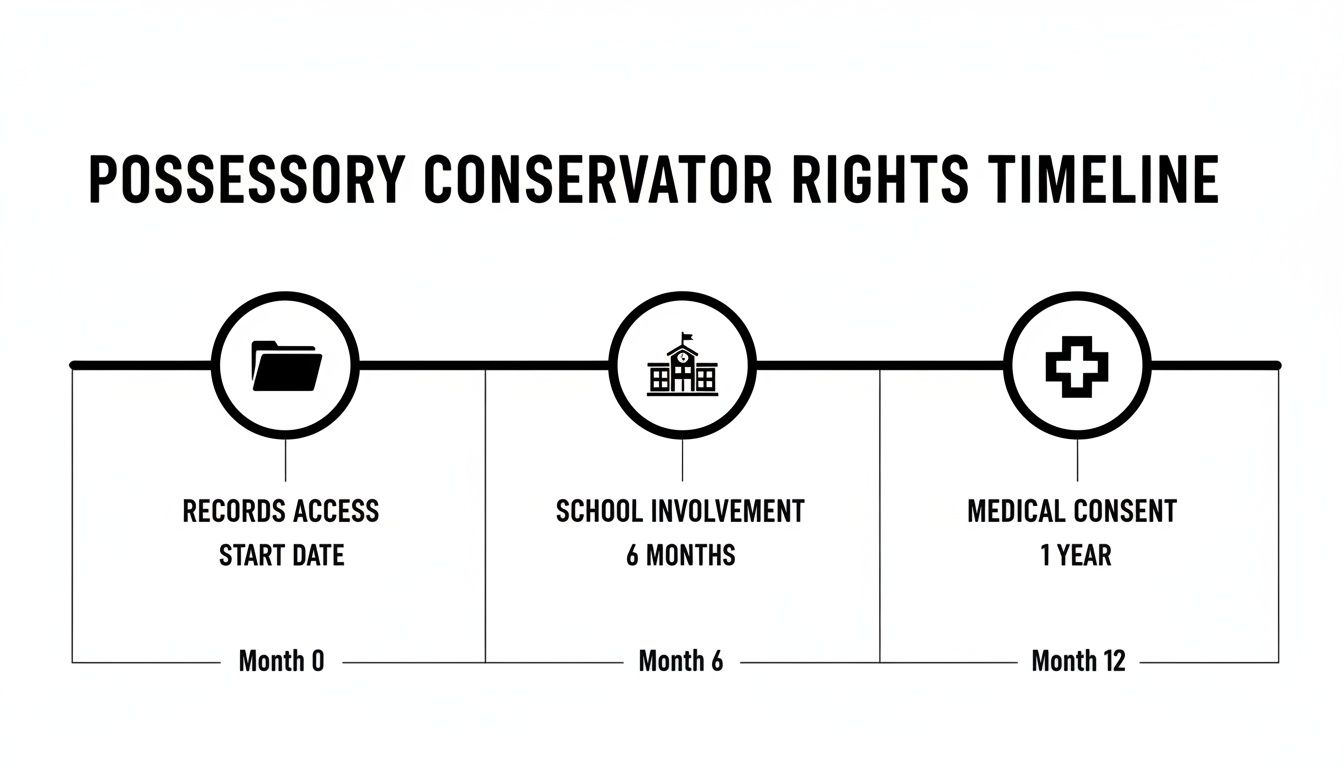
This timeline makes it clear that your rights to access records and be part of your child's life aren't limited to just your possession days—they are year-round.
To give you a clearer picture of what a year might look like, here's an example of a typical schedule.
Example Standard Possession Order Schedule (Parents Under 100 Miles Apart)
| Time Period | Possessory Conservator's Possession Time | Notes |
|---|---|---|
| School Year | 1st, 3rd, and 5th weekends of each month. | Possession begins when school is dismissed on Friday and ends when school resumes on Monday. |
| Thanksgiving | Every other year (e.g., odd-numbered years). | Alternates with the managing conservator to ensure fairness over time. |
| Christmas Break | Split into two halves, alternating each year. | One parent gets the first half (until approx. Dec 28), the other gets the second half. |
| Spring Break | Every other year (e.g., even-numbered years). | Alternates with the managing conservator. |
| Summer | 30 days of possession time. | Can be taken in a single block or split into multiple visits if both parents agree. |
| Child's Birthday | A few hours with the child on their birthday. | This is separate from the regular weekend schedule and is often specified in the order. |
This table is just a sample, but it shows how the SPO creates a balanced and predictable routine that children can rely on throughout the year.
What Happens When Parents Live Over 100 Miles Apart
Life, careers, and new opportunities can lead parents to live much farther apart. When that distance stretches to over 100 miles, the regular first, third, and fifth weekend schedule becomes impractical and, frankly, exhausting for a child.
The Texas Family Code gets this. It adjusts the SPO to fit the new reality.
Instead of frequent, short visits that involve a lot of travel, the schedule shifts to longer, less frequent periods of possession. The idea is to minimize travel headaches and maximize the quality of the time you spend together.
For long-distance parents, the SPO usually looks like this:
- Choice of Weekends: The possessory conservator can choose one weekend a month to have the child.
- Spring Break: The child spends every Spring Break with the possessory conservator.
- Extended Summer: Summer possession gets a big boost to 42 days instead of 30, giving you a much longer, uninterrupted block of time to reconnect.
This modified schedule acknowledges that even though the logistics are different, your importance in your child’s life hasn't changed one bit. It’s designed to ensure you can maintain a strong, healthy bond, even from a distance.
Ultimately, whether you live down the street or across the state, the law provides a clear path for you to stay deeply involved. The SPO is designed to be a fair, workable solution that always puts your child’s needs front and center.
When a Standard Schedule Is Not the Right Fit
While the Standard Possession Order (SPO) is the starting point for most Texas custody cases, it’s far from a one-size-fits-all solution. Think of it as a reliable template, but not every family’s story fits neatly into its boxes. The court’s true north is always the “best interest of the child,” a legal standard from the Texas Family Code that forces a judge to look beyond schedules and focus on a child’s real-world physical and emotional needs.
A possession schedule that works perfectly for a ten-year-old could be completely wrong for a toddler. Every family has its own unique circumstances, and Texas law gives judges the flexibility to create custom orders that fit those specific, and sometimes very challenging, situations. This is how the system protects children and fosters healthy parent-child bonds, no matter what.
Special Considerations for Children Under Three
The needs of infants and toddlers are worlds apart from those of school-aged kids. When a child is under the age of three, a judge will almost always set aside the Standard Possession Order for something more tailored. The priority here isn't about dividing weekends; it's about building secure attachments with both parents, which means more frequent, shorter periods of contact.
A custom schedule for a very young child often includes provisions like:
- Shorter, More Frequent Visits: Instead of a full weekend, a possessory conservator might have several four-to-six-hour visits scattered throughout the week.
- No Overnights at First: Overnight stays are usually introduced gradually as the child gets older and more comfortable being away from their primary caregiver for longer stretches.
- Step-Up Plans: The court order will often lay out a "step-up" plan that automatically expands the possessory conservator’s time as the child hits key age milestones.
This careful, phased-in approach helps the child build a strong, healthy bond with both parents without causing unnecessary stress or disrupting their fragile routines.
Protecting Children in High-Conflict Situations
Unfortunately, some cases involve a parent whose behavior could put a child’s safety or emotional well-being at risk. When there's a documented history of family violence, neglect, or substance abuse, the court’s number one job is to protect that child. This is when a judge will step in to heavily modify or restrict a parent’s access.
In high-conflict cases involving substance abuse, for example, courts might restrict a parent's access in 15-20% of cases by ordering supervised visitation. You can get more insights into how courts manage these complex possession issues by reviewing additional legal analysis on conservatorship.
A court's decision to order supervised visitation is never taken lightly. It is a protective measure designed to ensure a child's safety while still allowing a parent-child relationship to continue in a controlled, safe environment.
In these situations, a judge will often order supervised visitation, which means the possessory conservator’s time with the child has to be monitored by a neutral third party, like a trusted family member or a professional agency. These orders aren't meant to be punishment. They are a temporary shield, put in place until the parent can prove they can provide a safe and stable environment for their child.
Understanding Your Financial Responsibilities
When it comes to being a possessory conservator, your role goes far beyond just your scheduled time with your child. Let’s talk about the financial side of things—something that can feel stressful but is really just another powerful way you provide for your child’s future.
Think of child support not as a bill, but as your direct contribution to their day-to-day needs, like food, clothing, and a safe home, even when you aren't physically there. These financial duties are a core part of your parental responsibilities, giving your child the stable foundation they need to thrive.
How Texas Calculates Child Support
In Texas, the courts don't just pull a number out of thin air. The process for setting child support is guided by the Texas Family Code to keep things as fair and consistent as possible. The amount a possessory conservator pays is almost always based on a percentage of their net monthly resources—which is a legal way of saying your take-home pay after taxes and a few other required deductions are taken out.
For most parents, the math is pretty straightforward:
- One Child: 20% of net monthly resources
- Two Children: 25% of net monthly resources
- Three Children: 30% of net monthly resources
This formula ensures the support amount is proportional to your ability to pay. So, if your net monthly income is $4,000, the guideline child support for one child would be $800 per month. Payments are usually handled through a centralized state system, and you can learn more about how the Texas Child Support Disbursement Unit processes these transactions.
Providing Health and Medical Support
Your financial responsibilities don't stop with monthly child support payments. Texas law is clear that both parents have a duty to make sure their child has health and dental insurance. Most of the time, the court will order the possessory conservator to provide health insurance if it's available through your job at a reasonable cost.
If you're the parent carrying the insurance, you might get a credit that lowers your monthly child support payment. On the flip side, if the managing conservator provides the insurance, you'll likely be ordered to chip in for the cost of the premiums. Both parents are also typically required to split any out-of-pocket medical costs, like co-pays for doctor visits or prescription deductibles.
Meeting your financial obligations is one of the most powerful ways to show your commitment to your child’s well-being. It’s a tangible expression of your love and support that builds a foundation of security for their future.
It's absolutely critical to stay on top of these payments. Failing to do so can lead to some serious legal headaches. In fact, according to 2022 state reports, wage garnishment is used in 40% of enforcement cases. Consistently meeting your court-ordered obligations not only keeps you out of legal trouble but also goes a long way toward building a more stable and respectful co-parenting relationship.
Steps to Modify or Enforce Your Custody Order

Life doesn’t stand still, and neither do the needs of a growing family. The possession order that worked perfectly when your child was a toddler might feel completely impractical a few years down the road. This is a totally normal and expected part of co-parenting.
When your circumstances change, the law provides a way to update your court order so it continues to serve your child's best interests. This process is called a modification, and it’s a tool designed to ensure your legal arrangements can keep up with life's inevitable shifts.
The Standard for Modifying Your Order
You can’t just change a court order on a whim. To formally modify your possession schedule, a Texas court needs you to prove two things:
- There has been a material and substantial change in the circumstances of the child or one of the parents.
- Changing the order would be in the best interest of the child.
This legal standard is there for a reason—to promote stability for your child. It prevents a constant back-and-forth over minor disagreements and ensures only significant life events can trigger a legal change.
So, what qualifies as a "material and substantial change"? It’s a broad term, but it often includes big shifts like:
- A parent landing a new job with a completely different work schedule.
- One parent relocating to another city or state.
- A child’s needs evolving as they get older, like new school or extracurricular commitments.
- A major change in a parent’s living situation that directly impacts the child.
What Happens When the Other Parent Does Not Follow the Order
It's incredibly frustrating when a co-parent ignores the possession schedule and denies you your court-ordered time. This isn't just unfair—it’s a direct violation of a legal order. When this happens, you have the right to take action.
You can file a Petition for Enforcement with the court. This legal action asks a judge to force the other parent to comply with the existing order. It’s not about punishment; it’s about protecting your rights and ensuring your child gets the benefit of their time with you.
A court order is not a suggestion. If your co-parent is preventing you from seeing your child, an enforcement action is the legal tool designed to uphold the court’s authority and protect your parent-child relationship.
When you file for enforcement, the court has several tools at its disposal. A judge can order make-up visitation to compensate you for the time you lost. In more serious or repeated cases of non-compliance, the other parent could even face fines or jail time for contempt of court.
Whether you need to adapt your schedule to a new job or stand up for your legally protected time, you have options. Understanding the pathways for modification and enforcement empowers you to protect both your child's stability and your precious relationship with them.
Key Takeaways for Possessory Conservators
Navigating the legal world of conservatorship can be challenging, but understanding your role is the first step toward empowerment. Remember these key points:
- You Are a Parent, Not a Visitor: The term "possessory conservator" legally protects your time and your rights to be involved in your child's life.
- Information is Power: You have a legal right to access your child’s medical, dental, and school records and to consult with their providers and teachers.
- Possession Orders Provide Stability: The Standard Possession Order (SPO) is the default schedule, but it can be customized to fit your family’s unique needs and your child’s best interest.
- Your Responsibilities Are Key: Meeting your child support and health insurance obligations provides a critical foundation for your child's well-being.
- You Have Legal Options: If your order no longer works or the other parent isn't following it, you can seek a modification or file for enforcement to protect your rights.
If you need help with a child custody or visitation case in Texas, our experienced attorneys can guide you every step of the way. Contact The Law Office of Bryan Fagan, PLLC today for a free consultation.