
When your child’s future is on the line, understanding your rights matters most. You have a court order in your hands—a possession schedule, a child support agreement—that is supposed to provide stability. But what happens when the other parent treats it like a suggestion instead of a rule? This is where the powerful legal tool of contempt of court comes into play.
In simple terms, contempt of court happens when someone willfully disobeys a direct, lawful order from a judge. In the world of Texas family law, this is a situation we see all too often, usually involving custody schedules, visitation, or child support payments. It can be frustrating and destabilizing for your entire family, but you have options.

When a Court Order Is More Than a Suggestion
Let's be clear: a court order—whether it's your final divorce decree, a detailed possession schedule, or a child support order—is not optional. It’s a legally binding document signed by a judge, and it carries the full weight of the Texas court system. Its purpose is to create stability and predictability for your children by laying out exactly what’s expected of each parent.
So when a possession schedule is constantly ignored or child support payments just stop showing up, these aren’t just broken promises. They are direct violations of a legal document, and they can have serious consequences.
The Foundation of Fairness in Family Law
In Texas, every decision a judge makes about custody is guided by one core principle: the “best interest of the child.” This is the North Star for the court, influencing everything from naming parents as joint managing conservators (the standard setup where both parents share rights and duties) to hammering out the details of a possession schedule (the calendar outlining who has the kids and when).
When one parent decides to ignore these orders, they’re not just frustrating you; they're actively dismantling the stable foundation the court worked so hard to build for your child. Filing for contempt is the legal tool you use to hold that parent accountable and get things back on track. It’s a powerful way to enforce the rules that protect your child’s well-being and your own parental rights.
Think of it like this: A court order is the rulebook that both parents agreed to follow. When one parent throws that book away, contempt of court is how the referee—the judge—steps in to put the rules back in place.
This process ensures the decisions made for your child’s benefit are actually respected and followed. To get a deeper look at the legal nuts and bolts, you may find more information by understanding what contempt of court is. This guide will walk you through what contempt means for your family, how to handle it, and how to protect your rights and your children’s stability with confidence.
Civil vs. Criminal Contempt: What's the Difference for My Family?
When you hear “contempt of court,” it’s easy to picture a dramatic courtroom scene where a judge slams the gavel down and sends someone straight to jail. But in the world of Texas family law, it’s rarely that simple. Contempt isn’t a one-size-fits-all penalty; it’s a legal tool that comes in two very different forms: civil contempt and criminal contempt.
Knowing the difference is absolutely critical for parents. It shapes what you can ask the court to do, what kind of proof you’ll need, and what consequences the other parent might actually face. One is designed to fix a problem, while the other is meant to punish it.
Civil Contempt: The Key to Compliance
Think of civil contempt as holding a key. Its main purpose isn’t to punish; it’s to coerce—or strongly persuade—the other parent to start following the court order. It's all about fixing an ongoing problem and looking forward. A perfect example is when a parent falls behind on child support.
A judge’s order might sound something like this: "You are in civil contempt, and you will be jailed until you pay the overdue support." In this case, the parent holds the keys to their own jail cell. The moment they comply with the order (by paying up), the threat of jail disappears. The jail time isn't the point; it's just the leverage needed to unlock compliance.
The idea of contempt has a long history, developed over centuries to make sure court orders are taken seriously. In family law, which is what we live and breathe at The Law Office of Bryan Fagan, PLLC, these tools are vital. Knowing how to enforce a custody order can stop a small violation from becoming a massive problem, protecting both your parental rights and your child's sense of stability. You can dig deeper into the historical development of contempt powers and how they’re used today.
Criminal Contempt: The Punishment for Disobedience
Criminal contempt, on the other hand, is exactly what it sounds like. It’s a punishment for something that already happened. The goal here is to uphold the court’s authority and send a clear message: willfully disobeying an order has consequences.
Imagine your ex was supposed to return the kids on Sunday night but instead took them on an unapproved out-of-state trip, making them miss school and robbing you of your court-ordered time. That violation is in the past; it can’t be undone. A judge might find them in criminal contempt and impose a fixed penalty, like a hefty fine or a set jail sentence—say, 30 days—regardless of any promises to do better in the future.
The core difference is the objective. Civil contempt says, “Here’s what you need to do to get back on track.” Criminal contempt says, “You did that, and now there’s a price to pay.”
Civil vs. Criminal Contempt in Texas Family Law
For parents trying to make sense of this, seeing the two types side-by-side really clarifies what's at stake. Each has a different purpose, a different standard of proof, and very different outcomes. This comparison is the first step in deciding how to approach enforcing your order.
| Feature | Civil Contempt (The 'Key') | Criminal Contempt (The 'Punishment') |
|---|---|---|
| Primary Goal | To compel future compliance with the order. | To punish past, willful disobedience. |
| Legal Standard | The person filing must prove the violation by a “preponderance of the evidence,” meaning it's more likely than not that the violation occurred. | The violation must be proven “beyond a reasonable doubt,” the same high standard used in criminal cases. |
| Potential Outcome | Incarceration that can be ended by complying with the order (e.g., paying support), or paying the other parent's attorney fees. | A fixed punishment, such as a fine of up to $500 per violation or a jail sentence of up to 180 days per violation. |
| Who Benefits | The person who filed the motion, as it forces the other party to comply and corrects the problem. | The court's authority, by reinforcing that its orders cannot be ignored without consequence. |
Figuring out whether your situation calls for a civil or criminal remedy is a crucial first step toward getting things back on track. A family law attorney can help you determine the best path forward to protect your child’s best interests and make sure your court order is respected.
Common Reasons Parents File for Contempt
When you hear “contempt of court,” it’s easy to imagine a single, dramatic act of defiance in a courtroom. But for Texas families, the reality is often much quieter and more frustrating. Contempt isn’t always about one big explosion; it’s frequently a slow burn—a pattern of smaller actions that chip away at the stability your court order was meant to provide.
These aren’t just minor annoyances. They are violations of a legally binding document that directly impact your child's well-being and your rights as a parent. Understanding what these common triggers look like in the real world is the first step toward reclaiming control. Let's look at the scenarios that lead parents like you to file for enforcement.
Violating the Possession Schedule
The possession schedule is the heart and soul of a Texas custody order. It creates the predictability and routine kids desperately need to thrive after their parents separate. When one parent consistently disrupts that schedule, it can be grounds for contempt.
Common violations we see all the time include:
- Refusing to Return the Child: This is one of the most serious violations. When a parent decides on their own to keep the child past their court-ordered time, they're not just breaking a rule—they are illegally withholding your time with your child.
- Consistently Late Exchanges: Look, life happens. But when "running 10 minutes late" turns into a pattern of being an hour late for every single pick-up and drop-off, it creates chaos for everyone and puts the child in a stressful spot.
- Denying Visitation Altogether: A parent can't just decide to cancel the other's weekend because they're angry or there's a disagreement. Unless there is a genuine, court-recognized safety concern, blocking court-ordered possession is a clear violation.
These actions go against everything a Texas Standard Possession Order is designed to do. To get a better handle on how these schedules are supposed to work, you can check out our detailed guide on understanding child visitation and standard possession orders in Texas.
Failure to Pay Financial Support
Court orders about money are just as serious as the ones about visitation. A parent’s financial duties aren’t suggestions; they are direct commands from a judge to provide for their child.
Key financial violations include:
- Unpaid Child Support: This is probably the number one reason for contempt filings. Every single missed payment is a separate violation, and that back-support can pile up fast, creating real hardship for your family.
- Not Covering Medical Expenses: Most orders require parents to split the cost of things like doctor co-pays, braces, and prescription glasses. Refusing to pay your share is a violation.
- Failing to Maintain Health Insurance: If a parent is ordered to keep the child on their health insurance and lets the policy lapse, they can be held in contempt.
Ignoring Joint Managing Conservatorship Rules
In Texas, the vast majority of parents are named Joint Managing Conservators. This legal term means you are supposed to share in the big decisions for your child. The system is built on teamwork. When one parent starts making major calls on their own, they're violating the order.
A custody order is a roadmap for co-parenting. When one parent takes a detour, they aren't just getting lost—they are actively leaving the other parent and child behind. Filing for enforcement is how you get everyone back on the right path.
Examples of these kinds of violations include:
- Changing the child’s school or daycare without talking to the other parent first.
- Making non-emergency medical decisions, like getting braces, without the other parent's input.
- Signing a child up for a serious, time-consuming extracurricular activity without agreement.
Another major action that leads to contempt is simply not showing up for a court date. The court sees this as a direct sign of disrespect for its authority. As you can see from resources on missing your court date, this is taken very seriously. If you're seeing a pattern of these behaviors, it may be time to start thinking about your legal options.
How a Contempt Case Works in a Texas Court
Navigating the court system can feel overwhelming, especially when you’re already dealing with the emotional weight of a co-parenting conflict. But knowing what to expect is the best way to feel empowered and in control. A contempt case follows a clear, structured path, and understanding each step can demystify the whole process.
It all starts with a document called a Motion for Enforcement. This is the formal legal paperwork you file with the court to officially accuse the other parent of violating the court order. It's not just a simple complaint; it’s a precise legal tool that has to be drafted carefully to be effective.
The First Step: Filing the Motion for Enforcement
Think of the Motion for Enforcement as the foundation of your case. It must clearly and specifically lay out every single violation you're claiming. Vague accusations like "he's always late" just won't cut it with a judge.
Instead, your motion must include:
- The specific part of the order that was violated. You need to point to the exact section of your divorce decree or custody order that was ignored.
- The date, time, and location of each violation. For example, "On Sunday, March 15, 2024, at 6:00 PM, the father failed to return the child to my home as ordered in Section 4.2 of the Final Decree."
- Exactly what you're asking the court to do. This means telling the judge what you want to happen—whether that's make-up visitation time, repayment of child support, attorney's fees, or even jail time.
Accuracy here is non-negotiable. An improperly drafted motion can be thrown out by the court, forcing you to start all over again. Our firm has seen this happen, and you can learn more about the technical side of things by reading our guide on how to write a court motion.
After filing, the motion has to be personally served on the other parent by a sheriff or private process server. This isn't just mailing a copy; it's a formal delivery that ensures they have legally received notice of the hearing and the allegations against them.
What Happens at the Court Hearing
The court hearing is where both sides get to tell their story to the judge. Whether you are the one filing the motion (the "movant") or the one responding (the "respondent"), being prepared is absolutely essential.
If you are the movant, your job is to present clear evidence for each violation you listed. This could include things like:
- Text messages and emails showing missed visitations.
- Bank statements proving child support wasn't paid.
- A calendar or journal documenting every single late exchange.
If you are the respondent, you have the right to present a defense. Just saying you disagree with the order is not a valid defense, but there are legitimate reasons a judge might consider.
The following infographic breaks down the key areas—visitation, payments, and decisions—where violations often spark contempt actions.
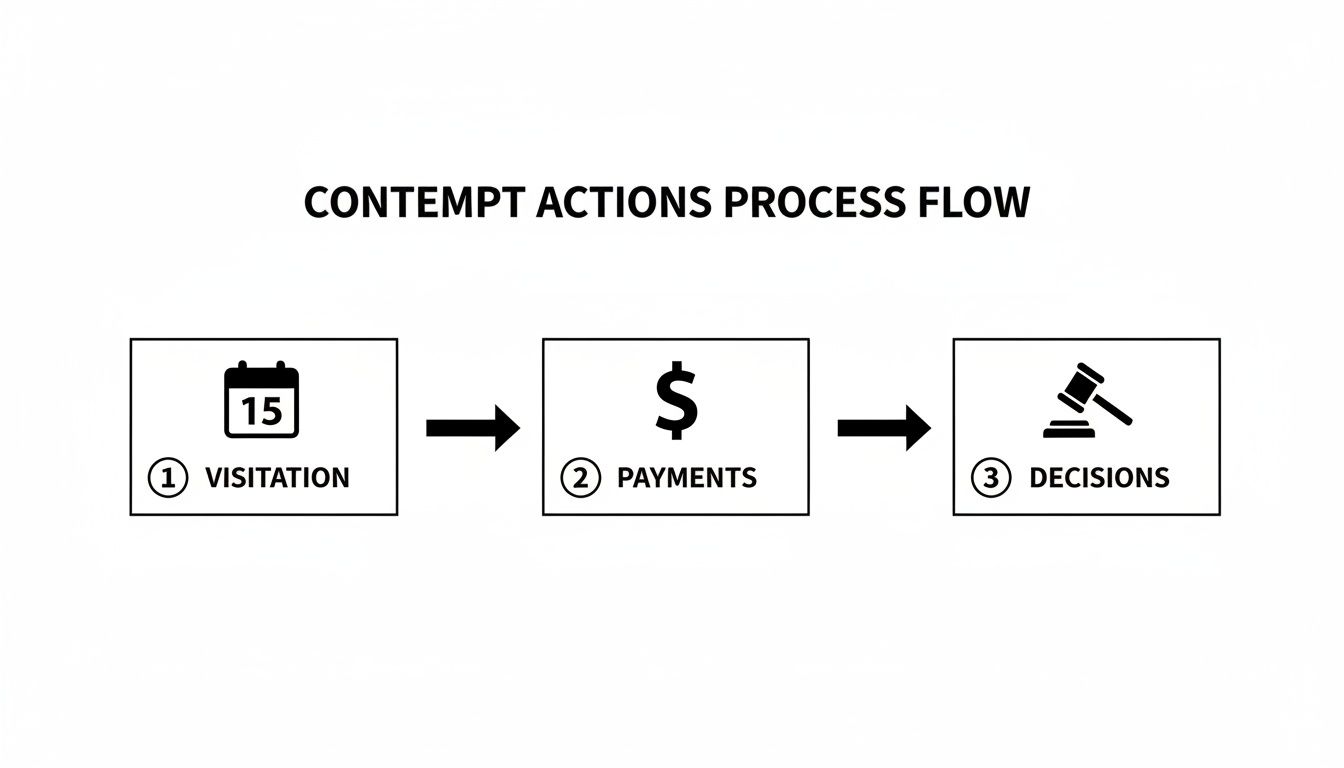
This visual highlights how contempt proceedings are the legal system’s answer when the core responsibilities of a co-parenting plan break down.
Common Defenses in a Contempt Case
Facing a contempt charge is incredibly serious, but the court will listen if you have a valid reason for your actions. A judge is looking for honesty and accountability, not just excuses.
Some common "affirmative defenses" include:
- Inability to Pay: For child support violations, you can argue that you genuinely could not pay due to something out of your control, like an involuntary job loss or a medical emergency. You must provide proof, like termination letters or medical bills.
- Agreement of the Parties: If you and the other parent mutually agreed to temporarily change the schedule and you have proof (like a text message), this can be a defense.
- Protecting the Child: If you denied visitation because you had a credible fear that the child was in immediate physical or emotional danger, the court will hear you out. This is a high standard to meet, but it's a valid defense.
It's crucial to understand how seriously Texas courts take these proceedings. A single violation of a possession or support order can lead to up to 180 days in jail, as defined under Texas Family Code § 157.173. That's why we always tell parents that following the order—or getting it formally modified if it’s not working—is the best path forward for everyone.
Ultimately, the judge will listen to all the evidence and testimony before making a ruling. This process ensures that decisions are based on facts, not just emotions, and aims to get your family back on the stable path outlined in your original court order.
Penalties and Solutions: How Judges Restore Order
When you're facing a contempt hearing, it’s easy for your mind to jump to the worst-case scenario. The idea of fines or even jail time is incredibly stressful. But a judge's primary goal isn't just to punish someone—it's to get things back on track for your child.
The court has a wide range of tools at its disposal, from serious penalties that hold a parent accountable to practical solutions designed to fix the problem that led you here. Understanding what a judge can actually do will help you walk into that courtroom with a clearer head and a better strategy.

What a Judge Can Order
If a Texas judge finds a parent in contempt, they have a lot of leeway to craft a remedy that fits the violation. The penalties are there to send a clear message: ignoring a court order is a big deal.
Here’s what a judge can impose:
- A Fine: The court can order a fine of up to $500 for each violation.
- Jail Time: For every single violation, a judge can sentence a parent to the county jail for up to 180 days.
- Community Supervision: Think of it like probation. A judge can place a parent on community supervision for up to 10 years, which usually comes with a list of conditions they must follow to stay out of jail.
These consequences aren't just theoretical. Family courts use their contempt powers to enforce orders, especially in high-conflict custody and support cases. Judges take these violations very seriously because they directly impact a child's stability.
Pathways to Making Things Right
More often than not, though, judges are focused on fixing the problem, not just dropping the hammer. They want to see compliance. They want to restore fairness and make sure the court's orders are followed from this point forward.
A judge’s primary goal in a contempt case is often compliance, not just punishment. They are looking for ways to fix the problem, restore the child’s stability, and ensure both parents follow the rules from now on.
Here are some of the constructive solutions a judge might order to get things back on course:
- Ordering Make-Up Visitation: If the other parent has denied your court-ordered time with your child, the judge can order them to give you extra possession days to make up for the time you lost.
- Repayment of Child Support: This is non-negotiable. The judge will order the non-compliant parent to pay every penny of overdue child support, usually with interest tacked on. For a deeper dive into this, you can check out our guide on how to enforce child support in Texas.
- Payment of Attorney's Fees: If you win your contempt case, the judge can make the other parent pay for your reasonable attorney's fees and court costs. You shouldn't have to be financially penalized for fighting to enforce your rights.
Ultimately, these remedies are designed to get your co-parenting relationship back to the framework laid out in your original order, keeping your child’s best interests front and center where they belong.
Key Takeaways: Your Next Steps as a Texas Parent
When your child’s well-being is at the center of a court order, every decision that follows matters deeply. Whether you’ve just filed a contempt motion against the other parent or you’re the one defending against it, the goal is always the same: get back to a stable, predictable routine that puts your child first.
This process shines a spotlight on a few hard truths for Texas parents. First, court orders aren’t suggestions; they’re legally binding directives. Second, your best friend in any enforcement action is a detailed log of every single violation—it’s the evidence that speaks loudest. And finally, clear communication can often prevent a small disagreement from becoming a full-blown courtroom battle.
A Practical Checklist for Parents
To protect your rights and keep your children’s lives on track, here are a few practical steps you can take right now:
- Become a Meticulous Record-Keeper: Start a journal or a digital log. Note every late pickup, every missed visitation, and every unpaid medical bill. Write down the date, time, and exactly what happened.
- Put it in Writing: Keep your co-parenting communication in texts or emails as much as possible. This creates an automatic, time-stamped paper trail that can be incredibly powerful if you end up in court.
- Know When to Modify vs. Enforce: Sometimes, the other parent isn't being defiant—the court order just doesn't fit your family's life anymore. If jobs, school schedules, or other circumstances have changed, filing to modify your custody order might be a much better solution than fighting over an outdated plan.
Your number one job is to protect your child’s sense of stability. The key is choosing the right legal tool for the job, whether that’s enforcement or modification.
For families across Texas, being proactive is the best strategy. We understand how common and frustrating these issues are. Our goal is often to help parents negotiate a solution before a small issue snowballs into a contempt filing. It keeps families out of the courtroom and preserves co-parenting relationships for the long term.
If you’re interested in the history behind these powerful court orders, this historical analysis of contempt powers shows just how seriously courts take their enforcement role. The smartest move you can make is to seek legal advice early. A quick conversation with an attorney can help you see all your options clearly and choose the path that brings peace back to your family.
Frequently Asked Questions About Contempt of Court
When you're dealing with something as serious as contempt of court, the questions can pile up fast. Feeling uncertain is normal, but getting clear answers is the first step toward finding your footing. Here are some of the most common questions Texas parents ask us, with straightforward answers to help you see the path forward.
How long can someone be jailed for contempt?
In Texas, this isn’t a slap on the wrist. For criminal contempt, a judge can sentence someone to up to 180 days in jail for each violation. With multiple violations, that time can add up quickly.
Civil contempt is different. It’s not about punishment; it’s about compliance. A person can be jailed indefinitely until they follow the court's order, like catching up on overdue child support. This is why you sometimes hear the phrase "holding the keys to their own jail cell." The moment they comply, the door opens.
Think it can't last long? Consider the case of treasure hunter Tommy Thompson. He found a historic shipwreck worth millions but refused court orders to reveal where the assets were. He was held in civil contempt and stayed in jail for years simply because he wouldn't comply, a powerful reminder of how long this can last. You can read more about this historic contempt case here.
What if I genuinely can't afford to pay my child support?
This is a critical point. A judge can only find you in contempt for willfully disobeying an order when you had the ability to comply. If you lost your job or a medical emergency wiped you out financially, making it impossible to pay, you might have an "affirmative defense."
But you can't just walk into court and say you're broke. You need to prove it. This means bringing concrete evidence like termination letters, bank statements, or medical records to back up your claim. You have to show the judge that your inability to pay was truly outside of your control.
Can we just agree to change the custody schedule ourselves?
Many parents make informal agreements to tweak the possession schedule. A quick text message, a phone call—it often works just fine, until it doesn't. While a judge might consider a written agreement (like a text thread) as a defense in a contempt hearing, verbal agreements are notoriously difficult to prove. One person’s memory will always be different from the other’s.
The only truly safe route is to get any permanent changes formally approved by the court through a custody modification. It might feel like a hassle, but it protects both of you and makes the new agreement legally enforceable. This simple step can prevent a future misunderstanding from escalating into a serious contempt allegation.
If you need help with a child custody or visitation case in Texas, our experienced attorneys can guide you every step of the way. Contact The Law Office of Bryan Fagan, PLLC today for a free consultation.