Skip to content
When your child's financial well-being is on the line, every missed or late child support payment can feel overwhelming. The stress is real, and it's easy to feel powerless. But as a parent in Texas, you have strong legal options. The path for how to enforce child support in Texas doesn't start with angry phone calls or courtroom drama. It starts with clear documentation and a calm, strategic approach.
These initial steps are critical. They build the foundation for any successful legal action, whether you end up working with the Attorney General's office or a private family law attorney. Understanding your rights is the first step toward securing the support your child deserves.
Your First Move When Child Support Stops
It’s a sinking feeling when a child support payment just doesn't show up. Your mind instantly races, calculating how you'll cover groceries, school supplies, or that upcoming doctor's visit. The emotional toll is real, and it’s a burden no parent should have to carry alone.
Your first actions, however, need to be methodical and focused on creating an undeniable record. This isn't about starting a fight; it's about building a rock-solid case to protect your child's legal rights and financial future.

Create a Detailed Payment Log
Your most powerful tool from the very beginning is a detailed log of every payment—or the lack of one. Don't rely on your memory.
Open a spreadsheet or a dedicated notebook and start tracking everything. For each payment due date, record:
- Date Payment Was Due: The exact date laid out in your court order.
- Amount Owed: The full amount of child support ordered by the court.
- Amount Actually Paid: Write down the exact figure, even if it was a partial payment or $0.
- Date Payment Was Received: Note the day the money actually arrived.
- Running Total of Arrears: Keep a cumulative total of all unpaid support. This number is crucial.
This log transforms your frustration into the kind of hard evidence a court or the Attorney General's office can act on.
Communicate Calmly and In Writing
The temptation to pick up the phone and express your frustration is understandable, but it's best to resist. All communication about missed payments should be in writing. Emails or text messages are ideal because they create a timestamped record you can use later.
Keep your messages direct, simple, and professional. A message like, "Hi, I haven't received the child support payment of $X that was due on [Date]. Please let me know when I can expect it," is far more powerful in court than an angry text.
This written trail proves you made a good-faith effort to resolve the issue before escalating things. Remember, establishing legal parentage is the necessary first step for any support order. You can learn more about that process in our detailed guide on how to establish paternity in Texas.
Your goal here isn't to win an argument in a text thread. It's to create an undeniable, documented record of non-compliance. This careful documentation is the bedrock of any successful enforcement action and empowers you to move forward with confidence.
By taking these proactive steps, you are actively building the case needed to secure the financial support your child is legally entitled to receive.
Working With the Texas Attorney General's Office
When you’re staring at a stack of bills and your child support isn't coming in, dealing with a large state agency can feel intimidating. However, the Texas Office of the Attorney General (OAG) is one of the most powerful tools a parent has.
The OAG’s Child Support Division is a dedicated legal resource designed to do one thing: make sure children get the financial support they are owed. They have resources and authority that go far beyond what a single parent can do alone, making them the right choice for many families struggling with enforcement.
The Power and Reach of the OAG
The sheer size of the OAG's operation speaks to its effectiveness. The Child Support Division manages about 1.5 million active child support cases, serving roughly 1.7 million children across Texas.
And they get results. Historically, the program has collected an incredible $11.34 for every $1 spent on its operations. That’s a testament to a system designed to work. You can see the real impact of child support in Texas for yourself. This isn't just about sending letters; it's about taking decisive legal and administrative action.
The OAG's enforcement methods are built for persistence. They apply consistent, far-reaching pressure on a non-compliant parent until the obligation to their child is met. It's a system designed for results.
How the OAG Enforces Child Support Orders
Once you have a case with the OAG, they can use a range of enforcement tactics—often without you ever needing to step into a courtroom. These methods are automated and designed to make it very difficult for a parent to avoid their responsibility.
Here are some of the most common tools they use:
- Wage Garnishment: This is the OAG's go-to method because it works. They can send an Order to Withhold Income straight to the non-paying parent's employer. The support money is taken out of their paycheck before they even see it.
- Tax Refund Interception: If the other parent is expecting a federal tax refund, the OAG can intercept it and redirect the money to you to cover past-due support.
- License Suspension: This gets a parent's attention. The OAG can suspend various state licenses—driver's licenses, professional licenses (like for doctors or electricians), and even hunting and fishing licenses.
- Placing Liens on Assets: They can put a legal claim, or lien, on property, bank accounts, personal injury settlements, and other assets. This means the parent can't sell that property or access those funds until the child support debt is paid.
Opening a Case and What to Expect
Getting started with the OAG is straightforward. You'll need to fill out an application and provide key documents, like a copy of your court-ordered child support and any records you have of missed payments.
It’s important to set realistic expectations. While the OAG is a powerful ally, the process can feel slow due to the massive volume of cases. It may take several months to see results, especially if the other parent is hard to locate.
Patience is key here. The trade-off for the wait time is significant: you get access to a powerful enforcement machine completely free of charge. For parents who need serious legal muscle but can't afford a private attorney, the OAG is an invaluable lifeline.
Taking Your Child Support Case to Court
While the Attorney General’s office is a fantastic resource, sometimes you need a more direct and immediate approach. If the OAG route isn't working fast enough, or you need to get a judge's attention, filing a private enforcement action gives you more control.
This path opens up some of the most powerful tools in the Texas legal system to ensure your child gets the financial support they're owed.
Taking this step means filing a Motion for Enforcement with the court that issued your original child support order. This legal document tells the judge the full story: every missed payment, the date it was due, and the total amount of back child support (known as "arrears"). It’s a clear signal that you are asking the court to step in and uphold its order.
The journey through the courts, whether with the OAG or a private attorney, follows a predictable path: open the case, locate the other parent, and enforce the order.
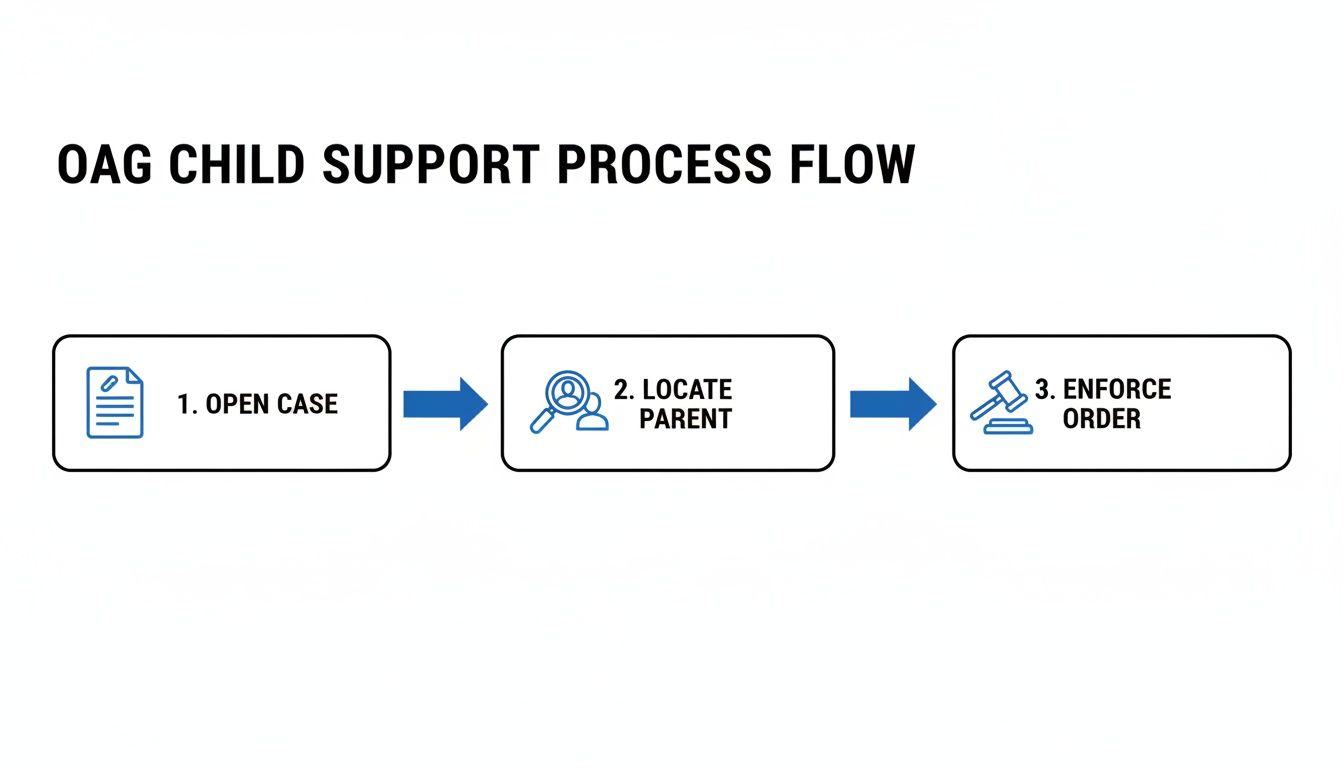
Going private often speeds up this process and gives you a dedicated advocate fighting just for you.
What Happens When You Hire a Private Attorney?
Many parents wonder whether it's better to use the free services of the Attorney General or hire a private lawyer. Both have their place, but they offer very different experiences. The OAG handles thousands of cases at once, meaning your case might not get the personal attention or speed you need. A private attorney is your personal advocate.
To help you decide, here’s a comparison of the two enforcement routes.
Comparing OAG Enforcement vs. Private Legal Action
| Feature | Attorney General (OAG) Enforcement | Private Attorney Enforcement |
|---|---|---|
| Cost | Free to the custodial parent. | Requires upfront retainer and hourly fees. |
| Caseload | Very high; attorneys handle thousands of cases. | Focused; your case gets direct, personal attention. |
| Timeline | Can be slow due to high volume and bureaucracy. | Generally much faster; can file motions immediately. |
| Control | You have very little control over the process or timeline. | You and your attorney drive the strategy and pace. |
| Tools Available | Full range of administrative and court tools. | Full range of court tools, often used more aggressively. |
| Communication | Can be difficult to get updates or speak to your caseworker. | Direct and consistent communication with your lawyer. |
| Best For | Simpler cases where the other parent is easy to locate and has a steady job. | Complex cases, uncooperative parents, or when you need fast results. |
Ultimately, choosing between the OAG and a private attorney comes down to your specific situation—how much you're owed, how cooperative the other parent is, and how quickly your child needs the money.
The Power of a Contempt of Court Finding
One of the most serious tools a judge has is finding the non-paying parent in contempt of court. This is a formal declaration that the parent has willfully and intentionally disobeyed a direct court order.
When a judge makes a contempt finding, they have serious options:
- Fines: The court can impose significant financial penalties for each violation.
- Jail Time: For serious or repeat offenses, a judge can sentence the non-paying parent to up to six months in county jail for each missed payment.
- Community Supervision (Probation): Often, a judge will order a jail sentence but suspend it, placing the parent on probation instead. The main condition? Pay back the past-due support on a strict, court-ordered schedule.
The threat of jail is often the most effective way to motivate a parent who has ignored everything else to finally pay what they owe.
Other Powerful Court-Ordered Remedies
Beyond contempt, a judge can order several other remedies to make it financially painful for a parent to continue avoiding their responsibility.
Placing Liens on Property and Assets
A judge can place a child support lien on the other parent's property. This is a legal "hold" on their assets that must be paid off before the property can be sold or refinanced.
Liens can be attached to:
- Real estate (a house or land)
- Vehicles (cars, boats, motorcycles)
- Bank accounts and retirement accounts
- Personal injury settlements or inheritances
This freezes valuable assets until the child support debt is cleared.
License Suspension
Just like the Attorney General, a court can order the suspension of various licenses. This includes the non-paying parent's driver's license, professional licenses (like for a nurse or contractor), and even recreational licenses for hunting and fishing.
Being unable to drive to work or legally do their job is a powerful motivator for compliance.
Getting these court orders requires following strict legal procedures, including properly serving the other parent with notice of the hearing. This is documented with an affidavit for service to prove they were notified. A private attorney will often ask the court for an income withholding order immediately, as it directs the employer to deduct child support from their paycheck, creating a reliable stream of payments.
How Your Original Child Support Order Shapes Enforcement
When you’re chasing missed child support, it's easy to focus only on what's owed now. But understanding how that dollar amount was calculated in the first place can give you a significant advantage.
Knowing the "why" behind the number gives you the confidence that you’re fighting for the correct amount your child is legally owed.
The Texas Family Code provides clear, predictable guidelines for this reason. The system is designed to be fair, ensuring a child gets consistent financial support based on a parent's ability to pay.
The Starting Point: A Parent’s "Net Resources"
Everything begins with a term called "net resources." This isn't just a parent's take-home pay. It's a much broader calculation of all their income sources, with only a few specific deductions allowed.
A parent’s net resources can include:
- Wages, salary, commissions, and overtime
- Income from self-employment
- Money from rental properties
- Royalties, bonuses, and investment income
- Retirement benefits and pensions
From this total income, the law allows deductions for federal income taxes, Social Security taxes, union dues, and the cost of the child's health insurance. What’s left is the "monthly net resources" figure the court uses. This ensures child support is based on the parent's entire financial picture.
The Guideline Percentages: Simple and Direct
Once the court determines the monthly net resources, it applies a straightforward percentage based on the number of children.
- 1 Child: 20% of Net Resources
- 2 Children: 25% of Net Resources
- 3 Children: 30% of Net Resources
- 4 Children: 35% of Net Resources
- 5+ Children: 40% of Net Resources
For example, if a parent's monthly net resources are $5,000 and they have one child, the guideline support would be $1,000 per month. This is why an Order to Withhold Income is so effective—it can be sent directly to an employer with a precise number based on these rules.
The "Cap" on Income and a Big Change Coming Soon
To keep things fair for high-income earners, Texas law puts a "cap" on the amount of net resources used in the calculation. For a long time, that cap was $9,200 per month. This meant that even if a parent earned far more, their child support was only calculated on that first $9,200.
This cap is adjusted periodically to keep up with inflation. A major update is coming on September 1, 2025, when the monthly net-resources cap will jump from $9,200 to $11,700—a 27% increase. You can read more about how this Texas child support cap increase could impact future support orders.
Understanding these three core pieces—net resources, the percentages, and the state cap—puts you in a much stronger position. You can look at your original court order and see how the numbers add up, confirming its accuracy. This knowledge takes the mystery out of the process and lets you advocate for your child with total clarity.
Enforcing Support When a Parent Leaves Texas
When your child's other parent moves out of state, it’s easy for panic to set in. A common question is: if they leave Texas, does child support enforcement stop at the state line? Let me put that fear to rest: it absolutely does not.
Your Texas child support order is a powerful legal document that follows the non-paying parent wherever they go. Thanks to a strong system of interstate cooperation, you can enforce that order across the country.

Understanding the Uniform Interstate Family Support Act (UIFSA)
The key to this process is a federal law that every state has adopted: the Uniform Interstate Family Support Act (UIFSA). Think of UIFSA as a binding legal agreement between all 50 states to honor and enforce each other's child support orders.
Under UIFSA, your original Texas order remains the one and only controlling order. The new state can’t change the support amount or ignore the terms. Instead, its courts must act as a partner to Texas to help you collect what's owed.
UIFSA ensures there is "one order, one time, one place." Your Texas order is the only one that matters, and every other state has a legal duty to help enforce it. This prevents a parent from moving to another state hoping to get a more favorable deal.
How Interstate Enforcement Works in Practice
So, what does this actually look like? The process usually starts right here in Texas. You can work with either the Texas Attorney General's Office (OAG) or a private attorney to begin an interstate enforcement case.
Here’s how it generally plays out:
- Finding the Parent: The OAG has access to federal and state databases, like the Federal Parent Locator Service, to track down the non-paying parent's new address and employer.
- Registering the Order: Your Texas order is formally "registered" in the state where the other parent now lives. This gives that state's courts the legal authority to take action on your behalf.
- Cross-State Wage Withholding: This is the most common tool. The Texas OAG works with the other state's agency to send an income withholding order directly to the parent's out-of-state employer. The money is then sent to you, just as if they still worked in Texas.
Taking Action Across State Lines
The collaboration between states is seamless and powerful. The other state can use many of the same enforcement tools available in Texas, such as intercepting state tax refunds, placing liens on property, and even suspending a driver's license issued by their new home state.
Dealing with child custody across state lines can feel incredibly complex, but when it comes to support, the law is firmly on your side. UIFSA was created for this exact problem, ensuring a parent cannot escape their financial duty to their child just by crossing a state border.
Common Questions About Texas Child Support Enforcement
When you're fighting to get the support your child is owed, it's natural to feel buried under a pile of questions. You're not alone. Here are clear answers to the concerns we hear most often from parents trying to figure out how to enforce child support in Texas.
How Long Does This Actually Take?
The timeline can vary depending on which path you take.
Working with the Office of the Attorney General (OAG) is a solid option, but due to their high caseload, it can take several months to get started. On the other hand, a private attorney can often get you a court date within weeks, moving things along much faster.
The quickest tool is an Order to Withhold Income. Once a judge signs it and it’s sent to an employer, they can start withholding support from the very next paycheck.
Can a Parent Really Go to Jail for Not Paying?
Yes, they absolutely can, though judges typically use it as a last resort. When a parent willfully ignores a court order to pay support, a judge can hold them in contempt of court.
This can lead to serious fines and a jail sentence of up to six months for each missed payment. Often, a judge will give the non-paying parent one last chance: pay a lump sum of what's owed now to avoid jail. It's an incredibly powerful way to compel immediate payment.
What if I Have No Idea Where They Work?
Don't worry—you're not expected to be a private investigator. Both the OAG and a private family law firm have access to resources far beyond a simple online search.
The OAG can use state and federal databases to check employment histories and tax records. A private attorney has legal tools like subpoenas, which can legally compel banks and businesses to hand over the financial and employment details you need.
You don't have to have all the answers before you start. The legal system has built-in ways to find the information needed to enforce your order and secure your child's financial future.
What Happens When the Other Parent is Self-Employed?
This is more complex, but it's a challenge we handle all the time. A standard wage withholding order won't work without a traditional employer, but you still have strong options.
A private attorney can use the legal discovery process to obtain bank statements, business records, and tax returns to paint a clear picture of their true income. Once that's established, a judge can:
- Order them to turn over funds from a bank account.
- Place a child support lien on their property—like a house, land, or vehicle.
- Order them to sell assets to pay off the past-due support.
Key Takeaways: Your Next Steps
Dealing with unpaid child support is one of the toughest challenges a parent can face, but you don't have to go through it alone. Texas law gives you powerful tools to protect your child’s financial rights. Taking action is an act of advocacy for your child, and every step you take makes a difference.
You’ve learned the main paths for how to enforce child support in Texas—from working with the Office of the Attorney General (OAG) to pursuing private legal action. Each route has its advantages, whether it's the no-cost power of the OAG or the speed and personal strategy of a private attorney. The most important thing is that you have options.
Making an Informed Decision
Figuring out the right path forward comes down to your specific situation. Consider these key factors:
- Urgency: How quickly do you need results? A private enforcement action is almost always faster than the OAG process.
- Complexity: Is the other parent self-employed, hiding assets, or out of state? These scenarios often benefit from the dedicated investigation a private attorney can provide.
- Communication: Do you need an advocate who will give you consistent updates and answer your questions directly? The personal attention from a family law firm offers peace of mind.
The single most critical step you can take right now is to get personalized advice from an experienced family law attorney. A consultation can help you understand which enforcement tools are best suited to your unique circumstances and give you a clear, actionable plan.
Remember, enforcing a child support order isn't about punishing the other parent; it’s about making sure your child has the financial stability they are legally entitled to.
If you need help with a child custody or visitation case in Texas, our experienced attorneys can guide you every step of the way. Contact The Law Office of Bryan Fagan, PLLC today for a free consultation.