
When your child's future is on the line, understanding your rights matters most.
If you're reading this, you may be in one of two painful situations. You may be worried that your co-parent's behavior is putting your child at risk. Or you may be scared that someone is calling you an unfit parent when that label doesn't reflect the full truth. Both situations can feel overwhelming.
Texas courts take these concerns seriously, but they don't make decisions based on fear, rumors, or one bad day. They look closely at safety, stability, and the child's daily life. That's why understanding what makes a parent unfit in Texas starts with knowing the legal standard the court uses in every custody case.
The Guiding Rule in Every Texas Custody Case
Texas doesn't begin a custody case by asking, “Which parent is better?” The court asks a different question. What arrangement is in the child's best interest?
Under Texas Family Code §153.002, the guiding rule is the best interest of the child. In plain English, that means the judge focuses on the setting that best protects the child's physical safety, emotional health, and overall development.
What best interest means in real life
A helpful way to think about this is a garden. If a judge were choosing where a young plant would grow best, the judge wouldn't focus on which gardener is more likable. The judge would look at sunlight, water, soil, and protection from harm. Child custody works much the same way.
The court looks at questions like these:
- Is the child safe here
- Is this home stable
- Can this parent meet daily needs
- Will this environment support healthy emotional growth
- Is there a pattern of harmful behavior
That's why the phrase what makes a parent unfit in Texas doesn't have a simple one-line answer. The court is looking at the full picture, not just a label.
Common custody terms that confuse parents
A few legal terms often cause stress because they sound more complicated than they are.
- Joint managing conservatorship usually means both parents share important rights and duties involving the child, such as decisions about education or medical care. It does not always mean equal time.
- Possession schedules are the court-ordered calendars for when each parent has time with the child. Many parents call this visitation, but Texas often uses the word possession.
- Conservatorship is Texas's term for custody. It covers decision-making rights and responsibilities, not just where the child sleeps.
Practical rule: Judges usually aren't looking for perfection. They're looking for safety, consistency, and a parenting arrangement a child can live in without fear or instability.
This matters for mothers and fathers alike. A mother doesn't automatically get custody because she is the mother. A father doesn't lose rights because he is the father. Grandparents and other caregivers may also become part of the conversation if a child's safety is at risk.
The court's focus stays on one issue. Will this parent-child relationship help the child thrive, or will it expose the child to serious harm?
What a Texas Court Considers Unfit
Texas law does not give one neat statutory definition of an unfit parent. Instead, courts examine conduct that places a child's physical or emotional well-being in danger. As explained by this discussion of Texas Family Code sections 153.002 and 263.307, Texas applies the best-interest standard while also evaluating specific indicators, including drug or alcohol abuse as a primary factor tied to neglectful supervision.
To make those warning signs easier to spot, this checklist helps summarize the kinds of issues courts often examine.

Active danger to the child
Some behaviors raise immediate safety concerns.
Texas Family Code §263.307 highlights conditions tied to neglectful supervision, and drug or alcohol abuse is one of the clearest red flags courts review.
That can include a parent who drives with the child while impaired, leaves dangerous items within reach, disappears for long stretches, or cannot maintain basic supervision because of addiction. If substance use is part of your case, practical information about critical meth addiction warning signs can help family members recognize behaviors that may support safety concerns.
Family violence is another major issue. If domestic abuse has affected the home, the court will view the child's emotional and physical safety through that lens. For a closer look at that topic, see how domestic violence affects child custody.
Neglect and failure to meet basic needs
Unfitness isn't limited to violence. It can also involve failing to provide the basics a child needs every day.
A court may become concerned when a parent cannot or will not provide:
- Food and shelter that are safe and consistent
- Medical care when the child is sick or injured
- Supervision appropriate for the child's age
- A stable home routine for school, sleep, and hygiene
Job loss or debt alone doesn't automatically make someone unfit. The legal concern appears when the financial problem directly affects the child's access to shelter, food, or medical care.
Here's where many parents get confused. Being poor is not the same as being unfit. The issue is whether the child is being endangered.
Passive unfitness and emotional endangerment
This is the part many articles skip.
A parent doesn't have to be violent or openly abusive to face serious custody concerns. Courts can also look at passive unfitness, meaning a parent's untreated mental illness, severe emotional instability, or inability to regulate behavior may interfere with daily caregiving.
That might look like:
- forgetting meals or medication because the parent is in crisis
- repeated emotional outbursts that frighten the child
- inability to maintain housing, routines, or school attendance
- refusal to seek treatment when the condition is clearly affecting parenting
A court may focus less on diagnosis and more on function. The question is whether the parent can safely care for the child day after day.
This is why records, treatment history, and home conditions often matter more than labels. A parent with a mental health condition is not automatically unfit. A parent whose unmanaged condition creates serious risk may be treated differently.
If parents are still able to work together on routines and transitions, a written framework can help reduce conflict. Parenting Plans in Texas Custody Cases explains what a Texas parenting plan must address.
For a broader overview, this video walks through common custody concerns in Texas.
How to Prove a Parent Is Unfit in Court
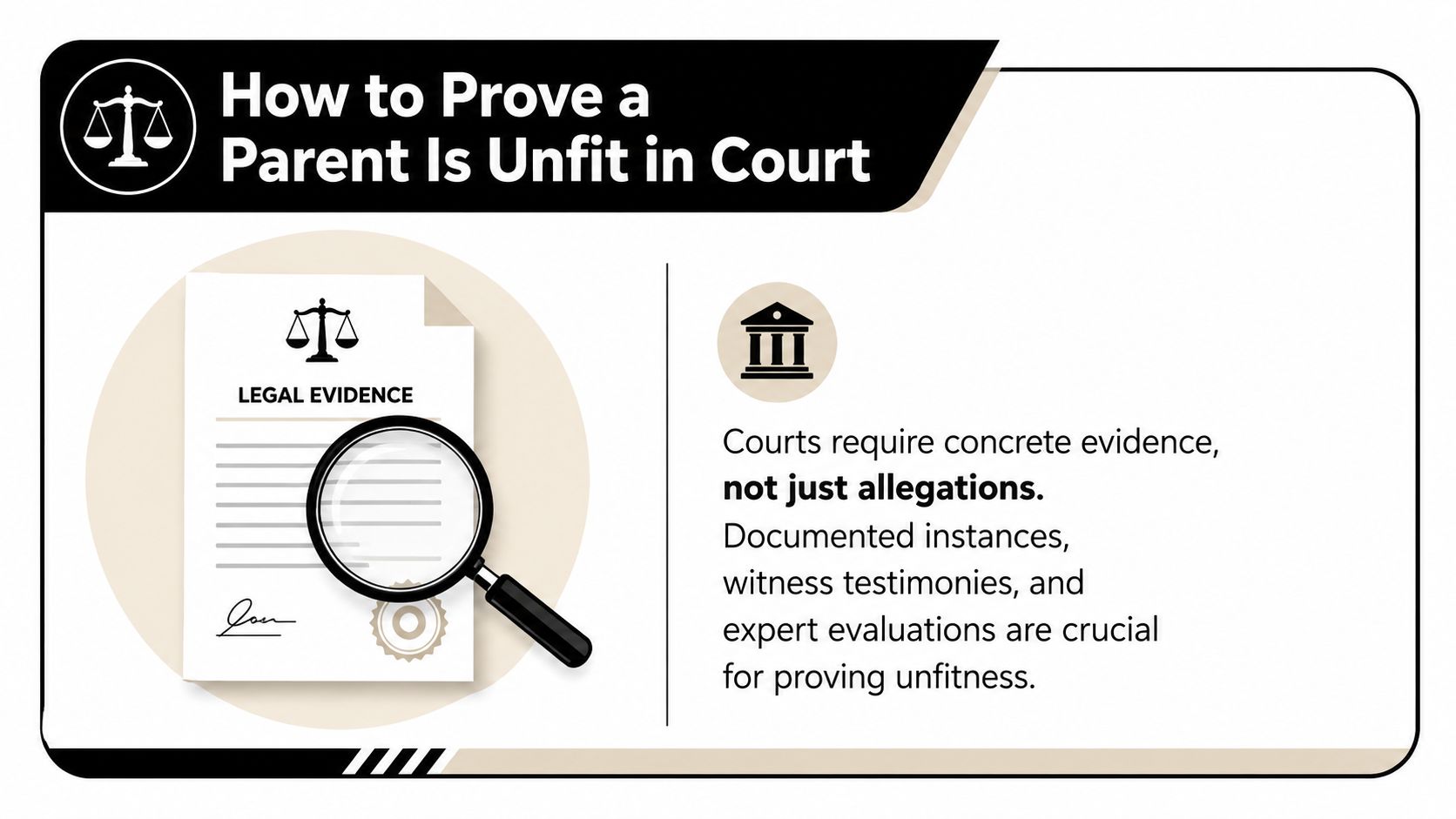
A judge won't remove rights or restrict access because one parent tells a troubling story. Courts want competent evidence. That means proof that can be reviewed, tested, and connected to the child's safety.
This summary captures the basic idea.
What evidence usually carries weight
If you believe your child is at risk, start thinking like a careful record keeper. Courts often look for:
- Police reports that document violence, disturbances, or arrests
- Medical records showing injuries, untreated conditions, or missed care
- Photographs and videos of unsafe home conditions or visible harm
- Text messages and emails that reveal threats, admissions, or instability
- School or counseling records showing attendance problems or behavior changes
The strongest evidence usually does two things at once. It shows what happened, and it ties that event to the child's safety or emotional well-being.
Why CPS records matter
Documented involvement from Child Protective Services can be especially important. As noted in this reporting on Texas child welfare cases, when CPS involvement is documented, it can be powerful evidence in unfitness cases and may support sole decision-making rights for the other parent or supervised visitation.
That doesn't mean every CPS contact proves unfitness. It means the court will pay close attention to documented findings, safety plans, and patterns.
Keep original records, not just summaries. Judges and attorneys often need dates, names, and full documents, not memory-based explanations.
Witnesses and expert input
People outside the family can matter a great deal. Teachers, counselors, doctors, neighbors, and relatives may testify about what they saw, heard, or documented. Their role is often to confirm patterns that one parent alone cannot prove.
In some cases, expert testimony becomes part of the case, especially when a child's condition, an injury, or mental health concerns need professional interpretation. If you're unfamiliar with how specialists explain technical evidence in court, this overview of understanding expert pathologist testimony helps show why expert opinions can shape a judge's view of disputed facts.
A useful way to organize your evidence is with a simple table.
| Evidence type | What it helps show |
|---|---|
| Police records | Immediate danger, disturbance, violence |
| Medical records | Injury, neglect, treatment gaps |
| Messages | Threats, admissions, ongoing behavior |
| CPS documents | Investigated safety concerns |
| Witness testimony | Patterns and daily impact on the child |
If you're defending yourself, this same rule applies in reverse. Bring records that show treatment, housing stability, school involvement, and safe parenting choices.
Real Life Scenarios of Parental Unfitness
The law becomes clearer when you see how these issues show up in daily life. These examples are fictional, but they reflect situations parents often face in custody disputes.
A parent with ongoing substance abuse
A father has regular possession time with his child, but the other parent notices missed pickups, slurred late-night calls, and a home that swings between messy and dangerous. Prescription bottles are left open on the counter. The child starts telling the other parent that “Dad sleeps all day.”
A Texas court would likely focus on supervision and safety. The issue isn't moral judgment. It's whether the child is being cared for in a stable environment.
A parent with severe untreated mental illness
A mother loves her child, but she has stopped treatment for a serious mental health condition. She forgets meals, leaves school forms undone for weeks, and has emotional episodes that leave the child frightened and confused. There's no allegation of hitting or screaming every day, but there is a pattern of inability to meet daily needs.
Passive unfitness becomes important. A judge may decide that the parent's condition, if unmanaged, creates emotional endangerment or neglect even without physical abuse.
The court usually looks at how the condition affects parenting, not whether the parent is trying hard or loves the child.
A child exposed to repeated domestic conflict
Parents sometimes assume that if the child wasn't directly struck, the court won't care. That's not how judges usually view it. If a child repeatedly witnesses violent arguments, sees one parent threatened, or lives around an abusive new partner, the court may see the entire environment as harmful.
The concern is broader than bruises. A child may suffer emotional harm from living in a home where fear is normal.
A parent in temporary hardship
Not every difficult period equals unfitness. A mother loses her job, moves in with family for support, and needs a short adjustment period while finding work. The home is clean, the child is fed, medical needs are met, and school attendance stays on track.
That situation is different from chronic neglect. Texas courts often distinguish temporary hardship from ongoing danger. That distinction matters for both mothers and fathers who are trying to rebuild after a setback.
Legal Consequences of an Unfit Finding
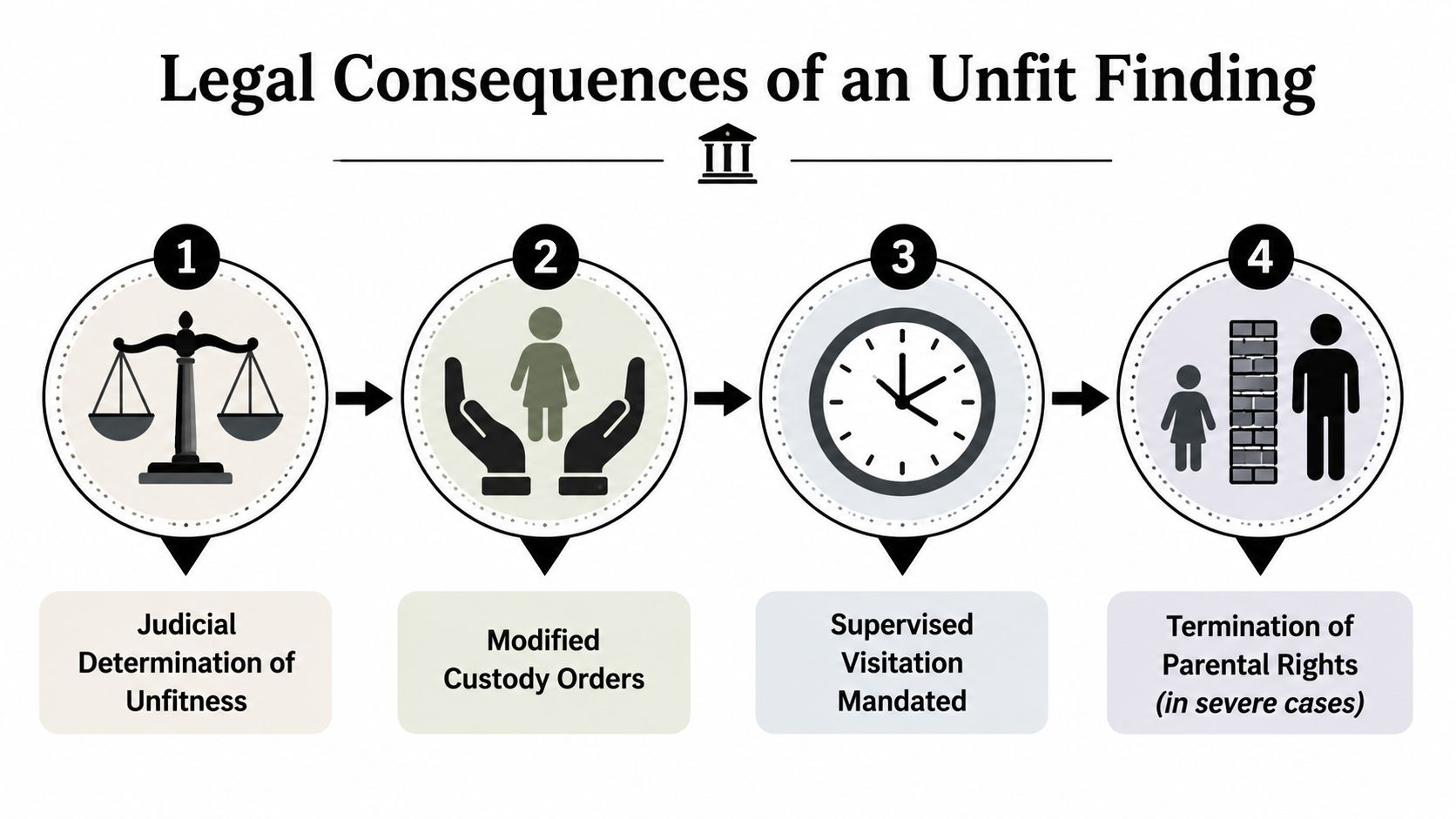
If a court decides a parent's behavior is harmful, the result isn't always the same. Judges usually try to match the order to the level of risk. Some cases call for guardrails. Others require strong restrictions.
This process flow helps show the range of possible outcomes.
Changes short of termination
Many parents are surprised to learn that a finding of risk doesn't always end the parent-child relationship. A judge may order measures such as:
- Supervised visitation so the parent can still see the child in a protected setting
- Drug or alcohol testing when substance use is part of the concern
- Counseling or treatment to address behavior affecting the child
- A modified possession schedule to reduce disruption or danger
A possession schedule is the court's calendar for parenting time. If safety concerns arise, that calendar may become more limited, more structured, or supervised.
Conservatorship can change
Texas also separates parenting time from decision-making authority. That's where joint managing conservatorship and sole managing conservatorship matter.
If the parents are joint managing conservators, they usually share major rights and duties involving the child. If one parent is named sole managing conservator, that parent may receive the exclusive right to make important decisions.
Under Texas Family Code Section 153.004 as discussed here, if a court finds a history or pattern of family violence within the two years before the suit is filed, the court cannot appoint the parents as joint managing conservators and must instead name a sole managing conservator to protect the child.
The most serious outcome
Termination of parental rights is the far end of the spectrum. Courts treat it as an extreme remedy, not a routine one. It generally comes up when a parent's conduct places the child in immediate danger or shows severe, ongoing endangerment.
If you need a fuller explanation of that process, this guide on when parental rights are terminated in Texas gives more detail.
For many parents, the important point is this. A court often tries to protect the child first through restrictions, supervision, or modifications before moving to the most permanent result.
Defending Against Allegations and Protecting Your Child
Being accused of unfitness can feel like your entire identity is under attack. If you're the parent making the accusation, you may feel guilty, scared, or unsure whether the court will listen. Both positions require careful action.

If you're defending yourself
Start with the truth and document it well. Texas courts don't label a parent unfit over every mistake. According to this explanation of Texas custody standards, a conviction for a non-violent misdemeanor generally won't make a parent unfit, and courts won't terminate parental rights without just cause.
That means you should gather evidence of stability, such as:
- Housing records that show a safe living environment
- Medical or counseling records showing treatment compliance
- School communications proving involvement in the child's life
- Clean drug test results if substance abuse has been alleged
- Witness statements from people who regularly observe your parenting
If the accusations are false or exaggerated, respond carefully and quickly. This guide on how to respond to false allegations can help you think through the first steps.
If you're trying to protect your child
Don't rely on emotional arguments alone, even if your fear is justified. Judges need a factual record. Write down dates, save messages, seek medical attention when needed, and report urgent safety concerns through proper channels.
You may also need to ask for a temporary order, emergency relief, or a modification of an existing custody order. If the current arrangement no longer protects the child, a change in conservatorship or possession may be necessary. For long-term planning, Modifying a Texas Custody Order explains when and how an existing custody order can be changed.
Creating a safer path forward
Parents often think their only choices are to “fight” or “give up.” Usually, there's a middle path. The law can create structure around school exchanges, communication, treatment requirements, supervision, and decision-making authority.
That's one reason many families speak with a family law firm early in the process. The Law Office of Bryan Fagan, PLLC handles child custody, visitation, possession rights, paternity, child support, custody modifications, and emergency custody matters in Texas.
Protecting a child and preserving a parent-child relationship are not always opposites. In many cases, the court tries to do both by setting safe conditions.
Mothers, fathers, grandparents, and caregivers all benefit from the same approach. Stay child-focused, document carefully, and ask for orders that solve real safety problems.
Key Takeaways and How an Attorney Can Help
A finding of parental unfitness can change custody, possession, and decision-making rights in a major way. But Texas courts don't base these decisions on labels alone. They look for credible evidence, a real connection to the child's safety, and a parenting arrangement that serves the child's best interests.
Next steps you can take now
- Focus on the child's daily reality. Courts care about safety, routine, supervision, and emotional stability.
- Document specific incidents. Dates, records, messages, photographs, and witness names matter.
- Separate hardship from danger. Temporary struggles don't always equal unfitness.
- Take passive concerns seriously. Untreated mental illness or emotional instability can matter when it affects caregiving.
- Ask for legal relief that fits the problem. That may mean supervised visitation, modified possession, sole decision-making rights, or emergency orders.
Why legal guidance matters
Custody cases involving unfitness allegations are emotionally charged. Parents often know something is wrong but struggle to prove it clearly. Others are unfairly accused and need help presenting the full picture. An attorney can organize evidence, explain Texas Family Code Chapter 153, prepare you for hearings, and ask the court for orders that protect your child without creating unnecessary conflict.
You don't have to sort through this alone. There is a path forward, and it starts with clear advice based on your family's facts.
If you need help with a child custody or visitation case in Texas, our experienced attorneys can guide you every step of the way. Contact The Law Office of Bryan Fagan, PLLC today for a free consultation.