
Legally, no, a child cannot unilaterally refuse court-ordered visitation in Texas, regardless of age. A child under 18 doesn't have the legal power to cancel a visitation order on their own, even though a child who is 12 or older may be interviewed by the court about their preferences.
When your child is crying, shutting down, or flatly refusing to go with the other parent, the legal answer can feel frustratingly simple compared to the emotional reality in your home. You're trying to protect your child's feelings, avoid a scene at the door, and still follow a court order that may not reflect what's happening right now.
That tension is real. Parents, grandparents, and caregivers often feel pulled in two directions at once. One side is your child's distress. The other is your legal duty under the order. Regarding can a child refuse visitation in Texas, what you usually need isn't just the rule. You need a practical way to respond without making the conflict worse.
When Your Child Says No to a Visit
A refusal rarely happens in a neat, courtroom-friendly way. It usually happens on a Friday afternoon, in the driveway, or ten minutes before pickup. Your child says they're not going. Maybe they say they feel sick. Maybe they lock themselves in a room. Maybe they tell you they hate going, or that they're scared, or that they're just tired of moving back and forth between homes.
That moment puts many parents in an impossible-feeling spot. If you push too hard, you worry you'll damage trust with your child. If you give in, you worry the other parent will accuse you of interference. Both concerns matter.
Why this is harder than it looks
Children don't always refuse visits for the same reason. Some are upset about normal transitions. Some are reacting to tension between the adults. Others are struggling with a new partner in the other home, school stress, different household rules, or deeper emotional issues connected to separation. Families looking for help with supporting children through parental separation often find that understanding the child's emotional experience helps lower conflict before it becomes a legal problem.
Practical rule: Treat a refusal as both an emotional event and a legal event. You need to respond to both.
If your child is refusing visitation, don't assume the answer is to force harder or give up. In many cases, the better approach is calmer and more deliberate. Listen carefully. Keep the order in mind. Avoid coaching, blaming, or making promises you can't legally keep. Then take steps that protect your child and protect you.
The Legal Reality of Visitation Orders in Texas
In Texas, what many parents call visitation is usually addressed in a possession order. A possession order is the part of a court order that says when each parent has time with the child. Think of it as the rulebook for co-parenting. It sets the schedule, and both parents are expected to follow it unless the court changes it.

Possession orders are binding
Texas courts don't treat a possession order as a suggestion. They treat it as a binding order that stays in place until a judge modifies it. According to this explanation of Texas visitation refusal law, there is no specific age at which a child can legally refuse court-ordered visitation, and a child under 18 cannot refuse visitation by law because Section 129.001 of the Texas Civil Practice & Remedies Code defines adulthood at 18.
That means the child's resistance may be important, but it doesn't erase the order.
What best interest means in plain English
Texas courts decide custody and possession issues based on the best interest of the child under Texas Family Code § 153.002. In plain English, that means the judge looks for the arrangement that most supports the child's safety, stability, emotional well-being, and healthy development.
Another phrase families often hear is joint managing conservatorship. That usually means both parents share certain rights and duties involving the child, such as decision-making authority. It does not always mean equal time. A possession schedule is the calendar that says when the child is with each parent. If you want a fuller explanation of how Texas handles parenting time, Is 50/50 Possession the Default in Texas? discusses whether courts order equal parenting time.
Courts often start from the idea that ongoing contact with both parents can serve a child well. But the exact schedule depends on the order in your case.
What this means for mothers, fathers, and grandparents
For mothers and fathers, the key point is the same. If there is a court order, neither parent gets to rewrite it at the curb because the child is upset. For grandparents and other caregivers helping with exchanges, the same practical rule applies. Follow the order that exists, not the one everyone wishes existed.
If the current arrangement no longer works, the answer is usually not self-help. The answer is legal action to enforce or modify the order.
How Texas Courts Weigh a Child's Preference
Texas law does allow a child's voice to be heard. It just doesn't give the child the final say. That distinction matters a lot when parents ask whether an older child can decide to stop visiting.

Voice, not veto
Under Texas Family Code § 153.009, children who are at least 12 years old must be given the opportunity to be interviewed by the court to express their preferences regarding custody or visitation, if requested, but the child's preference is never controlling because the court still decides based on the child's best interest under Texas Family Code § 153.002. That summary appears in this discussion of child preference in Texas custody matters.
So if your child is 12 or older, a judge may hear what your child wants. That does not mean your child can overrule the order.
Parents often misunderstand this point. They hear that a child can “choose” at a certain age. In reality, the court may listen more closely to an older, mature child, but the judge still makes the decision.
What judges tend to look for
A child's preference carries more weight when the child can explain clear reasons in a thoughtful way. A vague statement like “I don't want to go” usually doesn't help much by itself. A more detailed concern may matter more, especially if it connects to the child's well-being.
For additional background on how these issues come up in court, does a child get to choose which parent in Texas? is a useful starting point.
Here are the practical differences parents should keep in mind:
| Situation | What it usually means |
|---|---|
| Child dislikes rules or transitions | Frustrating, but not usually enough to stop visitation |
| Child is older and has a consistent preference | The court may listen more closely |
| Child raises serious safety concerns | The court may treat the issue very differently |
A short video can also help clarify how courts separate preference from legal authority.
A child can have strong feelings, sensible feelings, and even understandable feelings, while still not having the legal authority to cancel parenting time.
Your Role as the Parent When a Child Refuses
When a child refuses visitation, the law focuses heavily on what the parents did next. Judges want to know whether the parent with the child made a real effort to comply and whether the other parent showed up and acted in good faith.
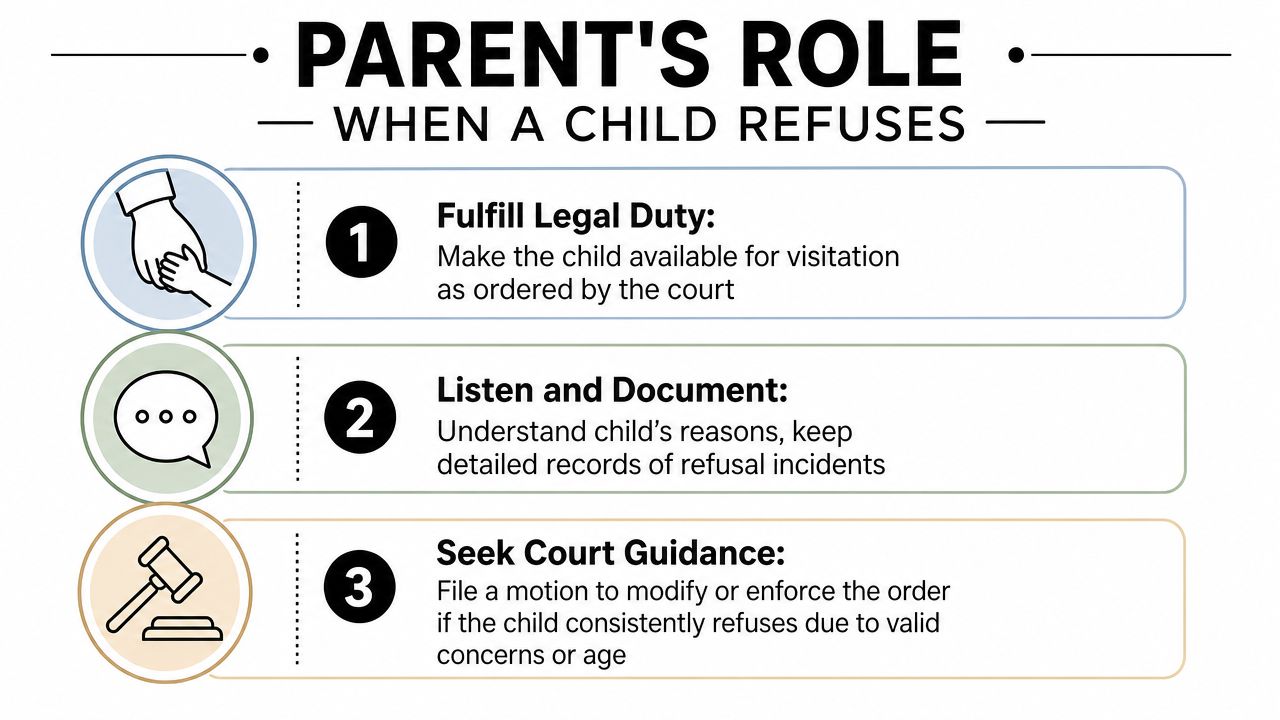
If you are the parent with the child at exchange time
Texas expects you to make a genuine effort. According to this Texas guide on visitation refusal, parents are legally required to make a genuine effort to enforce court-ordered visitation even when a child refuses, and failure to do so can result in contempt of court charges against the custodial parent.
That doesn't mean you should drag a terrified child across the driveway in every case. It does mean you shouldn't shrug, blame the child, and do nothing.
A better approach looks like this:
- Stay calm at the moment: Your child is already dysregulated. A yelling match makes the refusal worse and creates bad evidence for later.
- Use clear, simple language: Tell your child the court order requires the visit. Keep it short. Don't lecture.
- Listen without agreeing to cancel: You can validate feelings without promising the child won't have to go.
- Notify the other parent: Communicate promptly and stick to facts.
- Write down what happened: Note the date, time, what your child said, what you said, and what steps you took.
What works and what backfires
Some parents try to solve the problem by arguing with the other parent in front of the child. That usually backfires. It teaches the child that exchanges are battle scenes and that refusing creates adult chaos.
These responses usually help more:
Prepare early in the day
Pack bags, confirm pickup, and lower the chance of last-minute scrambling.Keep transitions boring
Calm, brief exchanges often work better than emotional speeches.Don't interrogate after the visit
Children often feel pressure to report on one parent to the other.Consider neutral support
A counselor, parenting coordinator, or attorney may help if the refusal is becoming a pattern.
What judges notice: Parents who encourage compliance, avoid badmouthing the other parent, and keep records usually stand on stronger ground than parents who say, “There was nothing I could do.”
If you are the parent being denied visitation
You still need to show up. The same source explains that for non-custodial parents, it is essential to physically appear at the correct address at the scheduled time to demonstrate good faith effort. In practice, many parents also document their presence carefully. Some take a photo or keep a receipt from a nearby store to help show they were there, as discussed in the same Texas resource.
If refusals keep happening, practical options may include mediation, counseling, or legal action. Some parents choose to speak with a family law attorney, such as Law Office of Bryan Fagan, PLLC, about whether enforcement or modification makes more sense based on the pattern.
When Refusal Signals Abuse or Safety Concerns
Not every refusal is about preference. Sometimes a child is trying to tell you something is wrong. Parents need to slow down, listen carefully, and separate ordinary resistance from possible danger.

Preference is not the same as fear
A child saying “Dad's house is boring” is very different from a child saying “I'm scared to be there.” A teen who wants to stay with friends is different from a child describing violence, neglect, substance abuse, or sexual misconduct.
The court may consider modification when refusal reflects serious concerns, and in extreme situations involving abuse or neglect, the court may reevaluate the broader custody arrangement. Courts generally limit visitation for safety reasons, not because a child dislikes going.
Red flags that need immediate attention
Look closely when a child reports specific, repeated, or alarming facts. Pay attention to changes in behavior too.
- Specific disclosures: The child describes concrete incidents, not just broad complaints.
- Physical signs: Unexplained injuries, pain, or sudden fear around exchanges.
- Sharp behavior changes: Withdrawal, panic, nightmares, or extreme distress tied to visits.
- Exposure concerns: Reports of dangerous people, drug activity, or violent conflict in the home.
If your child reports conduct that sounds abusive or dangerous, treat that as a safety issue first and a visitation dispute second.
What to do right away
If you believe your child is in danger, act through proper channels. Depending on the facts, that may mean contacting law enforcement, making a report to Child Protective Services, seeking emergency relief in family court, or all three. If CPS becomes involved, how CPS can affect your custody case in Texas can help you understand how those investigations may intersect with your existing order.
At the same time, be careful not to make accusations you can't support. False allegations can damage your credibility and your case. The right move is to document what the child said, preserve any evidence, and get legal advice quickly.
Legal Pathways for a Long-Term Solution
If refusals keep happening, your family needs more than a tense exchange plan. You need a legal path that fits the problem. In Texas, the two most common paths are enforcement and modification.
Enforcement when the order isn't being followed
An enforcement case is usually filed by the parent who is being denied court-ordered possession. The goal is straightforward. Ask the court to enforce the order that already exists.
That can be the right tool when one parent isn't making the child available, isn't encouraging compliance, or is otherwise failing to follow the schedule. Enforcement is about accountability. It is not about redesigning the parenting plan.
Modification when the order no longer fits reality
A modification case asks the court to change the existing order. This is often the better route when the refusal is ongoing, the child's needs have changed, or the current schedule has become unworkable. Texas courts may consider modifying the existing visitation order when there has been a significant change in circumstances and the modification serves the child's best interest.
For parents dealing with repeated conflict around exchanges, how to modify custody in Texas explains the basic process and what the court will expect.
Choosing the right next step
The right path depends on what is happening:
| Problem | Better fit |
|---|---|
| One parent refuses to follow the existing order | Enforcement |
| The schedule no longer works for the child or family | Modification |
| Safety concerns require urgent court action | Emergency relief, then possible modification |
Before filing anything, gather the facts carefully. Keep messages, calendars, notes about missed visits, and details about what your child has said. If new adults in the household or unfamiliar caregivers are part of the concern, some parents also look for lawful ways to verify identities safely and ethically while remembering that online information doesn't replace court evidence.
Next steps
If you're asking can a child refuse visitation in Texas, the practical answer is that the child's refusal does not cancel the order, but it does signal that something needs attention. Sometimes the issue is transition stress. Sometimes it is conflict between parents. Sometimes it points to a problem serious enough to bring back to court quickly.
Start with calm documentation and clear communication. Follow the current order as closely as safety allows. If the refusals are becoming a pattern, get legal guidance before a difficult situation turns into an enforcement fight or a larger custody problem.
If you need help with a child custody or visitation case in Texas, our experienced attorneys can guide you every step of the way. Contact The Law Office of Bryan Fagan, PLLC today for a free consultation.