Skip to content
When your child’s future is on the line, understanding your rights matters most. An affidavit of voluntary relinquishment of parental rights is the legal document a parent signs to permanently give up all rights and responsibilities for their child. It’s an irreversible step, most often taken to clear the way for a stepparent adoption or to resolve an incredibly complex family situation where it’s truly in the child’s best interest.
What This Difficult Document Really Means for You
Deciding whether to sign an affidavit of voluntary relinquishment of parental rights is one of the most profound and emotionally heavy choices a person can make. Let’s be clear: this isn't just paperwork. It is a final, legally binding act that permanently severs your status as a parent in the eyes of the law.

Think of it like signing away the deed to a family home you can never, ever get back. Once you sign this document and a judge approves it, you lose all rights to visit your child, make decisions for them, or even get information about how they are doing. It’s a decision that carries immense weight, and one that Texas courts do not take lightly.
The emotional toll of this process can be immense, often bringing up powerful feelings of guilt. It's important to acknowledge and process these feelings, and a compassionate guide on how to stop feeling guilty can offer some valuable support during this difficult time.
Immediate Consequences of Signing the Affidavit
It's critical to understand exactly what is lost when you sign. This affidavit doesn't just pause your rights; it permanently erases the legal parent-child relationship. To make the finality of this choice crystal clear, the table below outlines the specific rights and duties that are terminated for good.
| Parental Right/Obligation | Impact After Relinquishment |
|---|---|
| Custody & Visitation | You lose all rights to have your child live with you or visit you. This is known as losing your right to possession and access. |
| Decision-Making | You can no longer make decisions about your child’s education, healthcare, or religious upbringing. |
| Child Support | Your legal duty to pay future child support ends. However, you are still on the hook for any past-due support. |
| Inheritance | Your child loses the automatic right to inherit from you, and you lose the right to inherit from them. |
| Information | You no longer have the right to access your child's school records, medical information, or other important details. |
As you can see, the impact is total. This isn't a temporary measure; it's a permanent conclusion to your legal role as a parent.
The Irreversible Nature of This Decision
In Texas, this affidavit is designed to be irrevocable. Under the Texas Family Code, once you sign a properly drafted affidavit, there’s a very small window—often just 11 days—to formally revoke it. After that window slams shut, the decision is almost always final.
This legal finality isn't meant to be punitive. It exists to create stability for the child, especially when an adoption is waiting in the wings. This is not a choice to be made lightly, under pressure, or with any doubt. The consequences are for life, for both you and your child.
Sadly, this difficult process has become more frequent. Research shows the rate of parental rights termination for American children nearly doubled between 2000 and 2016, with about 1 in 100 U.S. children experiencing it by age 18. You can learn more about the trends and data behind parental rights termination from this in-depth analysis.
How Texas Law Views Relinquishment
Deciding to sign an affidavit of voluntary relinquishment means you're about to engage with a very specific set of Texas laws. These rules aren't just red tape; they are critical safeguards put in place to protect everyone involved—especially the child. Getting a handle on this legal framework is the first step to making an informed, empowered choice, ensuring you understand your rights and just how seriously Texas courts treat this permanent decision.
At the heart of this entire process is one guiding principle: the best interest of the child. Don't think of this as complicated legal jargon, but as the court's compass. Every single decision a judge makes must point toward securing a child's emotional, physical, and developmental well-being. It is, without a doubt, the most important factor in any Texas case involving a child.
The "Best Interest of the Child" Standard
When a judge looks at a request to terminate parental rights, they aren’t just rubber-stamping a parent’s wishes. They are legally obligated to weigh how this decision will shape the rest of that child's life. The court will dig into many factors, including:
- The child’s physical and emotional needs.
- Any potential danger to the child, both now and in the future.
- The stability of the child’s current home life.
- The plans for the child's future, such as a pending adoption by a stepparent.
A judge will only green-light a voluntary relinquishment if there is clear and convincing evidence that ending your parental rights is truly what’s best for your child. For a much deeper look at this topic, you can read our guide on voluntarily terminating parental rights in Texas, which breaks down many of these considerations.
Strict Rules for a Valid Affidavit
The Texas Family Code lays out very specific, non-negotiable requirements for the affidavit itself. These rules exist to stop a parent from making a hasty decision under pressure or during a moment of crisis. The law is designed to make absolutely certain your choice is deliberate, informed, and truly your own.
A crucial rule is the waiting period. A parent cannot sign a valid affidavit of voluntary relinquishment until at least 48 hours after the child’s birth. This "cooling-off" period ensures the decision isn't made in the immediate, often overwhelming, aftermath of childbirth.
Other strict requirements for the document to hold up in court include:
- It must be in writing and signed by the parent whose rights are on the line.
- It must be witnessed and notarized to verify the parent's identity and signature.
The Power of Irrevocability
Perhaps the most intimidating part of this legal document is its finality. In Texas, a properly written affidavit of voluntary relinquishment can be made irrevocable, which means it can’t be undone. If the affidavit contains this specific language, a parent usually has only until the 11th day after signing to file a formal revocation. Once that short window closes, the decision is permanent.
This finality creates legal security and stability for the child, which is especially vital if a stepparent or another family member is waiting to adopt. It allows the adoption to move forward without the fear that a biological parent might change their mind months down the road, creating chaos and emotional turmoil for the child. It's essential to understand this irrevocability clause before you sign a single thing, as it highlights the gravity of the step you are taking and why getting legal advice is so important.
Steps to Voluntarily Relinquish Parental Rights
Walking through the legal system, especially during such a raw and emotional time, can feel overwhelming. To cut through the confusion, we’ve put together a clear roadmap. This guide breaks down the entire process of using an affidavit of voluntary relinquishment of parental rights, from getting the document drafted to the final hearing where a judge makes the ultimate call.
Knowing what's coming can help lower the anxiety by making the whole procedure feel less like a mystery. Our goal is to give you, whether you're a mother or a father, the knowledge you need to move forward with a bit more certainty.
Step 1: Drafting the Affidavit Correctly
First things first: preparing the affidavit itself. This isn't just a form you fill out; it's a legal document with very specific requirements under the Texas Family Code. The wording has to be exact and must clearly state your intention to voluntarily and permanently give up your parental rights.
Because the language is so critical, this is absolutely not a DIY project. A small mistake or a missed detail could make the whole affidavit invalid, leading to major delays and headaches down the road. An experienced family law attorney will make sure the document is airtight and meets every legal standard.
Step 2: Executing the Affidavit
Once the affidavit is drafted, it has to be signed—or "executed"—in a very specific way. This part has its own strict rules, all designed to confirm your identity and ensure you're making this decision freely.
- Witnesses Are a Must: You can’t just sign this document by yourself. You must sign it in the presence of two credible witnesses.
- Notarization is Mandatory: On top of having witnesses, your signature has to be acknowledged before a notary public. The notary's seal is the official verification that you are who you claim to be and that you signed the document willingly.
This formal process highlights just how serious the affidavit is. It gives the court confidence that your decision wasn't made under pressure or because of coercion.
Step 3: Filing with the Court
After the affidavit is signed and notarized, it doesn't just take effect on its own. It has to be filed with the court as part of a formal lawsuit, known as a Suit Affecting the Parent-Child Relationship (SAPCR). This is usually done within a larger case, like a stepparent adoption or a termination suit started by the other parent. If you're looking for more on this, our guide on what a SAPCR form in Texas involves is a great resource.
This flowchart breaks down the key legal ideas a Texas court will look at during this process, zeroing in on the child’s well-being, the required waiting period, and the finality of the decision.
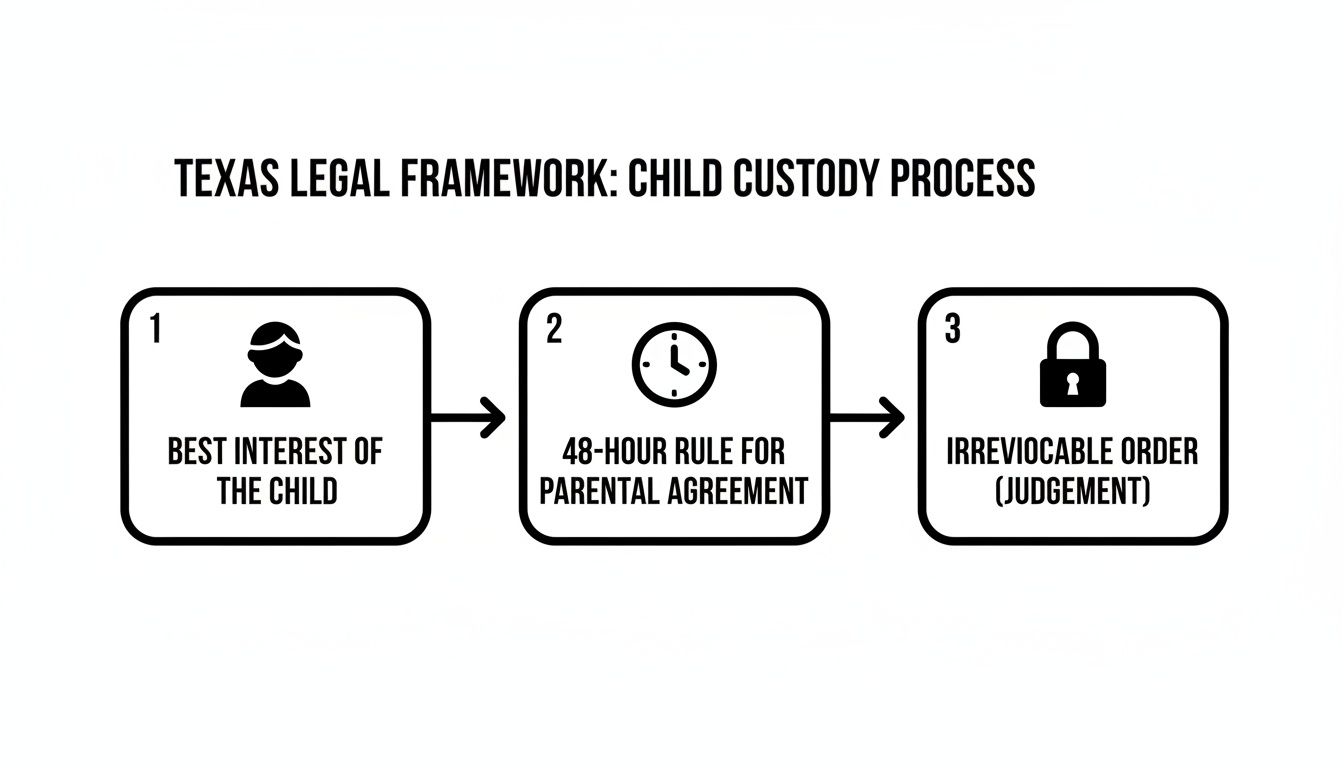
These legal guardrails are in place to make sure every decision puts the child's future stability first and that a parent's choice is deliberate and final.
The use of these voluntary affidavits became a more common legal tool after some big policy shifts. Historically, the entire landscape changed with the 1997 Adoption and Safe Families Act (ASFA), which led to a huge spike in terminations as states were given financial incentives to finalize adoptions. In recent years, this has resulted in over 70,000 such severances annually nationwide. While Texas follows these trends, it also provides important safeguards for parents.
Step 4: The Final Court Hearing
The very last step is a final hearing in front of a judge. A judge still has to determine that terminating your parental rights is in the best interest of the child. The court won't just rubber-stamp your decision based on the affidavit alone.
At the hearing, the judge will review the affidavit, confirm it was executed properly, and might ask you a few questions to make sure your decision was truly voluntary. If the judge agrees that termination serves the child's best interests, they will sign a final court order. Only then are your parental rights officially and permanently terminated.
This final step is what makes the decision legally binding. It’s the moment the legal parent-child relationship is formally and irreversibly ended, allowing the child to move toward a new, stable future, such as through adoption.
Real-World Scenarios for Voluntary Relinquishment
Legal documents can feel cold and impersonal, but the decision to sign an affidavit of voluntary relinquishment of parental rights is anything but. It’s a choice born from intensely personal, often heart-wrenching situations.
Seeing your own story reflected in the experiences of others can help make this path feel a little less isolating. Let’s walk through some of the real-life reasons why a parent might make this profound choice, not with judgment, but with understanding.
Paving the Way for a Stepparent Adoption
One of the most common—and often positive—reasons for relinquishment is to allow a stepparent adoption to move forward. Think about a child who has only ever known their stepparent as a mom or dad. The biological parent might live far away, have started a new family, and simply not have a real relationship with the child anymore.
In these situations, the biological parent recognizes that the child’s best chance at stability and security is to formalize the stepparent’s role. Signing the affidavit isn't an act of abandonment; it’s an act of love. It’s a gift that allows the child to have the legal and emotional security of a complete, unified family.
Untangling Complex Paternity Situations
Sometimes, a man is legally the father on paper, but a true father-child relationship never had a chance to grow. He might have been named the legal father years ago but has had zero contact since. The child may not even know his name.
For that legal father, remaining the parent on record can create roadblocks for the child, especially if the mother has remarried and her husband is ready and willing to adopt. By signing an affidavit of voluntary relinquishment, he acknowledges the reality on the ground: someone else has stepped up to be the father, and stepping aside legally is truly in the best interest of the child.
Finding a Path Forward in Difficult CPS Cases
Getting involved with Child Protective Services (CPS) is a terrifying and stressful experience for any parent. If you're struggling with addiction, instability, or other personal crises, you may be facing the devastating possibility of a court terminating your rights against your will.
In these painful cases, a parent might choose to sign an affidavit of voluntary relinquishment. It's an incredibly difficult decision, but it's often made to give the child a quicker path to a stable, permanent home—perhaps with a relative—instead of leaving them to drift in the foster care system. It can be a final, selfless act to put the child's need for safety and permanence first.
It's also crucial to understand that these choices don't happen in a vacuum. A 2016 analysis revealed that systemic biases can play a role, with Native American and African American children facing significantly higher rates of parental rights termination than white children. Often, these outcomes followed parents feeling overwhelmed by investigations and signing affidavits to allow for adoption. You can explore the data and contributing factors in the full study on the risks associated with parental rights termination.
Exploring Alternatives Before You Decide

Signing an affidavit of voluntary relinquishment of parental rights is a massive, life-altering decision. It’s permanent. And because there’s no going back, Texas law and any good family advocate will tell you to pump the brakes and consider every other path first.
These alternatives are not just legal loopholes; they are often compassionate, practical solutions that can give your child stability while keeping the door open to your relationship in some way. Before you make a choice this big, exploring options like private counselling can give you the space and clarity to figure out what's truly best for you and your child.
Modified Possession Orders
Giving up your rights completely isn't the only way to hand over the reins. A modified custody order is a powerful tool that allows another trusted adult to take the lead in your child’s life without erasing you from it.
- Granting Primary Custody: You can go to court and agree to name someone else—a grandparent, a stepparent, or the other parent—as the sole managing conservator. This gives them the exclusive right to decide where the child lives and make the big decisions.
- Retaining Your Rights: In that same order, you can be named a possessory conservator. You’re still the legal parent. You can still have a possession schedule (visitation), get school and medical records, and be part of your child's life, even if your role looks different.
This approach gives your child the stability they need without the gut-wrenching finality of termination. It acknowledges that someone else is the primary caregiver while preserving your legal connection to your child.
Mediation and Collaborative Law
Let's be honest—sometimes the thought of relinquishing rights comes from sheer exhaustion. The constant fights, the court battles, the stress of a high-conflict custody case can make you feel like giving up is the only path to peace. But it’s not.
Mediation gets you and the other parent in a room with a neutral professional to find common ground and build a parenting plan that actually works. Collaborative law is a process where you, the other parent, and your lawyers all agree to work together outside of court. Both of these routes are designed to turn down the heat and find solutions that don't involve a parent walking away for good.
Considering an Open Adoption
If adoption is truly the goal, it doesn’t have to mean a final, silent goodbye. In Texas, you can pursue an open adoption, which allows you to create a legally binding agreement for ongoing contact with your child after the adoption is finalized.
An open adoption can be a compassionate middle ground. It provides your child with the permanency of an adoptive family while honoring their roots by allowing for connection through letters, photos, or even occasional visits, depending on what everyone agrees is in the child’s best interest.
This is a way to secure your child’s future without erasing their past. For some, the legal identity of a child's father is a part of this complex puzzle. Understanding how fatherhood is legally established can be a crucial first step; you can read more about what an Acknowledgement of Paternity involves in our detailed article. Each of these alternatives puts your child’s stability first while respecting the emotional weight of your decision.
Next Steps: Making Your Final Decision
Deciding whether to sign an affidavit of voluntary relinquishment of parental rights is one of the heaviest and most personal choices a parent can make. It's an emotionally draining road, and moving forward requires feeling confident that you have all the facts and truly understand what this means for you and your child. This path is hard, but you don't have to walk it alone, and you have options.
At the heart of this entire process is one fundamental legal principle: the best interest of the child. A Texas court will only approve the termination of parental rights if it’s certain that the decision will give the child a safe, stable, and permanent home. This isn’t about punishing a parent—it’s about protecting a child’s future. The law treats this with the gravity it deserves, which is why the affidavit is designed to be permanent and, in almost all cases, irrevocable.
Key Takeaway
Before you take another step, let’s create a clear path forward. Take a breath and work through each of these items carefully.
- Reflect on Your Reasons: Find a quiet moment to be completely honest with yourself. What is driving this decision? What is the outcome you truly hope for, both for your child and for yourself?
- Explore Every Alternative: Before you commit to a permanent choice, really look at the other options. Could a modified custody order, mediation, or another legal solution provide the stability your child needs without ending your legal rights?
- Get Confidential Legal Advice: This is the single most important step you can take. An experienced family law attorney can walk you through your rights, analyze your specific situation, and make sure any choice you make is fully informed and legally sound.
The most important thing to remember is that this decision has to be yours and yours alone—made freely, without pressure from anyone, and with a crystal-clear understanding of its permanent consequences. Your child's future is on the line, and knowing the law and your options is everything.
This journey is far too important to travel by yourself. The right legal partner can bring the clarity and compassionate guidance needed to navigate this complex process, ensuring that no matter what, your child’s best interests are protected. It allows you to move forward knowing you’ve considered every angle and made the best possible choice.
If you need help with a child custody or visitation case in Texas, our experienced attorneys can guide you every step of the way. Contact The Law Office of Bryan Fagan, PLLC today for a free consultation.
Frequently Asked Questions About Relinquishing Parental Rights
When you’re considering a decision as significant as relinquishing parental rights, questions and concerns are completely normal. We’ve heard them all. Here are straightforward answers to the most common ones we encounter, grounded in Texas law and our experience helping families navigate this exact path.
Can I Change My Mind After Signing the Affidavit?
In most cases, the answer is no. An affidavit of voluntary relinquishment is built to be a final, permanent decision. The law doesn't make it easy to take back.
Most of these affidavits include a specific clause that makes them irrevocable. If you sign one with this language, Texas law gives you an extremely short window—just until the 11th day after signing—to file a formal, written revocation with the court. If the document doesn't have that irrevocable clause, you can technically revoke it anytime before the judge signs the final termination order. But given the finality of this step, absolute certainty isn't just a good idea; it's critical.
Do I Still Owe Child Support If I Relinquish My Rights?
Once a judge finalizes the order terminating your parental rights, your legal duty to pay future child support comes to an end. This is a crucial distinction that trips a lot of people up.
However, terminating your rights does not wipe out any past-due child support you already owe. That debt, known as "arrears," remains on the books. The Office of the Attorney General has the authority—and the obligation—to continue collecting any unpaid support that built up while you were still the child's legal parent. The termination only affects your obligations from that day forward, not the debts you leave behind.
Does the Other Parent Have to Agree to the Relinquishment?
No, the other parent’s consent isn’t legally required for you to relinquish your own rights. You are signing away your legal relationship with the child, not theirs.
But here’s the practical reality: a judge will only approve the termination if it’s in the child's best interest. Courts are almost never going to agree to a plan that leaves a child with only one parent to provide all financial and legal support. For the termination to move forward, there almost always has to be another person, like a stepparent, waiting in the wings to adopt the child and step into that role. The court’s number one priority is ensuring the child remains stable and supported.
How Is This Different From CPS Terminating My Rights?
The difference between voluntary relinquishment and involuntary termination comes down to one simple but powerful word: choice.
Voluntary relinquishment is a process you start yourself by knowingly signing a legal affidavit to give up your rights. In stark contrast, involuntary termination is a legal case brought against you by the state, usually through Child Protective Services (CPS), because of serious allegations like abuse, neglect, or endangerment.
While both actions ultimately lead to the same permanent outcome—the end of the parent-child relationship—one is a decision you make, and the other is a legal fight to keep your rights from being taken from you. That distinction is everything.
If you need help with a child custody or visitation case in Texas, our experienced attorneys can guide you every step of the way. Contact The Law Office of Bryan Fagan, PLLC today for a free consultation.