
When your child’s future is on the line, understanding your rights matters most. In Texas, paternity is the legal recognition of a father-child relationship. This is more than just biology; it's the official process that grants a father legal rights, like custody and visitation, and creates legal duties, such as providing child support. For mothers, it's the key to securing financial support. For fathers, it's the foundation for being a legal parent in the eyes of the court.
What Paternity Means for Texas Families

Understanding "what is paternity" is the first step toward protecting your parental rights and securing your child's future. It’s not just a biological tie; it’s a legal status with huge consequences for mothers, fathers, and children. For a mother, establishing paternity is the only way to get a court to order child support. For a father, it’s the absolute foundation for being a legal parent with rights a court can enforce.
This legal process is what transforms a genetic link into a formal relationship recognized under the Texas Family Code. Without it, a man has no legal claim to custody or visitation, and a mother cannot legally require him to provide financial support. It is the bridge between biology and legally-protected parenthood.
The Legal Father vs. The Biological Father
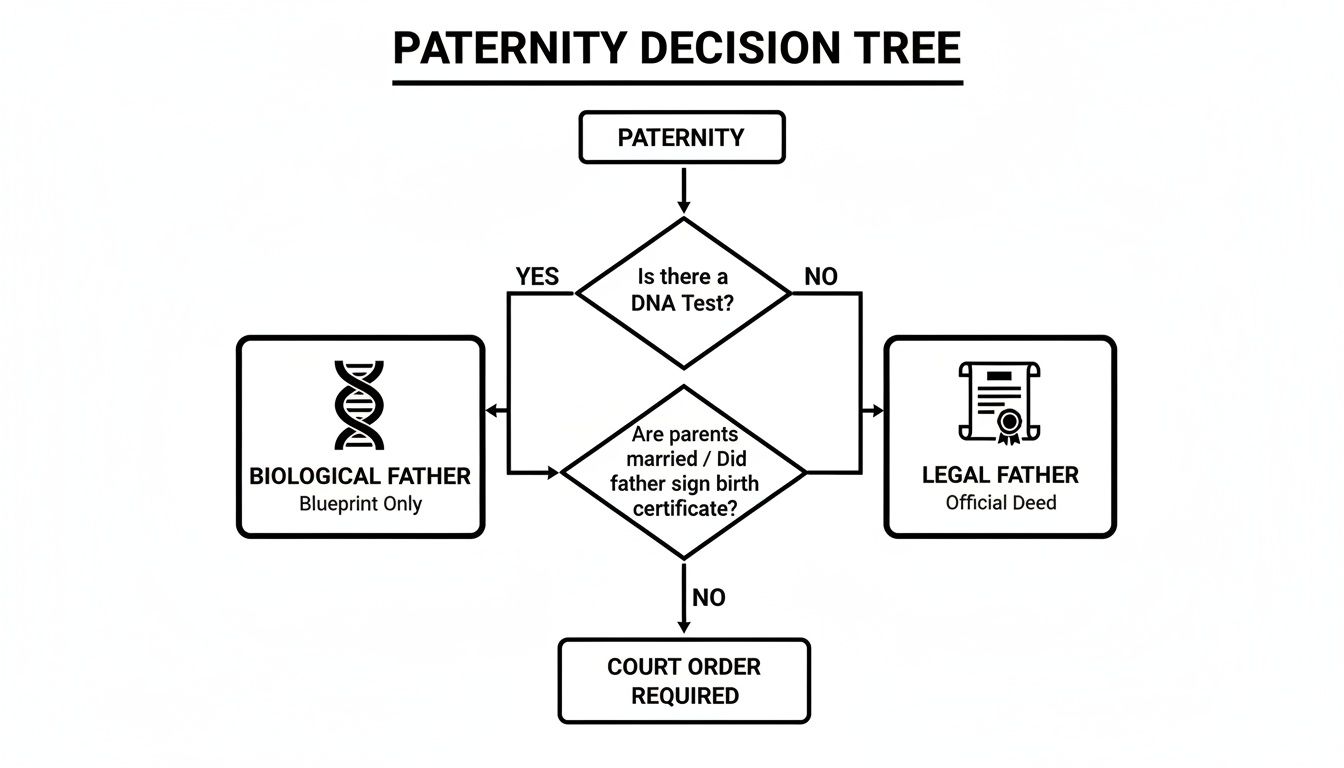
It’s incredibly important to understand the difference between a biological father—the man who shares a genetic link with a child—and a legal father, the man a Texas court recognizes as having parental rights and responsibilities. Think of it this way: biology provides the raw materials, but the law gives you the official title. Only a legal father has the rights and duties of parenthood under the law.
This distinction is everything because the court system runs on legal proof, not just DNA. Establishing paternity is what makes both parents legally accountable and ensures the child can receive the full spectrum of support, including:
- The right to receive financial support from both parents.
- The ability to have a court-ordered visitation schedule (possession and access).
- Access to the father's family medical history, which can be critical.
- The legal right to inherit from the father.
- Eligibility for the father's health insurance, Social Security, or veteran's benefits.
The table below makes the differences crystal clear. The gap between being a biological father and a legal father is massive, impacting everything from your right to see your child to their financial security.
Legal Father vs Unestablished Biological Father in Texas
| Legal Status | Legal Father (Paternity Established) | Unestablished Biological Father |
|---|---|---|
| Custody & Visitation | Has the legal right to sue for custody (conservatorship) and visitation (possession and access). | Has no legal right to custody or court-ordered visitation. |
| Child Support | Has a legal obligation to pay child support as ordered by a court. | Has no legal obligation to pay support until paternity is established. |
| Decision-Making | Can be granted the right to make decisions about the child's education and healthcare. | Has no legal say in major decisions concerning the child. |
| Inheritance | Child has a clear legal right to inherit from the father. | Child has no automatic inheritance rights. |
| Benefits | Child is eligible for father's health insurance, Social Security, or other benefits. | Child is not eligible to receive these benefits through the father. |
Until paternity is legally established, a biological father is, in many ways, a stranger to the child in the eyes of the law. He has no enforceable rights and no court-ordered responsibilities. This is why taking the formal step to establish paternity is so fundamental for everyone involved.
How Texas Determines Paternity
When it comes to fatherhood, it’s natural to think that biology is the end of the story. But in the eyes of Texas law, being a biological father and a legal father are two completely different things. Getting a firm grip on this distinction is the first and most critical step in protecting your rights and your child's future.
We often explain it to clients this way: biological paternity is like having the blueprint to a house, while legal paternity is like holding the official deed. The blueprint (your DNA) proves you have a connection, but it's the deed (a court order or a signed Acknowledgment of Paternity) that gives you the legal authority to be a parent.
Why the Law Separates Biology from Legal Rights
It can be a shock for many fathers to learn that a DNA test alone doesn't automatically grant them parental rights. This legal process isn't designed to create a roadblock; it's there to build a solid foundation of clarity and stability for the mother, the father, and—most importantly—the child.
The court requires a formal legal process to make sure everyone's rights and responsibilities are crystal clear and, crucially, enforceable. Without that legal step, a father has no guaranteed right to possession and access (visitation), and a mother has no way to legally request child support. It protects a child from being stuck in a difficult "he said, she said" situation over who their father is.
While understanding factors like a man's average sperm count can be relevant to the biological side of the equation, Texas courts shift the focus entirely from biology to legal documentation.
Under the Texas Family Code, only a legal father has enforceable rights to conservatorship (custody) and possession and access (visitation), along with the duty to pay child support.
This legal framework is designed to ensure that a father's role isn't left to chance or goodwill. It's about making sure your relationship with your child is formally recognized and protected by the court system.
The Consequences of Being Only a Biological Father
Without establishing legal paternity, a man's relationship with his child exists in a legal gray area, which leaves both parent and child in a vulnerable position. As an unestablished biological father, you have:
- No Right to Custody: You can't go to court and ask for time with your child. You also have no say in major decisions about their life, like where they go to school or the medical care they receive.
- No Enforceable Visitation: Any time you get to spend with your child is completely at the mother's discretion. If she changes her mind, you have no legal power to see your child.
- No Obligation for Support (and No Rights): While not having to pay child support might seem like a benefit, it's a double-edged sword. A mother can't get a court to order you to pay, but you also get none of the parental rights that come with that responsibility.
This is exactly why the process of establishing paternity is so vital. It’s what moves you from being a biological possibility to a legal reality, unlocking the door to a meaningful, court-protected relationship with your child. The law isn't meant to be a barrier; it's the bridge that formally and permanently connects you to your child's life.
How to Legally Establish Paternity in Texas
Knowing you're a father is one thing, but having the law recognize you as one is something else entirely. In Texas, turning that biological fact into a legal reality is a crucial step. It’s the foundation for everything that comes next—from your rights to see your child to your responsibilities for their financial support.
Think of it this way: without legal paternity, you’re standing on the sidelines. You can’t ask a judge for custody or visitation, and a mother can’t get a court to order child support. Making paternity official is the key that unlocks the door to your rights and responsibilities as a parent.
Let's walk through the three main paths to establishing legal paternity in Texas.
The Presumption of Paternity for Married Couples
For married couples, Texas law keeps it simple. There's a powerful legal assumption called the Presumption of Paternity: if a man is married to a woman when their child is born, he is automatically presumed to be the child’s legal father.
This shortcut, laid out in the Texas Family Code, saves most married couples from any extra paperwork. The law automatically recognizes the husband as the father if:
- The child is born while the couple is married.
- The child is born within 300 days after the marriage ends, whether by divorce, death, or annulment.
For most families, this means paternity is a settled legal fact from the moment their child arrives. However, this presumption isn't set in stone. It can be challenged in court if there’s a good reason to believe the husband isn't the biological father.
Signing a Voluntary Acknowledgment of Paternity
For unmarried parents, the most direct path to establishing paternity is by signing a Voluntary Acknowledgment of Paternity (AOP). This is a simple but legally powerful document where both the mother and the man she believes is the father agree and swear that he is, in fact, the biological father.
Hospitals often present this form to parents right after the child is born, but it can be completed at any time. Once it's signed by both parents and filed with the Texas Vital Statistics Unit, it carries the same legal weight as a court order. We break down the details of this form in our guide to the Acknowledgment of Paternity.
Crucial Warning: Signing an AOP is a huge legal commitment. You have a very short window—only 60 days from the filing date—to change your mind and rescind it. After that, overturning it is incredibly difficult and requires a lawsuit to prove fraud, duress, or a major factual mistake. If you have any doubt about paternity, do not sign this form.
Filing a Lawsuit to Adjudicate Parentage
What happens when parents don’t agree on who the father is, or if there are serious doubts? The final option is to let the courts decide by filing a Suit to Adjudicate Parentage. This type of lawsuit asks a judge to issue a definitive order declaring the child's legal father.
The mother, the man believed to be the father, the child (through a representative), or a state agency like the Attorney General’s Office can file this suit. The most critical part of this process is that a judge can order genetic (DNA) testing to get a conclusive answer.
Once a court-ordered DNA test proves a biological link, the judge will sign an order that legally establishes paternity. This order creates a permanent legal relationship between the father and child, with all the rights and duties that come with it.
This process isn't just a Texas issue; it's a nationwide priority. In fiscal year 2022 alone, national programs helped establish paternity for over 1.15 million children, highlighting just how fundamental this step is for families everywhere. For mothers, it's the gateway to securing financial support. For fathers, it's the essential first step to asserting their rights to visitation and being a part of their child's life.
The Rights and Responsibilities Paternity Creates

Once paternity is established, it’s not just a piece of paper. It’s a fundamental shift in your relationship with your child in the eyes of the law. Think of it as the moment a biological connection becomes a permanent, court-recognized legal bond.
For fathers, this is a game-changer. You’re no longer on the outside looking in; you gain the legal standing to be an active, decision-making parent. For mothers, it creates a clear path to seek financial stability for your child. But most importantly, for the child, it unlocks the emotional, financial, and personal benefits that come from having two legally recognized parents in their corner.
The Father’s Rights and Duties After Paternity
When a Texas court issues an order establishing paternity, it almost always creates what’s called a Suit Affecting the Parent-Child Relationship (SAPCR). This is the official court case where a judge will spell out the specific rights and responsibilities for both parents.
This order typically covers three core areas:
- Conservatorship (Custody): This is the legal term Texas uses for custody. It defines each parent's right to make crucial decisions for the child, like those involving their education and healthcare. In Texas, it is common for parents to be named Joint Managing Conservators, which means they share the rights and duties of raising their child.
- Possession and Access (Visitation): This is the court-ordered schedule that lays out exactly when the child will spend time with each parent. This is often a Standard Possession Schedule, which provides a predictable calendar for weekends, holidays, and summer visits.
- Child Support: This covers the financial duties to support the child, which includes monthly payments and the responsibility to provide health insurance.
These orders aren't just friendly suggestions—they are legally binding directives from a judge that both you and the other parent must follow. Getting a handle on your parental rights in Texas is the first step in building a solid co-parenting future.
Understanding Custody and Visitation in Plain English
In Texas, the starting point for most courts is the belief that it’s in the child’s best interests for parents to be named Joint Managing Conservators. This doesn't always mean a 50/50 split of time, but it does mean both parents are expected to share in the rights and duties of raising their child. Decision-making is often shared, though one parent is usually given the exclusive right to decide where the child lives.
The visitation schedule itself is detailed in a Possession Order. While parents are free to create a custom schedule that works for them, Texas has a default plan called the Standard Possession Order (SPO). This is what courts fall back on because it’s presumed to be in the child's best interest, providing a predictable calendar so everyone knows what to expect.
The global trend toward recognizing and encouraging paternal involvement underscores the importance of legally establishing paternity. Securing rights like custody and visitation allows fathers to be present and active caregivers—a factor heavily weighed by Texas courts under the "best interests of the child" standard.
This movement is reflected worldwide. In fact, by 2022, 122 countries began offering some form of paid paternity leave for new fathers. As you can discover more about this global shift in fatherhood, it becomes clear that legal systems are increasingly built to support a father's active role.
The Benefits for the Child Are Immeasurable
Frankly, establishing paternity is one of the most powerful gifts you can give your child. It goes far beyond the emotional security of knowing who both their parents are; it provides tangible, life-altering benefits that can shape their entire future.
A child with legally established paternity gains access to:
- Financial Security: The right to receive consistent financial support from both parents through a court order for child support.
- Vital Health Information: Access to the father’s complete family medical history, which can be critical for diagnosing and treating health conditions down the road.
- Government and Insurance Benefits: Eligibility for the father's health insurance coverage, Social Security survivor benefits, and veteran's benefits if applicable.
- Inheritance Rights: The legal right to inherit from their father, ensuring they are not unintentionally left out of his estate.
At the end of the day, establishing paternity gives a child a solid sense of identity and belonging. It cements their connection to both sides of their family tree and gives them the full advantage of having the love, support, and resources of two parents.
Navigating Paternity Disputes and DNA Testing
When there’s a question about who a child’s father is, the emotional toll on everyone can be immense. Doubt, confusion, and a sense of betrayal can make it feel impossible to know what to do next. But you’re not stuck. Texas law provides a clear path to replace that uncertainty with legal and scientific truth.
So, what happens when a mother needs to legally establish who the father is, or when a man has serious doubts about his biological link to a child? This is where a Suit to Adjudicate Parentage comes into play. It's a formal lawsuit with a single, crucial purpose: to get a judge to legally declare who the child's father is.
Who Can File a Paternity Lawsuit
This isn’t a legal tool reserved for just one person. Several people with a direct stake in knowing the truth can start the process. In Texas, a Suit to Adjudicate Parentage can be filed by:
- The child's mother
- A man who believes he is the father
- A man who is legally presumed to be the father (often through marriage) but has his doubts
- The child, typically through a legal representative
- A government agency, like the Texas Attorney General's Office, usually to establish child support
In every one of these cases, the court's guiding principle is the best interest of the child. Securing a legal father is a cornerstone of that principle.
The Central Role of DNA Testing
When paternity is in dispute, genetic testing is the most powerful tool we have to get a definitive answer. A judge has the full authority to order the mother, child, and the man in question to submit to a DNA test. The science is incredibly precise, typically showing a probability of paternity at 99% or higher or ruling the man out completely.
This isn’t a polite request—it’s a court order. Refusing to participate can bring serious consequences, including the judge simply ruling against you by default. We've seen it happen. You can learn more by reading our guide on what happens after a court-ordered paternity test.
For men who doubt their paternity and mothers who need to prove it, legal clarity is the only way to secure peace of mind. A definitive answer allows everyone to move forward, securing the child’s future and establishing fair legal rights and responsibilities.
The Risks of Ignoring Uncertainty
Letting doubts about paternity fester can lead to devastating emotional and financial fallout years down the road. Paternity fraud, where a man is incorrectly named as the father, is a very real and serious problem. The numbers don't lie. For instance, a 2023 study of court-mandated DNA tests found a non-paternity rate of 12%, with unmarried men in their 20s and 30s facing even higher risks. You can read the full research about these findings on paternity fraud to see why taking legal action is often the only safe move.
For a man, living with this uncertainty could mean paying child support for 18 years for a child who isn't biologically his. For a mother and her child, it means the actual father isn't providing the emotional or financial support the child rightfully deserves. Facing the truth, no matter how difficult, is always better than the alternative. A paternity suit delivers the final, legally binding answer that protects everyone involved.
Key Takeaways and Your Next Steps
You've absorbed a lot of information about what paternity means in Texas. Now comes the most important part: turning that knowledge into a concrete plan to protect your family and your child's future.
It can feel like you're staring at a complicated legal map, but the path forward starts with one fundamental truth: legal paternity is the absolute bedrock for a father's rights in Texas. Without it, a biological connection has no legal weight. Whether you establish it voluntarily with an Acknowledgment of Paternity (AOP) or through a court order, this is the step that unlocks the door to custody, visitation, and child support.
What's Your Next Move?
Your next step depends entirely on where you stand right now. Every family’s situation is different, and the right path for one person could be a misstep for another.
For Unmarried Fathers Who Are Certain of Paternity: If you and the mother are on the same page, signing an AOP is often the most direct route. It can be done right at the hospital after the child is born. But remember, that document carries the full force of law, so be absolutely sure before you sign.
For Mothers Needing to Secure Child Support: When a child's father isn't cooperating, your next step is to file a Suit to Adjudicate Parentage. This is the formal legal process to establish paternity, which then allows the court to issue a child support order.
For Men Who Question Whether They Are the Father: If you have even the slightest doubt, do not sign anything—especially not an AOP or a waiver of service. Your only safe option is to request a court-ordered DNA test through a paternity lawsuit to get a definitive answer once and for all.
Here’s a piece of advice we give every client: Never sign a legal document or agree to a court order unless you completely understand its lifelong consequences. The decisions you make in a paternity case will echo for decades, shaping your rights, your finances, and your relationship with your child.
Getting legal advice tailored to your specific situation isn't a luxury—it's a necessity. An experienced family law attorney can look at the facts of your case, explain your options in plain English, and help you forge the best path forward for both you and your child.
Frequently Asked Questions About Texas Paternity
When you're dealing with questions about paternity, it's easy to feel overwhelmed. The legal process can seem confusing, and the stakes couldn't be higher for you and your child. To give you some immediate, practical answers, we've put together a few of the most common questions our attorneys hear every day from parents in your exact situation.
Can I Be Forced to Take a DNA Test in Texas?
Yes, absolutely. If someone files a Suit to Adjudicate Parentage with the court, a judge has the full authority to order you, the mother, and the child to participate in genetic (DNA) testing. When fatherhood is uncertain, this is the court's go-to method for getting a clear, scientific answer.
Trying to ignore a court-ordered DNA test is a serious mistake. A judge could hold you in contempt of court, but what's more likely is that they'll issue a default judgment. That could mean you're named the legal father by default, even without a shred of scientific proof.
I Signed an AOP and Now Have Doubts. What Can I Do?
In this situation, the clock is ticking. After you sign a voluntary Acknowledgment of Paternity (AOP), Texas law gives you a very brief 60-day window to change your mind. To do so, you must file a specific rescission form with the Texas Vital Statistics Unit.
Once those 60 days are up, backing out of an AOP becomes incredibly difficult and expensive. You'd have to file a formal lawsuit and prove to a judge that you only signed it under fraud, duress (meaning you were threatened or forced), or because of a major, material mistake of fact. This is a tough legal battle, which is why we always tell clients to be 100% sure before putting pen to paper.
Does Establishing Paternity Automatically Grant Me 50/50 Custody?
No, it’s a common misconception. Establishing yourself as the legal father is the crucial first step—it's what gives you the right to walk into a courtroom and ask for custody and visitation. Think of it as your ticket to the main event, but it doesn't decide the outcome.
The final custody arrangement will always come down to what a judge believes is in the "best interest of the child." While Texas law starts with a presumption that naming parents as Joint Managing Conservators is best, the actual time you get with your child—whether it’s a 50/50 split or a Standard Possession Order—is decided based on a whole host of factors unique to your family.
Is There a Deadline to Establish Paternity in Texas?
For most parenting matters—like setting up custody, visitation, and child support—a paternity suit can be filed at any point before the child turns 18. But you should never wait. The longer you delay, the more you risk complicating your case, losing precious time with your child, and losing out on financial support.
There are some very specific exceptions, like trying to establish paternity to claim inheritance rights, where a suit might be filed after the child is an adult. But for all practical purposes of raising your child, the clock starts running from the day they are born.
If you need help with a child custody or visitation case in Texas, our experienced attorneys can guide you every step of the way. Contact The Law Office of Bryan Fagan, PLLC today for a free consultation.