
When your child's future is on the line, understanding your rights matters most.
Maybe your child has started spending far more nights at your home. Maybe the other parent's work schedule changed, or your son or daughter isn't following the old routine anymore. If you're still paying the same child support under an order that no longer matches daily life, it's normal to ask whether that amount should change too.
That question carries both money stress and emotional weight. Parents often feel torn between doing what's fair, staying financially afloat, and avoiding another court fight. Mothers, fathers, grandparents, and other caregivers all run into this same problem after a family's routine changes.
The short answer is yes, custody changes can reduce child support in Texas, but not automatically. Texas courts treat custody and child support as connected, yet separate, legal issues. A change in where the child is living or how often the child stays with you does not instantly change the amount due under your current order. Until a judge signs a new order, the old one still controls.
That's where many parents get tripped up. They assume a practical change at home is enough. It usually isn't.
Introduction When Your Life Changes Should Your Child Support
In Texas family law, the word custody usually shows up as conservatorship. That term refers to the legal rights and duties parents have regarding their child. Possession and access is the schedule. In plain English, that means when the child stays with each parent and how visits work.
A possession schedule is the calendar for parenting time. It may be a standard schedule, an expanded schedule, or a custom arrangement. The parent ordered to pay support is often called the obligor. The parent receiving support is often called the obligee.
Those labels matter because child support usually follows the structure of the court order, not the informal reality between parents.
Practical rule: If your child is living with you more often, that may matter legally. But it only changes support after the court changes the order.
Texas courts also make custody decisions based on the best interests of the child. That means the judge looks at what arrangement supports the child's stability, care, safety, schooling, and emotional needs. The court isn't focused on rewarding one parent or punishing the other.
That matters for both moms and dads. A father seeking more parenting time and a mother asking the court to reflect a new day-to-day routine both have to show the judge why the requested change helps the child, not just the parent's budget. The same idea can apply when a grandparent or caregiver has become heavily involved in the child's daily care.
Understanding Conservatorship and Child Support in Texas
Texas family law uses words that sound technical, but the ideas are more familiar than they first appear. One part of the order deals with who can make major decisions for the child. Another part deals with where the child stays on school nights, weekends, holidays, and summers. Child support connects to those written roles, but it does not automatically rise or fall every time the parenting schedule changes in real life.
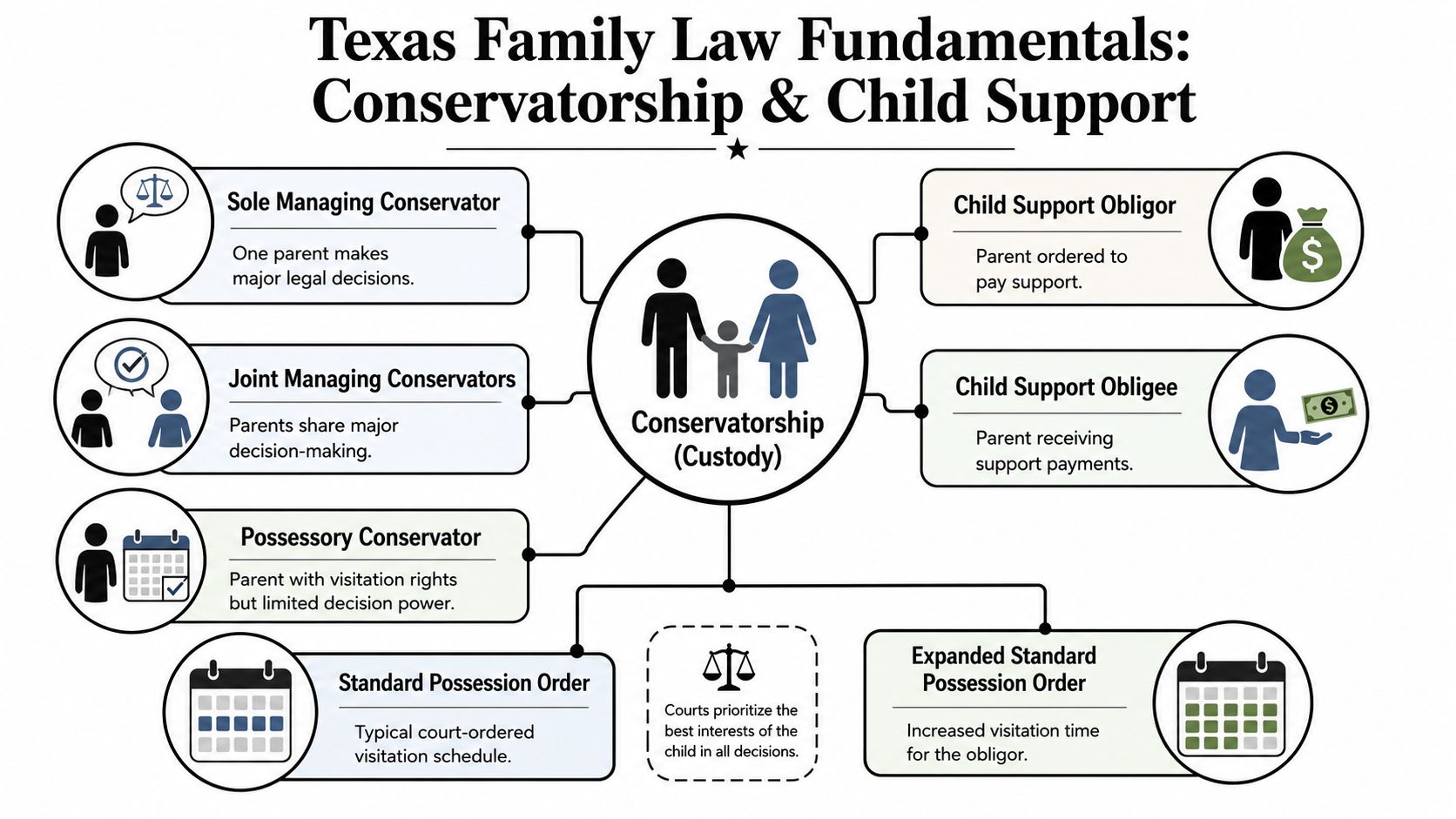
The key custody terms parents need to know
A good way to read a Texas order is to separate it into two buckets. The first bucket is decision-making. The second is parenting time.
Here are the terms that usually matter most:
- Joint managing conservatorship means the parents share some or all major rights and duties concerning the child.
- Sole managing conservatorship means one parent has a larger share of those major rights and duties.
- Possession and access means the parenting-time schedule.
- Primary residence refers to the parent who has the exclusive right to decide where the child mainly lives.
- Possessory conservator usually means a parent who has possession time but does not hold the same level of authority as the parent with the exclusive right to determine the child's primary residence.
That distinction causes a lot of confusion. A parent may hear “joint managing conservators” and assume support should be split evenly or disappear. Texas law does not work that way. Parents can share decision-making and still have one parent ordered to pay support.
How support and custody connect
Child support usually follows the written court order, not the day-to-day compromise parents may be trying at home. That is why sequence matters.
If you now have the child far more often than your order says, you may feel that your support should already be lower. Many parents are surprised to learn the law treats those as two separate questions. One question is whether the possession or conservatorship terms should change. The other is whether support should change. Sometimes those requests should be filed together. Sometimes the custody issue needs to be established first.
A useful comparison is a map and the road itself. Your family's actual routine is the road you are driving every day. The court order is the map the judge and the enforcement system still use. If the road changed but the map did not, the legal system still follows the map until a new order is signed.
Why more parenting time does not automatically mean less support
More overnights can matter, but overnights alone do not decide the outcome. Judges look at the full structure of the order, including who has the right to designate the child's primary residence, who is named as the obligor, and whether the new arrangement is stable enough to support a legal change.
That is why two parents can move to a more balanced schedule and still keep the same support order for a time. It is also why a parent should be careful about cutting payments based on an informal agreement. Even if the other parent agreed, unpaid support can still build up under the existing order.
The practical question is often not merely, “Has custody changed?” It is, “Has the kind of change happened that the court will recognize, and have I asked the court in the right order?”
What counts as a meaningful change
Courts usually focus on changes that are real, lasting, and tied to the child's care or the parent's ability to support the child.
Examples may include:
- the child now lives with the other parent much more than the current order provides
- one parent's income has changed in a serious way
- the child's needs have changed, such as schooling, medical care, or daily supervision
- the parent who was not handling most day-to-day care is now doing much more of it on a consistent basis
Timing matters here too. The court is usually looking for a change that happened after the current order was signed. If a parent asks for a reduction, the judge will want to know what is different now, why that difference is significant, and whether the written orders need to be updated to match the child's actual life.
The Legal Standard for Changing a Child Support Order
Texas doesn't lower child support just because parents start doing something different informally. The law requires a legal basis to modify the order.
Why the old order still controls
A custody change alone isn't enough to reduce support. The original order stays enforceable until the court signs a modification. Gray Becker's discussion of Texas modification rules explains that a custody or child-support change must fit one of the legal modification paths, including a material and substantial change or the separate review rule tied to the age of the existing order and a qualifying guideline difference.
That same discussion also notes an important possession-related point. If the person with primary custody has allowed someone else to have the child's primary care and possession for at least 6 months, that can support a custody modification, except in the active-duty military deployment situation described there.
For parents, that means this issue is often about sequence. If the child has been living mostly with you, you may need to address the custody order first or at the same time as support, rather than paying less on your own.
The judge looks at signed orders, not side agreements and not assumptions.
The two legal paths parents usually discuss
Most parents asking for a support change are looking at one of these routes:
| Legal path | What it means in plain English |
|---|---|
| Material and substantial change | Something important has changed since the last order |
| Review based on the age of the order | The existing order is old enough and the new guideline amount is different enough to qualify |
Many mothers and fathers find this frustrating. They may be doing more of the daily parenting already. They may be paying for food, school costs, and transportation more often than before. Still, unless the legal standard is met and the court signs off, the support amount generally doesn't move.
That's why strategy matters as much as the underlying facts.
How Increased Possession Time Can Lower Child Support
More time with your child can affect support, but the court has to translate that new reality into a new order. That's the missing step in many cases.
Why more parenting time doesn't automatically mean less support
Texas law sets a specific threshold for support modification. The Texas Attorney's discussion of Texas Family Code Section 156.401 explains that a child support modification can succeed only if the new order would differ from the current one by at least 20% or $100 per month. That same discussion notes that increased possession time may lower the guideline calculation in theory, but the change often isn't large enough by itself unless income has also changed.
So if you're asking whether can custody changes reduce child support in Texas, the answer is often, “Yes, but only if the legal and financial math both line up.”
A parent can move from a standard possession schedule to much more time with the child and still find that the support amount does not change enough to meet the legal threshold. That surprises a lot of people.
The practical sequence that often works best
If your child is living with you more, this is usually the smarter order of operations:
Document the actual schedule
Keep calendars, school records, messages, transportation logs, and anything else showing where the child has really been living.Compare the current order to reality
If the written order says one thing and daily life says another, you need to know exactly how far apart they are.Evaluate whether to seek a custody modification, support modification, or both
In some families, the possession issue comes first. In others, support and custody need to be addressed together.Decide whether the case is agreed or contested
If both parents agree, the process can be simpler. If they don't, the matter usually goes to court.
A parenting-time tool can help you organize your schedule evidence. For example, a Texas parenting time calculator can help parents estimate and track time with the child in a structured way.
Where the Office of the Attorney General fits in
Some parents assume the Office of the Attorney General can solve every support problem. It can help in some cases, especially when support is the issue and both sides are willing to cooperate. But a serious dispute about where the child primarily lives may still require district court involvement.
That's why parents shouldn't ask only, “Can I get support lowered?” They should also ask, “What should I file first, and what proof will the court expect?”
The Process to Formally Modify Your Court Orders
The legal process feels less intimidating when you break it into parts. Most parents are dealing with one of two tracks. An agreed modification or a contested one.

The basic modification path
Parents usually move through these steps:
- File a petition asking the court to modify the parent-child relationship, child support, or both
- Serve the other parent so the case is legally before the court
- Exchange information about schedules, finances, and the child's needs
- Try to reach agreement through negotiation or mediation
- Get a signed order from the judge
No signed order means no legal change.
Agreed cases and contested cases
An agreed modification happens when both parents accept the new arrangement. That might happen because the child has already been living under a different schedule and both parents want the paperwork to catch up to reality.
A contested modification happens when one parent disagrees about the facts, the support amount, or both. In that situation, the court may need evidence about the child's routine, the parents' incomes, and why the requested change serves the child's best interests.
Key point: A fair arrangement between parents is helpful. A signed court order is what makes it enforceable.
The OAG review process and district court
Texas Access guidance on support modification options explains that either parent can seek modification, and the Office of the Attorney General can review an active case. It also explains that the child-support office can help only when the parties agree. If they do not, the matter goes to district court. That same guidance notes the separate review rule tied to the age of the order and a qualifying difference in the new guideline amount, and it notes that incarceration for at least 180 days has been recognized as a material and substantial change since September 2021.
That's useful because it helps parents choose the right lane. If your disagreement is mainly about numbers and both of you agree on the facts, an administrative path may help. If you disagree about where the child really lives, who should have primary rights, or what schedule serves the child best, court is usually the place where the dispute gets resolved.
For a fuller overview of the legal filing process, parents often start with a guide on how to modify child support in Texas.
How Texas Recalculates Child Support
A recalculation starts with two questions. Who is the obligor under the current facts, and what are that parent's current net resources?
Once the court answers those questions, it applies the Texas guideline formula to the updated numbers. The formula often looks simple on paper, but parents get tripped up because they expect more parenting time to automatically produce a lower payment. Courts do not work from that shortcut. They work from the signed order, the parents' present incomes, and the legal role each parent holds under the updated arrangement.
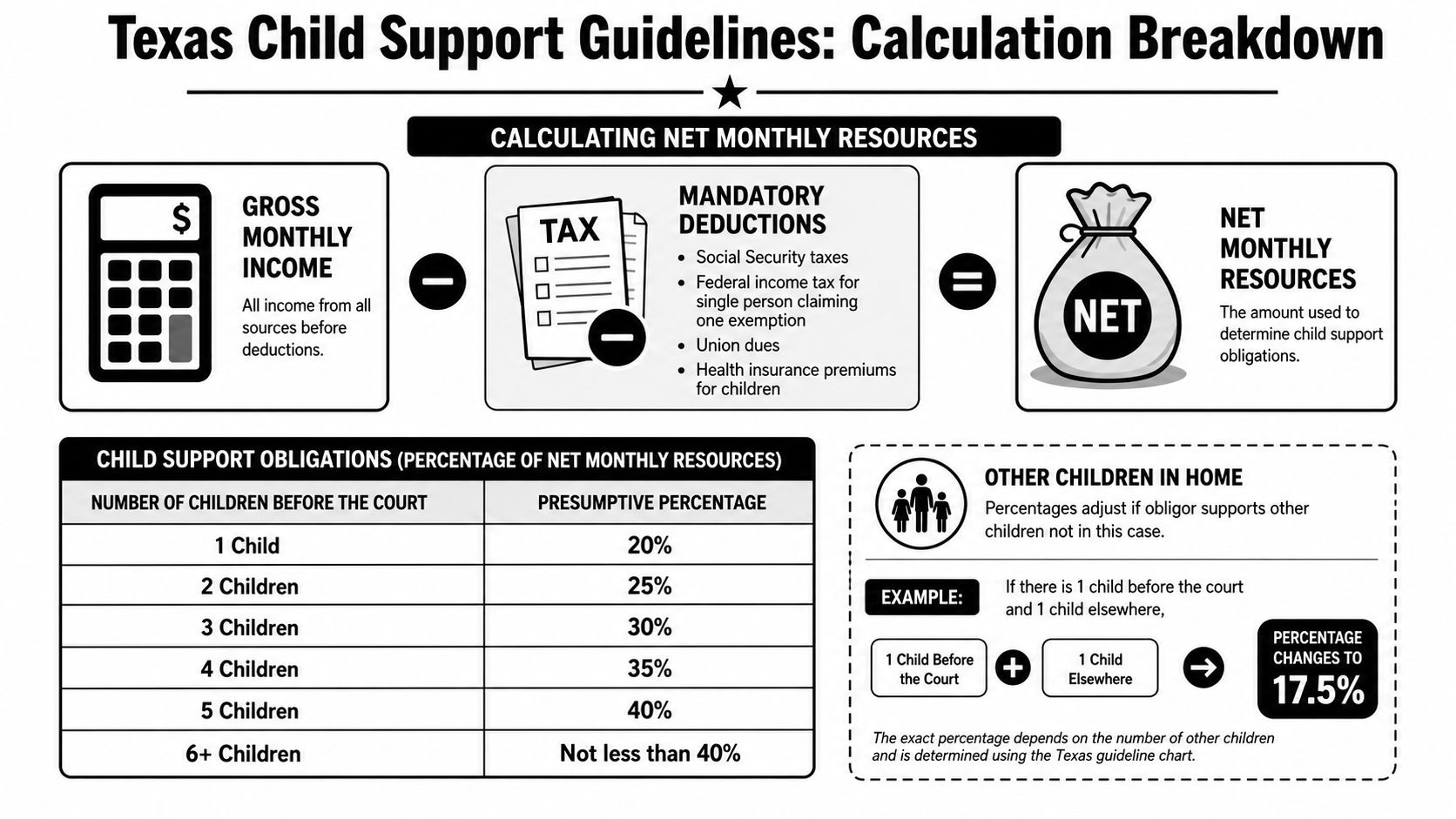
To help visualize the framework, this graphic gives a simple overview.
The guideline percentages
Texas guideline support is commonly calculated as a percentage of the obligor's net resources. For many families, that means 20% for one child, 25% for two children, and 30% for three children, subject to the details of the case and the income figures the court accepts. As noted earlier, a modification may also be available when the existing order is more than three years old and the new guideline amount would differ enough to meet the legal threshold.
Those numbers are the starting point, not the whole answer.
The court may also look at health insurance, who is paying certain child-related costs, whether another child support case affects the calculation, and whether the facts justify following the guideline amount or departing from it. A parent who wants a clearer picture of the worksheet can review this guide on how to calculate child support.
A simple example without risky assumptions
Suppose a father used to have a standard possession schedule and paid support under that arrangement. Over time, the child begins staying with him much more often. If the written court orders are later changed to reflect that new reality, the court may recalculate support because the original setup no longer matches the family's actual structure.
Now compare that with a different parent who gains additional weekends, more summer time, and extra overnights, but does not become the parent with the primary right that matters in the support analysis. That parent may feel, reasonably, that the increased time should lower support. Sometimes it does. Sometimes the math changes only a little, and sometimes the legal roles in the order still point to the same obligor. More time with your child matters. It just does not translate into an automatic dollar reduction.
That is why timing matters. If the primary issue is that the child now lives primarily with you, the custody piece may need to be addressed before the support numbers will accurately reflect your situation.
This short video may help you think through the general concept before you gather your documents.
Why caution matters
Parents often try to solve this privately. The child is spending more nights with one parent, expenses have shifted, and reducing the payment can feel fair.
The legal risk is that fairness and enforceability are not the same thing. Until a judge signs a new order, the old amount usually remains due. If you keep paying the prior amount, the strain may continue. If you pay less on your own, arrears can build even when your reason feels completely understandable. In practice, the safest strategy is to match the legal process to the change in your family, then ask the court to recalculate support from updated facts rather than assumptions.
Common Mistakes to Avoid When Seeking a Reduction
A parent often reaches this stage after months of doing more. More overnights, more grocery runs, more school pickups, more of the daily load. It can seem obvious that support should drop to match real life. In Texas, though, obvious and enforceable are not the same thing. The mistake is usually not the goal. It is the sequence.
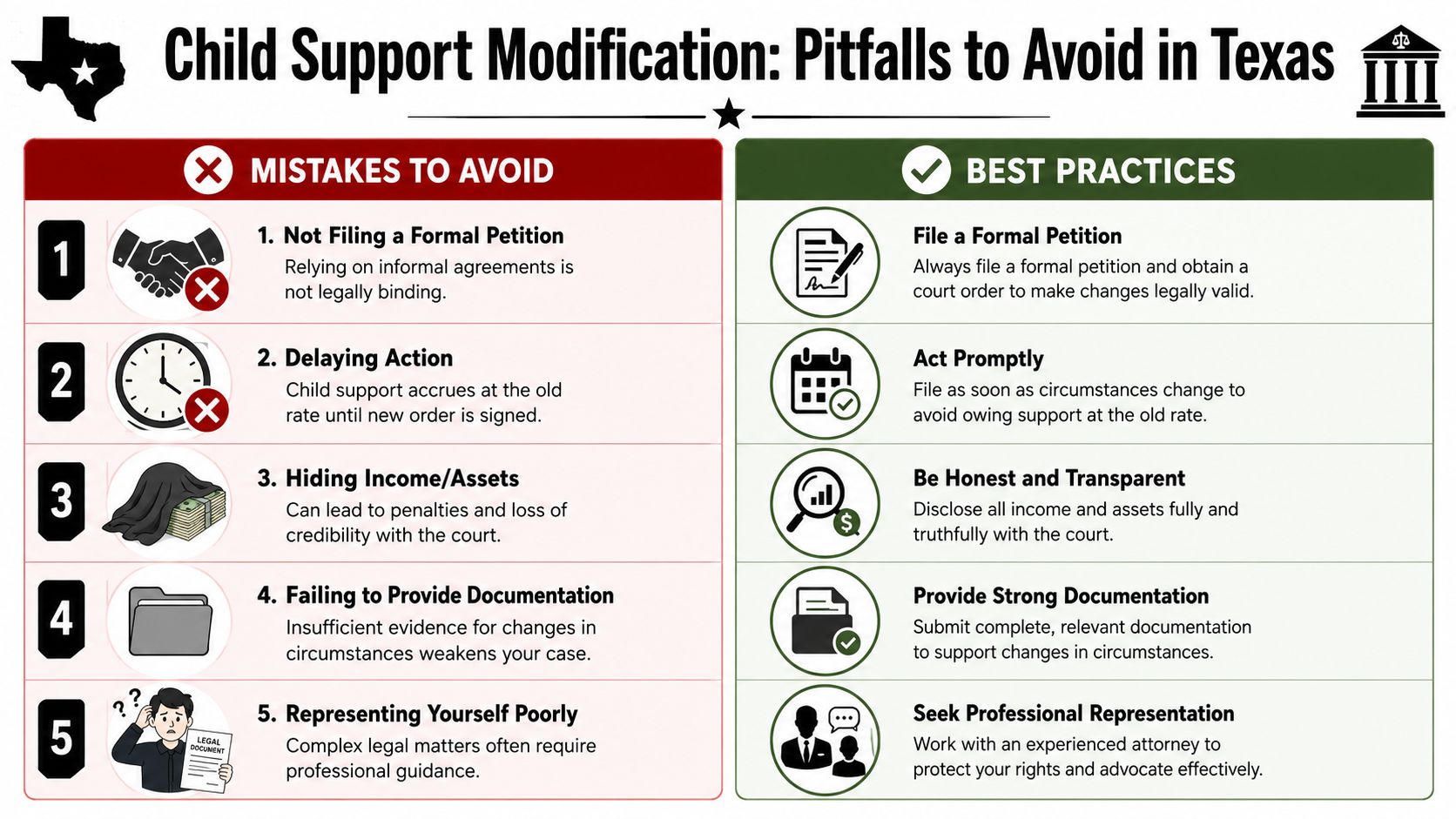
The errors that cost parents the most
A child support case works a lot like a map. If your family has been taking a different road for months, but the court order still shows the old route, the judge will usually follow the map that is on file until you update it. That is why these mistakes cause so many problems:
Relying on a verbal agreement
If the other parent says, “Just pay less for now,” that may feel cooperative, but it does not change the signed order. If conflict starts later, the unpaid amount can still be treated as owed.Filing the wrong issue first
This is one of the most expensive mistakes. If your real complaint is that the child now lives with you most of the time, a custody or possession change may need to come first, or be filed together with support. If you ask only for lower support without fixing the underlying custody terms, the court may still view the case through the old arrangement.Waiting too long to file
Parents often hope the new schedule will settle in or that the other parent will keep cooperating. During that delay, the current order keeps controlling. A later filing may help prospectively, but it usually does not erase what built up under the old order.Showing up without records
Judges need something firmer than memory, especially when parents disagree about how often the child spent time with each parent. Keep calendars, school attendance records, messages about exchanges, medical paperwork, insurance costs, and current income information.Assuming equal time ends support
Equal possession can affect support, but it does not automatically reduce it to zero. The court still looks at the order, the parties' roles, income, and the child's best interests.Treating support as the only issue
Money matters, especially when your budget is stretched thin. But if the child's primary home, school routine, or decision-making structure has changed, your case may be about more than support. Asking for the narrower fix can leave the larger problem in place.
Questions parents often ask
Some questions come up again and again because parents are trying to solve two problems at once. They want the order to reflect the child's real schedule, and they need the payment amount to make financial sense.
| Question | Short answer |
|---|---|
| If my child lives with me more, can I just reduce payments? | Usually no. You still need a court order. |
| Should I file custody first or support first? | It depends on what changed first and what the current order still says. If the living arrangement is the main mismatch, address that directly. |
| What if the other parent agrees privately? | Private agreement can help you resolve the case, but it should still be turned into a signed order. |
| Do judges care about the child's best interests in support cases? | Yes, especially when support and custody issues overlap. |
One practical way to think about it is this. Support is often the number parents feel first, but conservatorship and possession often explain why that number should change. If you reverse that order in your case strategy, you can end up arguing over math before the court has recognized the facts that drive the math.
Parents often feel pulled between staying civil and protecting themselves financially. A respectful, documented court modification usually does more to preserve peace than an informal deal that leaves room for later conflict.
Getting help early can change the outcome
Early legal advice helps parents choose the right request, in the right order, with the right proof. That matters for any family, and it can matter even more for military parents, families dealing with relocation, or grandparents and caregivers whose daily role has grown far beyond what the current order reflects.
The Law Office of Bryan Fagan, PLLC handles Texas custody, visitation, and support matters, including modification cases tied to changed possession schedules. The value in getting help early is often simple. It can help you avoid filing a support case when the actual first step is custody, or missing a support issue that should be raised alongside the custody request.
Next Steps and Getting the Right Legal Help
If your child is spending more time with you, your support order may need another look. But the key issue isn't just whether the family routine changed. It's whether that change fits a valid legal path for modification and whether the court will formalize it.
For many Texas parents, the biggest misunderstanding is this one. A real-life custody change does not automatically create a legal child support reduction. The order has to be modified. If the problem is mostly about where the child is living, you may need to address conservatorship or possession first, or at the same time. If the issue is mostly financial, the support path may be more direct.
Mothers and fathers should both keep the same focus. Protect your relationship with your child, protect your financial stability, and protect yourself by using the legal process instead of side agreements. Grandparents and other caregivers should do the same when they've become part of the child's primary day-to-day care.
If you're unsure where to begin, start with your paperwork. Read your current order closely. Gather records showing the child's actual schedule. Collect financial documents. Then get advice about sequence, because filing the right request in the right order can make a major difference in how your case unfolds.
The law can feel heavy when you're already carrying stress at home. Still, you do have options, and you don't have to guess your way through them.
If you need help with a child custody or visitation case in Texas, our experienced attorneys can guide you every step of the way. Contact The Law Office of Bryan Fagan, PLLC today for a free consultation.