
Yes, changing custody can reduce child support in Texas, but it isn't automatic. A court order is required, and you must prove a material and substantial change in circumstances, such as a significant shift in who has physical possession of the child.
If you're caring for your child more often now, paying more for groceries, school needs, transportation, and daily life, it's normal to wonder why your old support order still controls. Many parents find themselves in exactly that spot. The parenting schedule changed in real life, but the paperwork never caught up.
That mismatch feels unfair because it often is. Texas courts understand that families change over time, but they still require a formal legal process before child support can change. If you're asking, can custody changes reduce child support in Texas, the short answer is yes. The key question is whether your increase in possession time is enough to support a modification, and how to present that change the right way.
Your Life Has Changed Why Hasnt Your Child Support Order
A common situation looks like this. Dad used to have weekends, but now the child stays with him most school nights because Mom's work schedule changed. Or Mom was once the visiting parent, but now the child has been living with her much more often because school, medical appointments, and daily care are easier from her home. Grandparents and other caregivers sometimes see the same issue when they've stepped into a larger day-to-day role.
The bills change fast. The court order doesn't.
That's one of the hardest parts of post-divorce or post-order life. Parents often assume that if the child is spending much more time with them, support should automatically go down. In Texas, it doesn't work that way. The court looks at legal orders, not handshake updates or text-message agreements.
Why this feels so frustrating
When your actual parenting time increases, your responsibilities usually increase with it. You may be handling school pickups, after-school care, meals, clothing, homework, doctor visits, and bedtime routines. In practical terms, you're functioning more like the primary day-to-day parent, even if the old order says something different.
For both mothers and fathers, this can create two separate problems at once:
- Higher daily expenses: You're paying more directly for the child's needs.
- An outdated order: The child support amount still reflects an older schedule.
- Growing tension with the other parent: One side feels overburdened, while the other may feel blamed or threatened.
- Uncertainty about rights: You know life changed, but you may not know what counts legally.
Custody and support are related, but not identical
Texas uses several family law terms that can sound intimidating at first. A joint managing conservatorship usually means both parents share major rights and duties involving the child. That doesn't always mean equal time. A possession schedule is the court-ordered calendar that says when each parent has the child. And the best interests of the child standard means the court focuses on the child's stability, safety, and overall well-being when making decisions.
A bigger parenting role can support a child support change, but only if the court recognizes the change and signs a new order.
That's the point many parents miss. Increased possession time can matter a great deal. It just has to be turned into a legal modification.
The Legal Standard A Material and Substantial Change
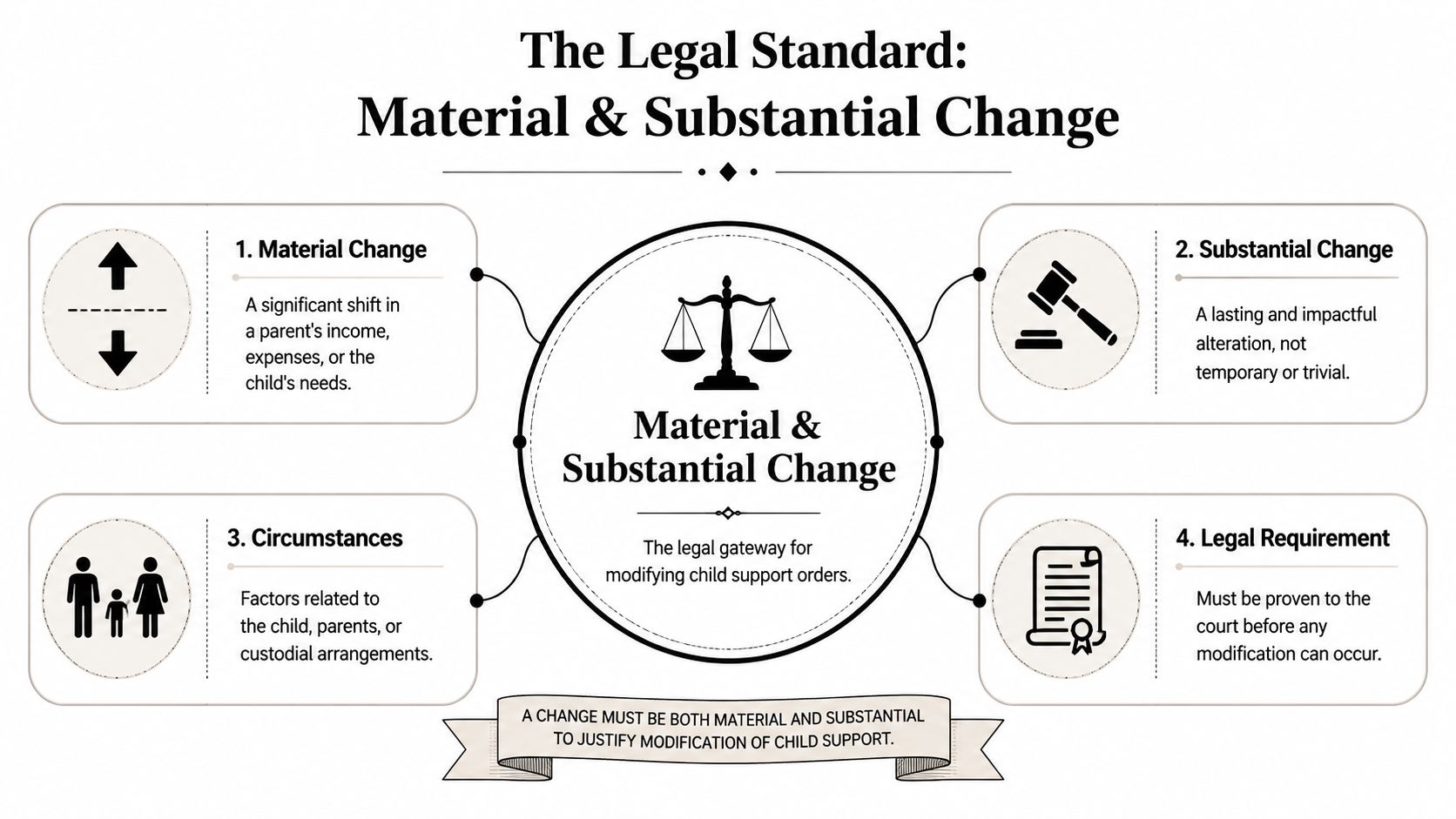
Texas family courts don't modify child support just because a parent feels the current amount is outdated. The court wants proof that something meaningful has changed since the last order. That legal threshold is called a material and substantial change.
In plain English, that means a real life change that matters enough for the court to revisit support. It's a gatekeeper. The law uses it to avoid constant relitigation over small or temporary shifts.
What counts as a material and substantial change
A custody-related change can qualify when the child's actual living arrangement has shifted in a serious way. Texas guidance specifically recognizes a change in the child's physical possession as a likely qualifying event, and common proof includes possession calendars, school records, and medical records showing where the child primarily resides, as explained by Texas Law Help's guidance on changing a child support order.
That matters because a lot of parents focus on labels. The court often focuses more on facts. Who gets the child ready for school most mornings? Where is the child sleeping most nights? Which home is listed in school or medical records? Those details can make the difference between a weak modification request and a strong one.
Why possession time matters so much
If your child is with you more, the support issue usually changes indirectly, not automatically. The law doesn't say, “more time equals lower support” in every case. Instead, the court asks whether the current facts justify recalculating support.
That's why increased possession is often the strongest part of a modification case. It gives the judge a concrete reason to look at the order again.
For example, a shift might matter when:
- The child now lives primarily with you: The day-to-day arrangement no longer matches the old order.
- School week possession changed: You now handle most weekday care, transportation, and routines.
- Medical or educational records reflect your address: Third-party records support your claim.
- The old schedule became unrealistic: Real life moved away from the written order and stayed that way.
Practical rule: The more your increased possession time looks stable, documented, and child-focused, the stronger your modification request usually becomes.
If you're also wondering how often Texas courts will revisit custody itself, this guide on how often custody can be modified in Texas gives useful background on the broader modification context.
Pathways to Modification When You Can Ask for a Change
Parents usually have one of two legal paths when they want support lowered after a custody shift. The right path depends on the age of the current order and how that order was created.
One route is based on changed circumstances. The other is based on time plus a measurable difference in the support amount. They aren't the same, and using the wrong one can slow your case down.
Path one based on a meaningful custody change
This is the route most parents use when possession has shifted. If your child is spending substantially more time with you than before, that may support a modification request because the facts of your family life have changed in a lasting way.
This path is often the better fit when:
- The child's living arrangement is different now
- You took on much more daily parenting
- The schedule changed after work, school, or family circumstances shifted
- The current order no longer reflects reality
This route is especially important if your existing support order came from a negotiated arrangement that didn't track the guideline amount.
Path two based on the three-year review
Texas also allows a separate review path in some cases. Under this benchmark, the current order must be at least three years old, and the guideline amount must differ from the current order by at least 20% or $100 per month, as explained in this Texas child support modification overview. The same source notes that this path doesn't apply if the original amount was a negotiated deviation from the guidelines.
Here's a simple side-by-side view:
| Path | What you generally show | When it helps most |
|---|---|---|
| Material and substantial change | A real, lasting change in circumstances, such as physical possession shifting | The child's actual living pattern changed |
| Three-year review | The order is old enough and the recalculated amount differs enough | The numbers now support a revision |
Which path fits your case
If you're reading this because your parenting time increased, the first path is often the most direct. The issue isn't just math. It's that your role in the child's life changed in a way the court should recognize.
Still, the second path can be useful when enough time has passed and the recalculation gap is clear. In practice, many parents need a lawyer to review the old order before deciding which argument is strongest.
A good strategy starts with the order already in place, not just the arrangement you think is fair now.
The New Math How Support is Recalculated
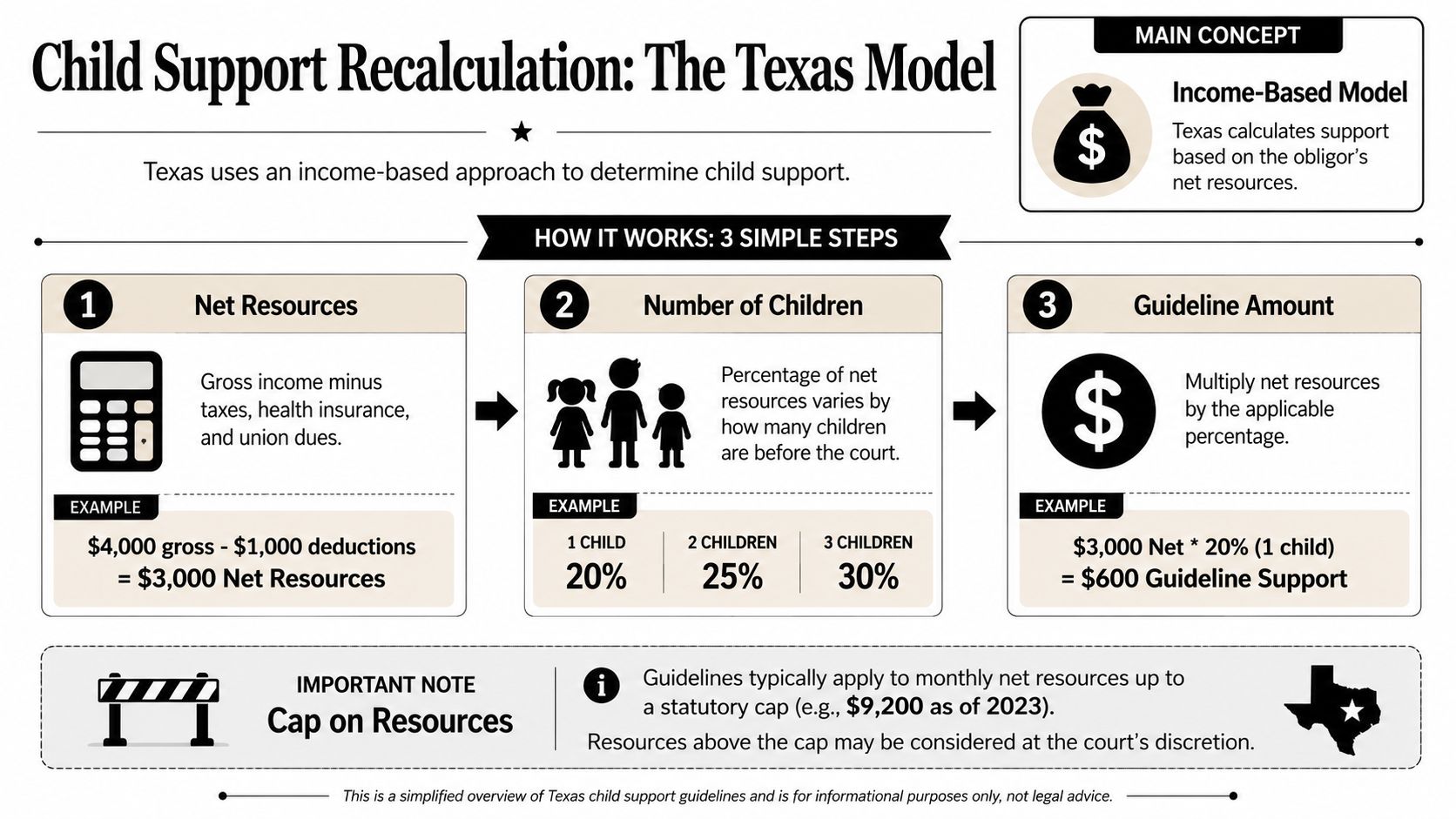
When parents ask whether custody changes reduce support, they're often really asking how Texas does the math once the facts change. The answer starts with the obligor, which is the parent ordered to pay support. Texas generally calculates support based on that parent's net income.
For guideline support, Texas typically uses 20% of the obligor's net income for one child, 25% for two children, 30% for three, 35% for four, and 40% for five or more, as described in this explanation of Texas child support modification and guideline percentages.
Why a custody change can alter the calculation
The key point is that support follows the legal and practical structure of care. If the child is now living primarily with the parent who used to pay support, the entire support picture may need to be reconsidered. In some cases, that parent may seek a reduction. In others, the roles may shift enough that support could be owed in the opposite direction.
That's why increased possession time matters. It can change who is carrying the larger daily financial burden.
A simple example without getting lost in formulas
Suppose a father had limited possession under the old order and paid child support based on that arrangement. Over time, the child starts living with him most of the week because of school stability and the mother's work hours. He's now paying for the child's regular day-to-day needs much more often than before.
The old support order may no longer fit those facts.
Or switch the example. A mother who once had less time now becomes the parent handling the child's school routine, doctor visits, and most overnights. If the child primarily resides with her in practice, the support analysis may change in a major way.
When courts recalculate support, they are looking at current facts, not old assumptions.
If you want a broader overview of the formula itself, this resource on how to calculate child support is a useful starting point.
What parents should focus on before doing the math
Before you get too attached to a number, focus on the facts that drive the recalculation:
- Who has the child most of the time: The actual possession pattern matters.
- Whether the change is lasting: Temporary swaps usually don't carry the same weight.
- Current income information: Support still depends on present financial facts.
- Whether the old order followed guidelines: That can affect the legal route you use.
A lot of frustration comes from doing support math before proving the custody change. The stronger approach is usually the opposite. First establish the new parenting reality. Then calculate support based on that reality.
Navigating the Legal Process Step by Step
A lot of parents get stuck at this stage for one reason. They know the child is spending more time in their home, but they are not sure how to turn that new routine into a court order that changes support.
In Texas, the process is less about telling the judge life feels different and more about proving that possession time changed in a real, lasting way. That proof is often what supports the required material and substantial change.
Start with proof of the new parenting pattern
Judges want specifics. General statements like “the child is with me more now” usually do not carry a case by themselves. A clean timeline does.
Useful records often include:
- Possession calendars showing where the child slept.
- School records reflecting pickup routines, addresses, and parent contacts.
- Medical records showing who took the child to appointments.
- Messages and emails confirming schedule changes over time.
- Income records such as pay stubs, tax returns, and insurance costs.
The goal is simple. Show that the increased parenting time is not a short-term workaround. Show that it became the child's real routine.
File a modification case in the right court
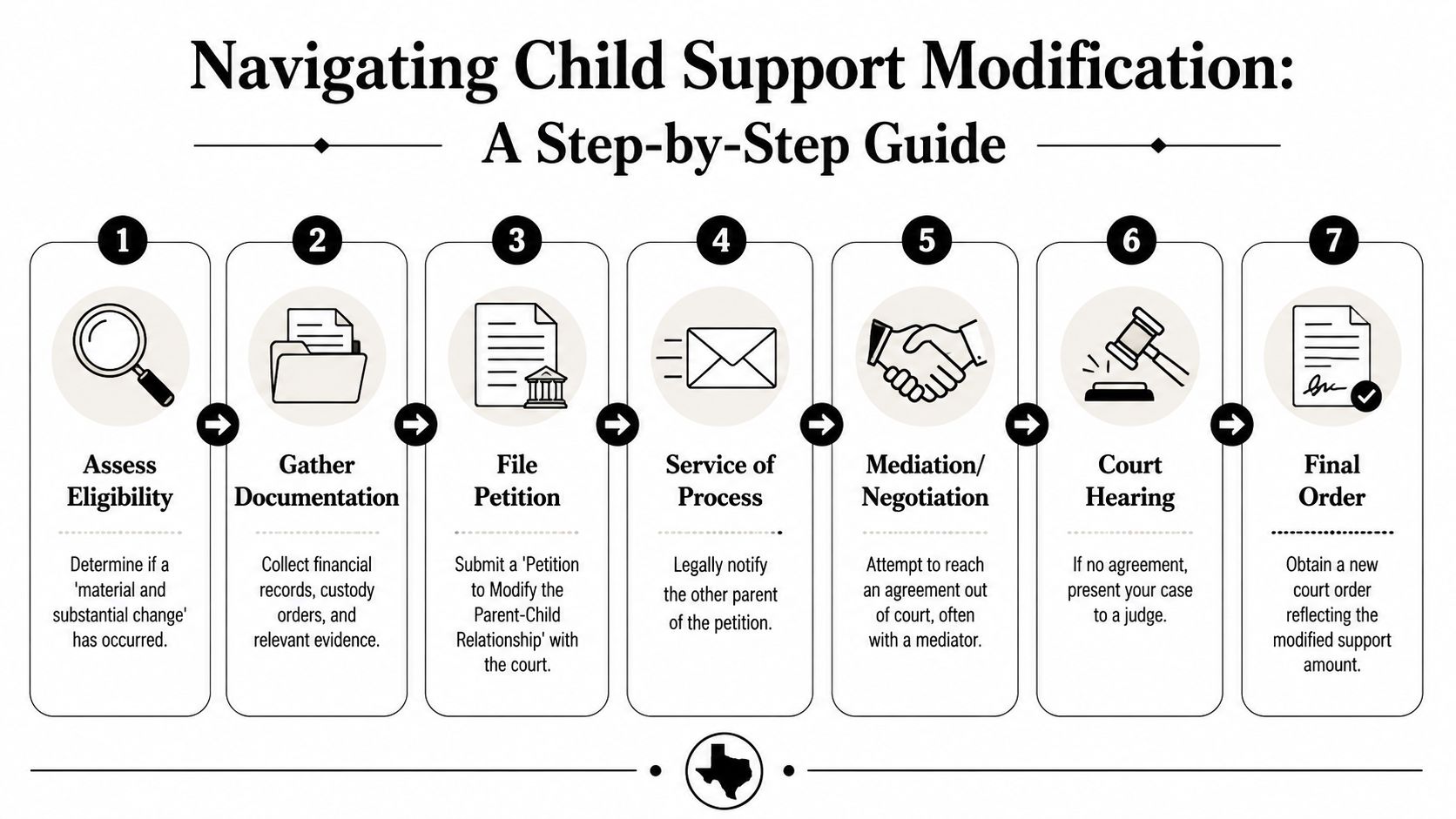
The usual filing is a Petition to Modify the Parent-Child Relationship. That request asks the court to review the current order and decide whether the change in possession and support should be updated to match current facts.
Parents who want a clearer overview of the filing process can review this guide on how to modify child support in Texas.
File in the court with continuing jurisdiction over your order unless a transfer is required. Filing in the wrong court or asking for the wrong relief can slow the case down and increase costs.
Give proper notice to the other parent
After filing, the other parent must be served or must properly appear in the case. This is not a technical side issue. If notice is not handled correctly, the court may not be able to move forward.
Once both parents are before the court, the case may proceed through temporary discussions, negotiated settlement, mediation, or a hearing.
Here is the video overview many parents find helpful before that stage:
Be ready to connect possession time to support
This is the part many parents miss. More overnights do not automatically reduce support. The court still has to decide whether the custody change is substantial enough to justify modifying the existing order and then apply the child support rules to the updated facts.
That means preparation should focus on two linked points. First, the child's schedule materially changed. Second, that change affects who is covering the child's day-to-day needs.
When those points are organized well, settlement talks are usually more productive.
Many cases resolve without a final trial
A contested hearing is not the only path. If both parents agree the child is now living under a different schedule, mediation can be an efficient way to work out revised terms and submit an agreed order.
Even then, the judge must sign the modified order before the support amount legally changes.
Keep the case centered on calendars, school routines, medical appointments, and daily care. Those facts usually matter more than frustration about what feels unfair.
The order changes when the judge signs it
Parents often assume the legal change happened when the schedule changed at home. It did not.
The prior support order generally stays in effect until a judge signs a new one. If you want the support amount to match the child's actual living arrangement, the safest course is to document the new possession pattern and file promptly.
Critical Mistakes to Avoid When Seeking a Reduction
The most expensive mistake in these cases is also the most common. A parent starts paying less because the child is staying with them more, and both parents seem to agree for the moment. Months later, conflict returns, and the paying parent learns the old amount never changed legally.
Texas doesn't treat that informal adjustment as enough.

Mistake one trusting a verbal agreement
Texas does not allow a parent to lower child support without court approval. The existing order remains enforceable until a judge changes it, and Texas also bars retroactive modification, so a reduced amount generally starts only after the modification request is filed, as explained in this discussion of modifying child support after an income drop in Texas.
That rule surprises people because informal parenting arrangements are common. Parents swap days. Work schedules shift. Kids spend more time in one home than the papers say. But support is different. The court expects a signed order.
Mistake two waiting too long to file
Delay can be costly. If you wait while the child is already living with you more often, the old support order still controls during that wait. Even if your reason for asking is strong, time works against you when there is no filing on record.
That's why parents should act promptly once the change looks stable rather than temporary.
Mistake three proving feelings instead of facts
Judges need evidence, not just understandable frustration. Saying “I have the child all the time now” won't carry the same weight as a detailed calendar, school records, and medical records that show the same thing.
Common weak spots include:
- Inconsistent records: Your calendar and your claims don't line up.
- Temporary schedule changes: You treated a short-term adjustment like a permanent shift.
- Retaliatory framing: The case sounds like a fight with the other parent instead of a child-focused request.
- No updated filing: You changed payments on your own and hoped the court would accept it later.
If your child support should change, file for the change. Don't self-edit the order.
The safest path is simple, even if it's not easy. Document the change, file the case, and get a signed order.
Frequently Asked Questions About Child Support Modification
What if my ex and I both agree the support should change
Agreement helps, but it doesn't replace a court order. Even if both parents are on the same page, you still need the new terms put into a formal order signed by the judge. Without that, the prior amount can still be enforced.
Do I still have to pay if my child is living with me full-time now
In many cases, yes, until the court changes the order. If your child's residence changed in a lasting way, that may be a strong basis to ask for modification. But the old order usually remains in effect until the legal process is completed.
How long does a modification take
It depends on the court, the county, whether the other parent agrees, and whether the case settles in mediation or needs a hearing. Some cases move more smoothly when the paperwork is complete and the evidence is organized early. Others take longer because the facts are disputed.
What evidence helps prove a custody change
Records showing where the child has been living are often the most useful. Possession calendars, school documents, and medical records can all help. Clear communication records may help too if they confirm schedule changes over time.
Does joint managing conservatorship mean no child support
No. Joint managing conservatorship usually refers to shared rights and duties, not necessarily equal possession or no support. One parent can still be ordered to pay child support even when both parents are joint managing conservators.
What does best interests of the child mean here
The best interests of the child standard guides Texas custody decisions. In everyday terms, the court looks for stability, appropriate care, and arrangements that support the child's well-being. A support modification tied to a custody change should always be framed around the child's actual needs and living situation.
Can mothers and fathers both ask for this kind of change
Absolutely. Texas courts don't reserve this process for one parent. Mothers, fathers, grandparents in appropriate cases, and other caregivers involved in conservatorship matters may need legal guidance when day-to-day care changes in a serious way.
Next Steps Protecting Your Rights and Your Childs Future
If your child is spending substantially more time with you now, you're not wrong to ask whether support should change too. In Texas, the answer is often yes, but only when the change is presented through the right legal process. Increased possession time can be the direct link that supports a finding of material and substantial change, and that can open the door to a new support calculation.
The most important thing is not to rely on assumptions. Don't assume extra parenting time automatically changes support. Don't assume a verbal agreement protects you. And don't assume waiting will somehow make the problem easier.
Start by gathering records that show your actual parenting schedule. Review your current order carefully. Then get advice specific to your family's facts, because small details often matter in modification cases.
If you need help with a child custody or visitation case in Texas, our experienced attorneys can guide you every step of the way. Contact The Law Office of Bryan Fagan, PLLC today for a free consultation.