Skip to content
When your child’s future is on the line, understanding your rights matters most. The legal term "termination of parental rights" can feel terrifying and absolute. In Texas, this court action permanently severs all legal ties, rights, and duties between a parent and a child. Let's break down what this truly means, because understanding this is the first step toward protecting your family.
Understanding the Finality of Termination

The thought of losing the legal connection to your child is a parent's worst nightmare. It's a heavy, emotional weight that can make it hard to think clearly. At The Law Office of Bryan Fagan, we want you to know that your fears are valid, but you are not powerless. Knowledge is the most important tool you have right now.
A Texas termination of parental rights is the most extreme measure a family court can take. It’s not just about losing custody; it's about erasing the legal parent-child relationship entirely. This means you would no longer have any right to visitation, decision-making, or even inheritance. It is a permanent and life-altering court order.
How Is Termination Different From Losing Custody?
It’s crucial to understand the difference between termination and losing custody. Custody, known in Texas as conservatorship, determines who a child lives with and who makes decisions for them. A parent can lose primary custody—meaning the child lives with the other parent—but still retain their parental rights.
- Losing Custody (Conservatorship): You may have a limited visitation schedule, known in Texas as a possession schedule, and may not have the right to make most decisions, but you are still legally the child's parent. You still have a right to see your child and a duty to pay child support.
- Termination of Rights: Your legal status as a parent is completely and permanently dissolved. All rights and responsibilities are gone, as if you were never the parent in the first place. This action paves the way for a child to be legally adopted by another family.
Voluntary vs. Involuntary Termination
The path to this outcome can happen in one of two ways. Voluntary termination is when a parent willingly consents to give up their parental rights. This most often occurs in the context of a stepparent adoption, where one biological parent agrees to the termination so their child's stepparent can become the legal parent.
In contrast, involuntary termination is when a court orders the termination against a parent's will. This is a lawsuit, often initiated by the other parent or the Texas Department of Family and Protective Services (DFPS), that seeks to prove the parent is unfit.
Voluntary vs Involuntary Termination at a Glance
| Aspect | Voluntary Termination | Involuntary Termination |
|---|---|---|
| Parent's Role | The parent actively consents to relinquish rights, usually by signing a legal affidavit. | The parent contests the termination, and a court must decide against their will. |
| Common Scenario | Stepparent adoptions where the non-custodial parent agrees. | Cases involving allegations of abuse, neglect, endangerment, or abandonment. |
| Legal Standard | The court must still find it is in the "best interest of the child." | Requires proof of specific statutory grounds AND that it's in the "best interest of the child." |
| Initiator | Usually filed by the parent seeking to adopt, with the biological parent's consent. | Often filed by the other parent, a family member, or the state (DFPS). |
| Evidence Needed | Proof of consent and that the new family situation (e.g., adoption) is stable. | "Clear and convincing evidence" of parental misconduct or endangerment. |
As you can see, the circumstances and legal requirements are worlds apart.
Involuntary termination is never a punishment. It is a profound legal measure taken only when a judge believes, based on a very high standard of evidence, that severing the parent-child bond is in the “best interest of the child.” This is the guiding principle that governs every decision a Texas family court makes regarding children.
The legal bar for involuntary termination is incredibly high for a reason. Unfortunately, statistics show that Texas courts are more willing to take this step than those in any other state. In fact, Texas has terminated parental rights for an astonishing 91,589 children since 2006, far more than any other state. This highlights the seriousness of these cases and why securing experienced legal guidance from the very beginning is so important. You can find more details about these trends by exploring the data behind Texas's approach to parental rights cases.
Facing this process is daunting, but you don't have to do it alone. By understanding these foundational concepts, you can begin to navigate the path ahead with clarity and strength.
How Texas Determines Grounds for Termination
When a court is asked to take a step as permanent as a Texas termination of parental rights, it can't operate on feelings or opinions. The law demands that the person filing the lawsuit—whether it's the other parent or the Department of Family and Protective Services (DFPS)—prove a specific, legally recognized reason, or "ground," for the termination. This is a critical safeguard for your rights as a parent.
Think of it like a prosecutor in a criminal trial. They can't just tell a jury someone is guilty; they have to prove the specific elements of a crime beyond a reasonable doubt. In a termination case, the petitioner has to prove one of the grounds laid out in Texas Family Code § 161.001 with "clear and convincing evidence." This is an extremely high legal bar, meaning the proof must be strong enough to create a firm belief or conviction in the judge's mind that the allegations are true.
What Do "Grounds for Termination" Mean in Real Life?
The legal language in the Texas Family Code can be dense and hard to follow. What really matters is understanding how these legal concepts play out in real family situations. While the law lists over 20 different grounds, some come up in court far more often than others.
Let's break down a few of the most common grounds in plain English:
- Endangerment: This is one of the most frequently used grounds. It means a parent knowingly put their child in situations or surroundings that endanger their physical or emotional well-being. This could involve exposing the child to domestic violence, drug or alcohol abuse, or a dangerously unstable living environment.
- Abandonment: This applies if a parent has intentionally left the child with another person without providing adequate support and has stayed away for a specific length of time. The key here is the parent's intent—did they plan on returning and being a parent?
- Failure to Comply with a Court Order: In cases involving DFPS, parents are often given a "service plan" with concrete steps they must take, like attending parenting classes, counseling, or passing drug tests. If a parent doesn't follow through on the court-ordered plan, that failure can become a ground for termination.
Knowing these grounds is the first step in building your defense because it tells you exactly what the other side has to prove. Mere accusations aren't enough; they need to be supported by solid, convincing evidence. You can learn more about what it takes to build a case around these issues by reviewing our guide on how to prove a parent is unfit in Texas.
Common Grounds for Involuntary Termination in Texas
To give you a clearer picture, let's look at some of the key statutory grounds a judge will consider. The table below simplifies the legal language from the Texas Family Code and shows how these grounds apply in real-world scenarios.
| Ground | Brief Explanation | Example Scenario |
|---|---|---|
| Endangering Conduct | Engaging in conduct or knowingly placing the child with people who engage in conduct that endangers the child's well-being. | A father allows his child to live in a home where he knows illegal drug activity is happening, putting the child at risk. |
| Failure to Support | Knowingly failing to support the child according to the parent's ability for a one-year period ending within six months of the lawsuit being filed. | A mother has the financial ability to pay child support but willfully refuses to make any payments for over a year, ignoring her duty. |
| Criminal Conduct | Being convicted or placed on community supervision for the death or serious injury of a child. | A parent is convicted of a crime that directly resulted in severe harm to their own child or another child. |
| Parental Rights Terminated for Another Child | The parent has had their rights to another child terminated based on a finding of endangerment. | A court previously terminated a mother's rights to her older son due to neglect, and she now faces similar allegations with her daughter. |
It's crucial to understand that proving one of these grounds is only the first half of a two-part test. Even if a ground is proven, the court must also find that termination is in the best interest of the child—a separate and equally important legal hurdle.
A major shift is happening in Texas, with the state putting a much bigger emphasis on keeping families together. In a stunning turnaround, Texas has cut its CPS child removals from 20,685 in 2018 to just 9,220 in 2024—that's a 55% drop in only six years. At the same time, child deaths from abuse and neglect have fallen by 53%. As detailed in the full analysis of this Texas child welfare revolution, this trend shows a growing commitment to helping families before taking the drastic step of termination.
This shift shows that courts do not make these decisions lightly. Your actions, your commitment, and your willingness to provide a safe home for your child are powerful arguments in your defense. Knowing the specific legal grounds you're up against allows you and your attorney to build a focused strategy to protect your parental rights.
Steps in a Termination Lawsuit
Facing a court case involving your child can feel like being thrown into a maze without a map. The legal jargon, the strict deadlines, and the formal procedures are confusing and, frankly, intimidating. This section is designed to give you a clear, step-by-step roadmap of the Texas termination of parental rights lawsuit, so you know what’s coming and can feel more in control.
The whole process kicks off when a Petition to Terminate the Parent-Child Relationship is filed with the court. Think of this as the official legal document that starts the clock ticking. Once it's filed, you will be formally notified through a process called service, where a constable, sheriff, or private process server hands you the legal papers in person.
Receiving these papers is an urgent call to action. You have a very specific, limited window of time to file a legal response, known as an Answer. If you miss this deadline, the judge can make a decision without ever hearing your side of the story—a devastating outcome called a default judgment.
Navigating the Key Stages of the Lawsuit
After you've been served and have filed your Answer, the lawsuit moves through several distinct phases. Each stage has a specific purpose designed to get the case ready for a final decision.
- The Ad Litem Attorney's Role: One of the first things a judge will do is appoint an attorney ad litem. This is a lawyer whose one and only job is to represent the best interests of the child. They act as an independent investigator—talking to you, the child, teachers, and anyone else involved—to make a recommendation to the court about what they believe is best for the child.
- Discovery: This is the evidence-gathering phase. It’s where both sides can request information from each other through written questions (Interrogatories), requests for documents (Requests for Production), and sworn testimony taken outside of court (Depositions). This is a critical time for building your case and understanding the other side's arguments. For cases involving documents from diverse linguistic backgrounds, access to reliable legal document translation services is crucial for ensuring accuracy and admissibility in court.
- Mediation: Before heading to a final trial, most Texas courts will require everyone to attend mediation. This is a confidential meeting where a neutral third-party mediator helps both sides try to hash out a settlement agreement. It’s a chance to resolve the case on your own terms instead of leaving the final, life-altering decision up to a judge.
The Two-Part Test for Termination
The infographic below breaks down the two fundamental pillars that the other party must prove for a Texas court to terminate your parental rights.
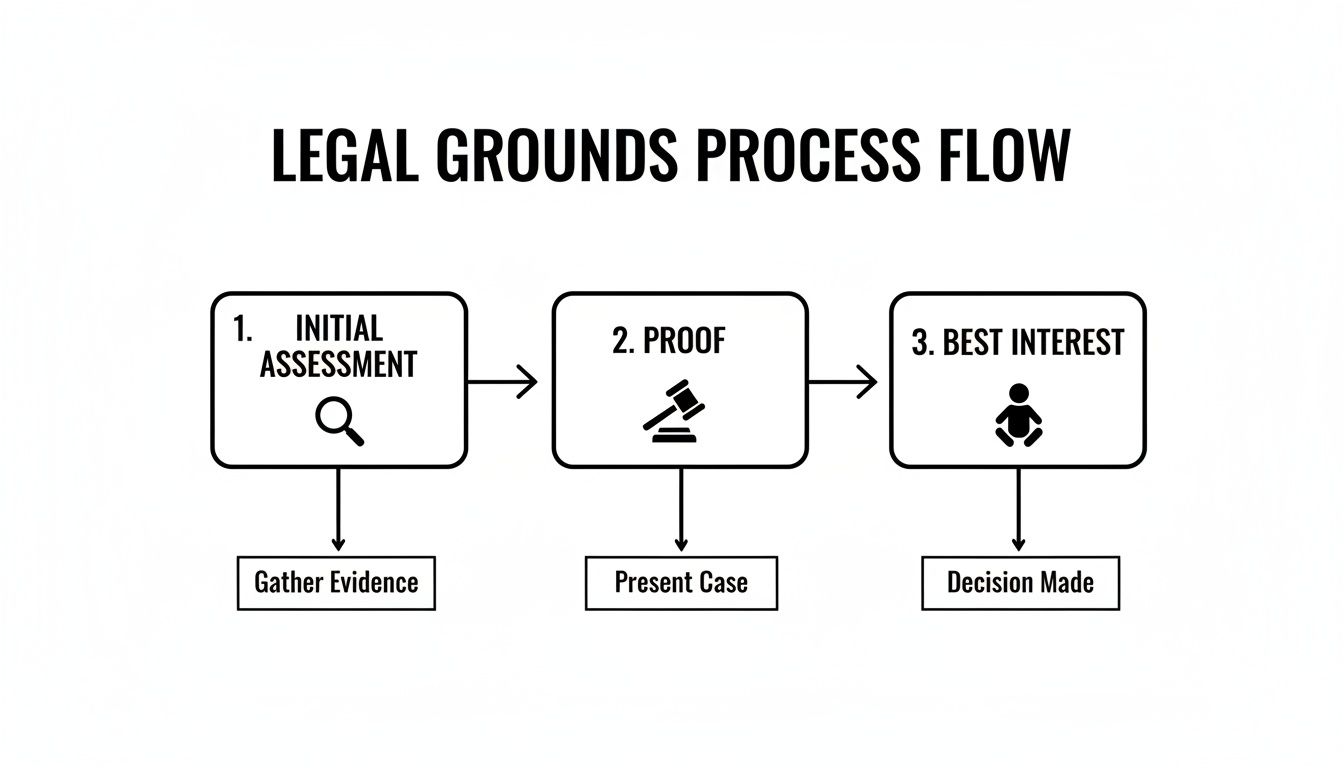
As you can see, proving a legal ground is only the first hurdle. The court must also be completely convinced that termination is truly in the child's best interest.
Accelerated Timelines in DFPS Cases
It is absolutely critical to understand that cases involving the Department of Family and Protective Services (DFPS) move on an extremely fast track. Texas law sets strict, non-negotiable deadlines for these cases to ensure children find a permanent, stable home as quickly as possible.
Federal data shows that Texas termination practices often prioritize speed, sometimes at the expense of family reunification. In a review of foster care cases, parental rights were terminated before the federal 15-of-22-month deadline in nearly half of the cases. Furthermore, just 4 out of 60 cases achieved permanency through reunification with parents, with the vast majority ending in adoption or other permanent placements.
This accelerated timeline means there is zero room for error or delay. You must hit every deadline and work proactively with your attorney from day one to protect your rights. If a settlement isn't reached through mediation, the case will head to a final trial, where a judge (or sometimes a jury) will hear all the evidence and make a final, binding decision.
The Critical Role of the Child's Best Interest
Even if a court finds that legal grounds for a Texas termination of parental rights exist, the case is far from over. Proving a ground like endangerment or abandonment is only the first hurdle in a mandatory two-part test. The second, and arguably most important, step is proving that termination is in the “best interest of the child.”
This legal standard is the guiding star for every single decision a Texas family law judge makes. Think of it as a powerful safeguard designed to ensure this life-altering decision truly focuses on the child’s future well-being, not just on punishing a parent for past mistakes. Without this critical finding, a judge cannot legally terminate your rights.
Understanding the Holley Factors
So, how does a judge figure out what’s actually in a child’s best interest? They don't just rely on a gut feeling. Texas courts are guided by a specific set of criteria established in a landmark case, now famously known as the “Holley Factors.”
These factors give the court a framework to evaluate the entire family situation from the child’s point of view. While it’s not a rigid checklist, these are the key questions the judge will be asking:
- The Child’s Needs: What does this child need to thrive, both physically and emotionally, now and in the future?
- Parental Abilities: Can the individuals seeking custody provide a safe, stable, and loving home? What are their capabilities?
- Stability of the Home: Is the proposed home environment a stable one, or is it chaotic and unpredictable?
- Parental Acts or Omissions: Are there things the parent has done—or failed to do—that suggest the current parent-child relationship isn't a healthy one?
- Danger to the Child: Is the child in any physical or emotional danger, right now or down the road?
A judge weighs all these factors together to paint a complete picture of the child's life. This is your chance to show the court that maintaining your parent-child relationship is essential for your child’s emotional health and stability.
How to Demonstrate Your Child's Best Interest
Thinking about your life through the lens of the Holley Factors can feel intimidating, but it’s also empowering. It gives you a clear roadmap for what you need to prove to the court. Your goal is to provide concrete, real-world evidence that shows preserving your bond is what’s truly best for your child.
The "best interest" standard requires the court to look beyond a parent's past mistakes and consider their present capabilities and the child's deep emotional ties. It acknowledges that children need love and stability, and severing a parental bond can inflict its own profound harm.
For example, you can present evidence of your consistent involvement in your child's life, your efforts to create a safe home, and your completion of any court-ordered services. This could mean showing report cards, letters from teachers, certificates from parenting classes, or bringing in credible witnesses who have seen your positive parenting firsthand. We offer more detailed guidance on how to build your case in our article on how to prove the best interest of a child in court.
This part of the case is where your story truly matters. It’s about more than just defending against allegations; it’s about proactively showing the court that you are a vital and positive force in your child's life. Your commitment, your actions, and your love for your child are your most powerful assets in that courtroom.
How to Defend Your Parental Rights

Getting served with a petition for a Texas termination of parental rights can make your world grind to a halt. It’s a direct challenge to your role as a parent, and feeling scared, angry, or overwhelmed is completely normal. But this isn’t the time to give up; it’s the time to stand up and fight for your family. The law gives you fundamental rights and powerful ways to defend your relationship with your child.
As a parent in a termination lawsuit, you are not a passive observer. You are an active participant with crucial rights, including:
- The Right to an Attorney: You have the right to be represented by a lawyer who will fight for your interests. If you cannot afford one in a case brought by the state, the court is required to appoint one for you.
- The Right to Be Heard: You have the right to show up at every court hearing, present your own evidence, and tell your side of the story.
- The Right to Confront Accusations: You have the right to see all the evidence being used against you and to question the witnesses who testify against you.
These rights are the bedrock of your defense. They ensure your side of the story gets told and that the court makes a decision based on the whole picture, not just one-sided allegations.
Building a Strong and Proactive Defense
A successful defense is about more than just denying accusations—it's about proactively showing the court your commitment and capability as a parent. The goal is to prove that keeping your family together is in your child’s best interest. Several powerful strategies can help get you there.
The most effective approach? Show a significant, positive change in your life. Courts understand that people can overcome challenges and make better choices for their families.
A judge will look at who you are today, not just who you were in the past. If you have taken concrete steps to address past issues, that progress is powerful evidence in your favor.
This strategy is all about proving you’ve turned a corner. It could mean showing you’ve successfully completed court-ordered services like parenting classes, counseling, or substance abuse treatment. It also means demonstrating stability, like holding down a steady job and maintaining a safe, clean home for your child.
Practical Steps for Mothers and Fathers
Whether you are a mother or a father, the core of your defense will be built on credible evidence. Start gathering your documentation immediately to build a strong case that proves your commitment.
Essential Documentation to Gather:
- Completion Certificates: Collect any certificates from parenting classes, anger management courses, or counseling sessions you have completed.
- Employment Records: Pay stubs and letters from your employer prove you have a stable income to support your child.
- Housing Information: A copy of your lease or mortgage statement helps establish that you have a stable home.
- Communication Logs: Keep records of all calls, texts, and emails with the other parent or caseworker to show you’re trying to stay involved.
Beyond documents, credible witnesses can be invaluable. These are people who can speak to your character and your positive relationship with your child—think teachers, counselors, neighbors, or family members who have seen you in action.
Unfortunately, sometimes a defense also means responding to untrue allegations. If you find yourself in this tough spot, it's critical to understand your options for addressing false accusations in a family law case.
Ultimately, your defense is your story—a story of your love for your child and your unwavering commitment to their future. At The Law Office of Bryan Fagan, we are here to help you tell that story clearly, confidently, and effectively in court.
Key Takeaways and Next Steps
Finding yourself in a situation involving a potential Texas termination of parental rights is, without a doubt, one of the most frightening and stressful things a parent can go through. The legal maze is complicated, what’s at stake couldn’t be higher, and it's completely normal to feel lost. Just remember, this is a permanent legal step, and the other party has to meet an incredibly high standard of proof to succeed.
Ultimately, your case will boil down to the court's two-part test: can they prove a specific legal reason for termination, and more importantly, is termination truly in the best interest of the child? That "best interest" standard is your strongest protection and the very core of your defense.
The single most important thing you can do right now is get ahead of the situation. Time is a luxury you don't have, especially when DFPS is involved. Getting a skilled lawyer on your side immediately gives you the power to build a real defense, protect your rights, and fight for the relationship you have with your child.
Your love for your child is the most powerful tool you have. By taking firm, decisive action now, you can turn that dedication into a smart legal strategy aimed at keeping your family together. Don't wait to find the help you need.
If you need help with a child custody or visitation case in Texas, our experienced attorneys can guide you every step of the way. Contact The Law Office of Bryan Fagan, PLLC today for a free consultation.
Frequently Asked Questions
When you’re fighting for your child, the questions and what-ifs can feel endless. Below, we’ve answered some of the most pressing concerns we hear from parents, grandparents, and caregivers about parental rights termination in Texas, giving you the straightforward clarity you need.
Can Parental Rights Be Reinstated After Termination in Texas?
For a long time, the answer was a hard no. A termination order was final and irreversible. However, Texas law recently changed, creating a very narrow and specific path for reinstatement, but it almost always involves cases with the Department of Family and Protective Services (DFPS).
It’s not an easy road back. To even have a shot, you must meet several strict conditions:
- The child cannot have been adopted in the time since your rights were terminated.
- At least one year must have passed since the judge signed the termination order.
- You must be able to prove there has been a significant and material change in your life circumstances.
Frankly, this is a tough legal battle with no guarantee of success. It's absolutely vital to talk to an experienced family law attorney to figure out if your situation even has a chance of qualifying.
What Happens If Only One Parent's Rights Are Terminated?
If a court terminates the rights of just one parent, the child doesn’t automatically end up in foster care. What usually happens is the other parent becomes the sole managing conservator.
This gives the remaining parent the exclusive power to make all major decisions for the child—from schooling to medical care. This scenario is common in stepparent adoptions, where one biological parent voluntarily gives up their rights so their former partner's new spouse can legally adopt the child. The legal tie is cut, but only with that specific parent.
How Can Grandparents Protect Their Grandchildren in These Cases?
Grandparents can be an incredible source of stability when a child’s world is turned upside down. If DFPS gets involved, Texas law actually prioritizes placing a child with relatives—what's known as kinship care—to avoid the trauma of traditional foster care.
Grandparents might also have the legal standing to file their own lawsuit to seek conservatorship (custody) of their grandchild. To do this, they generally have to show a judge that the child's current living situation with the parent(s) would significantly impair the child's physical health or emotional well-being. If you're a grandparent who wants to step in and protect your grandkids, acting quickly is absolutely essential.
If you need help with a child custody or visitation case in Texas, our experienced attorneys can guide you every step of the way. Contact The Law Office of Bryan Fagan, PLLC today for a free consultation at https://texascustodylawyer.net.