
When your child’s future is on the line, understanding your rights matters most. If your co-parent decides to ignore a court-ordered custody schedule, the sense of frustration and helplessness can be completely overwhelming. But you are not powerless. In Texas, your primary legal recourse is filing a Motion for Enforcement for contempt of court, a powerful action designed to hold a non-compliant parent accountable for violating a judge's direct order.
How Texas Determines Custody and Why Orders Matter

When a judge finalizes your child custody case, that order isn't just a set of friendly suggestions. It’s a legally binding command based on the best interests of the child, a standard that prioritizes their emotional and physical well-being above all else. Most Texas orders establish a joint managing conservatorship, where both parents share rights and responsibilities. This includes a detailed possession schedule that outlines exactly when each parent has the right to have the child.
Willfully disobeying this order comes with serious legal consequences. This is where the concept of contempt of court becomes your most important tool. By filing a motion for enforcement, you're formally asking a judge to step in and force the other parent to follow the rules. It’s the official way of telling the court that your rights—and more importantly, your child's right to a stable and predictable schedule—are being trampled on. This is the first step toward taking back control and making sure the court’s decree is taken seriously.
The Power of a Motion for Enforcement
When you file for contempt, you aren’t just lodging a complaint. You're starting a legal process that has real teeth. A judge has several powerful options to fix the situation, which can include:
- Ordering the other parent to give you make-up possession time for every visit you missed.
- Requiring them to pay for your attorney’s fees and court costs.
- Imposing hefty fines or even jail time for repeated or flagrant violations.
This process turns a frustrating personal problem into a formal legal matter where a judge can lay down the law. It completely shifts the power dynamic, serving as a stark reminder that the custody order carries the full authority of the court. You can learn more about what counts as a serious violation in our guide on custody order violations in Texas.
Understanding the Stakes Involved
The penalties for contempt of court in Texas are designed to be a serious deterrent. Under Texas Government Code §21.002(b), a judge can punish a single violation with a fine of up to $500 and confinement in the county jail for up to six months. These consequences are designed to punish actions that directly undermine the court's authority, like repeatedly denying visitation.
Given the importance of consistency for children, enforcement actions like contempt are an absolutely critical part of our family law system. You can explore more about these legal foundations on the Texas District & County Attorneys Association website.
Understanding Civil Versus Criminal Contempt
When you hear the term “contempt of court,” it can sound incredibly serious and intimidating. And while it is serious, in the world of Texas family law, it’s a specific legal tool that comes in two distinct forms. Knowing the difference between civil contempt and criminal contempt is crucial, because it shapes your entire legal strategy—from the evidence you need to gather to the results you can expect.
The easiest way to think about it is this: civil contempt is designed to compel future compliance, while criminal contempt is meant to punish past disobedience. One looks forward, the other looks back.
Civil Contempt: A Tool to Compel Action
Most of the time, when we file a contempt action in a child custody case, we’re talking about civil contempt. The goal isn't just to punish the other parent for what they did wrong, but to get them to do the right thing from this point forward.
I often tell my clients to imagine the judge saying, "You hold the keys to your own jail cell. You can get out the moment you agree to follow our custody order." That's the core of civil contempt. The threat of jail time is conditional—it hangs over the other parent's head until they finally comply.
- Goal: To persuade the other parent to follow the court order in the future.
- Example: A judge finds a parent in contempt for repeatedly denying visitation. The judge orders them to turn over the child for the next scheduled visit. If they refuse, they can be jailed until they agree to follow the order.
- Outcome: The parent can avoid or end the punishment by simply doing what the court ordered. This is called "purging" the contempt.
This approach is all about fixing the problem for the future and making sure your child's possession schedule is respected.
Criminal Contempt: A Punishment for Past Violations
Criminal contempt, on the other hand, is purely about punishment. It looks backward at a specific violation that has already happened and imposes a penalty for that past act. It’s the court’s way of drawing a line in the sand and saying, “You knowingly broke a rule, and there is a consequence for that.”
We typically see criminal contempt used for more serious or repeated violations, where the court needs to send an unmistakable message that its orders cannot be ignored. The punishment, whether it's a fine or a set amount of jail time, is fixed. Promising to do better won't make it go away.
A finding of criminal contempt is a formal ruling that a parent willfully disobeyed a direct court order. That act of disobedience, by itself, deserves a penalty, completely separate from ensuring future compliance.
Different Standards of Proof Matter to Your Case
This distinction between civil and criminal contempt has a huge impact on your case because it changes the level of evidence you need to bring to court. Since criminal contempt can lead to jail time—a loss of liberty—it demands a much higher standard of proof, the same as in any criminal trial.
Civil Contempt Burden of Proof
For civil contempt, you must prove your case by a “preponderance of the evidence.” This simply means you have to show that it is more likely than not (think 51%) that the other parent violated the custody order. You just have to tip the scales of justice slightly in your favor.
Criminal Contempt Burden of Proof
For criminal contempt, the bar is set much, much higher. You must prove the violation “beyond a reasonable doubt.” This is the toughest standard in our legal system. The evidence must be so solid that there is no other logical conclusion except that the other parent intentionally violated the order.
Understanding these differences is the first step in building a strong case for contempt of court custody in Texas. It allows you and your attorney to craft the right strategy, present the right evidence, and pursue the right remedy to protect your parental rights and your child’s stability.
What Happens When a Parent Violates a Texas Custody Order?
When your co-parent ignores a custody order, it’s more than just frustrating—it’s a direct defiance of a judge's command. In Texas, violating a court order is a serious offense. The family courts have powerful tools to enforce their rulings, and they don’t hesitate to use them to protect a child's right to a stable, predictable schedule with both parents.
It’s one thing to know you’re in the right, but it’s another to understand the very real consequences the other parent could face. These penalties aren't just about punishment. They're designed to fix the problem, restore your lost time, and make it crystal clear that ignoring a court order comes at a steep price.
Financial and Custodial Consequences
A judge's first step is usually to right the wrong. That means getting you the parenting time you were denied. From there, the court can add financial teeth to the order to make sure it doesn't happen again.
Under the Texas Family Code Chapter 157, a judge has several options, including:
- Ordering Make-Up Possession: The court will almost certainly order the non-compliant parent to give you extra time with your child to make up for every single moment you lost.
- Making the Other Parent Pay Your Legal Bills: If you win your contempt case, the judge can order the other parent to cover all your attorney’s fees and court costs. You shouldn't have to pay out-of-pocket to enforce an order that already exists.
- Imposing Fines: For every violation you can prove, a judge can hit the other parent with a hefty fine.
These remedies are designed to make you whole and send a strong message that non-compliance will not be tolerated.
Jail Time and Community Supervision
When make-up time and fines aren't enough to get the point across, Texas courts have the authority to bring down much heavier consequences. This power comes directly from Texas Government Code §21.002(b), which gives judges the ability to enforce their orders with the threat of jail.
A finding of contempt can lead to community supervision—what most people call probation—for up to ten years. If the parent messes up and violates their probation terms, the judge can revoke it and send them straight to jail to serve time that was previously suspended.
For repeated or particularly flagrant violations, a judge can skip probation and go straight to confinement. The law allows for a sentence of up to 180 days in the county jail for each individual violation. Think about that for a moment. If a parent has denied visitation over several weekends and holidays, each one can be counted as a separate offense, and the jail time can stack up fast.
Here’s a quick summary of the penalties a Texas judge can hand down.
Potential Penalties for Contempt of a Custody Order in Texas
| Penalty Type | Description | Governing Law |
|---|---|---|
| Make-Up Possession | The non-compliant parent must provide additional time with the child to compensate for denied visitation. | Texas Family Code §157.211 |
| Fines | The court can impose a fine of up to $500 for each violation. | Texas Government Code §21.002(b) |
| Attorney's Fees & Costs | The non-compliant parent may be ordered to pay the filing parent's legal fees and court expenses. | Texas Family Code §157.167(b) |
| Community Supervision | The parent can be placed on probation for up to 10 years, with conditions they must follow. | Texas Family Code §157.211(a) |
| Jail Time | The parent can be sentenced to up to 180 days in county jail for each proven violation. | Texas Government Code §21.002(b) |
The legal system has these strong measures for a simple reason: a consistent and predictable schedule is almost always in the best interest of the child. If you’re dealing with this kind of frustrating situation, it’s crucial to understand the entire process. You might find our detailed guide on what contempt of court entails helpful. Remember, taking action isn't about starting a war; it's about protecting your relationship with your child and giving them the stability they deserve.
Steps to File a Motion for Enforcement in Texas
Knowing your rights under a Texas custody order is one thing, but actually forcing the other parent to follow them is another battle entirely. When your co-parent repeatedly ignores the possession schedule, just waiting for them to change their ways isn't a viable strategy. Fortunately, the law gives you a clear path for taking action, and it all begins with filing a Motion for Enforcement.
This process can feel intimidating, but breaking it down into manageable steps can turn that uncertainty into a concrete plan. It empowers you to move forward with confidence. The first step is to stop letting violations slide and start documenting everything.
Preparing and Documenting Your Case
Before you even think about going to court, you need to build your case on a foundation of solid evidence. A judge can't enforce a court order based on your word alone; you have to be able to prove the violations occurred. This is where meticulous documentation becomes your most powerful tool.
Start a dedicated calendar or journal right away. For every single time the other parent violates the order—no matter how small it seems—you need to log the details:
- The specific date and time the violation happened.
- A clear, factual description of the incident (e.g., "Father was 45 minutes late for pickup," or "Mother refused to answer the door for my scheduled weekend possession").
- Any communication you had with the other parent about what happened.
Make sure to save every single text message, email, and voicemail related to these incidents. These digital records are incredibly compelling in court because they are time-stamped and often capture the other parent’s excuses or intentions in their own words.
Filing the Official Paperwork
Once you have your evidence organized, the next step is to file a formal Motion for Enforcement with the court that issued your custody order. This isn't just a simple complaint letter; it's a specific legal document that officially kicks off the contempt of court process.
This motion has to be incredibly detailed. You must list out each specific provision of the court order that was violated, along with the date, time, and the exact way it was violated. Precision is absolutely critical here. Any vagueness or mistake could give the other parent an opening to get a violation dismissed on a technicality. Our attorneys are experts at drafting these documents, and you can learn more about the specifics in our guide on the Motion to Enforce.
After the motion is filed, the other parent must be formally notified through a legal process called "service." This typically involves a sheriff, constable, or a private process server personally delivering a copy of the motion and a citation ordering them to appear in court. This step ensures they can't later claim they never knew about the hearing.
The Court Hearing and Potential Outcomes
At the court hearing, you'll finally have your day in court to present all the evidence you’ve gathered. This is where your careful and consistent documentation truly pays off. You will need to prove each violation you've alleged, and the other parent will get a chance to present their side of the story or any defenses they might have.
If the judge agrees with you and finds the other parent in contempt of court for violating the custody order, they have the power to impose a variety of penalties. The most common consequences are shown in this flowchart.
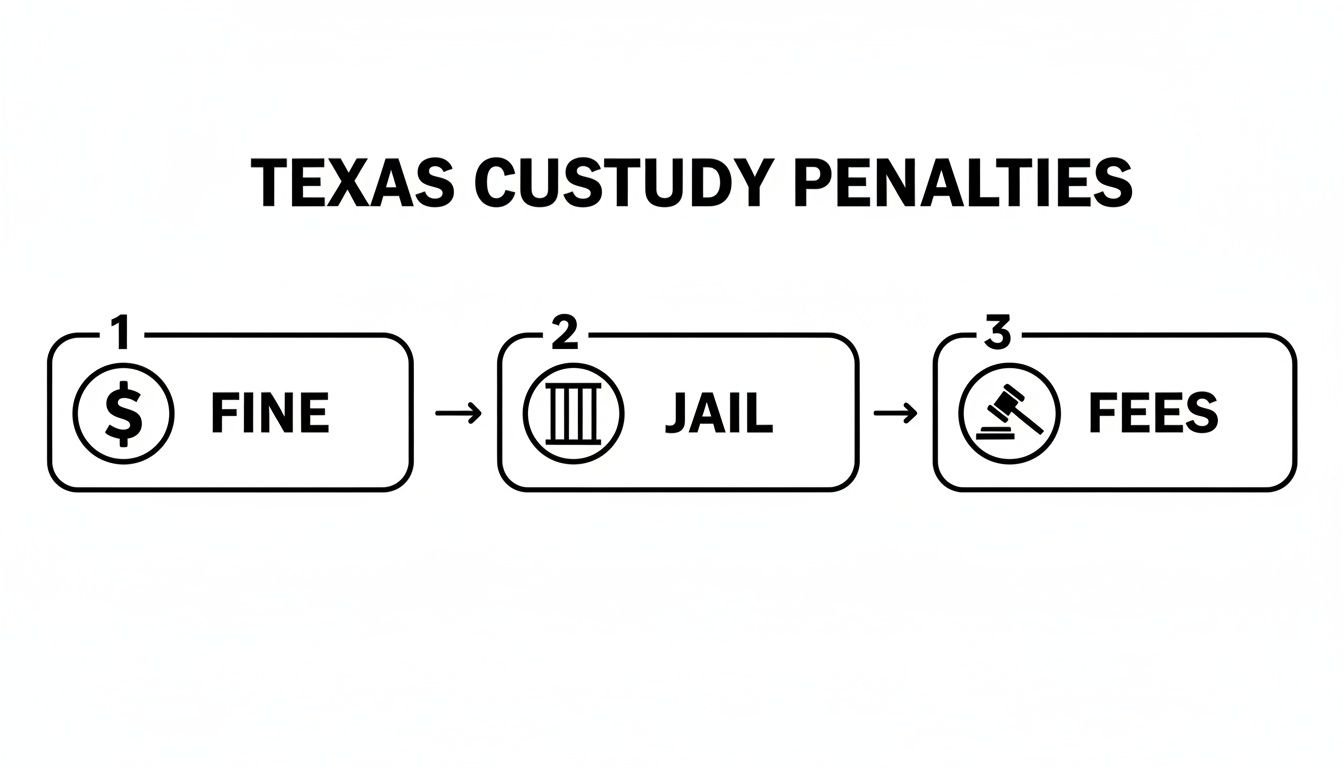
These penalties aren't just meant to punish past behavior; they're also designed to send a strong message and discourage any future violations. Texas law is strict on this point. Under Texas Government Code §21.002(b), the punishment for a single violation is capped at a $500 fine and up to six months in jail. However, with multiple proven violations, those penalties can stack up very quickly.
Filing a Motion for Enforcement is a powerful tool to assert your rights and, most importantly, protect your child's stability and their relationship with you. You don’t have to go through this complicated and emotional process on your own.
Common Defenses to Contempt of Court
When you’re served with a motion for contempt, it’s easy to feel like the judge has already made up their mind. But let’s be clear: Texas law understands that life is messy. Not every missed visit is a malicious act, and the courts provide real, legitimate ways for a parent to defend themselves against an accusation of violating a custody order.
Knowing these defenses is critical, whether you’re the one filing the motion or the one responding to it. If you’re filing, you need to anticipate the other parent’s arguments to build a rock-solid case. If you’re defending, you need to know exactly what the law says can excuse your actions. A judge will hear both sides, and being prepared is half the battle.

Affirmative Defenses to a Contempt Charge
In a contempt of court custody Texas case, the parent who filed the motion has the initial job of proving that a violation occurred. Once they do, the tables turn. The burden of proof then shifts to the accused parent to show they had a legally valid reason for not following the order. These specific, legally recognized excuses are called affirmative defenses.
The Texas Family Code lays out a few key affirmative defenses that can protect a parent from a contempt finding.
Voluntary Relinquishment: This is probably the most common defense we see. It’s when the other parent willingly gave up their court-ordered time. A text message saying, "I'm swamped this weekend, you can just keep the kids," is gold. This isn't you denying possession; it's the other parent handing it to you.
The Order is Unclear or Vague: You can't be held in contempt for failing to follow an order that no reasonable person could understand. If the possession schedule is contradictory, confusing, or just plain ambiguous, a judge may decide it’s unenforceable.
Inability to Comply: This defense is for situations where following the order was literally impossible due to circumstances outside your control. Think of a sudden, severe illness that lands you in the hospital or a multi-car pile-up on the freeway that makes an on-time exchange impossible.
It's crucial to understand what doesn't count. Simply disagreeing with the custody order or your child throwing a tantrum because they don't want to go are not valid legal defenses.
The High Bar for Denying Possession Due to Safety Concerns
One of the most serious defenses—and the hardest to prove—is when a parent denies possession out of a genuine, immediate fear for their child’s safety. The standard for this is incredibly high, and for good reason.
Under Texas law, you can't just have a vague worry or suspicion. You must be able to present credible evidence showing that the child would be in actual danger if you turned them over for visitation.
This requires far more than your gut feeling or dredging up old arguments. You need concrete proof, such as:
- Police reports documenting recent family violence.
- Hard evidence of current, dangerous substance abuse by the other parent.
- Statements from a professional, like a CPS caseworker or a therapist, who can confirm an immediate risk to the child.
Simply believing the other parent is a "bad influence" or has poor judgment won't cut it. If you have a legitimate, serious fear for your child’s safety, the proper legal move is to file for an emergency temporary restraining order—not to take matters into your own hands by violating the current custody order. A judge will expect to see that you took formal legal steps if the threat was as serious as you claim.
Frequently Asked Questions About Custody Enforcement

When your co-parent violates a custody order, your mind starts racing with questions. It’s a stressful, uncertain time, but getting clear answers is the first step toward finding your footing. We hear these questions from parents all the time, and here are the straightforward answers you need.
Is There a Deadline for Filing for Contempt?
Yes, and the clock is ticking. Texas law sets strict time limits for filing a motion to enforce a custody order through contempt of court.
- If you want the court to consider jail time as a penalty, you must file your motion no later than six months after the violation happened.
- For other remedies, like getting make-up possession time, you generally have a two-year window from the date the other parent's right to possession ended.
These deadlines are unforgiving. That’s why it is so critical to act quickly and document every single violation. If you wait too long, you could lose your chance to hold the other parent accountable in court.
Can I Stop Paying Child Support if I'm Denied Visitation?
This is one of the most common questions we get, and the answer is a firm and absolute no. In Texas, child support and visitation are considered two entirely separate legal obligations. While it is incredibly frustrating and unfair to be denied time with your child, withholding court-ordered child support is also a violation of the court's order.
Stopping child support payments will only land you in hot water. You'll be at risk of facing your own contempt action, which can lead to fines, wage garnishment, and even jail. It completely undermines your legal position and distracts the judge from the real issue: your co-parent's failure to follow the order.
What if Our Custody Order Is from Another State?
You don't have to travel back to the state that issued the order to get it enforced. If you and your child now live in Texas, the law provides a clear path forward. Thanks to the Uniform Child Custody Jurisdiction and Enforcement Act (UCCJEA), you can register your out-of-state order with a Texas court.
Once it's properly registered, a Texas judge can enforce that order just as if it had been issued here in the first place. This process is designed to protect your rights without forcing you to litigate across state lines.
Should I File for Contempt or a Custody Modification?
That’s a strategic question, and the right answer really depends on what you’re trying to achieve.
- File for Contempt if your primary goal is to compel the other parent to follow the current order. This action focuses on enforcement and finding a remedy for past violations.
- File for a Modification if the current order is just not working anymore and you believe a permanent change is in the best interest of the child. This is the right move when circumstances have changed so much that the old order is no longer practical or beneficial.
In some situations, it makes sense to file both motions at the same time. An experienced family law attorney can help you analyze your situation and choose the legal path that best protects your rights and your child’s well-being.
Key Takeaway: Your Next Steps to Protect Your Parental Rights
You’ve learned that contempt of court is a serious legal matter. More importantly, you now know that Texas law provides powerful tools to enforce your custody order and safeguard your relationship with your child. The frustration and anxiety you’re feeling right now are completely understandable. The key is to turn those feelings into focused, effective legal action.
The road ahead can look complicated, but you don't have to walk it by yourself. When you're facing a co-parent who intentionally ignores a court order, it's an emotional fight as much as a legal one. Having a dedicated advocate in your corner can change everything.
Turning What You Know into What You Do
Understanding your rights is the first step. Taking action is the next. A skilled family law attorney is your guide through this process. They will help you:
- Systematically document violations to build a powerful, evidence-based case.
- Draft and file the correct legal motions, making sure every detail meets the strict requirements of Texas courts.
- Represent you in the courtroom, presenting your side of the story clearly and persuasively to the judge.
- Advocate for your child’s best interests, keeping the focus on their need for stability and a strong relationship with both parents.
Taking legal action isn’t about making things worse. It’s about re-establishing the rules and making sure the court's orders are followed. It’s about defending your fundamental rights as a parent and protecting your child's well-being.
When your child's future is at stake, understanding your legal options is everything. A Motion for Enforcement isn’t just about punishing the other parent; it’s about securing a stable, predictable future for your child, just as the joint managing conservatorship was designed to do.
You Don't Have to Do This Alone
Handling a contempt of court custody Texas case takes more than just knowing the law; it demands a deep understanding of how to present a case that resonates with family court judges. The right lawyer can take your justified frustration and shape it into a compelling legal argument. They handle the deadlines, the paperwork, and the courtroom strategy so you can focus on what matters most—being a parent.
Your possession schedule isn't just a suggestion; it's a court-ordered right. You have the power to enforce it. The next step is getting the professional guidance you need to do it right.
If you need help with a child custody or visitation case in Texas, our experienced attorneys can guide you every step of the way. Contact The Law Office of Bryan Fagan, PLLC today for a free consultation.