Skip to content
When your ex-partner ignores a court order and denies you precious time with your child, it can feel like a profound injustice. The frustration, anger, and helplessness are completely understandable. A custody order violation in Texas undermines not just your parental rights, but also the stability your child needs. But it's crucial to remember that you are not powerless. Texas law provides clear pathways to enforce your rights and restore order.
What Is a Custody Order Violation in Texas?
When a judge finalizes your custody case, they issue what’s known in Texas as a possession order. This isn’t a list of friendly suggestions—it’s a court mandate with the full force of law behind it. A violation occurs whenever a parent breaks the rules set out in that order.
The Texas Family Code clearly defines the rules for possession and access, which is the legal term for the time you're entitled to spend with your child. Understanding exactly what counts as a violation is your first step toward protecting your relationship with your child. It’s easy to feel overwhelmed when an ex-partner disregards a judge's decision, but Texas law gives you solid options to enforce the order.

Common Examples of Custody Violations
Violations aren't always as dramatic as a parent disappearing with a child. More often, they show up as a pattern of smaller actions that create instability for your child and chip away at your rights as a parent. Recognizing these actions for what they are—violations of a court order—is the first step to taking back control.
Here’s a look at what these violations often look like and the first legal step you can take.
Common Custody Violations and Your First Legal Steps
| Type of Violation | What It Looks Like | Your First Legal Step |
|---|---|---|
| Denying Possession | The other parent outright refuses your scheduled weekend, holiday, or summer possession time. | Document the denial (texts, emails) and consider filing a Motion to Enforce the possession order. |
| Interfering with Communication | Your calls or video chats with the child are consistently ignored, blocked, or cut short. | Review your order for communication clauses, document every attempt, and consider an enforcement action. |
| Chronic Lateness/Disruptions | The other parent is consistently 30+ minutes late for exchanges, cutting into your court-ordered time. | Keep a detailed log of dates, times, and durations. This pattern can support a Motion to Enforce. |
| Unilateral Decision-Making | The other parent enrolls the child in a new school or schedules non-emergency surgery without your consent. | If you share joint decision-making rights, this is a major violation. File a Motion for Contempt and/or Enforcement immediately. |
| Failing to Return the Child | The other parent doesn't bring the child back at the scheduled end of their possession period. | Contact the police to file a report for interference with child custody and then file an emergency motion with the court. |
Recognizing these behaviors is your first step. The key is to document everything, as a clear pattern of violations gives you a much stronger position when you seek legal help.
Understanding the "Why" Behind the Violation
As family law attorneys, we've seen it all. Parents violate orders for a host of reasons, though none of them are a legal excuse. Sometimes it’s unresolved anger from the divorce. Other times, it's a misguided attempt to control you or a genuine, but legally incorrect, belief they’re acting in the child’s best interest.
For example, a parent might keep a child home from a visit because of a minor cold. While their intentions might feel protective, it's still a violation of a court mandate unless it’s a true medical emergency documented by a doctor.
Whatever the motive, the result is the same: your parental rights are being ignored, and more importantly, your child's life is being disrupted. The goal isn’t to punish the other parent—it’s to enforce the order and bring back the consistency your child needs to thrive. Knowing what counts as a custody order violation in Texas empowers you to do just that.
If you’re dealing with a co-parent who won’t follow the rules, you don’t have to handle it alone. Our experienced attorneys can help you understand your options and take decisive action. Contact The Law Office of Bryan Fagan, PLLC today for a free consultation to discuss your case.
How Texas Determines Custody: Understanding Your Rights
When you're trying to protect your relationship with your child, the legal language in a Texas custody order can feel like a foreign language. But before you can identify a violation, you have to understand the ground rules. Getting a firm grip on the core principles that guide every judge’s decision is the first step in advocating for your child and your rights.

The single most important concept in any Texas family court is the “best interest of the child” standard. This is the legal North Star. It means every decision a judge makes—from possession schedules to decision-making rights—is based on what will best promote your child’s physical and emotional well-being, not what either parent wants. The court will look at everything from the child’s specific needs and each parent's ability to meet them to the stability of the home and any history of conflict.
Joint Managing Conservatorship Explained
In most Texas cases, the starting point is Joint Managing Conservatorship. It sounds complicated, but it’s actually pretty straightforward. In plain English, it means both parents share the rights and responsibilities of raising their children, even if they live apart.
One parent is usually named the "primary" conservator, which gives them the right to decide where the child lives. The other parent is the "possessory" conservator. But being joint conservators doesn't automatically mean a 50/50 possession schedule. It ensures both parents have a say in major decisions about things like education, non-emergency medical care, and psychological treatment. This shared authority is exactly why it can be a serious violation if one parent makes a big decision on their own.
Key Takeaway: Joint Managing Conservatorship is the court's way of saying your child deserves two active and involved parents. It gives you the legal power to challenge the other parent if they try to shut you out of important life decisions.
Decoding Your Possession Schedule
Every court order includes a possession schedule, which is the detailed calendar that dictates exactly when the child is with each parent. This isn't a suggestion—it’s a legally binding court order. The schedule will map out everything: weekends, holidays, summer vacation, and even birthdays.
The most common schedule is the Standard Possession Order (SPO), which gives the non-primary parent possession on the first, third, and fifth weekends of a month. But for parents who live within 100 miles of each other, Texas law presumes an Expanded Standard Possession Order (ESPO) is in the child’s best interest.
A major legislative change is set to make this even more common. The 2026 Texas Family Code overhaul, driven by Senate Bill 1936, establishes the Expanded Standard Possession Order as the new default for parents living within 50 miles of each other. This reform, which takes effect on September 1, 2026, boosts the non-primary parent's time by 20-25% by adding Thursday overnights and Monday morning drop-offs at school. The goal is to give kids more time with both parents and cut down on custody battles. You can read more about how recent Texas family law reforms impact custody.
Knowing your exact schedule—whether it’s an SPO, ESPO, or something customized—is crucial. When the other parent refuses to hand over the child for your court-ordered time, they aren't just being uncooperative. They are directly violating a judge's order, and that gives you the grounds to take legal action.
If you need help with a child custody or visitation case in Texas, our experienced attorneys can guide you every step of the way. Contact The Law Office of Bryan Fagan, PLLC today for a free consultation.
How to Document Custody Violations The Right Way
When a co-parent repeatedly ignores your custody order, it’s maddening. The frustration is real, and it’s completely justified. But in a Texas courtroom, your anger, however valid, isn't evidence. A judge needs to see a clear, undeniable pattern of violations, not just hear how upset you are.
This is where documentation becomes your most powerful tool. This means building a case file so thorough and factual that the other parent simply can't argue with it. Your goal is to shift from subjective complaints to an objective log of facts—a timeline of events a judge can follow easily, leaving no room for excuses or denial.
Go Beyond a Simple Notebook
While a handwritten journal is a start, it's not as strong as a modern, time-stamped record. This is why we often guide clients toward co-parenting apps like OurFamilyWizard or AppClose. They are designed specifically for this purpose.
Communications within these apps are logged and cannot be altered, creating a verifiable record that sidesteps the "he said, she said" drama of text messages and phone calls. A text screenshot can be challenged, but a message log from a court-recognized co-parenting app is often treated like an official business record.
This is especially critical in complex cases. For example, Texas judicial statistics show that poorly documented claims, whether from fathers asserting their rights or mothers enforcing support, often get dismissed. At The Law Office of Bryan Fagan, PLLC, with offices across Houston, Dallas, and Austin, we frequently advise clients to use these apps to build a factual log, steering them clear of messy "text wars" that can backfire in court.
Build an Airtight Evidence Log
Your documentation needs to be organized, factual, and completely free of emotion. For every single violation, your log should capture the essential details.
- Date and Time: Note the exact date and time the violation occurred. Be specific.
- Specific Violation: Clearly state what happened. For example, “Parent was 45 minutes late for the 6:00 PM exchange,” or “Denied the scheduled 7:00 PM phone call.”
- Location: Document where the incident took place, like the designated school or police station exchange spot.
- Witnesses: If anyone else was there—a friend, a family member—write down their name.
- Your Actions: Briefly describe what you did. Did you wait? Did you send a polite, factual message through your co-parenting app to confirm the missed exchange?
Real-World Scenario: We worked with a father who was consistently being denied his midweek possession. Instead of getting into arguments, he started using his phone. At the designated exchange time, he would take a time-stamped photo showing his car at the school and then use a GPS check-in to prove his location. After just a few months, he had a calendar filled with undeniable proof that became the foundation for a successful Motion to Enforce.
Keep Your Custody Order Handy
It is absolutely essential to have a certified copy of your final orders with you. The language in your Possession Order is incredibly specific, and you need to be certain that what you're documenting is an actual violation of the court's decree.
If you aren't sure where your copy is or how to get a new one, you can check out our guide on how to obtain a copy of your final custody order in Texas. Having that document on hand lets you confirm the exact rules for communication, travel, and exchanges before you take action.
This meticulous approach does more than just organize your thoughts; it transforms your personal frustration into a powerful legal argument. By documenting every custody violation the right way, you give your attorney the ammunition needed to protect your rights and, most importantly, restore stability for your child.
Taking Legal Action: Steps to Enforce Your Custody Order
You’ve kept meticulous records. You’ve sent polite texts and emails. And still, the other parent is ignoring the custody order. When your best efforts to co-parent are met with consistent violations, it’s a clear signal that it's time to let the court intervene.
Fortunately, Texas law doesn't leave you powerless. It provides strong legal tools specifically designed to protect your parental rights and force compliance with the court's decree. The most common step is filing a Motion to Enforce.
Filing a Motion to Enforce
A Motion to Enforce is a formal legal document you file with the court. It's not just a complaint—it’s a demand for judicial action that details every single time the other parent failed to follow the possession order.
Filing this motion puts the other parent on formal notice that their actions have legal consequences. More importantly, it asks a judge to step in and fix the problem. The court can order specific remedies to make things right and discourage future violations.
These remedies can include:
- Make-Up Visitation: The judge can order the other parent to give you extra time with your child to compensate for the periods of possession you were wrongfully denied.
- Attorney’s Fees and Costs: If the court agrees the other parent violated the order, it can order them to pay you back for the attorney's fees and court costs you had to spend.
- Clarification of the Order: If the original order was vague, a judge can revise the language to eliminate any room for "misunderstandings" down the road.
We cover the nuts and bolts of this process in our detailed guide on the Motion to Enforce for custody in Texas. Think of this motion as your essential first step in holding the other parent accountable.
When to Escalate to a Motion for Contempt
Sometimes, a parent’s defiance of a court order is so willful and repeated that a simple enforcement action isn't enough. For these more serious cases, you can also file a Motion for Contempt of Court. This elevates the issue from a civil dispute to a quasi-criminal matter.
A contempt finding means the judge believes the other parent knowingly and intentionally violated a clear court order. The consequences are far more severe because they are designed to punish past behavior and send a crystal-clear message.
Key Insight: A Motion for Contempt signals that the violations are not just an inconvenience—they are a direct challenge to the court's authority. The potential penalties reflect that seriousness.
Possible punishments for contempt are significant and can include:
- Fines: The court can impose substantial fines on the non-compliant parent for each violation.
- Community Supervision: A judge might place the parent on a form of probation, where they must follow strict rules for a set period.
- Jail Time: For the most egregious or repeated violations, a judge has the power to sentence the parent to up to six months in county jail for each violation.
This flowchart breaks down the simple but critical steps for documenting violations—the bedrock of any successful enforcement action.
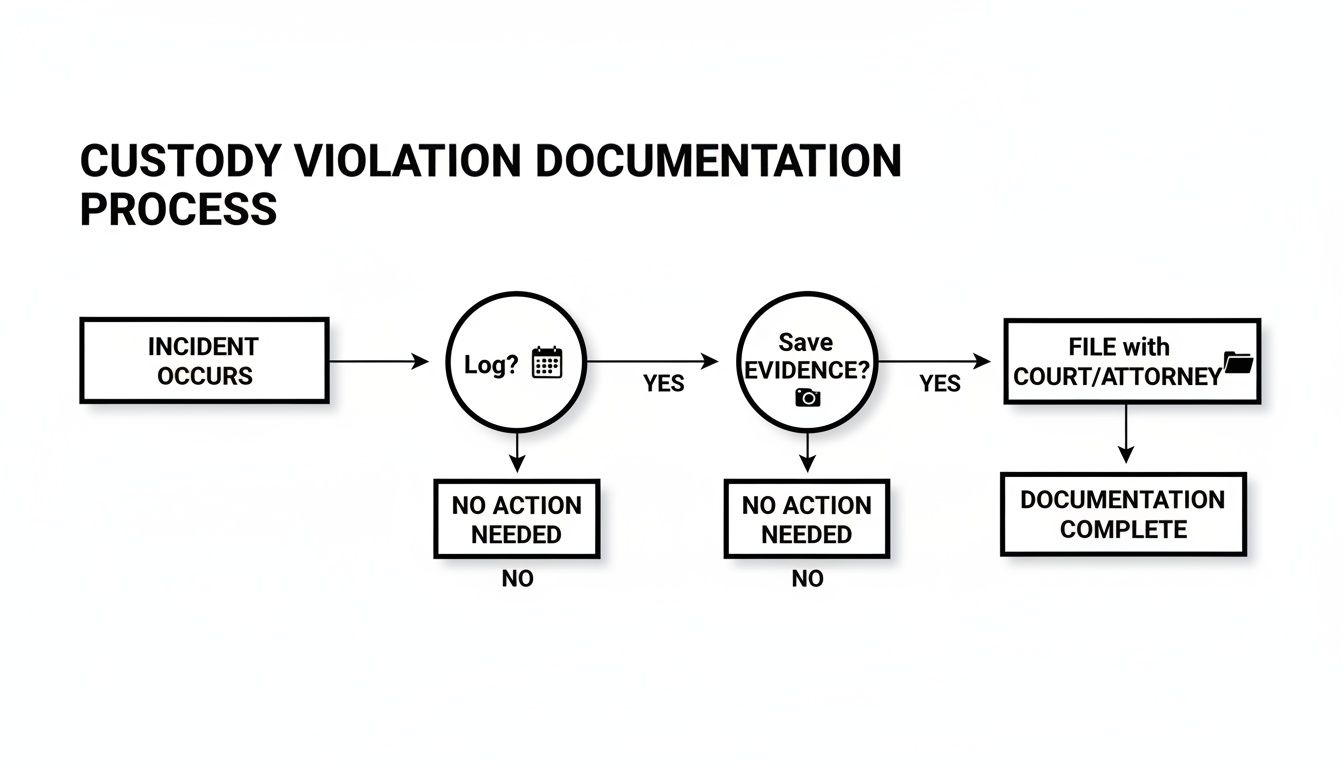
As you can see, consistent logging, saving, and organizing your evidence are the building blocks that give your case the best chance of success.
How the "Three Strikes" Law Raises the Stakes
Texas lawmakers have finally acknowledged the profound damage that repeated denials of possession cause. A groundbreaking "Three Strikes" law has been passed to dramatically increase the penalties for serial violators.
This new law, set to take effect September 1, 2026, sends an unmistakable message that using a child as a pawn will no longer be tolerated. On the third proven denial of court-ordered possession, the violation can be charged as a state jail felony.
This carries a potential punishment of up to two years in jail and thousands of dollars in fines. It's a game-changer for parents who have felt helpless in the face of repeated interference.
Knowing these legal paths exist is empowering. You are not without recourse. Whether you need to secure make-up time, get your legal fees paid, or seek more severe penalties through contempt, the law provides a clear road map to get the compliance you and your child deserve.
When Violations Justify a Custody Modification
Filing motion after motion to enforce your custody order can feel like you're stuck on a treadmill. You’re putting in the work, winning make-up time, but nothing really changes. While enforcement actions are a must for dealing with specific violations, a parent’s constant refusal to follow the rules often points to a much bigger problem: the custody order itself might not be working anymore.
When a parent repeatedly ignores a judge’s order, their actions become powerful evidence that a more permanent change is needed. This is the point where you stop playing defense and start thinking about using that pattern of violations to ask for a custody modification.
Proving a Material and Substantial Change
To change an existing custody order in Texas, you have to prove to the judge that a “material and substantial change in circumstances” has occurred since the order was signed. A long history of the other parent’s violations can absolutely be that change.
We’re not talking about one missed weekend or being late for a few exchanges. A modification becomes appropriate when the violations are so frequent or serious that they’re creating an unstable, high-conflict world for your child. The court’s number one priority is always the best interest of the child, and a parent who torpedoes a court-ordered schedule is acting directly against that interest.
Real-World Scenario: Let's say a mother has primary custody, but she constantly comes up with last-minute excuses to deny the father his weekends and holidays. She also enrolls the child in a new school without consulting him, which violates their joint managing conservatorship. The father has documented these issues for over a year and even won two enforcement motions. But the behavior just keeps happening. Here, the mother’s pattern of alienation and defiance shows she is unwilling to support the child's relationship with the other parent—a huge red flag for any judge.
When to Seek a Modification Instead of Enforcement
Choosing between another enforcement action and a full-blown modification comes down to your ultimate goal. Enforcement is about fixing what already happened. Modification is about building a better, more stable future. You should start thinking about a modification when:
- Parental Alienation Is Happening: The other parent is actively working to destroy your relationship with your child, making false claims, blocking your calls, or telling the child not to go on visits.
- The Child’s Environment Is Unstable: The violations are part of a larger, more troubling pattern, like frequent moves without notice, substance abuse, or exposing your child to dangerous people or situations.
- Enforcement Actions Aren’t Working: You’ve been to court multiple times, and while the judge gives you make-up possession, the other parent’s defiant attitude never changes.
Filing to modify custody is a major step. It’s a signal to the court that the problem goes far beyond just missed time—it's about the other parent's fundamental fitness and their ability to co-parent. You’re no longer just asking for the time you were owed; you’re asking the judge to re-evaluate who should have the right to decide where the child lives. That documented history of a custody order violation in Texas is the foundation for arguing that a new arrangement is essential to protect your child’s emotional well-being.
For a deeper dive into the legal requirements and procedures, you can learn more about how to modify custody in Texas in our comprehensive guide. This step isn’t about punishment; it’s about providing your child with the security and stability they deserve, even when one parent refuses to provide it.
Key Takeaways: Your Next Steps for Protecting Your Rights
Feeling like you're hitting a brick wall when the other parent ignores your custody order is incredibly frustrating. It's easy to feel powerless, but it's important to know you have options—and the law is on your side. Your path forward begins with shifting from frustration to a clear, confident strategy.
Your best friend in this fight is documentation. Every single missed visit, blocked phone call, or decision made without your input needs to be logged. Use a simple calendar or a co-parenting app to create a factual, detailed record. This logbook becomes the bedrock of any legal action you decide to take.
A Summary of Your Legal Toolbox
When your detailed records aren't enough to stop the violations, it’s time to pull out the legal tools designed to protect your relationship with your child.
- Motion to Enforce: This is your go-to move. It asks the court to step in, order make-up possession time, and can even require the other parent to pay for your attorney’s fees.
- Motion for Contempt: When violations are serious or a recurring problem, this motion ups the ante. It can result in fines and even jail time, sending a powerful message that ignoring a court order has real consequences.
- Custody Modification: If the violations are part of a consistent pattern, they can demonstrate a "material and substantial change" in circumstances. This opens the door to modifying the custody order itself, which could mean changing who has the right to determine the child's primary residence.
Remember, the goal isn’t to punish the other parent. It’s about enforcing the court’s order and restoring the stability your child deserves. The court will back you up when you can present a clear, consistent pattern of violations.
With recent Texas laws like the "Three Strikes" rule, which can lead to felony charges for repeat offenders who interfere with possession, your position as the compliant parent is stronger than you might think. If you are ready to put a stop to the violations and enforce your rights, the next step is to get personalized legal advice.
If you need help with a child custody or visitation case in Texas, our experienced attorneys can guide you every step of the way. Contact The Law Office of Bryan Fagan, PLLC today for a free consultation.
Common Questions We Hear About Custody Violations
When your co-parent isn’t following the custody order, it’s easy to feel frustrated, confused, and unsure of what to do next. We’ve guided thousands of Texas parents through these exact situations. Here are some of the most common questions we hear—and the straightforward, practical answers you need.
Can I Stop Paying Child Support if My Ex Is Blocking My Visits?
No. This is probably the most common—and most damaging—misconception we see in our practice. In the eyes of a Texas court, child support and visitation are two completely separate legal duties. One cannot be used as a weapon against the other.
Think of them as two different sets of rules you both have to follow. If you stop paying child support, even when the other parent is wrongfully denying you time with your child, you are now also in violation of the court order. This move seriously weakens your legal standing and opens you up to an enforcement action of your own, which could mean fines or even jail time.
The right move is to keep paying your support on time and use the proper legal channels to enforce your right to see your child.
What if My Child Doesn't Want to Go for Their Visit?
This is a heartbreaking and incredibly difficult spot for any parent. It’s natural to want to listen to your child's feelings, but your legal obligation is to follow the court's possession order. A judge will want to see that you did everything you reasonably could to get the visit to happen.
A Quick Tip from Our Attorneys: Your legal job is to get your child to the exchange point. If they refuse, don't argue. Instead, calmly document what happened. Note what your child said and what you did to encourage them to go. This shows the court you’re trying to follow the rules, which is critically important.
If your child's refusal becomes a regular thing, it might point to a bigger issue that needs to be addressed. This could be a good reason to look into counseling for your child or even file for a custody modification to tackle the root problem.
How Fast Can I Get a Judge to Enforce My Custody Order?
The timeline really depends on the court’s schedule and how urgent your situation is. Once you file a Motion to Enforce, you can typically expect a hearing to be set within a few weeks to a couple of months.
But what if you believe your child is in immediate danger? In that case, you don’t have to wait. You can seek emergency relief by filing for a Temporary Restraining Order (TRO). A judge can hear a TRO much faster—sometimes in just a few days. A TRO is designed to put immediate protections in place while the bigger legal questions get sorted out.
If you need help with a child custody or visitation case in Texas, our experienced attorneys can guide you every step of the way. Contact The Law Office of Bryan Fagan, PLLC today for a free consultation.