
When your child’s future is on the line, understanding your rights is the first step toward finding peace of mind. Custody agreements in Texas, which the law officially calls parenting plans or orders, are the bedrock documents that create stability and predictability for you and your child. This guide is here to break down these complex legal concepts into plain English, offering practical guidance for mothers and fathers navigating this emotional journey.
Navigating Your Child's Future in Texas

Facing a custody case can feel overwhelming. It's an emotional time, and the legal language can be intimidating. But it’s important to remember that a custody agreement isn't about one parent winning and the other losing. It's a roadmap designed to help you and the other parent co-parent successfully, even though you are no longer together.
The goal is to build a consistent, loving environment that allows your child to thrive. This guide is written for parents, grandparents, and caregivers seeking clarity on their rights and options. We will demystify Texas custody law, validate your concerns, and empower you with the knowledge to make the best decisions for your family.
What is a Texas Custody Agreement?
At its core, a Texas custody agreement is an enforceable court order that clearly defines the rights and responsibilities of each parent. Think of it as a comprehensive co-parenting rulebook, not just a visitation calendar. A well-drafted agreement provides structure, minimizes future conflicts by setting clear expectations, and ensures your child’s life remains as stable as possible.
Under Texas Family Code Chapter 153, every decision in a custody case must be based on the "best interest of the child." This is the guiding principle for judges, attorneys, and parents throughout the entire process.
To help you understand what this means for your family, let's look at the key components of every Texas custody agreement.
Core Components of a Texas Custody Agreement
Every family is unique, but all parenting plans share a common foundation. This table breaks down the essential pieces you'll find in nearly every Texas custody order.
| Component | What It Means for Your Family | Typical Arrangement in Texas |
|---|---|---|
| Conservatorship | This term refers to who has the legal right to make major decisions for your child, such as those concerning school, healthcare, and religious upbringing. It’s about parental rights, not just physical time. | Most parents are named Joint Managing Conservators, sharing decision-making rights. Often, one parent has the exclusive right to determine the child’s primary residence. |
| Possession and Access | This is the legal term for the visitation schedule. It details when the child will be with each parent—weekdays, weekends, holidays, and summer vacations. | Texas has a Standard Possession Order (SPO) that courts often use as a default schedule, but parents are encouraged to create a custom schedule that fits their family’s needs. |
| Child Support | This section outlines the financial obligations of each parent. It ensures the child's needs (food, housing, medical care) are met, based on state guidelines. | The non-primary parent typically pays monthly child support, which is calculated as a percentage of their net monthly income. |
Understanding these three pillars—Conservatorship, Possession, and Support—is the first step toward building a strong and effective parenting plan for your child.
Why a Formal Court Order is Crucial
Many parents start with an informal, handshake agreement, believing they can work things out as they go. While cooperation is wonderful, an informal deal is not legally enforceable. If a disagreement arises, you have no legal power to protect your time with your child or enforce the other parent's obligations.
Only a court order signed by a judge gives you the legal authority to enforce your rights. It transforms your agreed-upon terms into a binding document, giving both you and your child the security and predictability you deserve.
How Texas Determines Custody: Decoding the Legal Language

Navigating a Texas custody case can feel like learning a new language. You will hear terms like "conservatorship" and "possession schedule" that sound cold and impersonal. Don't let the jargon intimidate you.
These are simply the state’s terms for the two most fundamental parts of co-parenting: who makes the big decisions, and when and where the child will be with each parent. Once you understand the language, you’ll feel more confident and in control, whether you're negotiating with your co-parent, working with a mediator, or presenting your case to a judge.
Conservatorship: Who Makes the Big Decisions?
In Texas, we don't typically use the word "custody." Instead, the law refers to conservatorship. This isn't about where your child sleeps at night; it’s about which parent has the right to make critical life decisions for them.
These major decisions shape a child's upbringing and include:
- Medical Care: Who chooses the pediatrician and consents to medical procedures?
- Education: Who decides which school your child attends?
- Mental Health: Who consents to therapy or counseling if your child needs support?
- Religious Upbringing: Who guides the child’s spiritual or religious life?
Texas law begins with the presumption that it's best for children when both parents remain actively involved. You can learn more about how these rights and duties are divided in our detailed guide on conservatorship in Texas. The court will establish one of two types of arrangements.
Joint Managing Conservatorship
This is the most common arrangement in Texas courts. A Joint Managing Conservatorship means both parents share the rights and responsibilities of raising their child. You are expected to work together as a team on important matters.
However, "joint" doesn't always mean a 50/50 split of every decision. Usually, one parent is named the primary conservator. This parent has the exclusive right to decide where the child lives (often within a specific geographic area) and is typically the one who receives child support payments.
Sole Managing Conservatorship
This arrangement is far less common and is reserved for serious situations. A court will only grant one parent Sole Managing Conservatorship if there is evidence that giving the other parent joint decision-making rights would harm the child. This gives one parent the exclusive authority to make most major decisions without consulting the other parent. We typically see this in cases involving a history of family violence, substance abuse, neglect, or extreme conflict that makes co-parenting impossible.
Possession and Access: The Visitation Calendar
Once the decision-making framework (conservatorship) is established, the next step is to determine the physical time each parent spends with the child. In Texas, the visitation schedule is called a Possession and Access schedule, often shortened to a "possession order."
This is the detailed calendar that maps out when the child will be with each parent, covering:
- Regular weekends and weekdays during the school year.
- Major holidays like Thanksgiving and Christmas.
- Spring Break and summer vacation.
To ensure consistency for families, Texas law provides a template called the Standard Possession Order (SPO). The SPO is a detailed, presumptive schedule that courts often use as a starting point. While it works well for many families, it is not mandatory. You and your co-parent have the freedom to create a custom schedule that better suits your lives, as long as a judge agrees it is in your child’s best interest.
The "Best Interest of the Child" Standard

When a Texas judge makes a decision about your children, every ruling is viewed through one powerful lens: the “best interest of the child.” This is not just a legal phrase; it is the absolute bedrock of Texas family law.
This guiding principle ensures the court’s focus remains on your child’s well-being, not on what might seem “fair” to the parents. It recognizes that children need safety, stability, and love to thrive. Understanding what this standard truly means to a judge is one of the most powerful things you can do as a parent, as it helps you frame your case around what matters most.
What Are the Holley Factors?
How does a judge determine what is in a child’s best interest? To make consistent and fair decisions, Texas courts use a checklist known as the “Holley Factors.” These factors originated from a landmark 1976 Texas Supreme Court case and give judges a framework for evaluating a family’s circumstances.
It is not a test with a score. Instead, the court considers all factors together to get a complete picture.
The court's primary consideration shall always be the best interest of the child. This guiding principle is woven into every part of the Texas Family Code dealing with conservatorship, possession, and access.
Preparing for your case means being ready to explain how your actions and home environment align with these crucial points.
Key Factors a Judge Will Consider
While the list is not exhaustive, the Holley Factors provide a clear window into a judge's thinking. Whether you are a mother or a father, you should be prepared to address how you meet your child’s needs in these areas:
- The Child’s Needs: This covers your child’s emotional, physical, and developmental needs, both now and in the future. The court will consider who has been the primary caregiver—the parent who knows the daily routines, comforts fears, and celebrates joys.
- Parental Abilities: This evaluates each parent’s capacity to provide a safe, stable, and nurturing home. It includes emotional stability, parenting skills, and the ability to prioritize the child’s needs over personal conflicts.
- A Stable Home Environment: Children thrive on consistency. The court looks closely at the stability of each parent’s home and their plans to maintain that stability.
- Dangers to the Child: A judge has a duty to protect the child from potential physical or emotional harm. This includes any history of family violence, neglect, substance abuse, or placing the child in unsafe situations.
- The Child’s Wishes: For children age 12 or older, a judge may interview them privately to hear their preferences. While the child's wishes are not the final word, they are a factor the judge will consider.
Focusing on these factors helps you shift your energy from past conflicts toward building the future you want for your child. When you present your case in this way, you are speaking the court’s language and advocating effectively for your child’s well-being.
How to Create Your Custody Agreement
It’s easy to feel like a judge holds all the power in a custody case, but you and your co-parent have a significant opportunity to shape your family’s future yourselves. Reaching your own custody agreement through negotiation or mediation puts you in control. It almost always leads to better long-term co-parenting and saves you the emotional and financial cost of a courtroom battle.
Working together allows you to create a plan that fits your family’s real-world needs. The key is to have a clear process, understand your legal rights, and keep your child’s best interest at the center of every conversation.
The Path to a Signed Order
Creating an enforceable custody agreement is a process. It involves gathering facts, discussing terms, and getting the final document approved by a judge. An informal handshake deal offers zero legal protection when a disagreement arises.
Here are the essential steps to turn your discussions into a binding Texas court order:
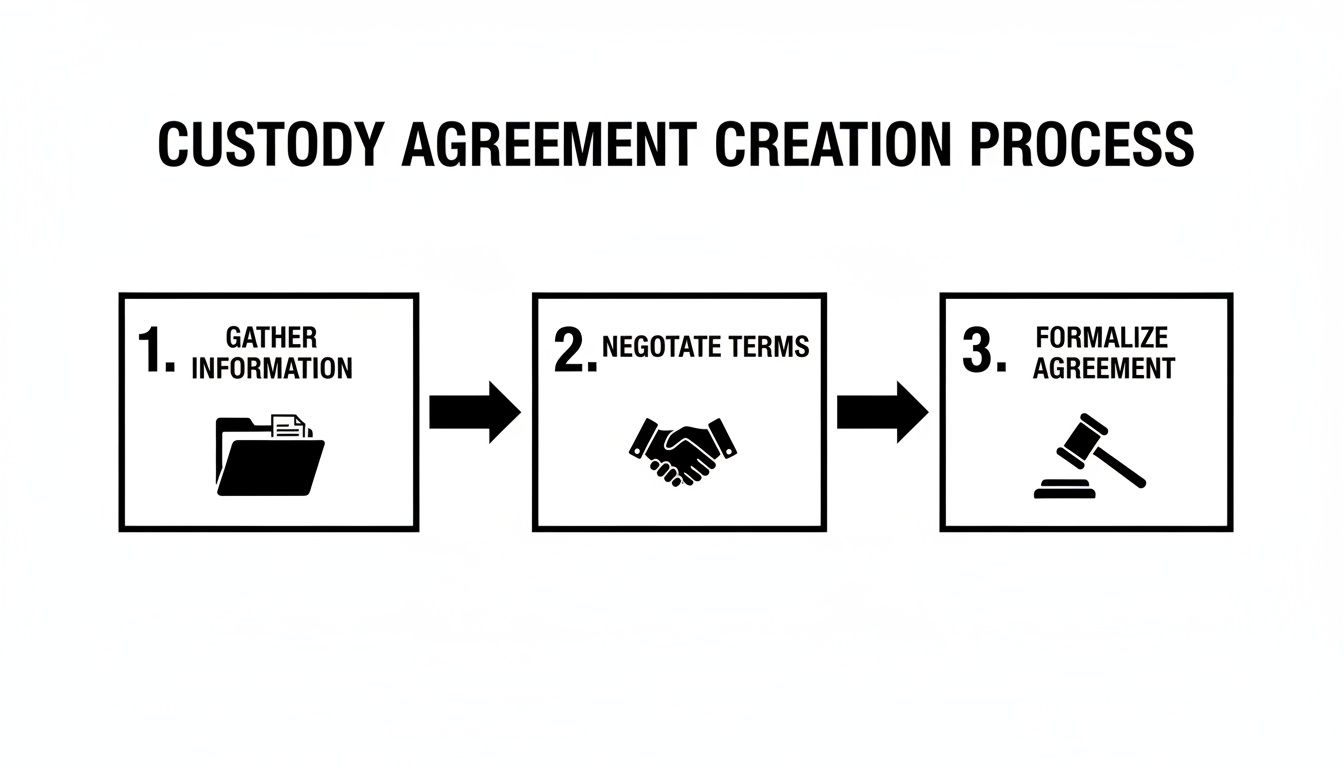
- Gather Essential Information: Collect documents related to your child's life: school schedules, medical records, costs for activities, and anything that illustrates their daily needs.
- Negotiate the Terms: Discuss the core components—conservatorship, the possession schedule, and child support. This can happen directly, through your lawyers, or with a neutral mediator.
- Draft the Agreement: Once you agree on the major points, your attorney will draft a formal legal document, often called an Agreed Final Decree of Divorce or an Order in Suit Affecting the Parent-Child Relationship.
- Formalize with the Court: A judge must review and sign your agreed order. That signature is what transforms your private agreement into a legally binding and enforceable court order.
Negotiation vs. Mediation
Direct negotiation can work if communication with your co-parent is still respectful. For many, however, mediation is a powerful tool. In mediation, a neutral professional facilitates a productive conversation, helping you find common ground and creative solutions in a confidential setting. While not for family law, reviewing resources like Service Level Agreement Templates can illustrate how agreements are structured for clarity.
The Fit Parent Presumption: A Key Legal Standard
When creating custody agreements in Texas, it is essential to understand the "Fit Parent Presumption." This legal principle reinforces the fundamental rights of biological parents. Texas law starts with the position that a fit parent acts in their child's best interest.
This becomes critical in cases where non-parents, such as grandparents, seek custody. A major legal update, effective September 1, 2025, makes this presumption even stronger. Under the new law, a non-parent must prove with clear and convincing evidence that denying their request would cause significant harm to the child—a much higher legal standard.
Key Takeaway: The law presumes that you, as a parent, know what is best for your child. This gives you a powerful legal shield for your parental rights.
This standard should give you confidence, knowing that your parental authority is respected by the court. To help structure your terms, our firm offers a practical parenting plan template to get you started.
How Child Support and Custody Are Connected
Child support and custody are two sides of the same coin. In Texas, they are intrinsically linked. The possession schedule and the designation of a primary conservator directly impact who pays child support and how much.
Texas law uses a straightforward percentage-based formula to ensure fairness and predictability. The calculation is based on the paying parent’s net monthly resources, providing consistency for families across the state.
Texas Child Support Guidelines
Under Chapter 154 of the Texas Family Code, courts use a standard calculation model. This is a tiered percentage system that scales based on the number of children.
Net resources include not just gross salary but also the income left after mandatory deductions like federal income taxes, social security, and the cost of the child's health insurance. This provides a realistic picture of a parent's ability to pay.
The standard guidelines are:
- For one child: 20% of net resources
- For two children: 25% of net resources
- For three children: 30% of net resources
- For four children: 35% of net resources
- For five or more children: 40% of net resources
For a deeper dive, explore our complete guide on how to calculate child support in Texas.
A Quick Example
Imagine a non-primary parent has $5,000 in net monthly resources and one child. Using the standard 20% rate, their base child support payment would be $1,000 per month.
This amount can be adjusted. If that parent has possession of the child for significantly more time than the standard schedule outlines, a judge may reduce the amount to reflect the additional costs they are covering.
It is also crucial to know that Texas lawmakers recently updated child support laws. Effective September 1, 2025, the cap on net monthly resources used for calculations will increase from $9,200 to $11,700. This change will impact maximum support amounts for higher-income families, increasing the maximum support for one child from $1,840 to $2,340.
This cap increase is a big deal. It provides a stronger financial safety net for children in Texas.
How Your Possession Schedule Changes Things
Your time with your child has a direct financial impact. More overnight stays with the non-primary parent can often lead to a reduction in their monthly child support payment.
- The Primary Conservator is typically the parent who receives support to help cover the child's daily living expenses.
- The Non-primary Parent is the one who usually pays support. However, if their possession schedule is expanded, the court can adjust the payment downward.
Comparing the Old vs. New Child Support Caps
Here's a quick comparison of the maximum child support amounts before and after the cap increase.
Texas Child Support Cap Changes (Effective Sep 1, 2025)
| Number of Children | Old Maximum Support (Based on $9,200 Cap) | New Maximum Support (Based on $11,700 Cap) |
|---|---|---|
| 1 | $1,840 | $2,340 |
| 2 | $2,300 | $2,925 |
| 3 | $2,760 | $3,510 |
| 4 | $3,220 | $4,095 |
| 5+ | $3,680 | $4,680+ |
When to Think About Modifying Child Support
Life changes, and a child support order may become outdated. Certain major life events can justify asking the court to review and modify the amount.
You may have grounds for a modification if:
- There's been a major income change for either parent (typically a 20% increase or decrease).
- The custody schedule has changed substantially.
- There has been another material and substantial change in circumstances.
Steps to Modify or Enforce a Custody Order
Life is not static. Jobs change, children grow, and family needs evolve. A custody agreement in Texas that worked perfectly years ago might feel outdated today. The good news is that a court order isn't set in stone.
Texas law provides two powerful legal tools for parents: one to change an order to fit new realities (modification), and another to compel a parent who isn't following the rules to comply (enforcement).
Changing Your Order Through Modification
To formally change your custody, visitation, or child support order, you must file a Petition to Modify the Parent-Child Relationship. You must prove two things to the court:
- There has been a material and substantial change in circumstances since the last order was signed.
- Changing the order is in your child's best interest.
A "material and substantial change" is the legal key that unlocks the door to a modification. Without it, a court is unlikely to alter the existing order.
Common examples that may justify a modification include:
- A Parent's Relocation: One parent plans to move a significant distance, making the current schedule unworkable.
- Changes in a Child's Needs: As children age, their needs, activities, and preferences can shift dramatically.
- A Parent's Unstable Lifestyle: One parent develops issues with substance abuse or criminal activity that could endanger the child.
- Denial of Possession: A consistent pattern of one parent refusing to follow the visitation schedule.
Upholding Your Rights Through Enforcement
What happens when your co-parent ignores the court order? If they consistently deny your scheduled visitation time, you can file a Motion for Enforcement. This legal action asks a judge to force the other parent to comply with the order.
If the court finds they have violated the order, the consequences can be serious. A judge may order make-up visitation time, issue fines, or even sentence the non-compliant parent to jail time for contempt of court. Your custody agreement in Texas is a powerful legal document, and knowing how to enforce it is as important as knowing how to create it.
Key Takeaways and Next Steps
You have already taken the most important step: arming yourself with knowledge. As you move forward, remember that every decision a judge makes will be based on the best interest of the child, and Texas law favors Joint Managing Conservatorship because it believes children benefit from having both parents involved.
Most critically, only a formal court order offers true legal protection. A handshake agreement is unenforceable. Your child’s stability depends on having a clear, legally binding plan.
Charting Your Course
The road ahead may feel uncertain, but you have the power to steer this process toward a positive outcome. Focus on these practical next steps:
- Gather Your Documents: Collect school records, medical information, and anything that paints a picture of your child's daily life.
- Explore Cooperative Options: Seriously consider mediation. It empowers you and your co-parent to control the outcome.
- Define Your Goals: Get clear on what a stable, loving future looks like for your child. This vision will be your guide.
This process is about building a secure foundation for your child to stand on for years to come. Your dedication to understanding custody agreements in Texas demonstrates your commitment as a parent. Hold onto that strength—it will guide you through this. For other situations requiring clear legal communication, you might find insights in guides about drafting specific legal letters in Texas.
If you need help with a child custody or visitation case in Texas, our experienced attorneys can guide you every step of the way. Contact The Law Office of Bryan Fagan, PLLC today for a free consultation. You can reach us at https://texascustodylawyer.net.