
When your child’s future is on the line, understanding your rights matters most. As you navigate a divorce or separation, your role as a parent is the one thing that remains constant. One of the first terms you will encounter is joint legal custody, and it’s a critical concept to understand. Think of it as a shared partnership where both parents have a legal right and responsibility to make major decisions that shape a child's life, even if the child lives primarily with one parent. It’s about ensuring both of you have a voice in your child’s future.
Defining Joint Legal Custody in Texas

Navigating a custody case can feel like learning a new language. Legal terms are used frequently, and it's easy to feel overwhelmed. Let's start by clarifying one of the most common points of confusion: legal custody is not about where your child sleeps at night.
Legal custody is about decision-making power. Physical custody, which Texas law calls a possession schedule, is about the day-to-day logistics—who has the child and when. They are two different, but equally important, concepts.
Here in Texas, the official term for joint legal custody is Joint Managing Conservatorship. This arrangement is the strong preference of Texas courts because it is founded on a simple yet powerful principle: children thrive when both parents are actively and meaningfully involved in their lives. It is the state's way of promoting co-parenting and ensuring children continue to receive the love and guidance they need from both sides of the family.
Key Custody Concepts at a Glance
To make this crystal clear, let's put these core ideas side-by-side. Grasping the difference between who makes the big decisions (legal custody) and who handles the daily routine (physical possession) is the foundation for creating a parenting plan that works for your family.
| Custody Type | Decision-Making Authority | Primary Focus |
|---|---|---|
| Joint Legal Custody (Joint Managing Conservatorship) | Both parents share the right and responsibility to make major decisions about the child's welfare (think school, healthcare, and religion). | Shared parental responsibility and cooperation. |
| Physical Possession (Possession Schedule) | The parent who has the child at any given time handles the routine, daily decisions (like what's for dinner or when bedtime is). | The child's daily care and parenting time schedule. |
This shared approach to parenting isn't just a Texas thing; it’s become the standard across the nation. The movement toward joint custody laws started way back in 1973 and has since been adopted by nearly every state, completely changing how family courts handle custody after a separation. For a deeper dive, you can discover more insights about the history of joint custody laws and their effects on families.
The guiding principle behind every custody decision, especially a Joint Managing Conservatorship, is what’s in the “best interest of the child.” This isn't just a phrase; it's the legal standard that every judge uses to make a ruling, focusing entirely on what will support a child’s emotional, physical, and developmental well-being.
How Texas Determines Custody: Joint Managing Conservatorship
When Texas courts are involved in your family’s life, they operate from one core belief: your child will thrive when both parents are actively and meaningfully involved. This isn’t just a nice idea; it's the foundation of Joint Managing Conservatorship, which is the legal term Texas uses for joint legal custody. Think of it as the default setting for nearly every custody case in the state.
The court automatically presumes that this shared parenting setup is in the “best interest of the child.” That phrase is more than just courtroom jargon. It’s the legal measuring stick a judge uses for every single decision, ensuring the final orders will support your child's emotional, physical, and developmental health.
The Best Interest of the Child Standard
So, what does “best interest of the child” actually look like in practice? It’s not a simple checklist. Instead, it’s a whole collection of factors a judge has to weigh to get a complete picture of your family’s situation. Their goal is to figure out what arrangement will create the most stable, secure, and nurturing home for your child.
The Texas Family Code requires judges to consider several key elements, including:
- Your child’s emotional and physical needs, both right now and down the road.
- Any potential emotional or physical danger the child might face.
- Each parent’s ability to provide a stable home and co-parent effectively.
- Any programs or resources available to help you and the other parent do what's best for your child.
- The specific plans each of you has for the child's future.
- The overall stability of the homes you are each proposing.
The court’s job is to piece all of this together to understand your child’s life from every angle. It's a holistic approach designed to protect your child’s well-being above everything else.
Primary vs. Non-Primary Roles Explained
Even within a Joint Managing Conservatorship, the court will typically name one parent as the primary conservator. This doesn't make them the "better" parent or give them more rights across the board. It simply means they have the exclusive right to decide where the child lives, usually within a certain geographic area.
The primary parent is often the one who receives child support payments and establishes the child's main home. The other parent, sometimes called the non-primary conservator, has a detailed possession schedule and equally important rights and duties regarding the child.
This structure is designed to give a child a stable home base while making sure the other parent stays consistently and deeply involved. Both parents still share the big-picture decision-making for things like school and healthcare. It’s a balanced approach that’s central to the Texas view on raising kids after a separation, which you can read more about in this detailed guide on conservatorship in Texas. Understanding these distinct roles is the first step to building a parenting plan that truly works for your child and protects your rights.
When a Texas court names you a Joint Managing Conservator, it’s not just a fancy legal title—it’s the official roadmap for how you and your ex will continue to raise your child. Getting a handle on this roadmap is the secret to co-parenting well and giving your child the security they crave. The whole idea is built on teamwork: both parents staying involved and shaping their child’s life together, sharing the big decisions that count.
But what does that actually mean on a Tuesday afternoon or a Sunday morning? It means you and your co-parent have to talk, collaborate, and agree on the big-picture stuff. Think major decisions like where your child goes to school, what kind of medical care they get, and choices about their religious upbringing. These are the cornerstones that build a stable, consistent world for your kid.
Shared Decisions vs. Independent Rights
While joint legal custody is all about shared responsibility, Texas law is practical. It knows that not every little thing requires a committee meeting. The law strikes a careful balance between the rights you must exercise together and those you can handle on your own. Nailing down this distinction is key to cutting down on conflict and being able to act fast when your child needs you.
For example, you absolutely have to agree on a major, non-emergency surgery for your child. But if your child takes a tumble at the park on your watch and needs stitches? You have every right to consent to emergency medical treatment right then and there, no permission needed. The law ensures you can always step up to protect your child's immediate health and safety.
It's helpful to see how these rights usually get divided up.
-
Decisions Requiring Joint Agreement: These are the heavy hitters—the choices with long-term effects on your child’s life. This list nearly always includes picking a school district, agreeing to non-emergency surgeries or medical procedures, and making decisions about psychological care.
-
Rights You Each Have Independently: No matter who has the kids for the weekend, both parents generally keep the right to see their child's medical and school records, show up for parent-teacher conferences and soccer games, and be listed as an emergency contact.
-
Day-to-Day Decisions: This is simple. The parent who has the child at the time makes the routine calls. What's for dinner, when does homework get done, and how is screen time managed? That’s up to the parent on duty.
Thinking about it from a broader perspective, successful co-parenting really hinges on good communication and cooperation. It's interesting to note that researchers have found that these kinds of shared arrangements are often most successful among parents who have the resources and skills to communicate effectively. One Canadian study found these arrangements were more common among parents with higher education and income levels, which really just highlights how critical strong co-parenting skills are.
To make things even clearer, here’s a table breaking down which parental rights are typically shared versus which can be exercised on your own.
Shared vs. Independent Parental Rights
| Decision Category | Typically Requires Joint Agreement? | Example |
|---|---|---|
| Education | Yes | Choosing the child's school district or enrolling them in private school. |
| Non-Emergency Medical | Yes | Consenting to braces or a tonsillectomy. |
| Emergency Medical | No | Rushing to the ER for a broken arm. The parent present can consent. |
| Psychological Care | Yes | Deciding if the child should see a therapist or counselor regularly. |
| Religious Upbringing | Yes | Deciding on the child's formal religious affiliation or instruction. |
| Extracurriculars | Often No for minor activities, Yes for major commitments | Signing up for a weekend art class (No). Enrolling in a competitive travel sports league with high costs and time demands (Yes). |
| Access to Records | No | Both parents can independently access school grades and medical records. |
| Daily Choices | No | The parent with possession decides on meals, bedtime, and daily discipline. |
This table gives you a general idea, but your specific court order is the ultimate guide. Always refer back to it.
The Role of the Primary Conservator
To prevent constant stalemates on every single issue, a Texas court order usually gives one parent a few specific, exclusive rights. This parent is called the primary conservator. Most importantly, the primary parent is typically given the exclusive right to decide where the child lives, though it's usually limited to a certain geographic area, like a specific county or school district.
This doesn't mean the primary parent is "in charge" or has more power across the board. It's a practical solution designed to give the child a stable home base and a clear answer to the question, "Where do I live?" The primary parent also usually has the exclusive right to receive child support payments for the child.
This structure provides much-needed clarity and stops arguments over the child’s primary residence before they start. But remember, all the other major decisions—from school choices to healthcare—are still a shared responsibility. While this setup works great for many families, it’s just one way to structure custody. To get the full picture, it’s worth taking a look at our guide on joint custody vs. sole custody in Texas.
Taking the time to truly understand the rights and duties spelled out in your court order is one of the most powerful things you can do. It lets you parent with confidence, knowing exactly where your responsibilities begin and end.
Making Sense of Possession Orders and Schedules
It’s one of the first questions almost every parent asks: "If we have joint custody, does that mean our child spends exactly half the time with me and half with my ex?" It’s a perfectly logical question, but in the world of Texas family law, the answer is usually no. This is where a lot of confusion comes in, so let's clear it up.
Think of it this way: joint legal custody (what Texas calls Joint Managing Conservatorship) is about sharing the right to make big decisions for your child. The actual day-to-day calendar of when your child is with each parent is a completely separate thing. That schedule is laid out in what the law calls a possession order.
How Possession Schedules Work in Texas
Even when parents are named Joint Managing Conservators, the court will almost always designate one parent as the primary conservator. This is the parent who has the exclusive right to decide where the child lives, though it's usually restricted to a certain geographic area, like a specific county or school district. This gives the child a stable home base for school and activities.
The other parent, sometimes called the non-primary conservator, then has a visitation schedule detailed in that possession order. The whole point is to create a predictable, consistent routine that allows the child to have a strong and healthy relationship with both parents.
The goal is to protect the simple, stable rhythm of a child's daily life, as you can see below.
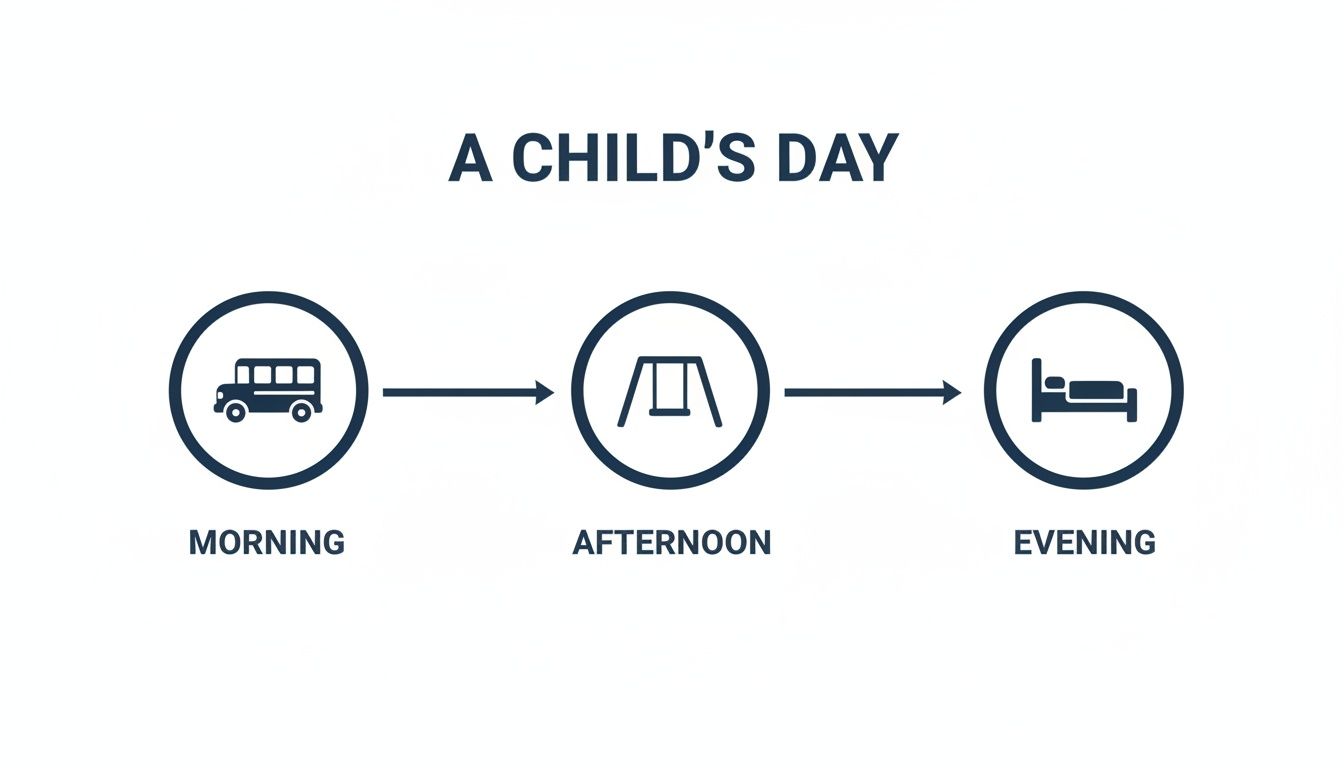
This image really drives home the main objective of any schedule: making sure a child’s day flows smoothly, no matter which parent’s house they woke up in that morning.
The Texas Standard Possession Order (SPO)
To give families a reliable and consistent starting point, Texas law created a default schedule known as the Standard Possession Order (SPO). It’s presumed by courts to be in the child's best interest and serves as the foundation for most custody cases.
Under a typical SPO, the non-primary parent will have the child on:
- The first, third, and fifth weekends of a month.
- Alternating major holidays, like Thanksgiving and Christmas.
- An extended period in the summer, usually 30 days.
This framework is built to give both parents predictable and meaningful time with their kids. For a much deeper dive, you can check out our complete guide on understanding child visitation and Standard Possession Orders in Texas. The SPO is a solid framework, but it's not your only option.
Creating a Custom Schedule for Your Family
While the SPO is common, it’s certainly not a one-size-fits-all solution. Every family has its own rhythm. You and your co-parent know your child's needs, your work demands, and your family's unique circumstances better than anyone. Because of this, Texas courts actually encourage parents to work together and create a customized possession schedule that truly fits their lives.
You might agree to a week-on, week-off schedule, give one parent every weekend, or design something totally different for the summer months. As long as you both agree on the plan and it serves your child’s best interests, a judge will almost certainly sign off on it.
Key Takeaway: The best possession schedules are the ones that put your child’s stability and routine first. Whether you stick with the Standard Possession Order or hammer out a custom plan, the goal is always the same: to make sure your child feels secure and maintains a strong, ongoing relationship with both of you.
Working through these scheduling details can be tough, no doubt about it. But getting it right is one of the most important steps you can take to build a healthy co-parenting future. A clear, predictable schedule cuts down on conflict and lets your child focus on just being a kid.
Navigating Disagreements and Co-Parenting Challenges

Let's be realistic: even with the best intentions, parents with joint legal custody are going to disagree. Life is complicated. Making big decisions about your child’s health, education, or future can stir up strong emotions and bring old conflicts back to the surface.
The key isn't trying to avoid conflict entirely—that’s impossible. It’s about having a healthy, productive way to resolve it when it pops up.
Successful co-parenting is built on solid communication and a shared promise to put your child’s well-being first. When you and your co-parent can talk through differences respectfully, you’re not just solving a problem; you’re modeling resilience for your child. But when communication breaks down, you need a backup plan.
Proactive Tools for Preventing Disputes
The best way to handle disagreements is to stop them from escalating in the first place. Your most powerful tool here is a detailed, well-thought-out parenting plan. This document, which becomes part of your court order, lets you outline exactly how you'll handle specific decisions before they ever become a source of conflict.
Consider including clauses that address:
- A tie-breaking mechanism: For certain issues, you might agree ahead of time that one parent has the final say if you reach a stalemate. This can be a lifesaver.
- Specific decision-making protocols: You can agree to follow a pediatrician's recommendations for medical issues or a school counselor's advice for educational choices. This takes the personal battle out of it.
- A requirement to use a co-parenting app: These platforms create a written record of communication, which encourages accountability and helps keep conversations focused on the facts, not feelings.
By planning ahead, you create a clear roadmap. It reduces stress for you, your co-parent, and most importantly, your child.
Using Mediation to Find Common Ground
When you can’t reach an agreement on your own, mediation is usually the next logical step. In fact, many Texas courts will require you to try mediation before they’ll even hear your dispute. This isn't about one parent "winning" and the other "losing."
Mediation is a confidential process where a neutral third-party mediator helps you and your co-parent talk through your differences. Their job is to help you find a mutually acceptable solution in a cooperative, not adversarial, environment. The goal is to empower you to create your own agreement, which is almost always more durable than one a judge imposes on you.
A mediator doesn't make decisions for you. Instead, they facilitate a conversation, help you see the issue from different angles, and guide you toward a compromise that serves your child’s best interests.
For some kids, adapting to new living arrangements and parental disagreements can be really tough. If you notice your child is struggling, it might be helpful to consult A Parent's Guide to Counseling for Kids for some supportive resources.
When to Seek a Court Modification
Sometimes, despite your best efforts, you and your co-parent simply cannot agree on a major issue. If the disagreement is significant and truly impacts your child's welfare—like a conflict over necessary medical treatment or a major educational path—you may need to ask the court to step in.
This is done by filing a Petition to Modify the Parent-Child Relationship. To be successful, you have to prove two things: that there has been a material and substantial change in circumstances since your last order was signed, and that changing the order is in the child's best interest. A judge can then rule on that specific issue, giving you a final decision when you couldn't reach one yourselves.
Handling these challenges requires patience, strategy, and a clear understanding of your legal options. By using these tools, you can shield your child from unnecessary conflict and continue to provide the stable, supportive environment they deserve.
Key Takeaways: What Really Matters
Trying to make sense of joint legal custody can feel like assembling furniture with instructions in another language. But once you grasp the basic idea, you have the power to build a better future for your child. The key thing to remember is that Texas law, through what it calls Joint Managing Conservatorship, is built on one simple belief: kids do best when both parents stay in the picture.
This isn't just about splitting holidays or following a visitation calendar. It’s about working together on the big-picture decisions that will shape your child's life.
The Bottom Line: Three Things to Keep in Mind
As you move forward, keep these core truths front and center. They'll help you stay grounded and focused on what's important.
- It’s About Decisions, Not Location: Joint legal custody is about your right to have a say in major choices—school, healthcare, and religion. It's a totally different thing from the possession schedule, which is the nitty-gritty of where your child sleeps each night.
- The "Best Interest of the Child" Is the Only Rule That Matters: Every single decision a Texas judge makes is measured against this standard. It’s all about creating a safe, stable, and supportive world for your kid.
- Good Communication Is Your Superpower: A solid, detailed parenting plan is your best defense against future arguments. And when you do hit a roadblock, tools like mediation are there to help you find a solution without having to fight it out in court.
Think of your court order as the official roadmap for your co-parenting journey. The single most powerful thing you can do to protect your family and keep conflict to a minimum is to know exactly what that roadmap says about your rights and responsibilities.
Once you understand these takeaways, you can shift your energy away from the stress of the legal fight and toward the goal that really counts: building a stable, loving future for your child. Joint legal custody works when both parents decide to communicate clearly and always put their child first.
If you need help with a child custody or visitation case in Texas, our experienced attorneys can guide you every step of the way. Contact The Law Office of Bryan Fagan, PLLC today for a free consultation.
Frequently Asked Questions About Joint Legal Custody
Trying to make co-parenting work can feel like assembling furniture without instructions—you know what the end goal is, but the steps in between can be confusing. Here are some straightforward answers to the questions we hear most often from Texas parents navigating joint legal custody.
Can one parent make a decision without the other in an emergency?
Yes, absolutely. Texas law is built for real life, not just for the courtroom. If your child breaks their arm at the playground or spikes a high fever in the middle of the night while they're with you, you have the right to get them immediate medical help.
You don't need to track down your co-parent for permission before heading to the ER. Your child's health and safety always come first.
Does joint legal custody get rid of child support?
This is one of the biggest myths we have to bust. The short answer is no. Joint legal custody (or Joint Managing Conservatorship) is all about shared decision-making, not money. Child support and custody are two separate issues in the eyes of Texas law.
Typically, the court will name one parent as the primary conservator—the one who decides where the child lives. That parent almost always receives child support from the other parent to help with the day-to-day costs of raising a child, no matter how you share decision-making.
What can I do if my co-parent won’t cooperate?
It’s incredibly frustrating when a co-parent refuses to communicate or just ignores what the court order says. Your first move should always be to document everything in writing. If talking it out isn't working, mediation is usually the next logical step. In fact, most Texas courts require you to try mediation before you can ask a judge to step in.
But if your co-parent is consistently breaking the rules or making unilateral decisions that hurt your child, it might be time for stronger action. You may need to go back to court by filing an enforcement action or a petition to modify the custody order.
How do we change our custody agreement if our lives change?
Life happens. People move, jobs change, and kids grow up with different needs. Your custody order isn't set in stone forever; it can be adapted. To make a formal change, one of you will need to file a Petition to Modify the Parent-Child Relationship.
To get a modification approved, you'll have to show the court two things:
- There has been a material and substantial change in your life, your co-parent's life, or your child's life.
- Making the change is in the child's best interest.
This could be anything from a parent needing to relocate for a new job to a teenager's schedule making the old visitation plan impossible.
If you need help with a child custody or visitation case in Texas, our experienced attorneys can guide you every step of the way. Contact The Law Office of Bryan Fagan, PLLC today for a free consultation at https://texascustodylawyer.net.