
When your child’s future is on the line, understanding your rights matters most.
If you're facing a breakup, divorce, paternity case, or a sudden custody dispute involving a toddler, you're probably carrying a special kind of fear. Your child is too young to explain what they need. They may still nap twice a day, cling to one bedtime routine, or struggle when they're away from a primary caregiver for too long. That makes custody for toddlers texas very different from custody for older children.
Texas courts know that, too.
A toddler custody case isn't just about splitting time. It's about building a plan that protects attachment, routine, safety, and your relationship with your child. The legal terms can feel cold at first, but they serve a practical purpose. They help a judge decide who makes decisions, where the child lives, and how parenting time should work in a way that supports a very young child.
You don't need to know every statute by heart to move forward. You do need to understand the basics clearly. That starts with your rights, your child's needs, and the court's main question: what arrangement is in your toddler's best interest?
Your Toddler's Future and Your Parental Rights
For parents of very young children, custody fights often feel personal because every small detail matters. Bedtime matters. Feeding routines matter. Which parent knows the pediatrician's advice matters. Even a short disruption can feel huge when your child is only one, two, or three years old.
Texas law doesn't expect you to be perfect. It does expect you to show that you can give your child a safe, steady, loving environment. That applies whether you're a mother, a father, a grandparent, or another caregiver with a serious role in the child's life.
A lot of parents come into these cases worried about one question: "Am I about to lose my child?" Usually, the better question is, "How do I show the court that my toddler will do best with a stable plan that protects important relationships?" That's where the law becomes useful instead of intimidating.
Three ideas shape most toddler custody cases in Texas:
- Best interest of the child means the judge focuses on what helps your child thrive, not what feels most fair to the adults.
- Conservatorship refers to decision-making rights and duties, such as medical, educational, and legal choices.
- Possession and access is the Texas term for visitation or parenting time.
If you're unsure what rights you already have, especially before a court order is in place, it's worth reviewing how parental rights in Texas work.
Your toddler can't walk into court and explain who handles naps, baths, medicine, or comfort after a nightmare. You have to tell that story clearly, calmly, and with proof.
That may sound like pressure, but it's also power. Once you understand what the court is looking for, you can start building a case around your child's real daily needs.
The Best Interest Standard for Toddlers in Texas
Texas judges don't choose custody arrangements based on who argues harder. They look at what will best protect the child. For a toddler, that usually means close attention to routine, supervision, safety, emotional attachment, and each parent's ability to meet everyday needs.

What best interest means in real life
In plain English, best interest asks questions like these:
- Who reliably feeds, bathes, soothes, and supervises the child?
- Which home is more stable and predictable?
- Can each parent support the child's emotional needs, not just basic care?
- Will a parent encourage a healthy bond with the other parent when it's safe?
- Is there any history of family violence, serious instability, neglect, or unsafe choices?
For a toddler, these questions look very practical. A judge may care less about broad promises and more about daily parenting behavior. Can you keep a nap schedule? Do you know the child's food sensitivities? Have you been involved in daycare drop-offs, doctor visits, and bedtime? Can you calm a tantrum without escalating things?
That's one reason the court's inquiry often feels so detailed. Young children depend completely on adults. Their world is built around consistency.
Why Texas courts are so cautious with toddlers
Texas courts don't treat these cases carefully by accident. In 2021, Texas confirmed 68,517 child maltreatment victims, with toddlers and infants ages 0 to 3 making up 41.2% of all cases, and neglectful supervision accounting for 74.3% according to the TexProtects State of the State report. That helps explain why judges focus so heavily on stable, predictable caregiving for very young children.
A toddler can't protect themselves from an unsafe exchange, a missed medication dose, or a chaotic home. So the court pays attention to the adults' planning.
If you want a fuller look at how judges weigh these issues, this guide on top considerations for determining the best interest of the child in Texas custody cases is a useful companion.
How judges compare parenting options
A judge usually isn't deciding whether one parent loves the child and the other doesn't. More often, the judge compares two imperfect households and asks which arrangement gives the child more security.
Think of it this way:
| Court concern | What it looks like for a toddler |
|---|---|
| Emotional needs | Comfort during separation, secure attachment, calm transitions |
| Physical needs | Meals, hygiene, sleep, medication, close supervision |
| Parental ability | Patience, consistency, follow-through, safe judgment |
| Home stability | Reliable housing, predictable routines, low chaos |
| Safety | No violence, serious substance abuse, or dangerous caregivers |
Practical rule: If you want the court to trust you with more parenting time, show how you meet your toddler's daily needs, not just how much you love them.
Best interest is child-centered, not parent-centered
Many parents get frustrated when the court may reject a schedule that seems equal on paper if it doesn't fit a toddler's developmental needs. That doesn't mean the judge is favoring one parent unfairly. It usually means the court is trying to reduce stress on a very young child.
For that reason, parents who stay child-focused tend to present stronger cases. Judges notice when a parent says, "Here's the routine that helps our child regulate and sleep," instead of, "I deserve half because it's only fair."
Understanding Conservatorship Joint vs Sole
In Texas, "custody" usually breaks into two pieces. One piece is conservatorship, which means decision-making authority. The other is possession, which means when the child spends time with each parent.
For many parents, conservatorship is the harder concept to understand because it doesn't always match where the child sleeps most nights.
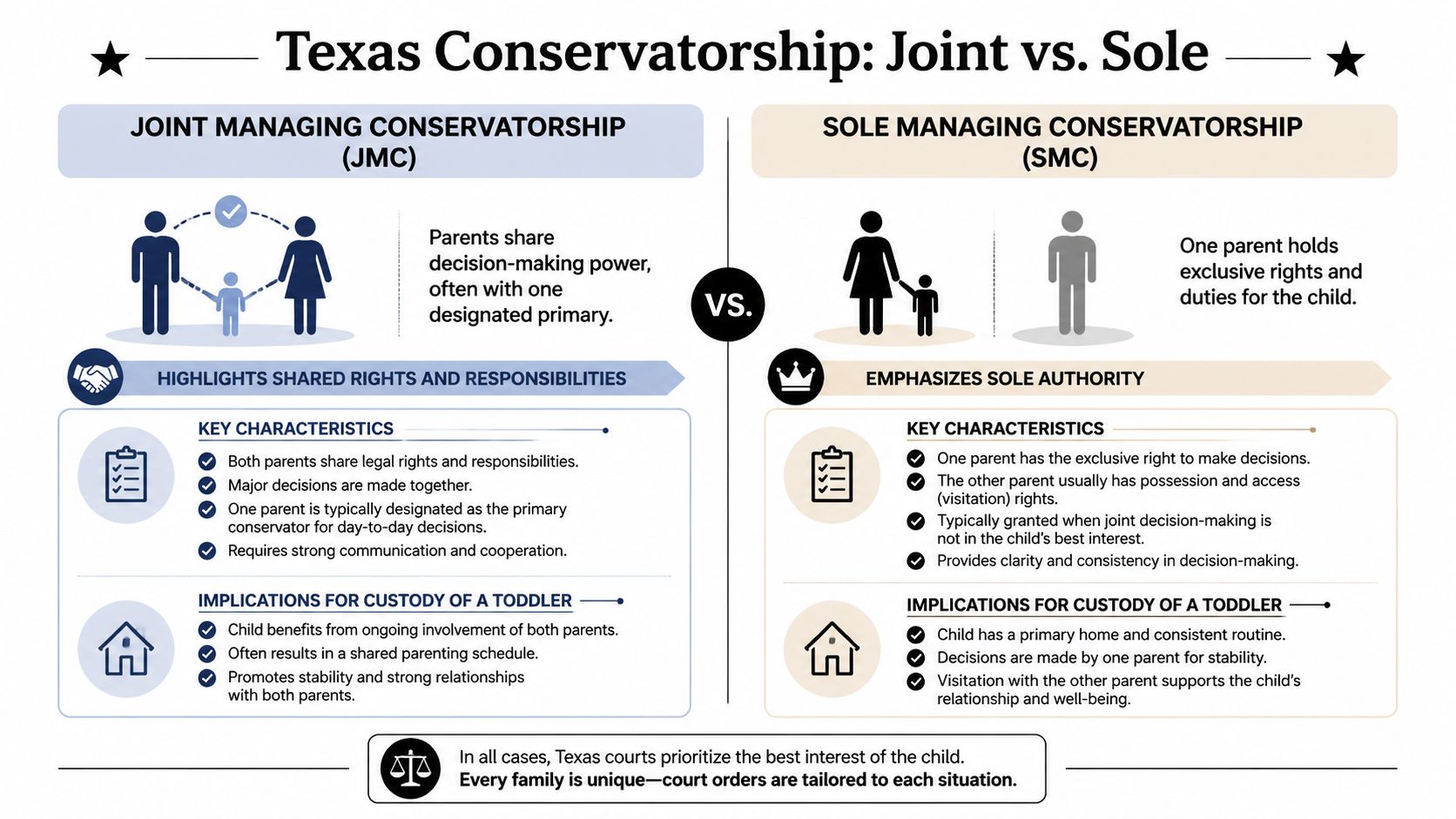
Joint managing conservatorship
A simple way to think about Joint Managing Conservatorship, or JMC, is that the parents are co-captains. They may not split time equally, but they both have recognized roles in major decisions about the child.
Those decisions can include:
- Medical care for non-emergencies
- Education choices such as daycare or preschool issues
- Access to records from doctors, schools, and providers
- Legal authority to act for the child in certain settings
Often, one parent still gets the exclusive right to decide the child's primary residence. So JMC doesn't automatically mean equal time or equal control over every issue.
Texas courts generally start from the idea that shared decision-making is better when parents can co-parent safely. As noted by Cordell & Cordell's Texas custody overview, Texas courts presume that Joint Managing Conservatorship is in the child's best interest and award it in approximately 60% of cases where parents show they can co-parent, but a history of domestic violence can overcome that presumption.
Sole managing conservatorship
Sole Managing Conservatorship, or SMC, is more like placing one parent in the pilot's seat for major legal decisions. This doesn't always cut the other parent out completely, but it gives one parent broader exclusive authority.
A court may lean toward SMC when there are serious concerns such as:
- family violence
- substance abuse that affects parenting
- repeated dangerous judgment
- severe instability
- a pattern of conduct that puts the child or the other parent at risk
In toddler cases, those concerns matter even more because a very young child can't report problems clearly or protect themselves.
Why this matters for young children
Parents often assume the biggest issue is "How many days do I get?" But for toddlers, decision-making power can shape daily life just as much. Who chooses the pediatrician? Who decides on therapy? Who selects daycare? Who determines where the child lives?
Those questions affect everything from commute time to sleep routines.
When parents can cooperate, courts often prefer a structure that keeps both involved. When safety breaks down, courts shift toward protection.
A quick comparison
| Issue | JMC | SMC |
|---|---|---|
| Major decisions | Shared or divided by court order | Mostly held by one parent |
| Primary residence | Often one parent has this exclusive right | Usually one parent controls it |
| Use in lower-conflict cases | Common | Less common |
| Use when danger exists | May be limited or denied | More likely if protection is needed |
Conservatorship and possession are not the same
This is a point many parents miss. A parent can be named a joint managing conservator and still have a limited possession schedule. Likewise, a parent may have meaningful possession but not have every major decision-making right.
That distinction is especially important in custody for toddlers texas cases because the court often builds a careful schedule first and expands time later if the arrangement works well.
Crafting a Possession Schedule for a Toddler
The question I hear most from parents is simple: "What will the schedule look like?"
For toddlers, the answer is almost never a one-size-fits-all calendar. Texas recognizes that children under three need something more customized.

Why the standard schedule usually doesn't fit
Under Texas Family Code §153.251(d), the Standard Possession Order isn't presumed to apply to children under three. Courts instead create customized, phased-in possession orders with shorter, more frequent visits that can expand over time, as explained by Texas Law Help's guidance on child visitation and possession orders.
That rule makes sense for toddlers. Long separations may be harder on a child who still relies on strong routine, familiar sleep cues, and regular contact with each parent.
A phased schedule gives the child time to adapt. It also gives the court a structure it can review later if things are going well.
What a phased schedule can look like
Every family is different, but many toddler schedules follow a progression rather than a sudden jump to long weekends.
A judge might consider a plan like this:
- Early stage with brief daytime visits several times a week when the parent-child routine is still developing
- Middle stage with longer daytime blocks and a consistent weekend component
- Later stage with overnights added when the child is older or already handling transitions well
- Expanded stage that moves closer to a standard schedule once the child matures and the parent has shown reliability
That doesn't mean overnights are impossible before age three. It means the court wants evidence that the child can handle them and that the parent is ready for the full routine, including overnight care, morning transitions, and return exchanges.
Small details often decide big outcomes
Toddler possession cases can turn on what seems minor from the outside.
One mother may argue that the child still nurses and needs short, frequent periods with the other parent. One father may show that he's been doing bath time, dinner, and bedtime on a regular basis, making overnights more realistic. Another parent may need a right of first refusal because daycare ends before the other parent gets off work.
These details matter because toddlers live in details.
If you're building a proposed schedule, practical planning around sleep and food helps. Parents often benefit from reviewing age-based examples for managing naps and meals for toddlers so the proposed order reflects a routine a young child can realistically follow.
A workable toddler schedule should fit the child's body clock, not just the adults' work calendar.
Common issues that deserve specific language
General wording causes conflict. Specific wording prevents it.
Consider addressing:
- Exchange times that don't interrupt naps
- Meal instructions for allergies, bottles, or feeding routines
- Sleep expectations including crib setup or bedtime rituals
- Daycare pickup authority so providers know who may collect the child
- Holiday transitions with shorter blocks if the child struggles with long separations
A short explanation from a family law attorney can help many parents understand how courts think about this balancing act:
A realistic example
Suppose your toddler is two years old and has spent most nights with one parent, but the other parent has stayed involved with meals, playtime, daycare pickups, and weekend care. The court may prefer a gradual plan that protects continuity while increasing contact. That often works better than either extreme, no contact or immediate equal overnights.
Parents usually do best when they propose a thoughtful calendar rather than asking for "more time." If you need ideas, these visitation schedule examples can help you think through what a child-centered schedule might look like.
Special Custody Considerations for Young Children
Toddler cases often hinge on issues that don't show up in a standard custody form. If your child is very young, your daily life may revolve around nursing, pumping, nap windows, daycare handoffs, favorite comfort objects, and bedtime rituals. Those aren't side issues. They can shape what the court sees as realistic and healthy.
Breastfeeding and pumping schedules
If a child is breastfeeding, the court may consider how feeding works in practice without treating nursing as an automatic reason to deny the other parent meaningful time. Judges tend to look for practical solutions.
That may include shorter visits at first, pumped milk exchanges, or a gradual schedule that protects feeding needs while still supporting the child's relationship with both parents. A parent who raises breastfeeding concerns should be prepared to explain the actual routine, not just make a general claim that the child can't separate.
Daycare and preschool disagreements
Daycare fights often sound small until you live through one. One parent wants a center close to home. The other wants a provider closer to work. A disagreement over pickup access can turn into a larger conflict about control.
Courts usually care about reliability, safety, commute burden on the child, and whether the parents can cooperate. A strong approach is to bring clear information. Provider hours, distance, cost structure, emergency contact rules, and the child's adjustment to the current setting all help the judge understand the key aspects.
Helping a toddler handle separation
Young children don't understand legal orders. They understand absence, routine, and stress. If your toddler cries at transitions, clings at drop-off, or struggles after exchanges, that doesn't always mean the schedule is wrong. It may mean the child needs more support around transitions.
Helpful strategies include:
- Consistent handoffs at the same place and time
- Transitional objects like a blanket or stuffed animal
- Short, calm goodbyes instead of drawn-out departures
- Shared routine notes about sleep, food, and medication
The best toddler schedules usually support both attachment and predictability. Children this young often handle frequent, calm contact better than long stretches of uncertainty.
Stability matters more than winning
A parent can hurt their own case by treating every disagreement like a battle. Judges notice which adult is trying to create order and which one is escalating conflict.
If you're asking the court for a particular arrangement, tie your request to the child's routine. Explain how the plan protects sleep, supervision, medical care, and emotional regulation. That's far stronger than arguing in general terms about fairness.
For grandparents and other caregivers, this point matters too. If you play a major role in the child's daily life, your records and observations may help the court understand what this child needs.
Establishing Paternity and Filing Emergency Orders
For unmarried fathers, one of the hardest truths in Texas family law is this: being the biological father and being the legal father are not always the same thing in court. If paternity hasn't been legally established, your rights may be far more limited than you expect.

Why fathers need to act early
For fathers of toddlers in Texas, proactively filing to establish paternity is essential. Even though Texas has no legal rule that mothers automatically win, mothers are often favored as primary caregivers for children under three, and fathers can respond by documenting involvement and asking for a phased-in possession order, as discussed in this Texas under-three visitation overview.
That matters because waiting can create a harmful pattern. The longer one parent functions as the obvious default caregiver without a formal order in place, the harder it may become to change the status quo.
What fathers should gather before filing
A strong paternity and custody case tells a story with documents. Start building that file now.
Useful proof can include:
- Caregiving logs that show when you fed, bathed, transported, or stayed with the child
- Medical involvement such as appointment confirmations or messages about treatment
- Photos and videos showing ordinary parenting, not just birthday snapshots
- Texts and emails that reflect cooperation, requests for time, or parenting coordination
- Receipts and records for diapers, formula, daycare, clothing, or other child-related costs
If you're a father reading this, don't assume the court already knows how involved you've been. Put it on paper.
When emergency orders may be necessary
Most custody cases move through the normal court process. Some don't. If your toddler faces immediate physical or emotional danger, a parent may need emergency relief.
That can arise from situations such as:
- threats of family violence
- serious intoxication while caring for the child
- plans to hide or remove the child
- dangerous living conditions
- exposure to abuse or severe neglect
Emergency orders are not for ordinary co-parenting frustration. They are for urgent risk.
Urgent point: Judges act fastest when a parent brings specific facts, dates, records, and sworn statements that show real danger to a child.
What to do if you believe your child is at risk
If you're considering emergency action, move carefully and quickly.
- Write down the facts immediately. Include dates, times, what happened, and who saw it.
- Preserve evidence. Save messages, photos, videos, medical records, and police or incident reports if they exist.
- Avoid retaliatory conduct. Don't turn an urgent safety concern into a self-help custody fight unless your lawyer advises immediate protective action.
- Seek legal advice fast. Emergency relief depends on timing, evidence, and how the request is framed for the court.
For mothers, fathers, and grandparents alike, emergency orders can protect a toddler, but only if the court sees clear proof that the danger is real and immediate.
Evidence and Documentation Your Keys to Success
Toddlers don't testify. They don't explain who takes them to the doctor, who packs the diaper bag, or which home keeps them on schedule. In a custody case, your evidence speaks for them.
That is especially important in cases involving very young children because the court often decides based on patterns, not isolated claims.
What good evidence looks like
Strong evidence is organized, specific, and ordinary. You don't need dramatic proof if the issue is steady caregiving. You need credible proof of what daily life looks like.
In Texas, fathers receive about 33% of parenting time on average, and a father seeking more balanced time with a toddler needs evidence of consistent involvement, caregiving ability, and a strong bond with the child, according to this national child custody statistics by gender summary that includes Texas.
That principle helps both parents, really. The parent who documents daily parenting usually presents the clearer case.
A practical evidence checklist
Keep your records in one folder, whether digital or paper. Label things by date.
Parenting journal
Write short entries about pickups, meals, naps, illnesses, bedtime, and behavior changes. Keep it factual.Communication records
Save texts and emails with the other parent. Courts often learn a lot from tone, cooperation, and follow-through.Calendar history
Mark who had the child, where exchanges happened, and whether time was missed or changed.Child-related records
Gather daycare notices, medical summaries, vaccination records, therapy paperwork, and emergency contacts.Financial proof
Save receipts for diapers, wipes, formula, medicine, clothes, childcare, and other direct expenses.
Witnesses can help if they know real facts
The best witnesses are people who see real parenting, not people who only know your side of the story. Daycare workers, relatives who observe regular care, pediatric office staff, and others with direct knowledge may be useful depending on the case.
A vague witness who says you're a "great parent" isn't nearly as helpful as someone who can say, "He handled drop-off every Monday and Wednesday and communicated with staff about the child's allergy plan."
How to present your evidence well
A judge needs a clear picture, not a paper avalanche. Organize your material around themes:
| Theme | Helpful proof |
|---|---|
| Daily care | calendars, journals, daycare logs |
| Medical involvement | appointment records, pharmacy receipts, messages |
| Communication | texts, emails, co-parenting app records |
| Home stability | lease documents, photos of sleeping space, routine plans |
Bring evidence that shows patterns over time. One perfect weekend matters less than steady caregiving month after month.
If you want more parenting time, or if you need to defend the schedule you already have, your records can make the difference between a claim and a convincing case.
Your Next Steps Protecting Your Toddler and Your Rights
If you're overwhelmed, start smaller. You don't need to solve the entire case tonight. You need to take the next right step.
A manageable plan
Start a parenting journal today
Track routines, exchanges, meals, naps, medical issues, and your direct care.Keep your communication child-focused
Judges respect parents who stay calm, practical, and centered on the child's needs.Gather records before there's a crisis
Save daycare paperwork, medical notes, receipts, and messages now.Think in terms of routine
For a toddler, a good custody plan protects sleep, feeding, supervision, and secure relationships.Act quickly if paternity or safety is an issue
Delay can hurt your position, especially when a status quo is forming around a very young child.
Key takeaway
A toddler custody case is not just a legal dispute. It's a decision about how your child will experience safety, comfort, and connection during some of the most important years of development.
The strongest parents in these cases aren't always the loudest. They're the ones who stay steady, document carefully, and present a plan that exactly fits their child.
You don't have to guess your way through custody for toddlers texas. With clear information and timely legal guidance, you can protect your bond with your child and advocate for an arrangement that supports their well-being.
If you need help with a child custody or visitation case in Texas, our experienced attorneys can guide you every step of the way. Contact The Law Office of Bryan Fagan, PLLC today for a free consultation.