Skip to content
When your child’s future is on the line, understanding your rights matters most. Navigating a custody case can feel overwhelming, but you don't have to do it alone. The legal system may seem complex, but at its core, it's about one thing: ensuring your child can thrive. Understanding your parental rights in Texas is the first step toward protecting your relationship with your child and building a stable future for them.
This guide is designed for parents, grandparents, and caregivers seeking clarity. We'll walk you through the key concepts in plain English, offer practical guidance, and empower you with the knowledge you need to advocate for your family with confidence.

How Texas Law Defines Parental Rights
When you're facing a custody dispute, the legal jargon can feel like learning a new language overnight. Our goal is to cut through the noise and give you straightforward answers that empower you to make the best choices for your family.
At its heart, Texas law is built around one guiding principle: what is in the best interest of the child. In nearly every case, the courts believe that having both parents actively and meaningfully involved in their children's lives is what’s best. This principle is the North Star that guides every decision a judge makes in a family law case.
Core Concepts You Need to Know
To get started, you need to know the language the courts use. These terms may sound technical, but the ideas behind them are things every parent understands.
- Conservatorship: This is simply the Texas legal term for "custody." It describes a parent's legal rights and responsibilities, such as the authority to make decisions about a child's education, medical care, and moral upbringing.
- Possession and Access: This is what most people call "visitation." A possession order is the court-ordered calendar that details when each parent has the child in their care.
- Best Interest of the Child: This is the most important concept in Texas family law. Every decision a judge makes about conservatorship and possession is based on what they believe will best support the child’s emotional and physical well-being.
Navigating the legal system is tough, especially when you feel your child’s future is hanging in the balance. But knowledge is power. By understanding the basics of parental rights in Texas, you can advocate more effectively for your child and work toward an outcome that protects what matters most.
Understanding Conservatorship (Custody) in Texas
The most important term you'll hear in a Texas custody case is conservatorship. It’s the legal word for your role as a parent—your official toolkit of rights and responsibilities. It’s not just about where your child sleeps; it’s about your authority to guide their life and make key decisions on their behalf.
What Rights Does a Conservator Have?
As a conservator, the Texas Family Code grants you the legal power to make critical decisions for your child. These rights ensure you remain a parent in every practical sense of the word, regardless of the possession schedule.
As a conservator, your rights typically include the power to:
- Make decisions about your child’s education.
- Consent to medical, dental, and surgical treatment.
- Direct your child's moral and religious training.
- Access your child’s medical, dental, and educational records.
This legal framework isn't just a set of rules; it’s a recognition of the fundamental bond you have with your child. In fact, Texas voters recently approved a historic Parental Rights Amendment, which constitutionally affirms that parents have the fundamental right to direct their children's upbringing. This gives you even stronger legal footing when asserting your parental rights in Texas. You can read more about the historic parental rights amendment to understand how it bolsters these protections.
Joint Managing Conservatorship: The Texas Standard
In the vast majority of cases, Texas courts name both parents as Joint Managing Conservators (JMCs). This is the default arrangement because the law presumes it's in a child’s best interest for both parents to share the rights and responsibilities of raising them.
Being a JMC doesn't automatically mean a 50/50 split of time, but it does mean you share decision-making duties. Think of it as being co-captains of a team. While one person might be calling the plays on a given day, both have the authority to guide the team’s overall strategy.
In a JMC arrangement, one parent is usually designated as the primary conservator. This parent has the exclusive right to decide where the child lives (often within a specific geographic area) and is the one who receives child support payments. The other parent, often called the non-primary conservator, has a standard possession schedule and the obligation to pay child support. This structure is designed to give your child a stable home base while ensuring they benefit from the active involvement of both parents.
The Texas Standard Possession Order Explained
Beyond the big decisions, parental rights in Texas also define when you actually get to have your child with you. In legal terms, this is called “possession and access,” but what it really means is your parenting time schedule.
To keep things predictable and fair, Texas law provides a default schedule known as the Standard Possession Order (SPO). Think of it as the standard blueprint for sharing time with your child after a separation. A judge will typically order this schedule unless there's a serious reason not to—like a history of family violence or substance abuse.
Getting familiar with the SPO is one of the most practical things you can do. It gives you a clear picture of what weekends, holidays, and summer breaks will look like, taking much of the guesswork out of planning your life.
The legal framework for these rights has evolved over time, aiming to give parents and children more stability and clarity.
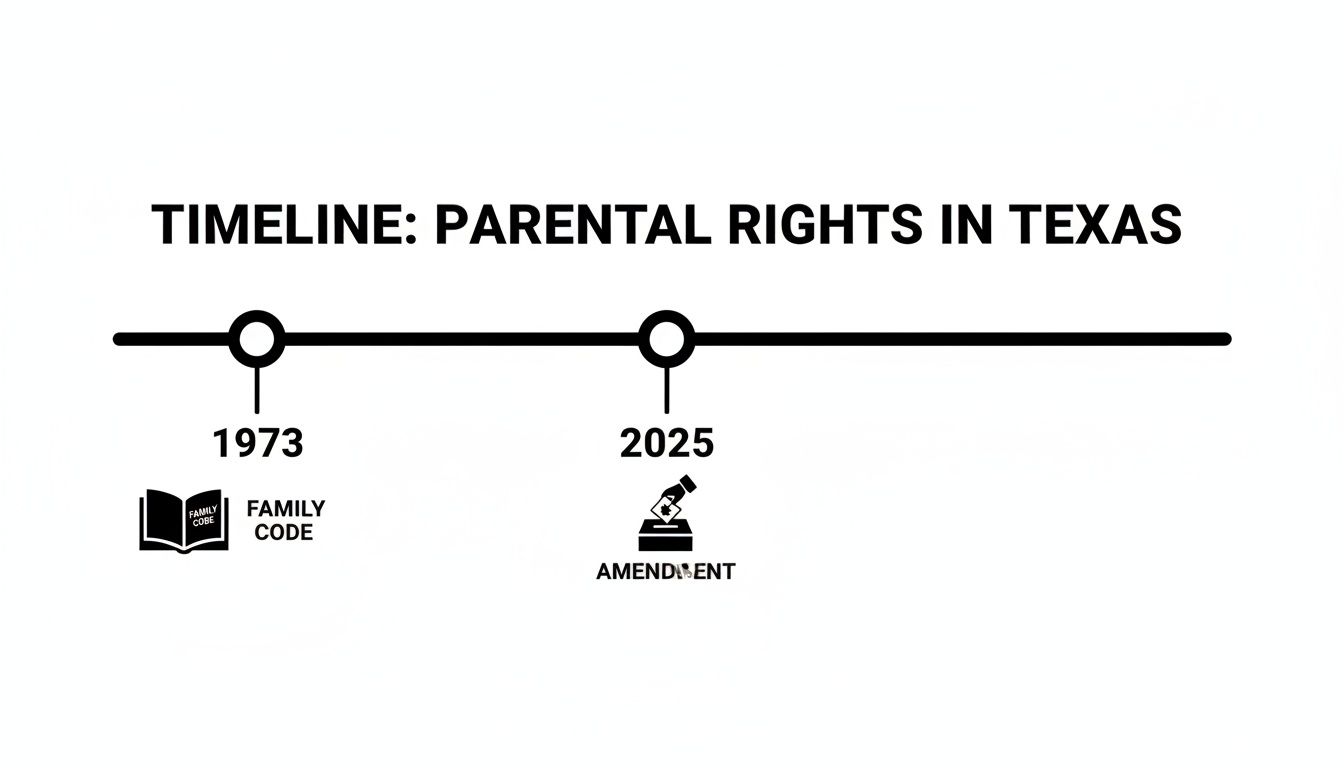
As you can see, the law isn't static. It's been updated since the Texas Family Code was established in 1973, reflecting a continuous effort to better define and protect the parent-child relationship.
How The Standard Possession Order Works
The SPO is usually laid out from the perspective of the non-primary parent—the parent who doesn't have the exclusive right to determine the child's residence. The schedule hinges on one key factor: how far apart the parents live. The magic number in Texas is 100 miles.
Let's walk through the most common setup, where parents live within 100 miles of each other. Here’s what the non-primary parent's time typically looks like:
- Weekend Time: Possession of the child on the first, third, and fifth weekends of a month.
- Holiday Time: Major holidays like Thanksgiving and Christmas are split and usually alternate between parents each year, so everyone gets a fair share of the special moments.
- Summer Time: The non-primary parent generally gets 30 days of possession during the summer break, which can be taken all at once or broken into different periods.
This structure creates a consistent routine that kids can depend on while ensuring both parents maintain a strong, active role in their lives. The specifics can get a little more complex, and you can learn more by reading our detailed guide on standard possession orders in Texas.
How Distance Changes The Schedule
Life happens, and sometimes parents end up living more than 100 miles apart. When that's the case, the standard schedule adapts to make travel more practical. The goal is still to ensure both parents have frequent and meaningful time with their child, but the logistics have to change. Here's a quick look at how the SPO shifts based on distance.
Texas Standard Possession Order at a Glance
This table shows how the standard parenting time for the non-primary parent changes when parents live more than 100 miles apart. The main difference is trading more frequent, shorter visits for less frequent, longer ones to make travel worthwhile.
| Possession Period | Parents Live Under 100 Miles Apart | Parents Live Over 100 Miles Apart |
|---|---|---|
| School Year Weekends | First, third, and fifth weekends of the month. | One weekend a month, chosen by the non-primary parent. |
| Spring Break | Alternates between parents each year. | The non-primary parent has the child every Spring Break. |
| Summer Possession | 30 days (usually with notice by April 1). | 42 days (usually with notice by April 1). |
| Thanksgiving Holiday | Alternates between parents each year (odd/even years). | Alternates between parents each year (odd/even years). |
| Christmas Holiday | Split into two phases, alternating each year. | Alternates yearly for the entire break (non-primary has it in even years). |
As you can see, long-distance plans give the non-primary parent every Spring Break and a longer summer possession period (42 days) to help make up for fewer weekend visits during the school year. The law encourages parents to work together to craft a schedule that fits their family's real life. As long as it serves the child's best interest, a judge will almost always approve a custom possession order you both agree on.
How Fathers Can Legally Establish Parental Rights
For mothers, parental rights are automatically established at birth. For married fathers, the law presumes they are the legal parent. But for unmarried fathers, there's a crucial extra step. Having your name on the birth certificate is a great start, but in Texas, it’s not enough on its own to grant you legal rights to custody or visitation.
To secure your standing as a legal parent, you must establish paternity. This is the legal process that connects you to your child in the eyes of the court. It’s the foundational step that unlocks your ability to seek conservatorship (custody) and possession (visitation), and it also legally binds you to provide child support. For many fathers, it's the most powerful action they can take to secure their role in their child's life.
Two Paths to Establishing Paternity
In Texas, there are two main ways for an unmarried father to make his rights legally binding. The path you take usually depends on whether you and the child’s mother are in agreement.
Acknowledgment of Paternity (AOP): This is the most straightforward route. The AOP is a legal form where both parents voluntarily swear that a man is the biological father. Most hospitals provide this form right after the child is born, but it can also be completed later and filed with the Texas Vital Statistics Unit. Signing an AOP makes you the legal father, but it does not create a custody or visitation schedule. You still need a court order for that.
Paternity Suit: If parents don't agree on paternity, one parent can file a "Suit to Adjudicate Parentage." This is a formal court case where a judge issues an order declaring who the legal father is. The judge will almost always order genetic (DNA) testing to get a scientific answer.
A paternity suit is a comprehensive solution. The final court order will not only declare the father but will also typically establish:
- Conservatorship (custody rights)
- A possession and access schedule (visitation)
- Child support obligations
This makes the paternity suit a one-stop-shop for resolving all major legal issues related to your parental rights. If you're an unmarried father ready to formalize your relationship with your child, you can learn more about how to establish paternity and take that critical first step.
Protecting Your Rights: Termination and CPS Cases
Losing your parental rights is often called the "death penalty" of family law. This process, legally known as the Termination of Parental Rights (TPR), permanently severs the legal relationship between a parent and a child. It is the most serious action a court can take and is reserved for the most extreme situations where a child's safety is at risk.
A court cannot terminate your rights lightly. A judge must find clear and convincing evidence—a much higher standard of proof than in a typical custody case—that termination is in the child’s best interest and that the parent has committed at least one of the specific harmful acts listed in the Texas Family Code.
Grounds for Involuntary Termination
These grounds are not about minor parenting mistakes. They are centered on serious actions or patterns of behavior that put a child in real physical or emotional harm's way. Some common reasons a court might involuntarily terminate parental rights include:
- Endangering the child: Knowingly placing a child in conditions that endanger their physical or emotional well-being.
- Abandonment: Voluntarily leaving a child and failing to provide support or maintain contact.
- Neglect or Abuse: Harming a child or failing to protect them from harm.
- Failure to comply with a court-ordered service plan in a Child Protective Services (CPS) case.
- Serious criminal conduct that demonstrates an inability to provide a safe home.
While termination is often involuntary, a parent can also choose to give up their rights. This is a profound and irreversible decision that should only be made with extensive legal advice. You can explore this topic further by reading about understanding voluntarily relinquishing parental rights in Texas.
A Shift Toward Keeping Families Together
Facing a CPS investigation is terrifying. It can feel like you're isolated and the system is stacked against you. But it's important to know that the legal landscape in Texas has been changing in your favor. Recent legislative reforms are pushing back against the unnecessary separation of families.
For instance, new laws have narrowed the legal definition of "neglect," making it harder for CPS to remove a child due to issues related to poverty. Another game-changing reform now requires CPS investigators to clearly inform you of your rights before they question you. These changes are making a real difference, with data showing a significant drop in child removals in recent years, part of what many are calling this significant child welfare revolution in Texas.
This means you are not powerless. You have the right to know why you're being investigated, the right to refuse entry to your home without a warrant, and the absolute right to speak with an attorney. Asserting your rights is your strongest line of defense.
How to Modify or Enforce Your Custody Order

Life doesn’t stand still, and a custody order that worked a year ago might not fit your family’s needs today. The good news is, your court order isn’t set in stone. It can be changed to reflect new realities, and it can be enforced if the other parent isn't following the rules. Knowing how to modify or enforce your order is a crucial part of protecting your parental rights in Texas.
Steps to Modify a Custody Order
To change your existing custody, visitation, or child support order, you must first show there’s been a “material and substantial change” in circumstances. This is the legal standard, and it means something significant has happened since the last order was signed.
Examples of a material and substantial change include:
- A parent getting a new job with a completely different work schedule.
- The primary parent planning a move out of state.
- A child developing new educational or medical needs.
- A child over the age of 12 expressing a strong preference to the judge to change which parent they live with.
If the court agrees a significant change has occurred, it will then determine what new arrangement is in the child’s best interest. The process begins by filing a formal "Petition to Modify the Parent-Child Relationship" with the court.
Steps to Enforce a Custody Order
It’s incredibly frustrating when the other parent doesn't follow the court-ordered possession schedule. Whether they are consistently late for exchanges or refuse visitation altogether, you have legal options.
An enforcement action is the legal tool used to hold the other parent accountable. You'll file a "Motion for Enforcement" that details exactly how, when, and where the other parent violated the order. Be specific: list dates, times, and what happened. Evidence is everything, so it’s vital to document every violation. For example, knowing how to create legally admissible text message exports for court can be crucial.
If a judge finds the other parent willfully violated the order, they can:
- Order make-up possession time.
- Order the other parent to pay your attorney’s fees.
- In serious cases, impose fines, probation, or even jail time.
Taking legal action is often the most effective way to protect your time with your child and ensure court orders are respected.
Key Takeaways and Next Steps
Navigating the complexities of parental rights in Texas can be challenging, but understanding the foundational principles empowers you to protect your family's future.
- Best Interest of the Child is Key: Every court decision is guided by what is best for your child's physical and emotional well-being.
- Joint Conservatorship is the Norm: Texas law presumes that both parents should share in the rights and responsibilities of raising their child.
- Know Your Schedule: The Standard Possession Order provides a predictable schedule for visitation, but you and your co-parent can agree to a custom schedule that works for your family.
- Your Orders Can Change: Life evolves, and your custody orders can be modified to reflect significant changes in circumstances.
- You Can Enforce Your Rights: If the other parent violates the court order, you can take legal action to enforce it.
Your relationship with your child is precious. Protecting it is our priority.
If you need help with a child custody or visitation case in Texas, our experienced attorneys can guide you every step of the way. Contact The Law Office of Bryan Fagan, PLLC today for a free consultation.