Skip to content
When your child's future is on the line, understanding your rights matters most.
A lot of parents find themselves in the same painful moment. Your son says he wants to live with Dad full-time. Your daughter tells you she feels more settled at Mom's house. Maybe the words come out during a calm drive home from school. Maybe they come out in anger after a hard weekend exchange. Either way, your heart drops. You may feel worried, relieved, defensive, confused, or all four at once.
The question usually follows fast: at what age can a child choose which parent to live with in texas? Many parents have heard some version of an "age 12 rule" and assume that once a child reaches that birthday, the child gets the final say. Texas law is more careful than that.
A child's voice matters. It matters a great deal. But it isn't the same thing as a child's legal decision. Texas courts listen to children, especially older children, while still protecting them from having to carry the full weight of an adult legal choice. That distinction is where many parents get lost.
Your Child's Voice and Your Family's Future
A parent might hear, "I want to live with you now," and immediately think two things at once. First, "My child trusts me enough to say this." Second, "What am I supposed to do with that information?quot;
Both reactions are normal.
In Texas custody cases, children are not treated like silent passengers. Courts understand that older children often have real thoughts about school, routines, friendships, household rules, and where they feel most secure. At the same time, judges also know children can feel torn between two people they love.
A custody case should never turn a child into the tie-breaker between parents.
That is why Texas law uses a protective approach. The court may listen closely to what a child wants, but the judge still has to decide what living arrangement serves the child's welfare.
If you're a mother, father, grandparent, or caregiver trying to make sense of this, the law can feel less like a map and more like a maze. Terms such as joint managing conservatorship, possession schedules, and best interest of the child can sound intimidating until someone explains them in plain English.
Here's the short version. In Texas, the law doesn't give children a simple age at which they get to choose. Instead, the law gives the court tools to hear the child while keeping the final decision where it belongs. With the judge.
The Myth of the Magic Age in Texas Custody
The biggest misunderstanding in Texas custody law is the idea that a child reaches a certain birthday and then gets to pick a parent like choosing which room to sleep in. That is not how the law works.
There is no magic age before 18 when a child can unilaterally decide which parent to live with in Texas. Not at 10. Not at 12. Not at 14. Not at 16.
What the court actually decides
Texas courts decide issues involving conservatorship and possession under the child's best interest.
In plain language, that means the judge asks: Which arrangement gives this child the healthiest mix of safety, stability, care, and support?
Consider a doctor evaluating a treatment plan. The patient can explain what hurts and what feels better. That information matters. But the doctor still looks at the whole chart before making a decision. A Texas judge does something similar in a custody case.
The court may consider things like:
- Home stability. Which household gives the child a more dependable routine for school, sleep, meals, and supervision.
- Emotional needs. Whether the child feels supported, heard, and emotionally safe in each home.
- Physical needs. Who is meeting daily care needs, appointments, school obligations, and practical responsibilities.
- Parenting history. Which parent has been consistently involved in homework, transportation, discipline, and decision-making.
- Safety concerns. Whether there is conflict, neglect, family violence, or behavior that puts the child at risk.
Plain-English custody terms parents should know
A few legal terms confuse people because they sound colder than they are.
| Term | Plain-English meaning |
|---|---|
| Joint managing conservatorship | Usually means both parents share major rights and duties involving the child, even if the child lives primarily with one parent |
| Primary conservator | The parent with the right to determine the child's primary residence |
| Possession schedule | The parenting time calendar, often called visitation by many families |
| Best interest of the child | The legal standard that guides the judge's decision |
Why Texas doesn't let kids make the final call
Children often speak from immediate experience. Adults and judges have to think about the longer road.
A child may prefer one home because bedtime is later there. Or because chores are lighter. Or because one parent enforces fewer rules. That doesn't make the child dishonest. It just means children don't always evaluate choices the way courts must.
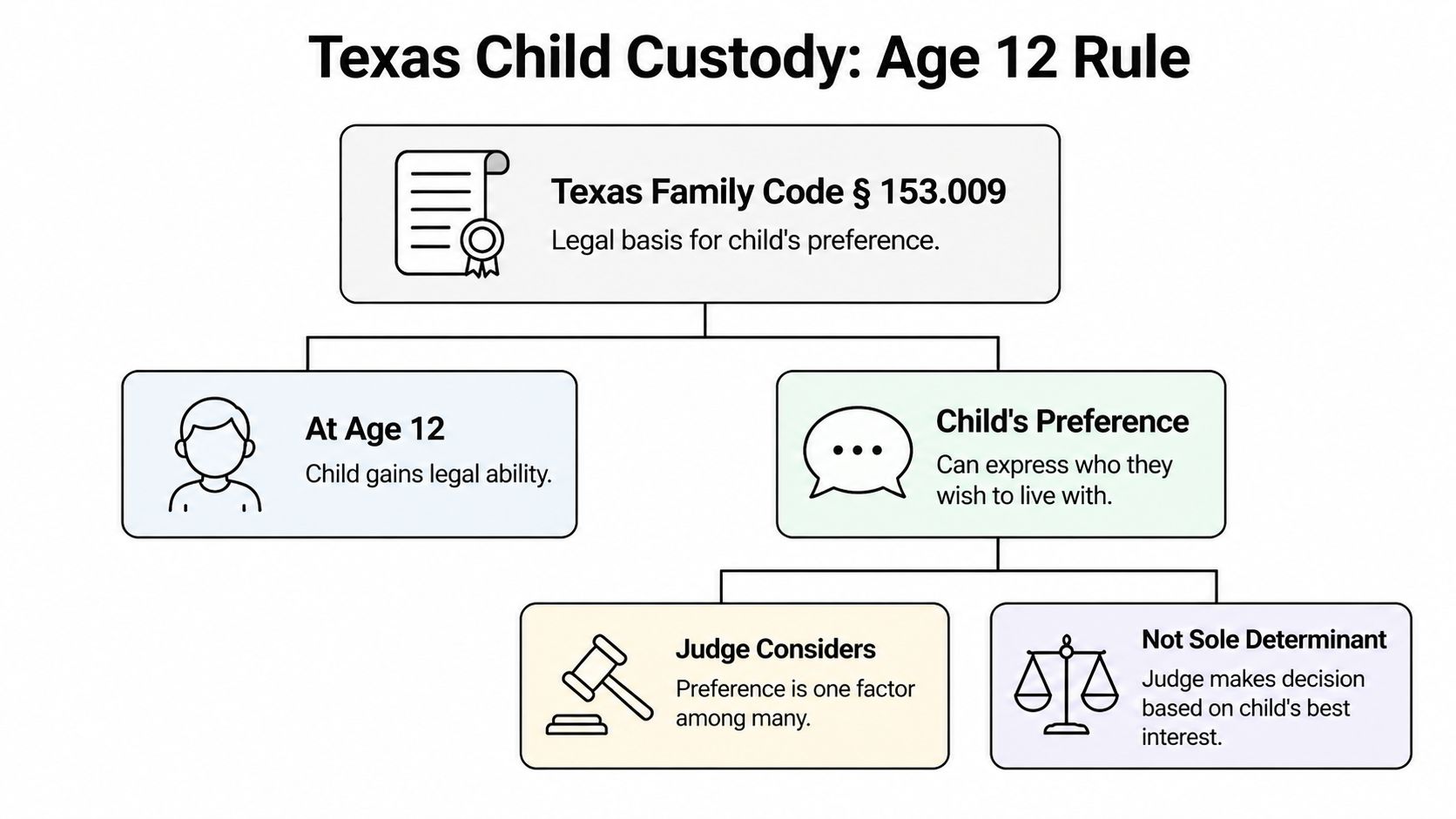
Practical rule: A child's preference is important evidence, not a binding command.
This is why parents should be careful about saying things like, "Once you turn 12, you can choose." That statement can create false hope for the child and serious disappointment later. It can also increase pressure on the child, who may begin to feel responsible for the entire case.
The Age 12 Turning Point What the Law Actually Says
The age people keep hearing about is 12, and there is a real legal reason for that.
Under Texas Family Code § 153.009, the court shall interview a child who is 12 years of age or older in chambers in a non-jury hearing involving the parent-child relationship. In simple terms, if the case calls for it, the judge must speak privately with a child age 12 or older about the child's wishes on residency. For children under 12, the judge may conduct that interview, but it is discretionary rather than required. A helpful summary of that rule appears in this discussion of Texas child preference interviews.
What that private interview means
Parents sometimes imagine this interview as a mini-trial where the child takes the witness stand and picks a winner. It isn't that.
The better analogy is this: the interview gives the child a microphone, not a gavel. The child gets to speak. The judge still decides.
During that conversation, a judge may want to understand:
- Where the child wants to live
- Why the child feels that way
- Whether the reasons sound mature and independent
- Whether anyone has pressured, coached, or influenced the child
- How the child is doing in each home
The private setting matters. It removes some of the pressure children feel when both parents are in the room. It also helps the judge hear from the child more directly.
Why age 12 matters but doesn't control the case
Age 12 is important because it marks a point where Texas law gives the child a guaranteed chance to be heard in the right setting. But it does not create a legal right to choose the primary home.
That distinction can be frustrating for parents who hoped for a bright-line rule. Still, it makes sense when you think about how family situations differ. One 12-year-old may speak with unusual maturity and give thoughtful reasons tied to school, stress, and consistency. Another may be reacting to a recent argument or stricter rules.
The law leaves room for that difference.
What about children younger than 12
Younger children are not ignored. A judge may still choose to speak with a child under 12. But the law doesn't require that interview the way it does for an older child.
That means the child's age affects how the court gathers information, not whether the court still has the final responsibility.
One more point matters here. According to the same Texas-focused summary above, child preferences influence outcomes in under 30% of contested cases where best-interest concerns point the other way. That is a useful reminder that the interview matters, but it doesn't override the court's larger duty.
How Judges Weigh a Child's Preference in Court
Once a child has expressed a preference, many parents expect the case to swing sharply in that direction. Usually, it doesn't happen that neatly.
A judge weighs a child's preference the way a person works through a large puzzle. One piece may be important. It may even help reveal the picture. But no single piece tells the whole story.

What judges are really looking for
Texas courts often evaluate best interest by looking at a group of practical concerns. Parents may hear lawyers refer to the Holley factors. You don't need to memorize the legal phrase to understand the basic idea.
A judge is asking questions like these:
- What does this child need right now? Emotional support, school stability, structure, medical care, and a calm home all matter.
- Which parent is more able to meet those needs day after day? Judges tend to focus on patterns, not promises.
- What has each parent done so far? Courts pay attention to who has been handling the ordinary work of parenting.
- Would a change help or disrupt the child? A move that sounds appealing can still cause major disruption in school, routines, or sibling relationships.
Reasons that carry more weight
A child's preference tends to matter more when the child can explain it clearly and the reasons are tied to well-being rather than convenience.
Examples that may sound stronger to a judge include concerns about constant conflict, major routine problems, struggles with school support, or feeling unheard in one home. Judges also tend to take maturity seriously. A thoughtful explanation usually lands differently than a vague statement like, "I just like it better there."
Parents should also remember that outside influences can affect what a child says. For example, teens may already be under social pressure from friends, school, or risky peer groups. If you're worried about outside influence, resources on the effects of peer pressure on meds can help families think more carefully about how environment shapes a child's choices.
Children often tell the truth as they understand it. A judge still has to decide whether that truth reflects a stable, independent preference.
What weakens a child's stated preference
Some things can reduce the value of the child's statement in court:
- Parental coaching. If a child sounds scripted, rehearsed, or fearful of disappointing a parent, the judge may discount the preference.
- Rule-shopping. A preference based mainly on fewer chores, less homework oversight, or looser discipline may not move the court much.
- Recent conflict only. If the child is reacting to one argument or one punishment, the judge may see that as temporary rather than a reason to change homes.
- Inconsistent explanations. If the child's reasons shift a lot, the judge may question how settled the preference really is.
For a closer look at how courts handle this issue, many parents also read about child preference in Texas custody cases.
Using a Child's Wish to Modify a Custody Order
A different question comes up after divorce or after final orders are already in place. If your child says they want to live with the other parent, can that change the current order?
Sometimes, yes. But there is an extra legal step.
In a modification case, the court doesn't start from scratch. The parent asking for a change must usually show a material and substantial change in circumstances. That's legal language for a meaningful shift in family life that justifies reopening the custody arrangement.
How a child's preference can open the door
For children age 12 or older, an expressed preference can play a powerful role in a modification case. Texas Family Code § 153.009 can make that preference a key evidentiary factor in getting the court to hear the request, as explained in this overview of custody preference and modification in Texas.
That doesn't mean the parent automatically wins. It means the child's mature, stated wish may be enough to help get the issue before the judge.
The difference is important:
| Stage | What the court asks |
|---|---|
| Getting a hearing | Is there a significant enough reason to revisit the current order? |
| Winning the modification | Would the requested change be in the child's best interest? |
According to that same Texas summary, modifications are granted in only 20% to 25% of preference-based motions. That tells parents something important. A child's preference can open the courthouse door, but it doesn't carry the whole case across the finish line.
What counts as a meaningful change
A material and substantial change isn't just ordinary frustration. Courts usually look for something more serious and more lasting.
That may involve shifts in home stability, school needs, ongoing conflict, caregiving patterns, or a child's sustained and mature desire for a different primary residence. If you want to understand how Texas courts evaluate these requests, this guide on changing the primary conservator in Texas is a useful starting point.
A modification case is not about proving one parent is perfect. It's about showing that circumstances have changed enough that the child's current order no longer fits the child's needs.
Why parents should avoid shortcuts
Some parents make a costly mistake here. They hear that a child is old enough to speak with the judge, so they stop following the current order. That can damage the case fast.
Until a court signs a new order, the old one remains in effect. If you believe a change is needed, the safer path is to act through the legal process rather than through informal household decisions.
What to Do When Your Child Wants to Change Homes
When a child says, "I want to live with you," your response matters. Not just emotionally, but legally.
The best first move is usually the simplest one. Listen without turning the conversation into a campaign.

What to say in the moment
Try to keep your tone calm and curious. A child who shares this kind of feeling is often testing whether it's safe to be honest.
You don't need to solve everything in one conversation. In fact, you shouldn't.
A healthier response sounds like this:
- "Tell me more about that." This invites honesty without pressure.
- "I'm glad you told me how you feel." That reassures the child without promising a legal result.
- "You don't have to choose sides with me." This reduces guilt and fear.
- "The adults will handle the legal part." That takes the burden off the child.
What not to do
Avoid turning the child into your evidence collector.
That means don't ask the child to repeat accusations, don't rehearse what they should tell a judge, and don't make promises like, "Once you're 12, the court will let you live with me." That kind of statement can hurt both your child and your case.
Parents should also be careful about involving relatives, new partners, or friends in these conversations. The more adults who start weighing in, the more the child may feel pulled apart.
A steady approach helps most: hear the child, write down what was said later, and keep the child out of the legal strategy.
Helpful next steps for parents
After the conversation, focus on facts rather than emotion.
- Document the basics. Note when the child raised the issue, the setting, and the reasons the child gave.
- Look for patterns. Has this concern come up repeatedly, or is it tied to a recent disagreement?
- Gather objective information. School concerns, routine problems, transportation burdens, and caregiving realities often matter more than angry text messages.
- Protect the child's emotional health. Some families benefit from outside support. If your child is struggling with loyalty conflicts or stress, local options such as Phoenix family therapy resources can help parents think about what supportive counseling may look like.
A short video can also help parents think through the practical side of custody concerns before taking action.
When to talk with a lawyer
You don't need to wait until things are explosive.
If your child has expressed a sustained desire to change homes, it may be time to learn whether the situation rises to the level of a legal modification. This resource on substantial change in circumstances in Texas custody cases helps explain the issue in more detail.
Mothers, fathers, and grandparents often come into these situations with different fears. One parent may worry about losing time. The other may worry about not being heard. A grandparent may worry the child's distress is being overlooked. The strongest position usually comes from staying child-focused, staying calm, and getting legal advice before making any dramatic move.
The Rare Path to Independence Emancipation in Texas
There is one unusual situation where a minor can choose living arrangements before turning 18. That path is emancipation.
Emancipation is not a custody preference issue. It is a separate legal process under Texas Family Code Chapter 31 that asks the court to treat the minor as an adult for legal purposes.
Who may qualify
This option is narrow by design.
A minor must be at least 17, or 16 if already living apart from parents or guardians, and must prove they are self-supporting and financially autonomous. A Texas-focused summary of this process appears in this discussion of emancipation and child choice in Texas.
That means the court will expect real proof that the teen can manage life without relying on parental support in the ordinary sense.
What emancipation changes
If the court grants emancipation, the legal effect is major. The young person gains adult legal capacity in this area, and custody and support orders terminate.
That is very different from an age-12 interview. An interview lets a child be heard in a custody case. Emancipation removes the child from the custody framework altogether.
Why this is rare
Most teens are not in a position to support themselves, manage housing, and handle adult responsibilities well enough to satisfy a judge. That is one reason emancipation isn't common.
Even so, it can matter in certain families, especially where an older teen is already functioning independently and ongoing custody conflict has become unworkable. The same Texas summary notes that emancipation petitions succeed at around 40% to 50% when the required proof is there.
For most families asking at what age can a child choose which parent to live with in texas, emancipation won't be the answer. But for a small number of older, self-sufficient teens, it is the only true pre-18 route to making that decision independently.
Key Takeaways and Your Next Steps
Parents deserve a clear answer here. There is no age before 18 when a child can choose which parent to live with in Texas. What Texas law does provide is a structured way for the court to hear the child while keeping the final decision focused on protection, stability, and long-term well-being.
Keep these points in mind:
- There is no magic age that gives a child unilateral decision-making power.
- Age 12 matters because a judge must interview a child 12 or older in the proper setting.
- Being heard is not the same as deciding. The judge still applies the best-interest standard.
- A child's preference can matter in a modification case, but it does not guarantee a change.
- Emancipation is separate and rare, and it applies only in limited circumstances for older, self-supporting minors.
If your child has started asking to live with you, don't panic and don't promise outcomes you can't control. Listen carefully, protect your child's emotional space, and get guidance before taking action. Good decisions in custody cases usually come from calm, informed steps, not rushed reactions.
If you need help with a child custody or visitation case in Texas, our experienced attorneys can guide you every step of the way. Contact The Law Office of Bryan Fagan, PLLC today for a free consultation.