Skip to content
When your child’s future is on the line, understanding your rights matters most. If you are a parent trying to shield your child from harm, the legal system can feel intimidating. But in Texas, the law is designed with your child's safety as its highest priority, especially when domestic violence has entered the picture.
An act of family violence isn't just a personal tragedy; it's a critical event that can fundamentally change your custody arrangement. It’s what the court calls a material and substantial change in circumstances, giving you the legal foundation you need to modify your custody order and protect your child.
How Domestic Violence Impacts Texas Custody
When family violence occurs, the court's main focus shifts immediately to ensuring the child's physical and emotional well-being. This isn't just about changing visitation schedules; it's about re-evaluating who has the right to make crucial decisions for your child and under what conditions they can see them.

The Power of the Rebuttable Presumption
Texas law has a powerful tool designed specifically to protect children in these situations. It's called a rebuttable presumption, and while the term sounds complex, its purpose is simple and direct.
Under Texas Family Code § 153.004, if a judge finds that a parent has a history of family violence, the law automatically assumes it is not in the child’s best interest for that parent to be a joint managing conservator. In plain English, this means the court starts with the belief that the parent who committed violence should not share equal decision-making rights. As we explain in our detailed guide on how domestic violence affects child custody, this is a significant advantage for the protective parent.
The presumption is "rebuttable," which means the other parent gets a chance to argue their case. But the burden of proof is on them to convince the judge they should still have joint rights. This legal standard is a true game-changer in a domestic violence custody modification in Texas.
What This Means for Mothers and Fathers
This legal principle gives you immediate leverage when you're seeking to modify a custody order, whether you are a mother or a father. The court formally acknowledges the danger and instability that domestic violence brings into a child's life.
Here’s how it typically plays out:
- Decision-Making Power: The parent who committed violence is far less likely to keep the right to make joint decisions about your child’s education, medical care, and other critical life choices.
- Possession and Access: The court will almost certainly restrict that parent's time with the child. In most cases, this means ordering supervised visitation to ensure your child's physical and emotional safety is protected at all times.
- Child's Best Interest: This standard reinforces the core principle of all Texas family law—the best interest of the child—by recognizing that a peaceful, stable, and safe home is non-negotiable.
It's also important to remember the deep emotional toll that witnessing violence takes on young minds. Resources focused on understanding the impact of trauma on children can shed light on why creating a safe environment is so critical for their healing and development.
If family violence occurred within the two years prior to the court's decision, this powerful rebuttable presumption becomes a central factor. It significantly tilts custody modifications in favor of protecting the child and empowering the non-abusive parent.
Taking Immediate Action: Emergency Orders for Child Safety
When you believe your child is in immediate danger, waiting for a standard court hearing isn't an option. That fear is real, and the threat is happening now. Fortunately, Texas law recognizes this urgency and provides powerful legal tools to get you in front of a judge quickly, securing immediate protection for your child.
Getting these emergency orders is often the very first step in a domestic violence custody modification in Texas, and understanding how they work is critical to your peace of mind.

Think of these orders as an immediate legal shield. Their purpose is to create a safe space for your child right now, giving you breathing room to start the formal process of changing your main custody arrangement without constantly fearing for your child's safety.
What is a Temporary Restraining Order (TRO)?
A Temporary Restraining Order (TRO) is often your first line of defense. It’s a powerful court order that can be requested ex parte—a legal term meaning you can get it from a judge without the other parent being present or even knowing about the hearing beforehand. This is vital when you're worried that giving advance notice could cause the other parent to act erratically, disappear with the child, or cause more harm.
A TRO lays down a set of immediate, non-negotiable rules the other parent must follow. It can, for example, prohibit them from:
- Coming near you or your child.
- Contacting you or your family.
- Removing the child from their school or daycare.
- Disturbing your peace at your home or workplace.
To get a TRO, you must show the judge that irreparable harm could happen if the order isn't granted immediately. This requires presenting concrete evidence like recent police reports, threatening messages, or your own sworn statement detailing specific, recent acts of violence or credible threats.
Understanding Other Emergency Protective Measures
While a TRO is a common starting point, it's not your only option. Depending on the specific danger your child is facing, an attorney might pursue different or additional orders to build a stronger wall of protection. It’s crucial to understand the differences, and our team can help you determine if you need to file for a Texas emergency custody order and walk you through the process.
To help you see the options at a glance, here’s a quick breakdown of the most common types of immediate orders.
Types of Emergency Protective Orders in Texas
This table offers a quick-reference guide to understand the different immediate legal options available to protect your child from harm.
| Type of Order | Purpose | How to Obtain | Typical Duration |
|---|---|---|---|
| Temporary Restraining Order (TRO) | Broad, immediate prohibitions on specific actions (e.g., contact, removing child). | Filed with a custody modification; granted ex parte based on a sworn affidavit showing risk of irreparable harm. | 14 days, until a temporary orders hearing can be held. |
| Temporary Protective Order | Specifically for family violence; offers more extensive protections like ordering abuser out of the home. | Filed as a separate application, often with police involvement. Requires showing family violence has occurred. | 20 days initially, can be extended up to 2 years after a full hearing. |
| Emergency Custody Order | Immediately changes who has possession of the child, giving you temporary sole custody. | Can be part of a TRO or filed as a standalone emergency motion. Requires showing immediate physical or emotional danger. | Until the next court hearing, typically scheduled within 14 days. |
Each of these orders serves a distinct purpose. A Temporary Protective Order, for example, is specifically designed for family violence cases and offers much longer-term protection than a TRO. An Emergency Custody Order is the most direct way to temporarily remove the other parent's right to possession. Choosing the right one—or combination—is key.
How New Laws Help Protect Families
Recent changes in Texas law have made it easier for parents to secure these vital protections. For example, 2025 Texas family law reforms affect custody and help streamline the path for a non-abusive parent to gain sole conservatorship and strengthen protections for children.
These legal instruments are not just paperwork; they are your most powerful tools for creating immediate safety. They send a clear signal to the court and to the other parent that the situation is serious and that your child's well-being is the absolute priority. An experienced attorney can help you determine which order is right for your situation and present the strongest possible case to the judge.
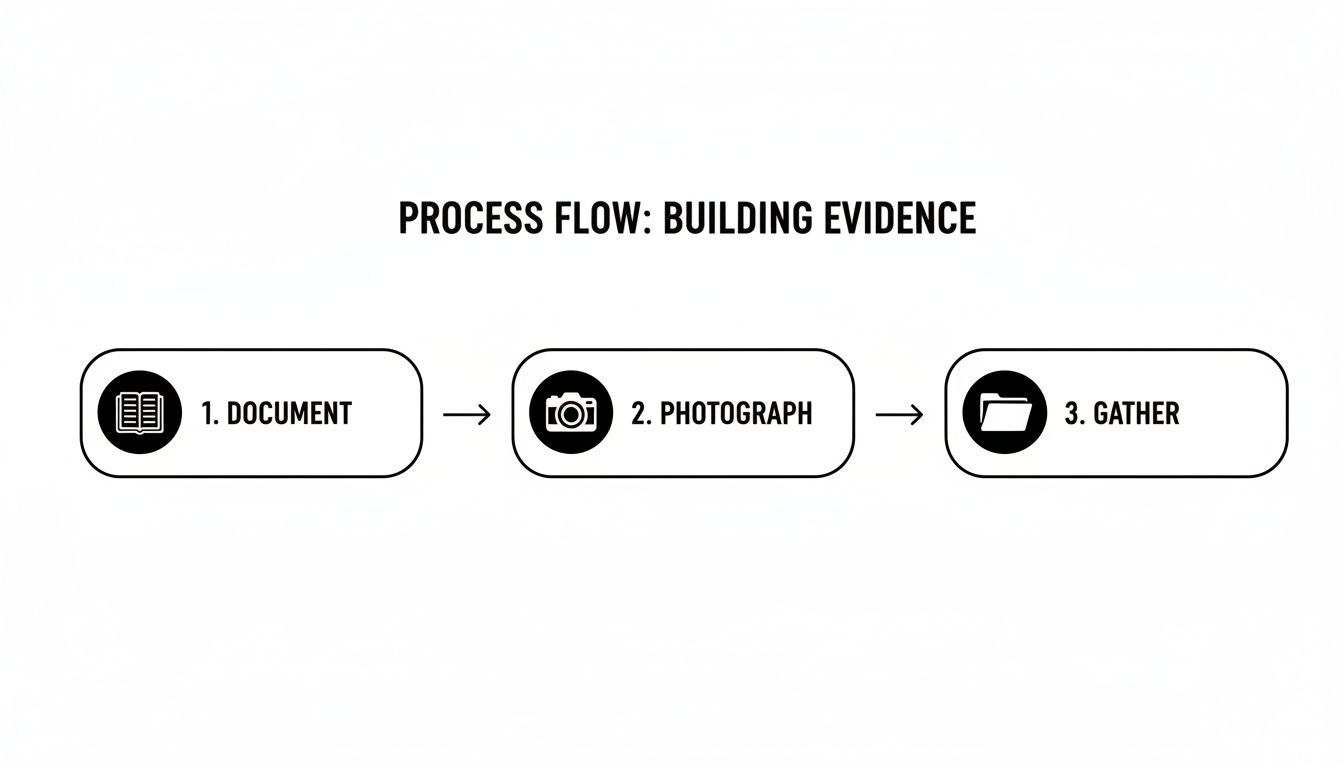
Building a Strong Case with Effective Evidence
When you’re fighting to protect your child, your story is powerful—but a judge needs more than your word. In a Texas courtroom, winning a custody modification comes down to concrete, undeniable proof. Feelings and suspicions won't move the needle; solid evidence will.
Our job as your advocate is to help you build a case that paints a clear, factual picture for the court. We need to show a pattern of behavior and demonstrate how that behavior directly harms your child. This isn't about retaliation. It's about giving the judge the factual foundation they need to rule in your child’s best interest.
What Evidence Do Texas Judges Find Compelling?
A parent's testimony is vital, but it becomes exponentially more powerful when backed by objective proof. Think of it as creating a file that leaves no room for doubt. Judges are looking for credible evidence that confirms your claims of family violence.
Some of the most compelling pieces of evidence include:
- Police Reports and Protective Orders: These official documents are invaluable. A police report from a domestic disturbance or a previously granted Protective Order immediately gives your case a documented history of violence that judges take very seriously.
- Medical Records: If you or your child ever needed medical attention for injuries caused by the other parent, those records are critical. They provide a neutral, third-party account of physical harm.
- Photos and Videos: Visuals can be incredibly impactful. Dated photographs of injuries, property damage, or screenshots of threatening text messages can illustrate the reality of the situation in a way words alone cannot.
- Written Communication: Save every abusive email, text message, and social media post. This digital trail can create a timeline and establish a clear pattern of harassment, intimidation, or emotional abuse.
The Power of Keeping a Detailed Log
One of the most effective tools at your disposal is a simple journal. This isn't just a place to vent; it's a factual log of events that can establish a pattern of behavior over time, which is crucial in court.
Start a secure, dated journal today. For every incident of abuse, threats, or concerning behavior, record:
- The date and time of the event.
- A factual description of what happened, avoiding emotional language.
- Who was present, especially if your child or other witnesses were there.
- The outcome, noting if police were called or if anyone needed medical care.
This log becomes a roadmap for your attorney and a critical piece of evidence. It helps you recall specific details under the stress of a court hearing and shows the judge this isn't an isolated incident, but a persistent threat.
Gathering Your Evidence the Right Way
It is absolutely critical that you gather your evidence legally. For instance, Texas is a "one-party consent" state for recording conversations. This means you can legally record a phone call or in-person conversation that you are a part of without the other person's consent. However, recording conversations you are not a part of is illegal. That evidence will be thrown out and could damage your credibility.
Likewise, illegally accessing the other parent's private email or social media accounts will only backfire. An experienced attorney can guide you on using proper legal tools, like a subpoena, which is a court order that forces a person or company to turn over documents. Learning how to prove an unfit parent in Texas is all about building a case that is both powerful and legally sound.
Your story deserves to be heard, and backing it with solid, legally-obtained evidence is the best way to make sure a judge understands the danger your child is in. It’s how you move from a position of fear to one of strength.
Navigating the Custody Modification Process
Once you’ve gathered your evidence, it’s time to engage with the legal system. This part of the journey can feel daunting, but knowing the road ahead can give you a sense of control. The goal is simple: to formally ask the court to change your custody order to keep your child safe.
Step 1: Filing the Petition to Modify
The first official move is filing a Petition to Modify the Parent-Child Relationship. This is the legal document that gets the ball rolling. It tells the court and the other parent that you're seeking a change to your custody orders and, most importantly, why. You’ll need to clearly state that the family violence constitutes a material and substantial change in circumstances.
After the petition is filed, the other parent must be officially notified through a process called service. This is a legal requirement to ensure they know about the lawsuit and have a chance to respond. A skilled attorney ensures this is done correctly so your case isn't delayed by procedural issues.
Step 2: The Role of Mediation
Believe it or not, many Texas counties require you to try mediation before a final trial. Mediation is a confidential meeting where a neutral third-party mediator helps both sides try to find common ground.
When domestic violence is a factor, the process looks different. You can—and should—request to be in a separate room from the other parent. The mediator will then shuttle between the two rooms, so you never have to be in the same space. While it might seem impossible to agree on anything, mediation can sometimes help resolve smaller details, leaving only the most critical issues for the judge.
Step 3: Determining Conservatorship and Possession
One of the biggest outcomes of a domestic violence custody modification in Texas is deciding who gets the final say in your child's life. In legal terms, this is called conservatorship.
- Joint Managing Conservatorship: This is the default in Texas. It means both parents share the rights and responsibilities for major decisions about the child's health, education, and welfare.
- Sole Managing Conservatorship: This gives one parent the exclusive right to make those critical decisions.
A judge’s finding of family violence creates that legal presumption that joint managing conservatorship is not in the child’s best interest. This powerfully shifts the odds in favor of the protective parent being named the Sole Managing Conservator, giving you the authority to protect your child.
The parent who isn't named a managing conservator is usually called the Possessory Conservator. They have the right to possession and access—what most of us call a visitation schedule.
However, when you’ve proven family violence, that access is going to be severely limited. The court will almost certainly order that all visitation must be professionally supervised. This means the other parent can only see the child at a designated agency, with a neutral third party present at all times. The purpose is crystal clear: protect the child from any further physical or emotional harm.
The court process is a maze of filings, hearings, and legal standards. But every step is there for a reason, providing a structured way for you to present your evidence and fight for a new order that puts your child’s safety above all else.
If you need help with a child custody or visitation case in Texas, our experienced attorneys can guide you every step of the way. Contact The Law Office of Bryan Fagan, PLLC today for a free consultation.
Understanding Supervised Visitation and Its Rules
When a judge modifies a custody order due to domestic violence, the court's number one priority is protecting your child. This often leads to an order for supervised visitation—a specific legal arrangement designed to keep your child safe while allowing them to see the other parent. Knowing how these visits work can help calm your fears and give you confidence.

Supervised visitation is not a casual get-together. It is a completely controlled environment where every detail—from the location to who is in the room—is structured to eliminate any chance of physical or emotional abuse.
How Supervised Visitation Works
In a supervised visit, the parent who committed violence (the Possessory Conservator) is never left alone with your child. A neutral third-party supervisor must be present to observe the entire interaction from start to finish.
The rules are incredibly strict, and for good reason. The supervisor's job is to:
- Observe and Report: They are the court's eyes and ears, watching everything that happens and documenting any inappropriate behavior for the judge.
- Intervene When Necessary: If the parent’s words or actions become harmful or emotionally manipulative, the supervisor has the authority to end the visit on the spot.
- Ensure a Safe Exchange: The supervisor often handles the drop-off and pick-up, meaning you do not have to see or interact with the other parent.
This highly structured setup is a common outcome in a domestic violence custody modification in Texas. It's the court’s way of balancing a parent’s right to see their child with the non-negotiable need to keep that child safe.
Who Can Supervise and Where Do Visits Happen?
Judges are very particular about who can act as a supervisor. The court will almost always appoint one of two options:
- A Professional Supervision Agency: These are organizations that specialize in high-conflict family dynamics. They use trained, impartial supervisors and provide secure, child-friendly facilities.
- A Court-Approved Neutral Person: In rare cases, a judge might approve a truly neutral individual that both parents agree on. However, the court has to be convinced that this person can stay impartial and enforce every rule.
Most often, visits happen at the designated agency’s facility. These centers are built for safety and are usually equipped with toys and games to make the experience more comfortable for the child. You can discover more insights about how Texas courts handle these cases to better understand what to expect.
A Path Forward for the Other Parent
While your child's safety is the immediate priority, Texas courts do leave the door open for rehabilitation. A supervised visitation order isn't always permanent. It typically comes with a clear set of steps the other parent must complete before they can ask the court for less restrictive visitation.
The main requirement is usually completing a Batterer's Intervention and Prevention Program (BIPP). This isn't just an anger management class; it's an intensive, state-certified program designed to help abusers recognize and change their patterns of violence. Successful completion of a BIPP, along with any other court-ordered therapy, is the first major step toward potentially earning unsupervised visits down the road.
Ultimately, supervised visitation gives your child the protection they need right now while holding the other parent accountable. It’s a powerful legal tool that puts your child’s well-being first.
Common Questions on Custody and Domestic Violence
When your child's safety is on the line, a million questions can run through your mind. It's a whirlwind of fear and confusion, but you're not navigating this alone. Here are clear, practical answers to the questions that keep parents up at night.
Let's get you the clarity you need to move forward with a domestic violence custody modification in Texas.
What if the abuse was only directed at me and not my child?
This is a common and painful question. The answer is clear: Texas courts absolutely consider violence against a parent as a direct threat to the child's well-being. The law recognizes that watching a parent suffer abuse is a deeply traumatic experience for a child.
Under the Texas Family Code, a history of family violence—even if the child was never physically touched—creates a powerful legal presumption that it is not in the child’s best interest for the abusive parent to be a Joint Managing Conservator. Your testimony, backed by evidence, is crucial for showing the court that the environment is unstable and harmful, which is exactly what a modification is designed to fix.
Can I move to another city or state with my child to get away?
Your instinct is to protect your family by putting distance between you and the danger. It’s a completely normal urge. However, acting on it without the court’s permission can seriously harm your custody case.
Most Texas custody orders include a geographic restriction, which legally dictates where the child's primary home can be—usually a specific county and its neighbors. Ignoring this restriction is a serious violation.
The legally sound way to relocate is to:
- First, file for emergency orders to get immediate protection.
- Then, file a Petition to Modify the Parent-Child Relationship that specifically asks the court to lift the geographic restriction and allow you to move.
You'll need to prove to the judge that the move is essential for the safety and well-being of you and your child. This strategy protects your parental rights while making your family's security the top priority.
How long does a custody modification case take in Texas?
There's no single answer, as the timeline for a domestic violence custody modification in Texas depends on your case.
If you secure emergency orders like a TRO, things move very fast at the start. You'll have a hearing within 14 days to establish temporary rules that keep your child safe while the rest of the case unfolds.
From there, a fully contested modification—where parents cannot agree—can take several months, or sometimes over a year, to finalize. The pace depends on the court's schedule, the amount of evidence, and the level of conflict. But remember, those initial temporary orders will act as a shield, protecting your child throughout the entire process.
Next Steps: Taking Action to Protect Your Child
Reading this guide is a huge first step, but what you do next is what will truly make the difference for your child's safety. Just by being here and learning about your options for a domestic violence custody modification in Texas, you’ve shown incredible courage.
You are not powerless. The Texas family courts have specific tools—from immediate emergency orders to permanent modifications—designed to pull a child out of a dangerous situation. The key is knowing how to use those tools, gathering your evidence, and having an experienced guide in your corner.
Your child's safety isn't up for debate. The law starts with the assumption that it is not in a child's best interest to be around violence. Our job is to make sure the judge understands the reality of what's been happening. You don't have to face this alone.
If you need help with a child custody or visitation case in Texas, our experienced attorneys can guide you every step of the way. Contact The Law Office of Bryan Fagan, PLLC today for a free consultation.