Skip to content
When your child’s future is on the line, understanding your rights matters most. An emergency custody hearing in Texas is the legal system’s rapid-response tool, designed to protect a child from immediate physical or emotional danger when every second counts.
This isn’t about settling the final custody arrangement. Think of it as a crucial first step—a temporary intervention designed to get your child out of harm's way until a full, more detailed hearing can be held. It gives you, as a loving parent, a direct path to ask a judge for help when your child needs it most.
How Texas Determines Custody in an Emergency

You can think of an emergency custody hearing as the legal equivalent of calling 911. Its only purpose is to address a crisis right now. When you have a genuine belief that your child is in a dangerous situation, the Texas Family Code provides a way for you to seek immediate protection from a judge.
This process is not for long-term disagreements about school choices or holiday schedules. It’s for one thing: presenting clear, compelling evidence that a child faces an imminent threat. The court’s highest priority is the “best interest of the child,” and it has the power to act swiftly to remove them from a harmful environment.
How Texas Courts Intervene
The process begins when you file a petition with the court, detailing exactly why your child is in danger. This is almost always filed with a request for a Temporary Restraining Order (TRO). A TRO is a powerful, short-term court order that can do several things right away:
- Instantly change who has physical possession of the child.
- Prevent the other parent from taking the child out of a specific county or the state.
- Establish strict rules for contact and communication.
What makes this process so potent is that a judge can grant these initial orders “ex parte.” This means the decision can be made based on your evidence alone, without the other parent being present or even notified yet. You can get more details on how this works in our guide to getting an ex parte custody order in Texas.
A judge will only grant an ex parte order if there is convincing evidence that the child would suffer immediate and irreparable harm before a full hearing could be held. This is the court's way of pressing "pause" on a dangerous situation to ensure a child's safety.
Before we dive deeper, here's a quick overview of what an emergency custody hearing involves.
Emergency Custody Hearing at a Glance
| Component | What It Means for You | Why It Matters |
|---|---|---|
| Urgent Petition | You must file specific legal documents outlining the immediate danger to your child. | This is your formal request for the court's immediate help. It must be clear and compelling. |
| Ex Parte Order | A judge can issue a Temporary Restraining Order (TRO) based only on your evidence. | This allows for swift action to protect your child without waiting for the other parent to respond. |
| High Legal Standard | You must prove a risk of "immediate and irreparable harm." | This standard is high to prevent misuse of the process for non-emergency issues. |
| Short-Term Solution | The initial order is temporary, typically lasting for 14 days. | It’s a bridge to safety, not the final decision. A full hearing will be scheduled soon. |
| Focus on Safety | The judge’s only concern is whether the child is safe at this moment. | This keeps the hearing focused on the crisis at hand, not long-term custody arrangements. |
This table highlights that an emergency hearing is a targeted, rapid response designed for true crises.
Understanding the Goal of the Hearing
It’s absolutely critical to understand that an emergency hearing is just the first step. That initial TRO is temporary, usually lasting for 14 days. As soon as that order is granted, the court will schedule a follow-up hearing where both parents get a chance to present their side of the story.
The purpose of this first hearing is to stabilize a crisis, not to decide the final conservatorship (the Texas legal term for custody). The judge's focus is incredibly narrow: Is the child safe right now? If the answer is no, the court will act decisively to protect them. This process gives legal weight to your deepest parental instinct—to protect your child at all costs.
What Qualifies as an Emergency for Texas Courts
When you realize your child is in danger, every instinct screams to protect them. But in the world of Texas family law, not every crisis you feel in your gut meets the court's definition of a legal emergency. The bar is set incredibly high, and for a good reason—these orders are powerful tools reserved for true, immediate threats.
To get an emergency order, you have to prove the situation puts your child at risk of "immediate and irreparable harm." That phrase is the entire ballgame. It’s the lens through which a judge will view your case in a matter of hours, or even minutes.
Think of it this way: arguing with your ex over bedtime rules is a conflict. Finding out they’re driving drunk with your child in the car is a crisis. The court is built to respond to the second scenario with lightning speed.
The Standard of Immediate and Irreparable Harm
Let's unpack what "immediate and irreparable harm" actually means in a courtroom. Immediate means the danger is happening right now or is about to happen—not something that occurred six months ago or might happen down the road. Irreparable harm means the damage to your child’s physical or emotional well-being would be so severe it couldn't be fixed later on.
A judge needs to see cold, hard facts that paint a picture of a clear and present danger. Your sworn statement, known as an affidavit, has to be detailed, specific, and brutally honest about the threat.
The judge is asking one fundamental question: "If I don't sign this order right now, is this child likely to suffer a harm that we can't undo?" This sharp focus on the child's immediate safety drives every single decision.
Real-World Examples of Emergencies
To give you a clearer picture of what meets this high standard, here are some common situations that Texas courts almost always consider to be genuine emergencies:
- Child Abuse or Neglect: This is the most obvious one, covering physical, sexual, or emotional abuse. Hard evidence like police reports, CPS findings, or medical records is crucial. Serious neglect, like leaving a small child alone for long periods or failing to provide food or a safe home, also qualifies.
- Serious Substance Abuse: We’re not talking about a parent having a glass of wine at dinner. This is about a parent’s drug or alcohol abuse directly endangering the child—like using illegal drugs in the home or getting behind the wheel while impaired with the child in the car.
- Exposure to Family Violence: A child who witnesses domestic violence or is a victim of it is experiencing immediate emotional and often physical harm. This is a top-priority emergency for any Texas judge.
- Parental Kidnapping Threats: If one parent makes credible threats to snatch the child and flee the state or country—and especially if they have the means to follow through—a court will act immediately to prevent it.
Knowing exactly when and how a Texas court can step in is critical. We cover the court's authority in more detail in our guide on when Texas can exercise emergency custody jurisdiction.
When Disagreements Are Not Legal Emergencies
It's just as important to know what a court will not consider an emergency. Filing an emergency motion for a non-emergency issue can seriously damage your credibility with the judge down the line. Common parenting conflicts that do not meet the standard include:
- Arguments over which school the child should attend.
- The other parent being late for drop-off or wanting to switch a weekend.
- Disagreements about diet, video games, or general parenting styles.
- Introducing the child to a new boyfriend or girlfriend (unless that person has a history that poses a direct threat to the child).
These issues are frustrating and important, but they typically need to be addressed through a standard custody modification, not an emergency order. They simply don't involve the immediate threat of irreparable harm.
The Texas legal system has many ways to protect children, and these tools are often interconnected. For example, in FY2026, courts across Texas issued 9,863 Magistrate's Orders for Emergency Protection, which often work alongside custody cases to shield families from immediate danger.
Understanding this crucial distinction helps you assess your situation realistically, gather the right proof, and use the system effectively to protect your child.
Steps to File for an Emergency Custody Order
When you realize your child is in danger, the legal system can feel like an intimidating maze of paperwork and procedures. But getting your case in front of a judge quickly is a matter of taking focused, strategic steps. We’ll walk you through the essential documents for an emergency custody hearing in Texas, breaking it down so you know exactly what to expect.
Your first, and most critical, tool is a sworn statement called an affidavit. This isn't just another form to fill out; it's your direct testimony to the judge, explaining precisely why your child is facing immediate harm.
The Sworn Affidavit: Your Most Important Tool
A judge will likely read your affidavit before they hear from anyone else. It needs to paint a clear, undeniable picture of the risk your child is in, using specific, objective facts. Vague claims like “the other parent is a bad influence” simply won't cut it.
Your affidavit must provide the kind of concrete details a judge can act on:
- Specific Dates and Times: Pinpoint exactly when an event happened. For example, “On Monday, May 6th, around 9:15 PM…”
- Direct Quotes: If you remember exactly what was said, include it. “She screamed, ‘If you try to take him, I’ll make sure you never find us.’”
- Witnessed Events: Describe what you saw or what others are willing to testify they saw. “Our neighbor, John Davis, called me after he saw him leave our daughter alone in the car.”
- Physical Evidence: Mention any text messages, photos, or police reports you have that back up your claims.
This document is your one shot to convince the court that the situation is urgent enough to issue an immediate Temporary Restraining Order (TRO) before the other parent is even aware of the case.
This flowchart shows the critical difference between a true legal emergency that requires immediate court action and a serious disagreement that follows a more standard path.
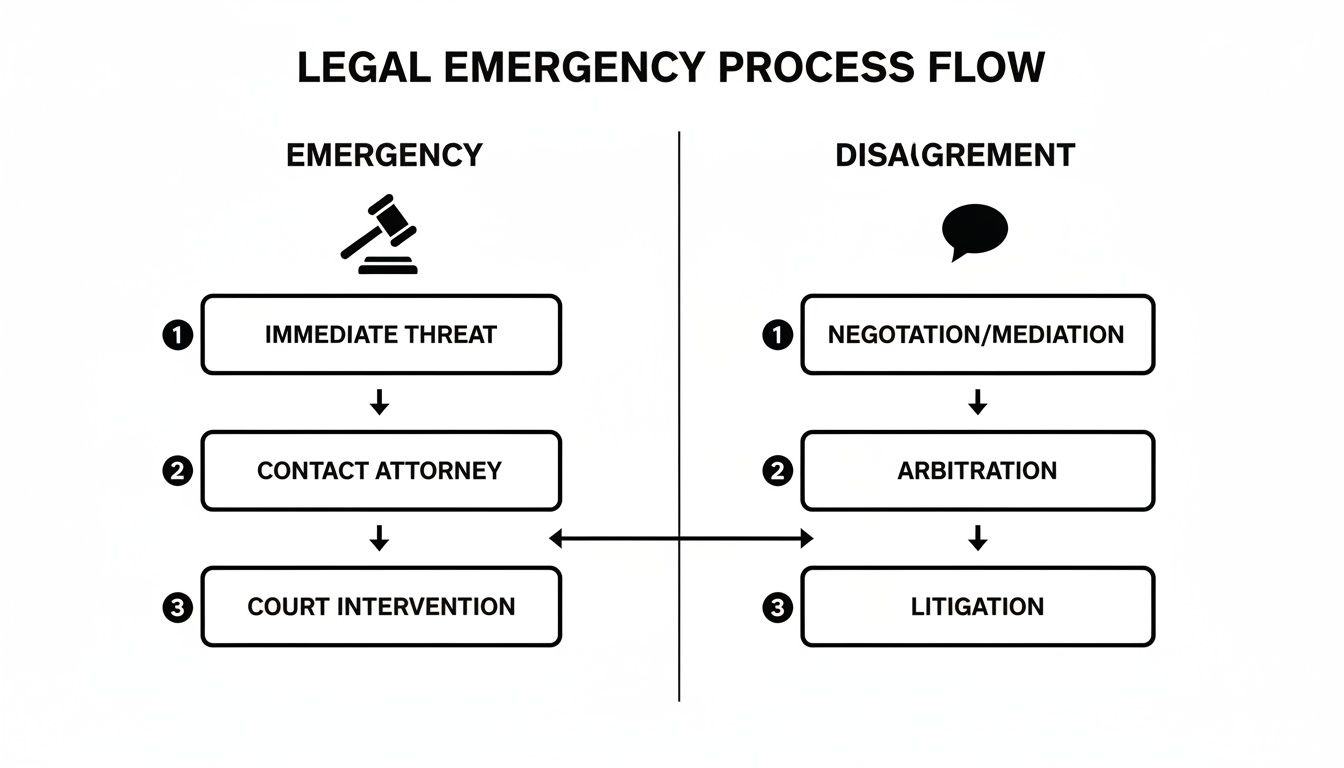
As you can see, a genuine threat of harm triggers an urgent court response, while other custody disputes move through negotiation or standard litigation.
Filing the Core Court Documents
Along with the affidavit, your attorney will file a set of documents to officially launch the legal process. Each form has a specific job to do in asking the court for immediate protection.
- Petition to Modify the Parent-Child Relationship: If a custody order already exists, this is the official request to change it. It asserts that there has been a significant change in circumstances and that a new order is in the child’s best interest.
- Application for a Temporary Restraining Order (TRO) and Temporary Injunction: This is your formal request for emergency protection. It clearly states what you need the court to do right now—like give you sole possession of your child and prevent the other parent from contacting you or coming near your home.
As your case gets underway, it's helpful to understand the legal docketing process, which is how the court tracks every document and event in your case.
The paperwork might seem overwhelming, but think of it this way: The Petition opens the door to the courthouse, the Affidavit tells the judge why you're there, and the Application for a TRO asks for the specific protection your child needs this very minute.
Getting this paperwork right the first time is non-negotiable—any error can lead to delays you simply cannot afford. Working with an experienced family law attorney ensures every detail is accurate, persuasive, and filed correctly. You can get a deeper look at the paperwork in our guide on how to file for emergency custody in Texas. This partnership is what turns a moment of crisis into a clear action plan to protect your child.
Gathering Persuasive Evidence for Your Hearing

When you step into an emergency custody hearing, what you say matters, but what you can prove is what changes everything. A judge has to make a snap decision based on a very limited set of facts, and your most powerful tool is concrete, undeniable proof.
Vague accusations are easy for a court to dismiss. What truly convinces a judge to take immediate action is organized, objective evidence that tells a clear story. Your job is to build a factual narrative that backs up every single claim you made in your affidavit, leaving no doubt that your child’s safety is on the line.
Building Your Case with Tangible Proof
The stronger and more varied your proof, the more weight your request will carry. While every situation is different, the most compelling evidence in an emergency custody hearing in Texas usually falls into a few key categories.
- Digital Communications: Save absolutely everything. Text messages, voicemails, emails, and social media posts can offer a direct window into the other parent’s state of mind and recent actions. A threatening text or a post admitting to substance abuse is incredibly persuasive.
- Visual and Audio Recordings: A picture is worth a thousand words, and a video can be priceless. Photos of injuries, a home in disarray, or video capturing dangerous behavior can be hard to argue with. Just make sure any recordings you make are obtained legally according to Texas law.
- Official Documents: This is where your case gains serious credibility. Police reports from domestic calls, medical records detailing injuries, and any findings from Child Protective Services (CPS) are seen as highly reliable by the court.
- Witness Testimony: Statements from neutral, third-party observers can be invaluable. Think of a teacher who noticed signs of neglect, a counselor who heard your child say something troubling, or a neighbor who witnessed a dangerous incident. Their words can powerfully corroborate your story.
In some cases, knowing how to use a modern search engine for people can help you verify information or uncover publicly available details that might be relevant to your situation.
Presenting Your Evidence Effectively
It’s not enough to just have the evidence; you have to present it in a way the judge can immediately understand. Create a timeline of events and clearly link each piece of proof to a specific date or incident. The more organized you are, the more credible you will appear.
A judge in an emergency hearing is short on time. Your job is to connect the dots for them, showing a clear pattern of behavior that places your child in immediate danger. A well-organized binder with labeled tabs is far more effective than frantically scrolling through your phone.
The bottom line is that every piece of evidence you gather serves one critical purpose: to prove that the court must act now to protect your child’s physical and emotional well-being. It’s what turns your legitimate fear into a legal certainty the judge can—and will—act on.
What to Expect Inside the Courtroom
Walking into a courtroom for an emergency hearing can feel overwhelming. The formal rules, the high stakes, and the emotional weight of the situation are enough to rattle anyone. But knowing what’s coming can make all the difference, helping you trade anxiety for the confidence your child needs you to have.
The whole process is built for speed. Your very first trip to court will likely be for the ex parte hearing. This is often a quick meeting with just you, your attorney, and the judge. Here, your detailed affidavit is the star of the show, as the judge will decide whether to grant a Temporary Restraining Order (TRO) based only on your sworn testimony.
If the judge finds that a true emergency exists, they'll sign the TRO on the spot. This order gives you immediate protection and, just as importantly, schedules a full hearing, usually within 14 days. That’s when both parents will appear in court to present their side of the story.
Your Demeanor and Testimony
How you carry yourself in court speaks volumes. The judge isn't just listening to your words; they're observing your composure, credibility, and focus. Your one and only job is to be a calm, believable advocate for your child’s safety.
- Dress Professionally: Think business casual. It shows you respect the court and are taking this with the seriousness it deserves.
- Speak Clearly and Respectfully: Always address the judge as "Your Honor." Do not interrupt the judge or the other attorney, no matter how tempting it is.
- Stay Focused on Facts: When it's your turn to speak, stick to what happened. Avoid emotional jabs or name-calling. Instead of saying, “He’s a terrible father,” provide a specific example: “On May 15th, he left our six-year-old home alone for four hours.”
The judge’s role is to apply the law to the facts. When you provide clear, fact-based testimony, you make it much easier for them to see the immediate risk and rule in your child’s favor.
A judge once told a client, “I can’t do anything with anger, but I can do everything with facts.” That’s a powerful piece of advice. Center your testimony on provable events and how they directly affect your child, not your personal feelings about the other parent.
The Courtroom Timeline and Efficiency
The speed of these hearings is a direct reflection of the court's commitment to protecting children. Texas courts, especially in busy counties, work incredibly hard to keep their dockets moving—a huge advantage when every second counts. In Tarrant County, for example, family courts in 2026 managed an impressive 119.4% clearance rate, which means they resolved more cases than were even filed.
This efficiency is more than just a statistic; it’s a lifeline. It means that for an urgent emergency custody hearing in Texas, the system is ready to move fast, with 31.8% of cases resolved in just three months. You can see more details in our analysis of Tarrant County's family law case statistics. For a family in crisis, this means a judge can hear your case and issue a protective order in a matter of days, stopping potential harm in its tracks.
The Roles of Key Players
Knowing who’s who can help take the mystery out of the courtroom process.
- The Judge: This is the decision-maker. Their job is to hear the evidence from both parents and make a temporary ruling based on one standard: the best interest of the child.
- Your Attorney: Your guide and your voice in the courtroom. They will present your evidence, question witnesses, and make the legal arguments for you.
- The Other Parent's Attorney: They are there to represent their client and will try to challenge your evidence and testimony.
- The Bailiff: A law enforcement officer responsible for keeping order and security in the courtroom.
By preparing for the environment, sticking to the facts, and presenting yourself as a credible parent, you can walk into that courtroom ready to do what needs to be done to protect your child.
You Have the Order: What Happens Now?
Walking out of court with an emergency order in hand can feel like the first deep breath you’ve taken in weeks. It is a monumental relief. You fought to protect your child, the judge listened, and now you have a court-backed plan to keep them safe. But this victory isn't the finish line; it’s the start of a new, more stable chapter.
That document you're holding is a temporary order. Think of it less as a final judgment on custody and more as a crucial set of ground rules designed to bring calm to the chaos. It’s a temporary roadmap, making sure everyone knows their role and your child’s routine is predictable while the rest of the case moves forward.
Understanding Your Temporary Orders
This court order is now the law, and it's essential to follow it to the letter. Every detail matters, and violating any part of it could seriously damage your case down the road.
Typically, the order will clearly define:
- Possession Schedules: This lays out exactly who has the child and when. Unlike a standard custody schedule, an emergency order might give one parent exclusive possession or demand that all visits for the other parent be professionally supervised.
- Parental Rights: The order will specify who gets to make the big decisions about your child’s schooling and medical care. In an emergency situation, a judge will often grant one parent the exclusive, temporary right to make these critical calls.
- Communication Rules: It may establish very strict rules about how, when, or even if the other parent can contact you or the child.
An emergency order is not a suggestion. Following it perfectly shows the court you're the stable, protective parent you've claimed to be. On the flip side, if the other parent violates the order, you need to document it meticulously. Every violation becomes powerful evidence for your next hearing.
The Road Ahead: From Temporary to Permanent
The temporary order creates a safe space and buys you critical time. Now, the focus of your emergency custody hearing in Texas shifts toward establishing a long-term, stable plan. Your attorney will guide you through the next phase, which almost always involves one or more of these steps.
- A Full Hearing: That initial emergency order is usually short-lived, often for only 14 days. The court will schedule a follow-up hearing where both you and the other parent can present a much more detailed case with more evidence and testimony.
- Mediation: Before heading back to a full-blown trial, most Texas courts will require you and the other parent to try mediation. Here, a neutral professional helps you negotiate a final parenting plan that you can both agree on.
- Custody Evaluation: If the case is particularly complex or contentious, the judge might appoint a custody evaluator. This professional will conduct an in-depth investigation into your family's situation and make a formal recommendation to the court on what arrangement is in the child’s best interests.
This period is your chance to build an airtight case for the final custody order. By working closely with your lawyer, you can turn this temporary protection into a secure and nurturing future for your child.
Frequently Asked Questions About Emergency Custody
When your child's safety is on the line, your mind is racing with questions. Getting clear, plain-English answers is the first step toward taking control of a frightening situation and protecting your family. Here are some of the most common questions we hear from Texas parents about an emergency custody hearing in Texas.
How Quickly Can I Get an Emergency Hearing?
The court system is designed to move fast in a true crisis. Once you file your affidavit and petition, it’s not uncommon to get an initial ex parte hearing for a Temporary Restraining Order (TRO) within just a day or two.
A judge will quickly review your evidence to determine if your child is in immediate danger. If they agree and grant the TRO, the court will schedule a follow-up hearing—where both parents have the chance to be heard—typically within 14 days.
What Happens if the Judge Denies My Request?
Hearing a "no" from a judge can feel devastating, but it is absolutely not the end of the road. It simply means that the evidence you presented did not meet the very high legal bar for immediate and irreparable harm required for an emergency order.
Your attorney will immediately pivot to the next best strategy. This usually means pursuing a standard modification of your existing custody orders through the regular court process, which allows more time to build a stronger, more detailed case for the safety of your child.
Can I File for an Emergency Order Without a Lawyer?
Legally, yes, you can represent yourself—what the courts call filing pro se. However, in these incredibly high-stakes situations, it is strongly advised against. The legal standard is strict, the paperwork is complex, and even a small mistake can lead to a quick denial.
The stakes are simply too high to go it alone. An experienced family law attorney is crucial for drafting a persuasive affidavit, presenting evidence correctly, and navigating the courtroom. Their expertise gives you the best possible chance of securing the order needed to protect your child.
Having a skilled advocate on your side takes your legitimate parental concerns and translates them into a legal argument that a judge is prepared to act on.
Key Takeaway: Next Steps for Protecting Your Child
When your child’s safety is at risk, you don’t have time to waste. An emergency custody hearing in Texas is a powerful legal tool designed for exactly these situations. Remember these key points:
- Act Quickly: The process is built for speed when there is a real threat of immediate and irreparable harm.
- Evidence is Everything: Your case depends on clear, specific proof—texts, photos, police reports, and witness statements.
- This is Step One: An emergency order is a temporary fix. The goal is to secure your child’s safety now while working toward a stable, long-term solution.
- You Don’t Have to Do This Alone: Navigating the legal system in a crisis is overwhelming. An experienced family law attorney can guide you, protect your rights, and be the advocate your child needs.
If you need help with a child custody or visitation case in Texas, our experienced attorneys can guide you every step of the way. Contact The Law Office of Bryan Fagan, PLLC today for a free consultation.