
When your child’s future is on the line, understanding your rights matters most. You have a Texas custody order, but life has changed. What worked a year ago might not be what's best for your child today. The good news is that custody orders aren't set in stone. The law recognizes that families evolve, and sometimes, the court order needs to evolve, too.
But you can't just walk into court every time you and your co-parent disagree. Texas law has a specific standard you have to meet before a judge will even consider changing your current custody arrangement. This guide will walk you through what it takes to modify custody in Texas, offering the clarity and confidence you need to protect your child.
How Texas Determines if a Custody Order Can Be Changed

Before you can ask a judge to update your custody plan, you have to prove two very specific things. This two-part test is designed to prevent endless court battles while still allowing for necessary adjustments when life throws a curveball.
The Two-Part Test for a Custody Modification
First, you have to show there’s been a material and substantial change in circumstances since the date your last order was signed. In plain English, this means something significant and likely permanent has happened. It can’t be a minor inconvenience or a temporary problem. The change has to have a real impact on your child or the parents.
Second, and this is the most critical piece, you must prove that changing the order is in the best interest of the child. This is the guiding star for every family court judge in Texas. It's not about what’s fair to the parents—it's about what will support your child’s physical, mental, and emotional well-being.
A judge’s primary focus will always be the child’s stability and welfare. Proving that a modification serves their best interests is the most critical part of your case.
What Counts as a "Material and Substantial Change"?
So, what does that legal phrase actually mean for your family? While every situation is different, Texas courts consistently recognize certain scenarios as meeting this threshold.
Here are a few common examples our attorneys handle for both mothers and fathers:
- A Parent is Relocating: One parent is planning a move—whether across the state or across the country—that makes the current possession schedule impossible to follow.
- A Dangerous or Unstable Home: A parent's living situation has become unstable. This could be due to issues like new or worsening substance abuse, recent criminal activity, or introducing a dangerous new partner into the home.
- Your Child's Needs and Wishes Have Changed: As kids get older, their needs evolve. A teenager may have a strong, well-reasoned desire to live with the other parent. In Texas, if a child is 12 or older, the judge must interview them and will seriously consider their preference.
- Remarriage or Blended Families: A parent getting remarried can be a material change, especially if it introduces new stepsiblings or significantly alters the family dynamic, as we've discussed in other Texas child custody cases.
- A Parent Is Not Following the Order: If one parent consistently and intentionally denies the other parent their court-ordered time with the child, a judge may see this as a reason to modify the order.
If your situation sounds like one of these, you might have strong grounds to file for a modification. Recognizing whether your circumstances meet this initial requirement is the first step in building a successful case.
Understanding the Legal Standards for Changing Custody
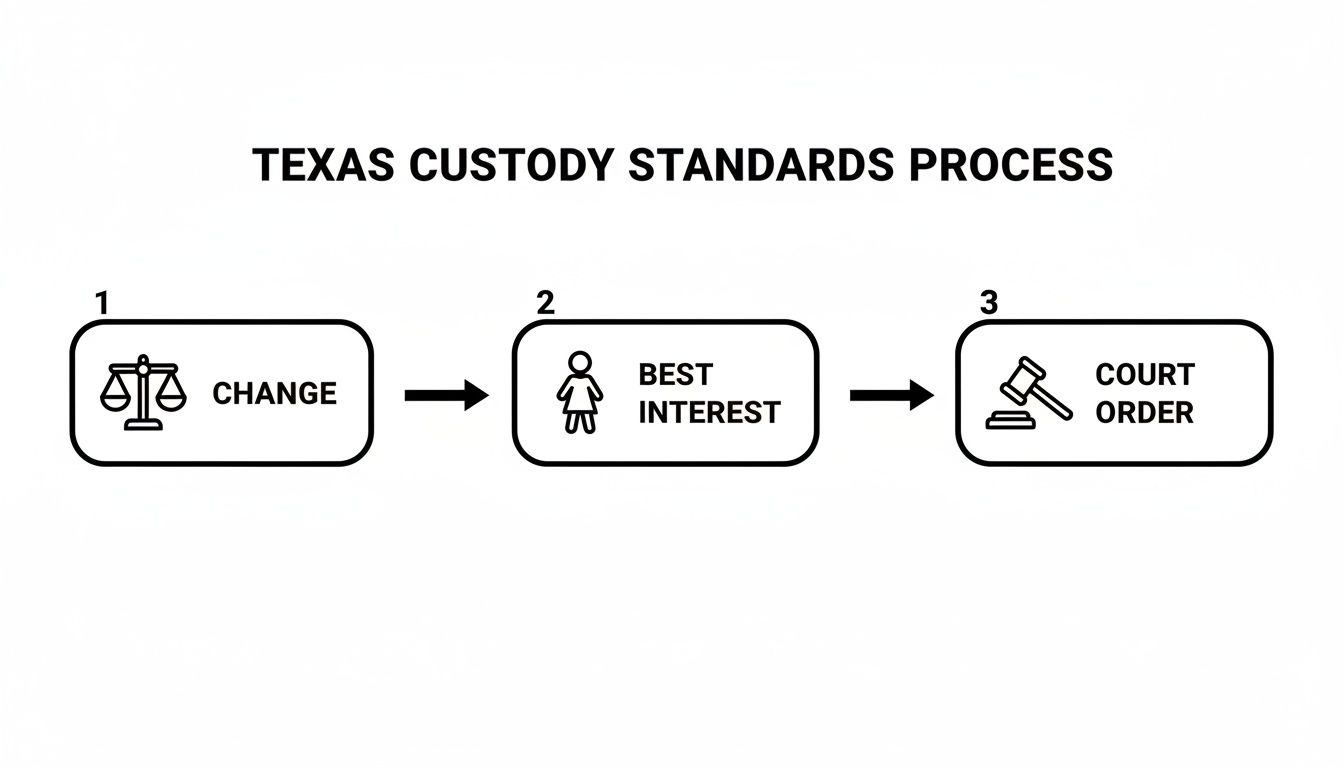
Thinking about changing your custody order is a big step, and one that Texas courts don’t take lightly. Judges are focused on one thing above all else: maintaining stability for your child. To successfully modify an order, you have to prove your case by clearing two specific legal hurdles. Getting familiar with these standards is the first step in building a case that a judge will take seriously.
The First Hurdle: Proving a Material and Substantial Change
Before a court will even consider changing your order, you must prove there has been a material and substantial change in circumstances since the last order was signed. This legal term means that something significant and likely permanent has happened in the life of your child or one of the parents. This isn’t about small disagreements. A judge needs to see a fundamental shift that makes the old custody order unworkable or no longer appropriate for your child.
Here are a few common situations that might meet this standard:
- A parent moving away: If one parent is relocating to another city or state, the old possession schedule is instantly obsolete.
- A major change in a parent's life: This could be a new job that requires constant travel, a remarriage, or unfortunately, a new struggle with substance abuse or criminal activity.
- The child’s needs have changed: Perhaps your child has been diagnosed with a medical condition that requires specialized care, and one parent is better equipped to provide it.
- An unsafe or unstable home: Clear evidence of neglect, family violence, or instability in the other parent’s home is one of the most compelling reasons for a court to step in.
The bottom line is this: you have to prove that things aren't just a little different—they're so fundamentally altered that the existing order no longer serves your child’s best interest.
The Guiding Star: The Best Interest of the Child
Once you’ve proven a material and substantial change, you face the second—and most important—standard: showing that your requested modification is in the best interest of the child. This is the absolute cornerstone of Texas family law, governed by Chapter 153 of the Texas Family Code. Every decision a judge makes is viewed through this lens.
So, how does a court figure out what's "best"? They use a set of guidelines known as the Holley Factors. This isn't a simple checklist. It's a comprehensive framework judges use to evaluate the entire situation. We break these down in detail in our post on understanding Texas custody and the Holley Factors, but some of the key considerations include:
- The child’s emotional and physical needs.
- Any immediate or future danger to the child.
- The parental abilities of each person seeking custody.
- The stability of each parent’s home.
- The child’s own wishes (if they are 12 or older).
Your job is to connect the dots for the court. You need to show how the material and substantial change directly impacts these best interest factors and why your proposed new plan is the best solution for your child's well-being.
Steps to Modify a Custody Order in Texas
Navigating the legal path to change a custody order can feel like a maze, but it follows a clear sequence of steps. Knowing what to expect can give you a sense of control and let you focus on what really matters: your child.
The journey starts by filing a formal request with the same court that issued your original custody order. This key document is called a Petition to Modify the Parent-Child Relationship. This isn't just another form—it's your chance to legally state the material and substantial change that has occurred and explain why the changes you’re asking for are in your child's best interest.
Taking the First Legal Steps
Once your petition is filed, you must formally notify the other parent. This is a critical step called service of process. You can't just hand them the papers or send a text. Texas law requires a neutral third party, like a sheriff, constable, or private process server, to officially deliver the lawsuit paperwork. This ensures the other parent is properly informed and has a fair chance to respond.
The other parent, now the "Respondent," has a specific deadline to file an official "Answer" with the court. This is typically due by the first Monday after 20 days from the date they were served.
Gathering Information and Seeking Agreement
After the initial filings, your case moves into a phase known as discovery. This is the formal, court-supervised process both sides use to gather evidence. You can request documents, send written questions (interrogatories), and even schedule depositions (out-of-court testimony under oath) to build your case. This is where you'll collect the proof needed to show the material change and back up your argument. For a complete look at the paperwork involved, you can review our guide on essential Texas custody modification forms.
Most Texas counties require parents to attend mediation before they can get a final trial date. This is a confidential meeting with a neutral mediator who helps you and the other parent try to reach an agreement without a judge deciding for you.
Mediation is a powerful tool for finding common ground. If you can work out a new plan, you can sign an Agreed Order. A judge will typically approve it, making it your new, enforceable custody order. This route is almost always faster, less expensive, and far less stressful than going to trial. For help understanding legal procedures or preparing documents, an AI legal assistant can also provide support.
When Immediate Changes Are Necessary
But what if you can’t wait months for a final hearing? If your child is in immediate physical or emotional danger, you can request a Temporary Restraining Order (TRO) and a hearing for temporary orders.
At this hearing, a judge can issue a temporary order that changes the custody arrangement right away while the main case moves forward. To get this kind of emergency relief, you must present compelling evidence that your child’s current situation puts them at risk.
How to Build a Strong Case with Compelling Evidence

Winning a custody modification in Texas isn't about who tells the most emotional story. It's about who tells the clearest story, backed by solid proof. Good intentions don't move a judge, but organized, credible evidence does. Your job is to prove that there has been a material and substantial change and that changing the order is in your child's best interest.
What to Document When Modifying Custody
Gathering evidence can feel overwhelming, but it doesn't have to be. The key is to focus on documentation that paints a clear picture of your child's life and the circumstances that have shifted.
Here’s a practical list of what we tell our clients to start collecting immediately:
- Communications: Save every text, email, and message from co-parenting apps (like OurFamilyWizard). These can reveal crucial patterns of cooperation, conflict, or one parent denying the other's time with the child.
- A Parenting Calendar: Keep a daily log of when you have the child, when visits are missed or late, and any noteworthy events that happen on each parent’s watch.
- School and Medical Records: Gather report cards, attendance sheets, and emails with teachers. Notes from doctors or therapists can highlight a child’s specific needs or show how their current environment is affecting them.
- Witnesses: Think about who sees your family in action. Credible people like teachers, coaches, counselors, or trusted family friends who have firsthand knowledge can offer powerful testimony.
Accurate records of conversations can be a game-changer, and many pros rely on tools for transcription for legal professionals to keep things organized.
Think of yourself as the storyteller of your child's life. Each piece of evidence—a report card, a text message, a doctor's note—is a chapter in that story. Your goal is to arrange these chapters to show the judge why your proposed ending is the one that is best for your child.
An experienced family law attorney is invaluable here. They know what kind of evidence a judge finds persuasive and how to present it in a way that’s easy to follow and hard to ignore. We dive deeper into this in our article on how to win a custody modification case.
Practical Guidance for Mothers and Fathers
When you’re facing a custody modification, it's easy to worry about whether old-school gender biases will play a role. The truth is, Texas law is designed to be gender-neutral. The court’s decision boils down to one thing: the best interests of the child. It isn’t about the parent’s gender. Your job is to build a case that proves you provide the most stable, nurturing, and consistent environment for your child to thrive.
There's a long-held perception that courts automatically favor mothers. While national data often seems to back this up, the story in Texas is more encouraging for involved fathers. Fathers here have secured roughly 33% of parenting time in recent years—a huge step up from the 20% national average. If you want to dig deeper into these trends, you can review key Texas divorce and custody statistics. This shift proves that Texas judges are focusing more on proven parental involvement and less on outdated assumptions.
Empowering Strategies for Fathers
For any dad looking to expand his parenting time or become the primary parent, the game plan is simple: demonstrate active, consistent, and meaningful involvement.
- Document Your Day-to-Day Involvement: Keep a detailed log of your role in homework, doctor’s visits, parent-teacher conferences, and extracurriculars.
- Become the “Point Person”: Volunteer to be the main contact for the school nurse or the soccer coach to show you're a go-to parent.
- Showcase Your Stable Home: Highlight that your home provides consistency, a dedicated space for your child, solid routines, and emotional security.
When you present a clear record of your active role, you’re no longer just asking for more time—you’re proving you are equipped to meet your child’s needs.
Proactive Strategies for Mothers
For mothers, particularly those who have been the primary caregiver, a modification case often means raising concerns about the child's safety, stability, or specific needs. The key is to voice these concerns with concrete evidence.
- Zero in on Specific Needs: If your child has unique medical, educational, or emotional needs, document exactly how you are the parent best equipped to manage that care with records from therapists, doctors, and school counselors.
- Detail Instability Concerns with Proof: If you are worried about the environment at the other parent's home, document patterns of missed visits, irresponsible behavior, or exposure to unsafe situations. Vague accusations won't work.
- Highlight Your Role as the Anchor: Demonstrate how you provide consistency through stable school routines, friendships, and community involvement.
Whether you are a mother or a father, your story to the court should be the same: “I am the parent who provides the stability, care, and support my child needs to thrive, and here is the evidence that proves it.”
Key Takeaways and Next Steps
Modifying a custody order is a serious legal step, but breaking it down into a clear game plan can help you move forward with confidence. Successfully changing a Texas custody order comes down to a few core truths.
Your Path Forward:
- Prove a "Material and Substantial Change": This is the legal key that unlocks the courthouse door. Without it, a judge won't hear your case.
- Focus on the "Best Interest of the Child": This is the gold standard in Texas family law. Your argument must center on what your child needs for their physical, emotional, and mental well-being.
- Gather Evidence: Your word alone is rarely enough. You need texts, emails, photos, and witness statements that paint a clear picture of why the old order no longer works.
Why You Shouldn't Go It Alone
Facing a legal fight over your child is not a journey to take by yourself. The stakes are simply too high. While you can technically file the paperwork on your own, a seasoned family law attorney brings strategy, guidance, and powerful advocacy to the table. An experienced lawyer will:
- Honestly evaluate if your situation meets the legal standard for a modification.
- Help you build a powerful case by identifying evidence that will matter to a judge.
- Negotiate from a position of strength, not desperation.
- Stand up in court and tell your story in a clear, credible, and persuasive way.
Your relationship with your child is priceless. Protecting it means making smart, informed decisions.
If you need help with a child custody or visitation case in Texas, our experienced attorneys can guide you every step of the way. Contact The Law Office of Bryan Fagan, PLLC today for a free consultation.
Common Questions About Modifying Custody in Texas
When you're thinking about changing your custody order, your mind is probably racing with questions. Getting straight answers is the first step toward making a clear-headed decision for your family.
How Long Does a Custody Modification Take in Texas?
The timeline can vary greatly. If you and the other parent agree on the new terms, you might finalize an order in just a few months. However, if your case is contested (meaning you can’t agree), it can easily take anywhere from six months to over a year. The final timeline depends on the complexity of the issues and the court's calendar.
Can I Stop Visitation If I File for a Modification?
This is a critical point: you must continue to follow your current court order until a judge signs a new one. Withholding visitation, even if you feel you have a good reason, can seriously harm your case. A judge is likely to see it as you taking the law into your own hands. The only exception is if you have proof that your child is in immediate physical or emotional danger. In that specific scenario, you need to file for a Temporary Restraining Order (TRO) and ask the court for emergency relief—not just stop visits on your own.
What Is the Difference Between Joint and Sole Managing Conservatorship?
Understanding these legal terms is key. In Texas, Joint Managing Conservatorship is the standard. It means both parents share the rights and duties of raising their child, even if one parent is the "primary" parent who decides where the child lives.
Sole Managing Conservatorship is much rarer and usually granted only in situations with a documented history of family violence, substance abuse, or extreme neglect. In this setup, one parent gets the exclusive right to make most major decisions for the child. A modification can change this designation, but you'll need powerful, convincing evidence to justify such a dramatic shift.
How Much Does It Cost to Modify a Custody Order?
There's no single price tag. The final cost depends on attorney's fees, whether the case is contested or agreed, mediation costs, and court filing fees. An uncontested, agreed-upon case might run a few thousand dollars, while a high-conflict case that goes to trial could easily cost tens of thousands.
If you need help with a child custody or visitation case in Texas, our experienced attorneys can guide you every step of the way. Contact The Law Office of Bryan Fagan, PLLC today for a free consultation.