
When your child’s safety is on the line, clear action matters more than panic.
You may be reading this after a late-night phone call, a disturbing text, a school report, or something your child said that made your stomach drop. In that moment, most parents ask the same question. “Can I do something right now?”
In Texas, sometimes the answer is yes. An emergency motion for custody texas parents file is a request for immediate court intervention when a child faces urgent harm. It is not for ordinary parenting disagreements. It is a narrow, serious legal tool meant to protect a child when waiting could make things worse.
That matters because fear alone won’t carry an emergency case. Facts will. The good news is that worried parents often have more usable evidence than they realize, especially on their phone, in school messages, medical records, police reports, or messages from the other parent. What works is quick, organized, factual action. What doesn’t work is filing in anger with vague accusations and hoping the judge fills in the gaps.
That Gut-Wrenching Moment Your Child’s Safety Is at Risk
A parent gets a text that says, “Please come get me.” Another hears from a neighbor that the child was left alone. A school calls because the child arrived frightened, exhausted, or with unexplained injuries. A grandparent learns that a parent disappeared for the weekend and left the child with someone unsafe.
Those moments feel chaotic, but the legal question is focused. Is there an urgent threat to the child that requires immediate court action?
An emergency custody filing is often tied to a Temporary Restraining Order, commonly called a TRO. In plain English, that is a short-term court order asking a judge to step in fast to protect a child until the court can hold a fuller hearing.
What this tool is really for
Texas courts use emergency orders carefully. Judges know these filings can interrupt possession, daily routines, and the other parent’s rights. That’s why the court expects specific facts showing danger, not just conflict.
Parents sometimes assume a missed pickup, rude messages, or chronic co-parenting problems automatically justify an emergency filing. Usually, they don’t. If the problem is serious but not immediate, the better path may be a modification, enforcement case, or protective orders depending on the facts.
If your concern involves risk to your child’s safety, it helps to understand how Texas courts view child endangerment in custody cases. That legal lens often shapes whether a judge sees your filing as a true emergency or a dispute that belongs on a regular hearing track.
Practical rule: If you’re asking for emergency relief, your proof should answer one question clearly. “Why can’t this child safely wait for a normal hearing?”
What to do in the first hour
The first hour matters. Don’t start by writing a long emotional statement to the other parent. Start by preserving evidence.
- Save messages: Screenshot texts, emails, social media messages, and call logs.
- Write a timeline: Note dates, times, places, and who saw what.
- Get records: If police, medical staff, or CPS got involved, identify the agency and report details.
- Protect the child first: If there is immediate physical danger, contact law enforcement.
A strong emergency case often begins with very ordinary acts. Save the photo. Keep the voicemail. Write down exactly what your child said, without adding your interpretation. Accuracy carries weight.
What Qualifies as an Emergency in Texas Family Courts
Texas judges don’t grant emergency custody because one parent is upset, offended, or frustrated. They grant it when the evidence shows immediate danger to the child’s physical health or emotional welfare.
Emergency custody orders in Texas are temporary protective measures that typically last 14 days until a full hearing, and courts grant them only on clear proof of immediate danger such as abuse, severe neglect, parental substance abuse, or a credible risk of parental kidnapping under Texas Family Code § 105.001, as described in this discussion of Texas emergency custody orders.

Situations that may qualify
A court may treat these situations as emergencies when the facts are documented and current:
- Physical abuse: Injuries, violent discipline, or assaults against the child.
- Sexual abuse or exploitation: Any credible evidence of sexual harm or grooming.
- Severe neglect: Lack of supervision, food, shelter, medical care, or a safe caregiver.
- Substance abuse tied to danger: A parent’s drug or alcohol use that places the child at risk.
- Domestic violence around the child: Violence in the home that affects the child’s safety or emotional welfare.
- Threatened abduction: Evidence the other parent may hide the child, flee, or remove the child without authorization.
- Mental health crisis impairing care: A crisis that leaves the parent unable to safely supervise or protect the child.
Situations that usually don’t qualify by themselves
Some problems are serious, but not usually emergency-level without more:
- A parent is late for exchanges.
- The other parent violates parts of the possession schedule.
- You suspect poor judgment but can’t point to a present risk.
- The child prefers one household over the other.
- The co-parent is hostile, rude, or difficult.
Those issues may still support a custody modification or enforcement action. They just don’t automatically justify emergency relief.
How judges think about immediate danger
Texas courts focus on the child’s best interests. That phrase means the judge is looking at what protects the child’s safety, stability, and overall well-being. In an emergency setting, the safety piece comes first.
You may also hear terms like joint managing conservatorship and possession schedules. Joint managing conservatorship usually means both parents share important decision-making rights. A possession schedule is the court-ordered timetable for when each parent has the child. An emergency order can temporarily interrupt those usual arrangements when safety requires it.
A judge is not deciding who is the better parent in an emergency hearing. The judge is deciding whether the child needs immediate protection before the regular process can work.
For mothers and fathers alike, the court’s question is the same. Can you prove a present threat with facts a judge can rely on? If the answer is yes, the court can act quickly. If you’re dealing with an interstate or urgent safety situation, this guide on when Texas can exercise emergency custody jurisdiction can help you see where the court’s authority begins and ends.
Building Your Case The Crucial Affidavit and Evidence
The affidavit often decides whether your emergency request gets traction. It is your sworn written statement to the judge. In many cases, the judge first sees your story through that document before hearing much else.
If the affidavit is vague, dramatic, or packed with conclusions, it weakens the case. If it is specific, chronological, and supported by records, it gives the court something solid to act on.
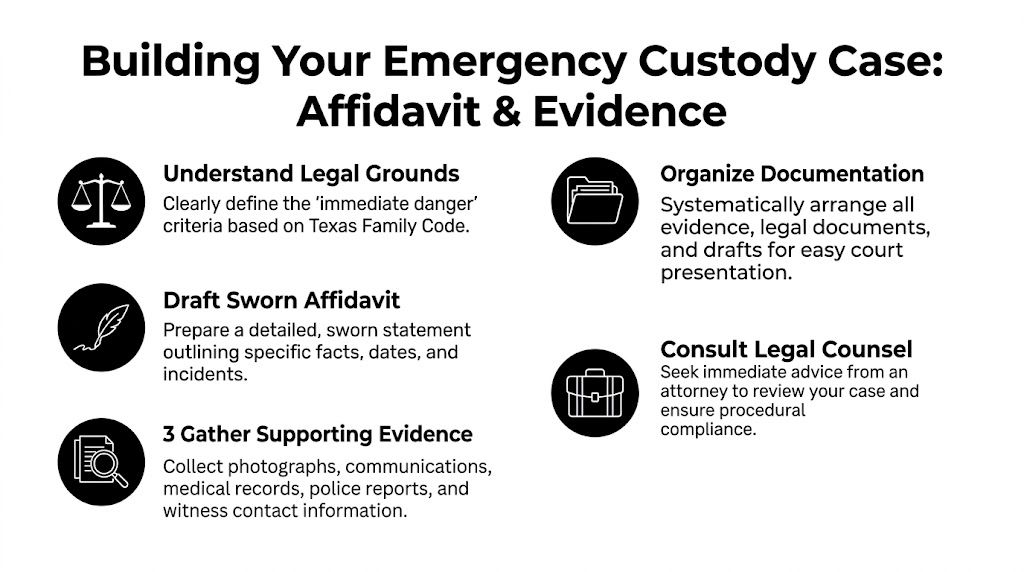
Texas courts look for strong, detailed evidence, and generic allegations often fail while corroborating proof such as dated police reports, physician-signed medical records, and timestamped photos can support relief. The affidavit must connect each item to immediate danger, as explained in this overview of emergency custody evidence standards in Texas.
What the affidavit should say
A useful affidavit usually answers these questions:
What happened
Describe the event plainly. Avoid labels first. Start with facts.
When and where it happened
Dates and times matter. “Last night at about 9:15 p.m.” is better than “recently.”
How you know
Did you see it, hear it, photograph it, or receive a report from a school, doctor, or officer?
Why the child is in immediate danger
Connect the event to current risk, not future worry.
What proof supports the statement
Identify each photo, message, report, or witness.
What works and what doesn’t
Here is the difference judges notice quickly.
Weak statement: “My ex is abusive and unsafe.”
Stronger statement: “On [date], my child told me the other parent hit him with a belt. I photographed bruising that night. The next morning, I took him for medical evaluation. I also reported the incident to law enforcement. Attached are the photographs, medical records, and report details.”
One is an accusation. The other is a sworn factual narrative with evidence.
Build evidence from your phone first
Most emergency cases start with digital evidence.
- Photos and videos: Keep originals if possible. Don’t crop out date and time details if your device stores them.
- Texts and emails: Screenshot the full thread, not one isolated sentence.
- Voicemails: Save them and make a backup.
- School apps and parent portals: Preserve attendance alerts, behavior notes, or nurse communications.
- Location and travel messages: Save anything showing sudden disappearance, threats to leave, or refusal to disclose the child’s whereabouts.
If you’re organizing multiple drafts of your affidavit or comparing revisions from counsel, a tool that helps track changes in PDF documents can make it easier to catch edits before filing. In emergency work, confusion over which version is final can cost time you don’t have.
Essential Evidence Checklist for Your Emergency Motion
| Evidence Type | What to Look For & Why It Matters |
|---|---|
| Police reports | Incident details, dates, officer names, and report numbers. These help anchor your claims in an outside record. |
| Medical records | Records signed by a treating physician or provider, especially when they describe injuries, treatment, or safety concerns. |
| Photographs | Clear, dated or timestamped images of injuries, unsafe living conditions, damage, or neglected conditions. |
| Text messages and emails | Threats, admissions, intoxicated messages, refusal to disclose the child’s location, or messages showing instability. |
| Witness statements | Teachers, counselors, relatives, neighbors, or caregivers who observed conduct or the child’s condition firsthand. |
| CPS records or investigations | Any agency involvement connected to abuse, neglect, or unsafe supervision. |
| School records | Attendance problems, behavior changes, nurse reports, or statements made to school personnel. |
| Call logs and voicemails | Repeated threats, panicked calls from the child, or evidence of harassment tied to the urgent issue. |
| Travel or relocation records | Messages, tickets, or other proof suggesting concealment or unauthorized removal of the child. |
| Your written timeline | A clean, chronological summary that helps the judge follow events quickly and accurately. |
A few hard truths about evidence
Parents sometimes sabotage a strong case by overexplaining or editing the facts to sound more persuasive. That usually backfires.
Keep your affidavit factual enough that the judge can trust every sentence, even if the other side contests every word.
Another common mistake is filing too soon with half the proof still missing. Speed matters, but so does structure. In some cases, the better move is to spend a short burst of time gathering the reports, screenshots, and witness contact information first. If you need help turning raw facts into a court-ready motion, this guide on how to write a court motion is a useful starting point.
For parents who want legal support, one option is working with a Texas family law firm that prepares emergency custody filings, affidavits, and supporting evidence packets, such as the Law Office of Bryan Fagan, PLLC. The value in any emergency case is not slogans. It is getting the facts into admissible, organized form fast.
How to File Your Motion with the Court
Filing feels intimidating when your child may be at risk, but the process is more manageable when you treat it as a sequence of tasks.
You generally start by preparing the family court documents tied to your case. That may involve an existing custody case or a new filing affecting the parent-child relationship, depending on your situation. Along with the motion itself, the court will expect the sworn affidavit and whatever supporting records you have gathered.
What gets filed
The exact paperwork can vary by county and case posture, but emergency filings often include:
- The emergency motion: This tells the court what relief you are requesting.
- A request for temporary restraining relief: This asks the judge to act immediately to protect the child.
- Your affidavit: This is the factual backbone.
- Supporting exhibits: Reports, photos, medical records, texts, and witness-related documents.
If you already have custody orders in place, the filing may be framed as an emergency modification. If you don’t, the case may begin with a suit concerning conservatorship, possession, and access.
What ex parte means
Many parents hear the phrase ex parte and assume something unusual or unfair is happening. It means the judge may review the emergency request before the other parent appears.
That first appearance is short and focused. The judge wants to know whether immediate protective action is justified based on the sworn facts and evidence in front of the court. The judge is not deciding the entire custody case that day.
This is why preparation matters. If your papers are thin, disorganized, or emotionally charged without proof, the court may refuse emergency relief even if your underlying concern is real.
What to expect after filing
Once the court reviews the request, one of several things can happen:
- The judge signs temporary emergency relief.
- The judge denies emergency relief but sets the matter for a regular hearing.
- The court asks for corrections, clarification, or additional proof.
If the order is signed, the next step is critical. The other parent must be legally served with the lawsuit and the signed order. Service is not a technical side issue. It is part of due process, and mistakes here can create serious problems later.
Practical filing advice
Some of the best filing decisions are simple:
- Use one clean evidence packet: Don’t make the clerk or judge sort through scattered screenshots.
- Label exhibits clearly: “Exhibit 1, photo dated…” is easier to follow than unnamed files.
- Bring printed and digital copies if allowed: Courts vary, and backup matters.
- Stay calm in court: Judges notice who can state the facts cleanly under pressure.
For mothers and fathers alike, the filing stage is where discipline matters more than emotion. The parent who arrives with organized facts often gets heard more clearly.
The 14-Day Countdown to Your Temporary Orders Hearing
Getting an emergency order is only the first win. It is not the finish line.
Texas uses a strict 14-day hearing window after the initial ex parte order. If the full hearing with both parties does not happen within that period, the emergency order automatically expires, as explained in this discussion of the Texas emergency custody hearing deadline.

Why this hearing matters so much
The first hearing is often one-sided because the court is trying to act quickly. The temporary orders hearing is different. Both sides appear. Both sides can present evidence and challenge the other’s position.
That means your emergency filing has to stand up under pressure.
A parent sometimes relaxes after the initial order is signed. That is a mistake. The next hearing is where the court decides whether there should be continuing temporary protections while the larger custody case moves forward.
How to use the days wisely
Think of these days as trial preparation in compressed form.
- Refine your timeline: Fill in missing times, places, and names.
- Secure witnesses: Teachers, relatives, counselors, or officers may need notice.
- Update records: If new incidents happen, preserve them immediately.
- Prepare your testimony: Practice a factual answer to likely questions.
- Review weak spots: If there are gaps or prior conflicting messages, be ready to address them forthrightly.
Don’t spend these days arguing with the other parent. Spend them preparing to prove your case.
What judges often look for at this stage
The court is paying close attention to consistency.
If your affidavit says one thing, your texts say another, and your testimony shifts, credibility can erode fast. On the other hand, when your documents, testimony, and witnesses line up, the court has a much firmer basis to continue protections.
The hearing may also shape broader temporary orders on conservatorship and possession. In plain terms, conservatorship means the legal rights and duties parents hold regarding the child. Possession refers to when each parent has physical time with the child. The emergency issue can become the doorway to a larger temporary custody structure that lasts while the case continues.
Navigating Special Circumstances in Emergency Cases
Not every emergency custody case fits the typical post-divorce pattern. Some involve deployment orders, paternity issues, or grandparents stepping in because no parent is available to keep the child safe.

Military families
Military parents face a unique problem. A deployment, temporary duty assignment, or relocation does not automatically create an emergency. But it can support emergency relief if the change leaves the child in immediate danger, such as being placed with an unsuitable caregiver.
Texas law can accommodate these cases through ex parte relief, and courts may need to account for virtual hearings and military documentation like command letters under Texas Family Code §156.006 and the Uniform Deployed Parents Custody and Visitation Act, as discussed in this overview of emergency custody issues for military families in Texas.
What works in military-related emergency cases is specificity. “He got deployment orders” is not enough. “He left the child with a person who has active substance abuse problems, and I have messages confirming the plan” is much closer to the legal standard.
Unmarried parents
Unmarried parents often assume biology alone resolves custody rights. It doesn’t always work that way procedurally.
If paternity has not been legally established, an unmarried father may need to address that issue as part of asserting custody rights. An unmarried mother may still need quick court action if the other parent poses a danger. In either direction, the emergency facts still have to meet the same immediate-harm standard.
Grandparents and relatives
Grandparents, aunts, uncles, and other relatives sometimes become the first safe adult in the room. If both parents are unavailable, impaired, missing, violent, or unable to provide safe care, a relative may need to pursue emergency relief.
These cases are fact-heavy. Courts are careful because parental rights are important. But when a child is plainly unsafe, relatives can play a critical role in bringing the facts forward quickly.
The common thread in unusual cases
The legal path changes depending on who is filing and what prior orders exist. The underlying question does not.
Can you show the judge, with specific proof, that this child needs immediate protection now?
That is true whether you are a deployed service member, a father establishing rights, a mother seeking urgent relief, or a grandparent stepping in because no one else did.
Your Next Steps to Protect Your Child's Future
If your child may be in danger, don’t wait for the situation to “settle down” on its own. Emergency cases usually get better when a parent acts carefully and quickly.
Key Takeaway
The strongest emergency custody cases are not the loudest. They are the clearest. A judge needs facts, proof, and a direct explanation of why the child cannot safely wait.
Next steps you can take now
- Document immediately: Save photos, texts, voicemails, school messages, and any reports connected to the incident.
- Write a clean timeline: Dates, times, locations, and who observed what.
- Separate fear from proof: Your concern is valid, but the court decides based on evidence.
- Think about the hearing now: The emergency filing is only the first stage.
- Get legal guidance quickly: Emergency filings move fast, and small mistakes can have large effects.
If you are a mother, father, grandparent, or caregiver, your role is not to become a courtroom expert overnight. Your role is to protect the child, preserve the facts, and move with purpose.
The parent who acts calmly, documents thoroughly, and asks for the right relief gives the court the best chance to protect the child.
Frequently Asked Questions About Emergency Custody
Some of the hardest questions come after you understand the basics. Parents start wondering what happens if the judge says no, whether they should file without a lawyer, and how emergency relief affects longer-term custody.
FAQ Section
| Question | Answer |
|---|---|
| What if the judge denies my emergency motion? | A denial does not always mean the court thinks your concerns are unimportant. It may mean the judge does not see enough proof of immediate danger for emergency relief. You may still have options through a regular custody modification, enforcement action, or other family court request. |
| Can mothers and fathers both file for emergency custody? | Yes. Texas courts do not reserve emergency relief for one parent over the other. The issue is whether the filing party can prove urgent harm and show that immediate intervention is necessary for the child’s protection. |
| Can grandparents file in an emergency? | In some situations, yes. A grandparent or other relative may need to step in when both parents are unavailable or unsafe. These cases are often more procedurally complex, so careful pleading and evidence matter. |
| Do I need an existing custody order to ask for emergency relief? | Not always. Some parents are seeking emergency help within an existing case, while others need to open a case affecting conservatorship and possession. The right filing depends on the family’s legal posture. |
| Is an emergency custody order permanent? | No. Emergency relief is temporary. Longer-term conservatorship, possession, and parental rights are decided through later hearings and orders. |
| Can I file without an attorney? | You can, but emergency cases leave very little room for procedural mistakes. Problems with affidavits, exhibits, service, or hearing preparation can weaken a case quickly. |
| Will the other parent get to respond? | Yes. The other parent usually gets the opportunity to appear and respond at the temporary orders hearing. That is why preparation after the initial filing is just as important as the filing itself. |
| What does best interests of the child mean in simple terms? | It means the court looks at what most protects the child’s safety, stability, and well-being. In an emergency setting, immediate safety is often the first concern. |
If you need help with a child custody or visitation case in Texas, our experienced attorneys can guide you every step of the way. Contact The Law Office of Bryan Fagan, PLLC today for a free consultation.