
The first holiday season after a separation can feel heavier than any court paper. You may be staring at a calendar, wondering who gets Thanksgiving morning, where your child will wake up on Christmas, and how to answer the hardest question of all: “What’s our holiday plan this year?rdquo;
If that’s where you are, your stress makes sense. Holidays carry memories, traditions, and a lot of emotion. They also bring pressure. Parents often fear that one missed holiday will change their bond with their child forever.
The good news is that Texas law gives families a starting point. The holiday possession schedule texas parents often hear about is part of a larger custody framework designed to reduce guessing and lower conflict. It’s not perfect for every family, but it does give you something many parents need most during a difficult season: predictability.
A predictable schedule helps children know what to expect. It also gives parents a shared reference point when emotions are running high. If you’re still adjusting emotionally, resources about healing after divorce can help you care for yourself while you build a calmer co-parenting routine for your child.
Your Guide to Peaceful Holidays After Divorce
A parent walks into my office in late fall and says the same thing in different words every year: “I don’t even know where to begin.”
Usually, the worry sounds practical at first. Who has the child when school lets out? What if Thanksgiving lands on my regular weekend? What happens if we always celebrated Christmas Eve with my family?
Underneath those questions is grief. Parents aren’t just managing dates. They’re adjusting to a new version of family life.

Why the schedule exists
Texas didn’t create holiday rules to make parents feel boxed in. The schedule exists to give children consistency and to prevent the same argument from happening every November and December.
Consider it a train track. The track doesn’t decide how joyful the trip will be, but it does keep everyone from going in opposite directions. A standard holiday schedule gives both parents a route to follow.
That matters because children do better when adults reduce conflict around transitions. A clear order can’t erase sadness, but it can lower the number of last-minute fights, text battles, and painful misunderstandings.
Holiday schedules work best when parents treat them as a peace plan, not a scoreboard.
What anxious parents often need to hear
If this is your first time dealing with a holiday possession order, you may be afraid that the calendar is taking something from you. In many cases, it’s doing the opposite. It’s protecting your time by spelling it out.
A written order can help when:
- One parent assumes old traditions still control and the other parent expects the court order to apply.
- Family members add pressure by asking where the child “should” be.
- School calendars create confusion about when a holiday period starts and ends.
The goal isn’t to make holidays feel mechanical. The goal is to stop conflict from swallowing the holiday itself.
A calmer way to approach it
Start with this mindset: the schedule is the floor, not the ceiling. It gives your child a stable base. From there, some parents cooperate and trade time by agreement. Others follow the written order exactly because that’s what keeps things calm.
Both approaches can be healthy when they protect the child from conflict.
Understanding the Foundation of Texas Custody Orders
A lot of parents reach the holiday section of a custody order and feel lost almost immediately. The dates look precise, but the words around them can feel unfamiliar or cold. If that is where you are, you are not behind. You are learning a new system at a stressful time.
Before the holiday calendar starts to feel manageable, it helps to understand three building blocks: joint managing conservatorship, possession order, and the best interest of the child standard. Once those terms make sense, the schedule usually feels less like legal code and more like a plan you can use.
Conservatorship means rights and duties
Texas parents often say “custody,” but Texas courts usually use the word conservatorship. In plain language, conservatorship describes the legal rights and duties each parent has toward the child.
Many parents are appointed joint managing conservators. In many families, that means both parents keep important roles in major decisions involving the child, such as education, medical care, and general welfare. It does not automatically answer the question, “Whose day is it?” That part comes later.
This point causes a lot of anxiety. A parent may hear “joint” and assume it means a perfectly equal split of time. Texas law does not use the term that way. Joint managing conservatorship usually refers to shared legal responsibility, while the calendar for actual parenting time is set out somewhere else in the order.
Possession is the calendar
A possession order is the part of the court order that tells you when each parent has the child. If conservatorship covers legal roles, possession covers time on the clock and days on the calendar.
A court order works a lot like a house. Conservatorship is the frame that defines who has which legal responsibilities. Possession is the floor plan that tells everyone where the child will be on certain days. The child’s best interest standard works like the safety rules used to decide whether the structure makes sense for the people living in it.
That last phrase, best interest of the child, can sound broad because it is broad. The court uses it as the guiding principle for custody decisions. Judges are looking for an arrangement that supports the child’s safety, stability, emotional health, and ongoing relationship with each parent when appropriate.
What best interest of the child really means
Parents often ask what a judge is really trying to protect. Usually, the answer is the child’s day-to-day well-being.
In practice, courts often favor schedules that support:
- Stability, so the child knows what to expect
- Healthy relationships with both parents, when appropriate
- Lower conflict, especially during exchanges and holidays
- Practical routines that work with school, distance, and family life
That focus can be reassuring. Texas law is not supposed to start with the assumption that one parent matters more. The court is supposed to start with the child’s needs.
A useful question to keep in mind is simple: “Will this choice make my child’s life steadier, calmer, and healthier?rdquo; That question will help you read the order with the right lens.
Why the standard schedule matters
Texas often uses a Standard Possession Order, or SPO, as the starting point in many custody cases involving children over age 3. It is widely treated as the baseline framework in Texas possession orders, subject to the child’s needs and the facts of the case. The Texas Family Code lays out that structure in Texas Family Code Chapter 153.
That baseline matters for a practical reason. Predictable schedules reduce guesswork. They also reduce the chance that one parent is relying on family tradition while the other is relying on the written order.
Some parents also hear about an expanded standard possession order in Texas and wonder whether that changes holiday time. It can affect regular periods of possession in some cases, but the holiday rules still need to be read carefully in the specific order signed by the court.
Why parents often feel stuck here
Holiday schedules carry more emotion than many other parts of a custody case. Parents are not just reading dates. They are thinking about memories, family expectations, travel, and the fear of missing something important.
A clear legal framework helps because it gives you a starting place that is not based on pressure, guilt, or last-minute bargaining. Understanding these terms helps you make informed choices about whether to follow the standard order as written, agree to a different plan, or ask the court for a change when the current arrangement no longer fits your child’s needs.
The schedule is not meant to erase emotion. It is meant to create enough predictability that your child is not carrying the weight of adult uncertainty.
The Texas Standard Holiday Possession Schedule Explained
Your child asks, “Where will I wake up on Christmas morning?rdquo; and you realize the answer depends on a court order written in legal terms instead of everyday language. That moment feels heavy for many parents. The good news is that the standard holiday schedule is built to answer that question in a predictable way, so your child is not stuck in the middle of adult uncertainty.
When parents talk about the holiday possession schedule texas courts commonly use, they usually mean the holiday provisions in the Standard Possession Order under Texas Family Code §153.314. The basic rule is straightforward. Holiday possession overrides the regular weekend schedule. If a holiday period lands on a first, third, or fifth weekend, the holiday schedule controls.
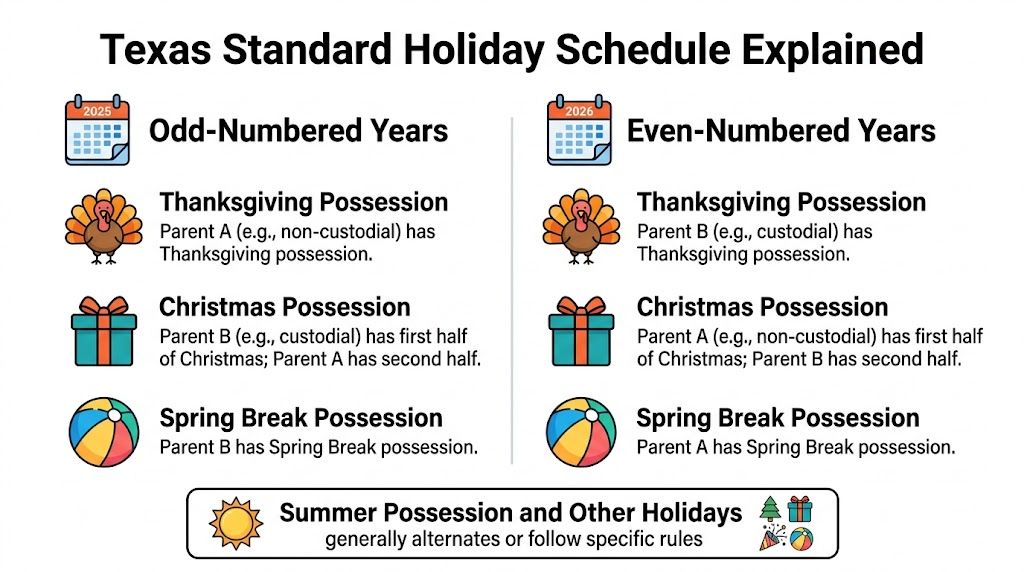
A helpful way to read the order is to treat it like layers on a calendar. Start with the holiday. Then check the year. Then confirm the school dismissal and return dates. That order of operations clears up a lot of confusion.
Thanksgiving
Thanksgiving rotates by year.
Under the Texas SPO, the possessory conservator has Thanksgiving in odd-numbered years, and the managing conservator has it in even-numbered years. The holiday period typically begins at 6 p.m. on the day school dismisses before the break and ends at 6 p.m. on the following Sunday.
The reason for that structure is fairness over time. One parent does not get every Thanksgiving. The schedule alternates so the child can keep meaningful traditions with both sides of the family across the years.
If you feel disappointed in the years you do not have Thanksgiving, that reaction is normal. Many parents do. The written rotation at least removes the yearly fight over who gets the holiday.
Christmas
Christmas creates the most questions because Texas usually splits it into two separate periods instead of awarding the whole break to one parent.
Under the Texas SPO:
- In even-numbered years, the possessory conservator gets the first half of Christmas break, from 6 p.m. on the day school dismisses for vacation until noon on December 28.
- In odd-numbered years, the possessory conservator gets the second half, from noon on December 28 until 6 p.m. on the day before school resumes.
The managing conservator receives the opposite half each year.
This arrangement can feel mechanical, but there is a child-focused reason behind it. It gives both parents guaranteed holiday time and reduces pressure to renegotiate every December. One year may include Christmas Eve or Christmas morning. The next may include New Year’s celebrations and the end of the school break. Over time, the schedule aims for balance rather than perfection in any single year.
Spring Break
Spring Break also alternates by year under the standard pattern.
Usually, one parent has the full school break in one year, and the other parent has it the next. As with Thanksgiving, the key is to check the year first and then match the exact dates to your child’s school calendar. That school calendar matters because the beginning and end of possession are often tied to when school releases and resumes.
Mother’s Day and Father’s Day
These weekends are simpler.
Under the Texas SPO, Mother’s Day weekend goes to the mother, and Father’s Day weekend goes to the father, regardless of which parent is labeled managing or possessory conservator. Parents often find this part easier to read because it does not depend on odd or even years.
That predictability serves an emotional purpose too. It protects parent-specific time that many families consider especially meaningful.
Child’s birthday
The child’s birthday has its own rule. The parent who does not already have possession that day usually has access from 6 p.m. to 8 p.m., with pickup and return at the possessing parent’s residence.
The period is brief, but it gives the non-possessing parent a defined opportunity to celebrate. For a child, even a short birthday visit can matter because it confirms that both parents remain part of the day.
Quick-reference table
| Holiday | Standard rule |
|---|---|
| Thanksgiving | Possessory conservator in odd-numbered years, managing conservator in even-numbered years |
| Christmas | Split into two periods that alternate each year |
| Spring Break | Alternates by odd and even years |
| Mother’s Day | Always with the mother |
| Father’s Day | Always with the father |
| Child’s birthday | Non-possessing parent gets 6 p.m. to 8 p.m. |
Why parents still get mixed up
Confusion usually comes from three places.
First, the labels can distract from the actual schedule. Your order may use managing conservator and possessory conservator rather than the everyday terms “custodial” and “non-custodial.”
Second, parents often look at the usual weekend calendar before checking the holiday language. For holiday periods, that is backwards. Start with the holiday provision.
Third, school calendars control more than many parents expect. If school dismisses earlier or resumes on a different date, the possession period may shift with it.
Some families also have orders with expanded exchange times during regular possession periods. If you want to compare how school-based exchanges work outside the holiday context, this explanation of the expanded standard possession order in Texas is a useful reference.
A simpler question usually gets you to the right answer faster: Does a holiday period apply to this date? Once you answer that, the rest of the schedule becomes much easier to read.
Customizing Your Holiday Schedule Beyond the Standard Order
The standard order is common, but it isn’t a cage. Many families do better when they build a custom holiday arrangement that fits their real lives.
Texas law allows that flexibility. The Standard Possession Order governs approximately 80-90% of initial custody orders in Texas for children over 3, but it’s only a presumption, and parents can agree to a different plan if that better serves the child’s best interest under Texas Family Code §153.251 et seq., as explained in this discussion of the Texas standard possession calendar and customization options.

When a custom schedule makes sense
Some families need more than a simple odd-even rotation.
A custom schedule may help when:
- Work schedules are unusual and one parent works holidays every year.
- Family traditions are rooted and both parents want to preserve different celebrations.
- Children are older and their school, sports, or travel plans make the default arrangement awkward.
- Extended family lives far away and a slightly different split would reduce stress.
Customizing doesn’t mean one parent “wins.” Done well, it means the adults are solving a problem together.
What collaboration can look like
Parents often reach workable agreements like these:
- alternating Christmas Eve and Christmas Day instead of using the two larger blocks
- keeping Thanksgiving with one side of the family but adjusting winter break time elsewhere
- building in travel time when one parent lives farther away
- setting exchange locations that reduce stress for the child
A written calendar is often easier than paragraphs of legal language. Some parents use a shared digital calendar. Others rely on a printed yearly calendar. As one practical option, the Law Office of Bryan Fagan, PLLC offers a color-coded Texas possession calendar through its resources, which some parents use to visualize weekends, holidays, and summer periods.
Put every agreement in writing
Well-meaning parents often encounter trouble. A verbal agreement may feel cooperative, but it can fall apart quickly when memories differ.
If you and the other parent agree to something different from the standard order:
- Write it down clearly
- Use exact dates and exchange times
- Address transportation
- Submit it properly if court approval is needed
If you need ideas for how different schedules can look in real life, reviewing these visitation schedule examples can help you think through options.
Keep the child at the center
The strongest custom schedules usually have one thing in common. They are built around the child’s experience, not the parents’ frustration.
Ask yourself:
- Will this reduce transitions that feel rushed?
- Will my child know what to expect?
- Will this lower conflict between homes?
- Is this practical enough to repeat every year?
If the answer is yes, a custom plan may serve your family better than the default framework.
Navigating Common Scenarios and Special Circumstances
Real families rarely fit neatly inside a calendar box. That’s why the hardest holiday questions usually come from situations that feel small at first, then turn into major stress points.
When parents live far apart
Many parents assume distance changes everything about holiday possession. For holidays, that usually isn’t true.
Under Texas Family Code §153.314, the holiday possession schedule remains identical even when parents live over 100 miles apart, and it still supersedes regular visitation. The same source also notes that non-compliance can lead to enforcement, including a motion for contempt under Family Code §157, and that 70-80% adherence in unmodified SPOs helps reduce litigation by providing a clear structure, according to this guide on the Texas holiday possession schedule for 2025.
That means if you live in Houston and the other parent lives several hours away, Thanksgiving and Christmas still follow the holiday rules in the order. The challenge becomes logistics, not which parent gets the holiday.
A long-distance parent should focus on practical details:
- Confirm exchange timing early so no one is guessing around school dismissal.
- Plan transportation in writing if travel is significant.
- Check school calendars carefully because school release dates control many holiday periods.
A child’s birthday can be emotional
Birthdays can stir up old expectations. One parent may want a full party day, while the other wants a private celebration.
Under the standard holiday framework discussed earlier, the non-possessing parent gets a short birthday period. In practice, parents can make that smoother by keeping plans simple. A dinner, cake, or gift exchange often works better than trying to create two competing celebrations.
Children usually remember whether a birthday felt peaceful more than whether it was elaborate.
Military families and changing duty schedules
Military parents often face a different kind of uncertainty. Deployment, training, and sudden schedule changes can interfere with even the best-written order.
If you’re in a military family, don’t assume you have to just “make do” informally. A deployment-related issue may call for a temporary adjustment, a negotiated revision, or court involvement depending on the facts. The Servicemembers Civil Relief Act can also affect court timing and procedure in some cases.
A practical approach is to gather:
- duty schedules or deployment information
- your current court order
- a list of upcoming holiday dates likely to be affected
- any written communication with the other parent
That information helps your attorney evaluate whether a temporary agreement is enough or whether formal court action is safer.
When the other parent doesn’t follow the order
Sometimes the conflict isn’t confusion. It’s refusal.
A parent may say, “I know it’s your year, but my family already made plans,” or “The child doesn’t want to go.” Those situations are painful because they mix emotion with legal rights.
When that happens, start by staying calm and documenting the problem. Save texts, emails, and school-calendar references. Don’t respond with threats or make your child carry messages between homes.
If the issue continues, legal enforcement may be necessary. A clear order matters because courts can enforce specific terms more easily than vague understandings.
How to Enforce or Modify Your Holiday Possession Order
Even a clear order won’t solve every problem by itself. Sometimes a parent refuses to follow it. Other times, the order made sense years ago but no longer fits your family.
Those are two different legal paths. One is enforcement. The other is modification.
Enforcing an existing holiday order
If the other parent violates the holiday schedule, start with the written order in your hand. Read the exact language. Then compare it to what took place.
A careful response often looks like this:
Document the violation
Save texts, emails, missed exchange details, and relevant school calendar information.Communicate briefly and clearly
Keep your message child-focused. Don’t argue about old grievances.Avoid self-help choices
Don’t decide to withhold future time because you feel the other parent “owes” you.Talk with a family law attorney
An attorney can review whether the order is specific enough for enforcement.
If court action is needed, a parent may file an enforcement case. If you want a clearer idea of that process, this overview of a motion to enforce custody in Texas explains the basics in straightforward terms.
Modifying an outdated holiday schedule
Modification is different. You aren’t claiming the other parent broke the order. You’re saying the order itself needs to change.
That may come up when:
- a parent relocates
- work schedules shift in a lasting way
- the child’s school or activity demands change
- the current holiday rotation keeps causing conflict that a better plan could reduce
Texas courts usually require a material and substantial change in circumstances before modifying an existing order. The court will also still look at the best interest of the child.
How to decide which path fits
Ask two questions:
- Is the order clear, but the other parent isn’t following it? That points toward enforcement.
- Is the order being followed, but it no longer works for the child or the family? That points toward modification.
Parents sometimes blur these together. That can waste time. If your real problem is a bad fit, enforcement won’t fix it. If your real problem is defiance, a modification request may miss the point.
A court can’t protect a schedule it can’t identify clearly. Specific language matters.
Don’t wait until the next holiday crisis
Parents often seek help after a painful Thanksgiving or a chaotic Christmas exchange. That’s understandable, but early action is better.
If your order is vague, if exchanges keep breaking down, or if your family circumstances have changed, speaking with counsel before the next holiday season can give you more options and more peace of mind.
Key Takeaways for Managing Your Texas Holiday Schedule
Holiday possession can feel very personal because it is. But clarity helps.
Here are the points that matter most:
- The standard holiday schedule gives predictability. It creates a baseline that helps parents and children know what to expect.
- The child’s best interest stays at the center. Courts focus on stability, meaningful parent-child relationships, and reduced conflict.
- You may be able to customize the schedule if both parents agree and the arrangement fits the child’s needs.
- You have legal remedies if the other parent refuses to follow the order or if the current order no longer works.
For many parents, the biggest relief comes from realizing they don’t have to solve everything in one emotional conversation. Start with the signed order. Read the holiday language carefully. Mark the dates on a calendar. Then decide whether your next step is cooperation, clarification, enforcement, or modification.
If you’re overwhelmed, that doesn’t mean you’re failing. It means this matters to you. And when your relationship with your child matters, getting informed is a strong first move.
Frequently Asked Questions About Holiday Possession
What if a holiday falls on my regular weekend
The holiday schedule controls. Under the Texas standard framework, holiday possession supersedes the regular weekend or weekday schedule. So if Thanksgiving or Christmas overlaps with your normal weekend, follow the holiday terms in the order.
Who usually handles transportation for holiday exchanges
That depends on the wording of your court order or agreed order. Some orders assign pickup to one parent and return to the other. Others tie exchanges to school or a residence. Don’t assume. Read the transportation and exchange provisions carefully.
What if my child wants to stay with the other parent for a holiday
This is common, especially with older children. A child’s feelings matter, but parents should be careful not to let the child make adult legal decisions in the moment. If the two parents agree to a change, put it in writing. If this becomes a repeated issue, you may need to review whether the current order still fits the child’s needs.
Can grandparents be part of holiday planning
Yes, in practical terms, many families build holiday plans around grandparents and extended family traditions. But the legal right to possession usually belongs to the parent named in the order unless a court has granted separate rights.
Should we follow our informal agreement or the court order
If there’s a conflict, the signed court order is the enforceable document. Informal agreements can help when both parents cooperate, but they are risky if they aren’t written down clearly and consistently.
If you need help understanding or resolving a holiday possession issue, Law Office of Bryan Fagan, PLLC can help you review your order, evaluate your options, and take action that protects your relationship with your child. If you need help with a child custody or visitation case in Texas, our experienced attorneys can guide you every step of the way. Contact The Law Office of Bryan Fagan, PLLC today for a free consultation.