Skip to content
When your child’s future is on the line, understanding your rights as a father matters most. Many fathers worry that the legal system is biased against them, but winning full custody in Texas is absolutely achievable for a dedicated dad. The key is to move past old myths and focus on proving to the court that you are the parent best equipped to provide your child with a stable, loving, and supportive home.
Understanding How Texas Determines Custody

Many fathers enter a custody battle feeling like the deck is stacked against them, believing that Texas courts automatically favor mothers. This is a common misconception. The Texas Family Code is written to be completely gender-neutral, meaning a judge cannot legally make a decision based on whether a parent is a mother or a father.
Instead, every single decision comes down to one powerful principle: the “best interest of the child.” This is the legal standard that guides every custody ruling in the state, and it will be the foundation of your entire case.
Plain-English Explanations of Custody Terms
In Texas, what most people call "full custody" has a specific legal name: Sole Managing Conservatorship. This gives one parent the exclusive right to make the most important decisions in a child's life—such as determining where they live (their primary residence), making choices about their education, and consenting to non-emergency medical care.
The more common outcome is Joint Managing Conservatorship, where both parents share those rights and responsibilities, even if the child lives primarily with one parent. To be named the Sole Managing Conservator, your job is to provide the court with clear, compelling evidence showing that giving you sole decision-making authority is what truly serves your child’s best interests.
To give you a clearer picture, here are some of the critical elements a judge will look at when a father is seeking sole managing conservatorship.
Key Factors in a Texas Custody Case for Fathers
| Factor | Why It Matters for Your Case |
|---|---|
| Parental Involvement | You must show a consistent history of being an active caregiver, involved in daily routines, school, and healthcare. |
| Child's Best Interest | This is the core legal standard. All your evidence must prove that your custody is what's best for the child's emotional and physical well-being. |
| Evidence of Unfitness | To get sole custody, you often need to show that naming the other parent a joint conservator would not be in the child's best interest due to issues like substance abuse, neglect, or family violence. |
| A Stable Home | Demonstrating you can provide a safe, stable, and nurturing environment is essential. |
| Paternity | If unmarried, you must legally establish you are the father before you can even ask for custody rights. |
| A Clear Parenting Plan | You need a detailed, realistic plan for how you will raise your child, covering everything from schedules to education. |
This table provides a snapshot of where your focus needs to be. You're not just telling the judge you're a good dad; you're proving it with facts and evidence.
The Three Pillars of a Strong Custody Case
To build a case that a judge will take seriously, your strategy should focus on three critical areas:
- Establishing Your Legal Rights: Before you can fight for custody, you must be recognized as the child's legal father. For unmarried dads, this is the first, non-negotiable step. You can learn more about how to establish paternity to get started.
- Demonstrating Your Role as an Active Caregiver: You have to show the court just how involved you are in your child’s day-to-day life. Think school pickups, doctor visits, bedtime stories, and being their emotional support.
- Presenting a Clear, Child-Focused Plan: A judge needs to see that you’ve thought this through. You need a concrete plan for your child's future that guarantees their stability, safety, and happiness.
This journey takes patience, preparation, and an unwavering commitment to putting your child first. By understanding the law and focusing on what really matters, you can build a powerful case that gives you a real opportunity to secure your child's future.
Understanding the "Best Interest of the Child" Standard

In every Texas courtroom, one principle guides every custody decision: the “best interest of the child.” This isn't just a sentimental phrase; it's the legal standard defined in Texas Family Code Chapter 153. It requires a judge to look past what the parents want and focus entirely on what will create the safest, most stable, and most nurturing environment for the child.
For any dad seeking full custody, truly grasping this standard is everything. The court isn’t asking which parent is “better” in a general sense. It’s asking which parent is best equipped to meet the child’s specific needs—day in and day out.
From Joint to Sole Conservatorship
You should know that Texas law starts with a presumption in favor of Joint Managing Conservatorship. This is the standard arrangement where both parents share the rights and duties of raising their child, even if one parent determines the child's primary residence.
When you are asking for "full custody," you are legally asking the court to name you the Sole Managing Conservator. This means you have to prove that appointing the parents as joint managing conservators would not be in the child’s best interest.
That's a high bar to clear. It requires compelling evidence that the other parent’s actions or circumstances pose a risk to your child's physical or emotional well-being.
What Are the Holley Factors?
To guide custody decisions, Texas courts use a set of guidelines known as the “Holley Factors.” Think of these not as a simple checklist, but as a framework the judge uses to see the whole picture of your child’s life.
A judge will weigh things like:
- The child’s specific needs: This covers their emotional, physical, and developmental needs, both now and for the future.
- Each parent’s abilities: The court will scrutinize each parent’s capacity to provide a safe, stable, and loving home.
- The stability of the home: A consistent, predictable environment is almost always given priority.
- Parental actions (or inactions): The judge will review any behaviors that might signal an unhealthy or improper parent-child relationship.
- Any danger to the child: This is a major factor. It includes any history of neglect, substance abuse, family violence, or instability.
These factors are where you turn abstract ideas into concrete proof. The father who consistently manages doctor appointments, shows up for parent-teacher conferences, and helps with homework every night is providing powerful evidence that he is the parent best equipped to meet his child's needs. If you need a deeper dive, our detailed article explains how to prove the best interest of the child.
A judge sees your entire case through the lens of these factors. Your strategy should be laser-focused on showing how your care and stability align perfectly with your child's needs, while the other parent’s situation, unfortunately, may present a risk.
The Reality for Fathers Seeking Custody
While the law is gender-neutral, statistics show that fathers often face an uphill battle. U.S. data reveals that dads win sole custody in just 18.3% of cases, even with 2.5 million single-father households nationwide.
This gap is partly due to old biases and situations where parents mutually agree the mother will have primary custody. But fathers can absolutely improve their odds. Success skyrockets when a dad can prove undeniable stability. Custodial fathers are more likely to be employed full-time (74.3% vs. 51% of custodial moms) and less likely to live in poverty. You can explore more of these family law statistics for 2023 to understand the current landscape.
This data isn’t meant to discourage you—it’s meant to arm you with the truth. It shows you exactly what judges are looking for: the parent who can provide a rock-solid foundation for their child's future. Your actions, your preparation, and your ability to prove you are that parent will make all the difference.
Building Your Case with Evidence
In a Texas custody fight, what you say matters, but what you can prove is what wins the day. This is where you translate your commitment as a father into cold, hard facts—the kind of tangible proof a judge can’t ignore. Building a strong case isn’t about a dramatic, last-minute courtroom reveal. It’s about the methodical, day-in-day-out work of showing you’re the parent who provides the most stable, supportive, and nurturing home.
Judges in Texas make their decisions based on the "best interest of the child." They don't know you or your family, so they rely entirely on the facts presented in court. Your job is to paint them an undeniable picture of your involvement and your ability to meet every single one of your child’s needs.
Documenting Your Daily Involvement
Some of the most powerful evidence you can present comes from the small, everyday actions of a great dad. This is why you should start a detailed parenting journal today. This isn't a diary for your feelings; it's a factual logbook of your caregiving.
What should you include?
- Daily Routines: Track who gets the kids up, makes their breakfast, helps with homework, and handles the nightly bedtime story. Be specific with times.
- Appointments: Log every doctor, dentist, or therapy visit you handle—from scheduling the appointment to taking them there.
- School and Activities: Note every parent-teacher conference, school play, and soccer practice you attend. Keep track of your communication with teachers and coaches.
- Quality Time: Be descriptive. Instead of "played with kids," write "Read The Gruffalo three times before bed," or "Helped Sarah work through a problem she was having with a friend at school."
This journal quickly becomes an indispensable tool. It creates a timeline that refutes vague accusations and establishes you as the constant, reliable parent in your child's life.
A well-kept journal is often the most persuasive piece of evidence you'll have. It provides concrete proof that counters he-said-she-said arguments and proves you're the one showing up consistently.
Gathering Critical Third-Party Documents
Your personal notes are vital, but backing them up with evidence from neutral sources gives your case a massive credibility boost. These documents offer an objective view of your child’s life and your central role in it.
Start collecting these items now:
- School Records: Report cards, attendance sheets, and communication from teachers can paint a picture of a child who is thriving in your care.
- Medical Records: Files from pediatricians, dentists, or specialists showcase your proactive approach to managing your child’s health.
- Communication Logs: Keep every text message and email with the other parent organized. Your goal is to look like the reasonable, business-like co-parent, even when faced with conflict.
This is the time to get organized. The checklist below outlines essential evidence you should gather to build a powerful case.
Essential Evidence Checklist for Your Custody Case
| Evidence Category | Specific Examples | How It Helps Your Case |
|---|---|---|
| Parental Involvement | Parenting journal, calendars, photos/videos of activities, communication logs (texts/emails). | Demonstrates consistent, hands-on care and your role as the primary caregiver. |
| Child's Well-Being | School records (grades, attendance), medical/dental records, letters from teachers/counselors. | Shows the child is healthy, stable, and thriving under your care. |
| Financial Stability | Pay stubs, tax returns, bank statements, proof of health insurance for the child. | Proves you can provide a stable home and meet the child's financial needs. |
| Home Environment | Photos/videos of the child's room and living space, lease/mortgage documents. | Establishes you provide a safe, clean, and stable living environment. |
| Other Parent's Instability | Police reports, CPS records, criminal history, witness statements, substance abuse test results. | Provides concrete proof if the other parent's behavior poses a risk to the child. |
Gathering these documents takes time, so don't wait. The more organized and thorough you are, the stronger your position will be, whether you're negotiating a settlement or heading to court.
The Role of Witness Testimony
Sometimes, the best way to prove your bond with your child is through someone else's eyes. Strong witnesses can offer firsthand accounts of your parenting that a judge will find compelling. A good witness isn't just a family member or friend; it's someone who can speak to specific examples of your excellent parenting from a more neutral perspective.
Consider people like:
- Teachers or a school principal
- Coaches or extracurricular leaders
- Neighbors who see you interacting with your child daily
- A long-time babysitter or daycare provider
These individuals can provide unbiased testimony about your deep involvement, your child's happiness when with you, and the stable environment you provide.
Addressing the Other Parent’s Instability
This is often the most difficult but necessary part of seeking sole managing conservatorship. You must prove that the current situation is not in your child's best interest. This requires you to show, with evidence, that the other parent has ongoing issues that create risk.
This could mean documenting issues such as:
- Substance abuse problems
- A pattern of neglect
- Unstable housing or chronic unemployment
- An unsafe or chaotic home environment
Be warned: making accusations without solid proof can damage your credibility with the judge. You need police reports, medical records, or credible witness testimony. It's critical to frame this issue around your child's safety and best interest, not as a personal attack. Our firm has a detailed guide on how to prove a parent is unfit that explores the specific legal strategies for this.
Your goal isn't just to "win," it's to secure a safe and stable future for your child. In the United States, over 2.5 million fathers have sole custody of their children, making up 20% of all custodial parents. These numbers prove that courts recognize and reward dedicated fathers. Success often comes down to preparation and showing stability; for example, 74.3% of custodial fathers work full-time, a key factor judges weigh heavily. Since most cases settle before trial, fathers who meticulously prepare their evidence from day one are in a much stronger position to achieve the outcome their child deserves.
Navigating the Texas Court Process
The idea of stepping into a Texas courtroom can feel intimidating, but knowledge is power. When you understand the basic roadmap of a custody case, it demystifies the process and lets you focus on what really matters: your child. Think of it as a journey with a series of deliberate steps, each one building on the last to tell your story.
The process officially begins when you or your lawyer file an Original Petition in Suit Affecting the Parent-Child Relationship. This formal-sounding legal document simply lays out what you're asking the court to do—in this case, to name you as the Sole Managing Conservator.
The Importance of Temporary Orders
Shortly after filing, you’ll have one of the most critical hearings of your case: the hearing for Temporary Orders. These are court orders that put rules in place while your case is ongoing. A judge will decide on a temporary possession schedule, who makes key decisions for the child, and who pays child support for the time being.
Winning favorable Temporary Orders can set a powerful precedent. If you're named the temporary primary caregiver, it gives you the chance to establish a stable, successful routine for your child. Later, a judge will be much more hesitant to disrupt a stable situation that's clearly working when it's time to make a final decision.
This flowchart breaks down the key components of building a strong case.
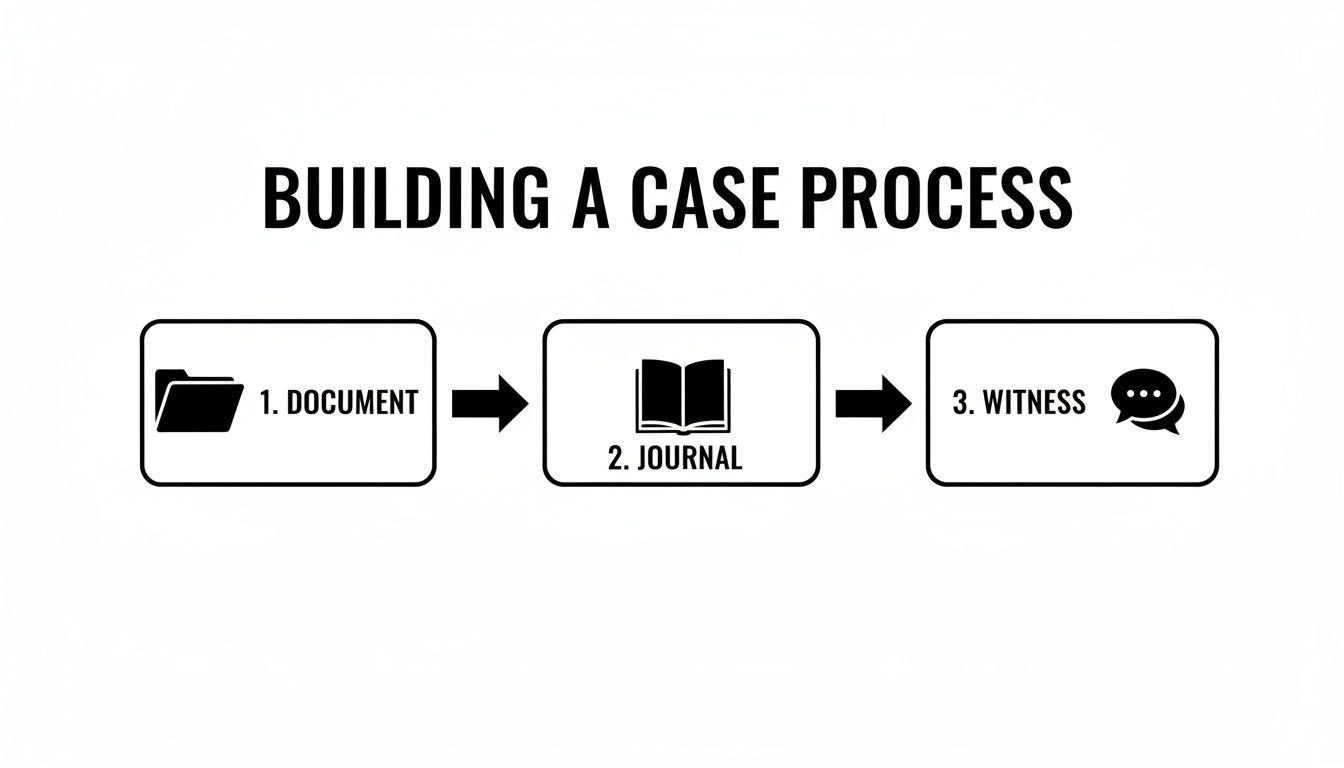
As you can see, a solid case is built on a foundation of good documentation, consistent journaling, and credible witness accounts.
The Role of Mediation
Before you ever see the inside of a courtroom for a trial, Texas law requires most parents to attend mediation. This is a confidential meeting where you, the other parent, and your attorneys sit down with a neutral third-party mediator to try and reach an agreement.
Don't think of mediation as a sign of weakness; it’s a required and often highly beneficial step. It gives you more control over the outcome and can save you the immense emotional and financial cost of a trial. A successful mediation results in a Mediated Settlement Agreement, which is a binding contract you can submit to the judge for their signature. As you work through the legal system, it's also good to know the rules for things like electronic signatures on court documents; you can learn more about the specific requirements by checking out resources on state-specific electronic signature laws.
Remember: In the courtroom, your demeanor matters just as much as your evidence. A calm, respectful, and child-focused attitude shows the judge you are mature and stable—exactly the qualities they look for in a primary parent.
Presenting Your Case in Court
If mediation doesn't lead to a full agreement, your case will proceed to trial. This is your chance for you and your attorney to present all your evidence and testimony to the judge. Giving effective testimony means being honest, direct, and sticking to the facts. Avoid emotional outbursts or speaking poorly of the other parent. Instead, keep the focus squarely on your child's needs and how you are best equipped to meet them.
Your attorney will guide you, but it’s helpful to know about other professionals who might get involved:
- Amicus Attorney: An attorney appointed by the court specifically to represent the child’s best interests.
- Custody Evaluator: A neutral mental health professional who conducts a detailed investigation into the family dynamic and makes a recommendation to the court.
Cooperating fully and honestly with these professionals is absolutely crucial. Their reports carry a lot of weight with the judge.
Data shows that custodial fathers are often financially stable, a factor courts weigh heavily. Globally, among the estimated 300-400 million separated fathers, those who succeed in custody cases tend to emphasize their deep involvement and ability to provide a stable home. In the U.S., where fathers now make up 20% of 12.9 million custodial parents, their households are far less likely to face poverty (11% vs. 27% for mothers). This proves that a stable dad can absolutely provide a thriving home, and that financial security is a key piece of evidence in proving you can provide for your child's best interests.
Common Mistakes Fathers Should Avoid

When you're fighting for your children, taking the right steps is only half the battle. Just as important is avoiding the wrong ones. The emotions in a custody case are intense, and it's easy for even the best dads to make mistakes that can damage their case.
You have to operate as if the court is watching your every move. Your behavior, from your text messages to your timeliness, gives a judge a window into your character, stability, and judgment. Every communication can—and often will—become evidence.
A single moment of frustration vented in a text message can be twisted to paint you as an angry, unstable parent. Understanding that you're under a microscope is your best defense.
Losing Your Cool in Communications
It's completely normal to feel frustrated, especially when co-parenting is strained. Letting that frustration bleed into your texts and emails, however, is a huge mistake. A judge will be reading these messages, looking for the parent who stays calm, reasonable, and focused on the child.
Let’s consider a common scenario: The other parent is 30 minutes late for an exchange.
- The Mistake: Firing off a string of angry texts. "Where ARE you?! You do this every single time! Can't you be reliable for once?"
- The Right Approach: Sending one calm, factual message. "Just checking on your ETA for the exchange. The kids are ready and waiting."
The second option documents the tardiness without making you look aggressive or difficult. It shows the judge that you're the stable parent, even when things don't go according to plan.
The Dangers of Social Media
Think of your social media accounts as public diaries that the opposing attorney would love to access. Posting negative comments about the other parent, complaining about the court process, or even sharing pictures from a night out with friends can be weaponized against you.
A judge’s perception of you is critical. They might see a photo of you at a bar and interpret it as a sign of irresponsibility. A frustrated post about your ex could be framed as proof you can’t co-parent effectively. When in doubt, don't post.
The smartest move? Either deactivate your accounts until your case is over or lock them down with the highest privacy settings and stop posting anything personal. This simple step can prevent a mountain of trouble.
Ignoring Court Orders and Financial Duties
Few things will damage a father's credibility with a judge faster than ignoring a court order. Whether it’s a temporary possession schedule or an order to pay child support, you must follow it to the letter.
Failing to pay court-ordered support is not a protest—it's a clear signal to the judge that you're unreliable and unwilling to provide for your child.
If you disagree with an order, you address it the right way: through your attorney in court. You don't take matters into your own hands. Proving you respect the legal process is essential if you want a judge to trust you with the immense responsibility of being a Sole Managing Conservator. Showing maturity and stability, especially under pressure, is how you demonstrate you are the right parent for the job.
Next Steps: Securing Your Child's Future
This entire process is about one thing: proving you can give your child the best, most stable environment in which to thrive. The legal road for a father seeking full custody in Texas can feel like a marathon. But by staying organized and laser-focused on what really matters, you can build a persuasive and compelling case.
The most powerful actions you can take right now boil down to two words: preparation and consistency. Never forget that every decision you make, every text you send, and every school pickup you handle becomes part of the story you’ll tell the court.
Key Takeaways for Fathers
To build the strongest possible case, focus on these principles every single day:
- Document Everything: Your parenting journal is your single most powerful tool. Log daily routines, doctor’s appointments, homework help, and every moment of quality time. Be specific.
- Stay 100% Child-Focused: In every communication and action, make it clear that your child's stability and happiness are your only priorities.
- Know the Legal Standard: Keep the "best interest of the child" standard at the forefront of your mind. All your evidence must point directly back to this principle.
- Seek Professional Guidance: You don’t have to walk this path alone. An experienced family law attorney is not just a guide; they are your strategist.
This is a tough road, but your dedication is the single most important factor in your child's future. When you stay prepared and focused on these key areas, you empower yourself to fight effectively for your family.
This isn't a battle you should fight on your own. Having a trusted advocate in your corner can mean the difference between winning and losing, helping you sidestep common mistakes and present your case with the confidence it deserves.
If you need help with a child custody or visitation case in Texas, our experienced attorneys can guide you every step of the way. Contact The Law Office of Bryan Fagan, PLLC today for a free consultation.
Frequently Asked Questions from Texas Fathers
When you’re fighting for your children, you have questions that need clear, no-nonsense answers. Here are some of the most common questions we hear from dads across Texas.
Does Texas Law Favor Mothers in Custody Cases?
No. The Texas Family Code is written to be completely gender-neutral. A judge is legally forbidden from basing a custody decision on whether a parent is the mother or the father. The only thing that matters in a Texas courtroom is the “best interest of the child.”
However, societal biases can sometimes exist. This is why it’s so critical for fathers to be over-prepared with an evidence-backed case that shows you are the parent best equipped to give your child a stable and nurturing home.
What if Paternity Has Not Been Legally Established?
This is the first, non-negotiable step. If you are not legally recognized as the father, you have zero custody or visitation rights under Texas law.
You must establish paternity first. There are two main paths:
- Acknowledgment of Paternity (AOP): If you and the mother agree, you can both sign this simple form.
- Paternity Suit: If the mother is uncooperative, you'll have to file a lawsuit. The court will then likely order DNA testing to legally establish you as the father.
Once you are legally the father, you can ask the court to make orders for custody (conservatorship), visitation (possession schedules), and child support.
Can My Child Choose Which Parent to Live With in Texas?
Yes, to an extent, but the child does not make the final decision. In Texas, once a child is 12 years of age or older, a parent can request that the judge interview the child privately to hear their preference about where they want to live.
A child’s preference is given significant weight, but it is not the final word. The judge still has the ultimate authority and will make a decision based on the child's overall best interest, considering all other factors in the case.
Do I Need an Attorney to Win Full Custody?
Legally, you have the right to represent yourself. However, seeking Sole Managing Conservatorship on your own is incredibly complex and high-stakes. The rules of evidence are strict, the standard of proof is high, and one mistake can damage your entire case.
An experienced family law attorney does more than just file paperwork. They build a legal strategy, know what evidence will persuade a judge, anticipate the other side's arguments, and help tell your story in a compelling way. Hiring the right lawyer dramatically increases your chances of achieving the best possible outcome for you and your child.
If you need help with a child custody or visitation case in Texas, our experienced attorneys can guide you every step of the way. Contact The Law Office of Bryan Fagan, PLLC today for a free consultation.