
When your child’s future is on the line, understanding your rights is the first step toward peace of mind. A paternity test court order is a formal, judge-signed document that legally requires a mother, child, and alleged father to participate in genetic testing. For many Texas families, this order is the only way to get legally-binding answers, protecting parental rights and, most importantly, your child's best interests.
Why a Court Order for Paternity Is So Important in Texas
Here in Texas, there's a big difference between being a biological father and being a legal father. That distinction is at the heart of many family law cases. A legal father has rights and responsibilities a court can enforce—like the right to seek custody (called conservatorship) or ask for a visitation schedule (called a possession schedule). A biological father without legal status, however, has none of those enforceable rights.
The Texas Family Code does have a way to establish legal fatherhood through the "presumption of paternity." The law presumes a man is the father if he was married to the mother when the child was born, for example. But for unmarried parents, that legal shortcut doesn't exist, which is why a court order becomes so essential.
The Difference Between Knowing and Proving
You may feel completely certain that you are—or are not—the father. But your personal certainty doesn't hold up in court. You need a court-ordered test to make any legal progress on the most important issues affecting your child:
- Establishing Child Support: A mother cannot legally require a man to pay child support until his paternity is established by a court.
- Securing Custody and Visitation Rights: A father cannot ask a judge for a possession schedule or a say in his child's upbringing until he is legally recognized as the dad.
- Accessing Benefits for the Child: A child can only access a father’s social security, inheritance, or health insurance benefits after paternity is formally established.
While many men who voluntarily take a paternity test are confirmed as the biological father, the dynamic changes when the issue lands in a courtroom. Studies show that when paternity is disputed in a legal case, the rate of exclusion can be as high as 26.9%. This means more than one in four men tested in these high-stakes situations are found not to be the biological father. You can learn more about these paternity statistics and their implications.
When the stakes are this high, a court order provides the legal clarity needed to address parental rights, child support, and custody.
Why a Court Order for Paternity is Essential
| Situation | Why a Court Order is Necessary |
|---|---|
| The alleged father refuses to test. | A court order legally compels him to submit to DNA testing. Refusing to comply with a judge's order has serious legal consequences. |
| The mother won't allow the child to test. | The order requires the mother to make the child available for testing, ensuring the process can move forward for the child's benefit. |
| You need to challenge an existing paternity claim. | If you were named the father by default or signed an Acknowledgment of Paternity under pressure, a court order is required to get the genetic testing needed to disprove it. |
| The results need to be legally binding. | At-home DNA tests are not admissible in court. A court order ensures a strict chain-of-custody process, making the results legally undeniable for matters like child support and custody. |
Ultimately, a court order protects everyone involved by creating an official, legally recognized result. It’s not about mistrust; it’s about building a solid legal foundation for your child’s future.
For both mothers and fathers, a court order simply removes all doubt. It provides the legal foundation you need to build a secure future for a child, making sure they get the financial and emotional support they deserve from both parents. This is the core of the “best interests of the child” standard that guides every single decision a Texas family court makes.
How to Start the Legal Process in Texas
Taking the first step to establish parentage can feel overwhelming, but it’s a structured process designed to bring clarity to your family. In Texas, the journey begins by filing a formal document with the court called a Petition to Adjudicate Parentage. This petition officially asks a judge to determine a child's legal father.
This is a path available to both parents. A mother can file to seek child support, and a man who believes he is a child's father has every right to file to secure his parental rights.
Under the Texas Family Code, several people can start this process:
- The child’s mother
- A man who believes he is the father
- The child themselves (through a legal representative)
- A government agency, like the Office of the Attorney General
This one legal action is the foundation for all future orders involving your child, from custody and visitation to child support. To understand the specific legal steps required, you can find a deeper dive into this process here: how to formally establish paternity.
Filing the Petition and Serving the Other Parent
Let's walk through a common scenario. A father, let's call him Mark, wants to be legally recognized as his daughter’s dad. His goal is to set up a formal possession schedule so he can have consistent time with her. The mother isn't cooperating, so Mark decides to file a Petition to Adjudicate Parentage.
This document will outline the essential facts: the names of the mother, the child, and himself, along with a clear request for the court to establish his legal parentage and order a DNA test.
Once the petition is filed, the next step is critical: formally notifying the mother about the lawsuit. This is called “service of process.” You cannot simply text her or email a copy of the petition. Texas law requires a constable, sheriff, or private process server to personally hand-deliver the legal documents. This ensures she is officially aware of the case and has a fair opportunity to respond.
The goal of this process is to move from uncertainty to clarity. This simple flow chart breaks down the journey from having a question to getting a court order that provides the answers your family needs.
As you can see, a legal question, when brought to the court, can lead directly to the clarity and stability your child deserves. By starting this process, you are taking a powerful step toward defining legal rights and responsibilities for everyone involved.
What to Expect at Your Paternity Court Hearing
Walking into a courtroom can be nerve-wracking, especially when your child's future is at the heart of the matter. It’s natural to feel anxious, but knowing the true purpose of this initial hearing can bring a sense of relief.
This first meeting with the judge is not about deciding custody, visitation schedules, or child support. The goal is much simpler. The sole objective of this hearing is for the judge to decide one thing: whether to grant the paternity test court order.
What the Judge Needs to See
A Texas judge doesn't need a mountain of evidence to order a DNA test. In most situations, they just need a credible, good-faith reason for the request. The legal bar is not incredibly high at this stage.
Typically, a judge will order the test if they have one of the following:
- A sworn statement from the mother naming a man as the child's possible father.
- A sworn statement from a man claiming he might be the father.
- Any credible evidence suggesting a relationship between the mother and alleged father around the time of conception.
The court's priority is getting a clear, scientific answer for the child's sake. Court-ordered testing has become a standard procedure in family law. Globally, over 15 million relationship tests have been performed. In contested legal cases, the rate at which an alleged father is actually excluded can be as high as 28%. You can dig into the research behind these growing trends in paternity testing to see just how common this has become.
This hearing is a procedural step, not the final trial. The judge is focused on establishing the facts, and a DNA test is the most reliable way to do that. Keep your presentation to the court brief, respectful, and centered on why genetic testing is necessary to move forward.
What Happens if the Other Parent Is a No-Show?
One of the biggest fears parents have is, "What if they just don't show up?" It's a valid concern, but their absence will not stop the process.
If the other parent was properly served with the lawsuit paperwork and fails to appear in court, the judge can issue a default order. This means the judge can—and almost certainly will—grant your request for the paternity test without hearing from them. Their absence doesn't halt the proceedings; it simply means they’ve given up their chance to object. The court can then set firm deadlines for them to comply with the DNA testing order.
Understanding that this hearing is just a focused, fact-finding step can help you feel more prepared and in control. For more guidance on what to expect in a courtroom setting, take a look at our guide on how to prepare for a custody hearing.
Understanding the Genetic Testing Procedure
Once the judge grants your request for a paternity test court order, the focus shifts from the courtroom to the clinic. This is where the legal process meets science, and it’s all about ensuring the DNA test is handled in a way that is legally sound and completely reliable.
The court will not accept results from an at-home test kit you bought online. The entire process must follow strict legal and scientific protocols to be admissible as evidence.
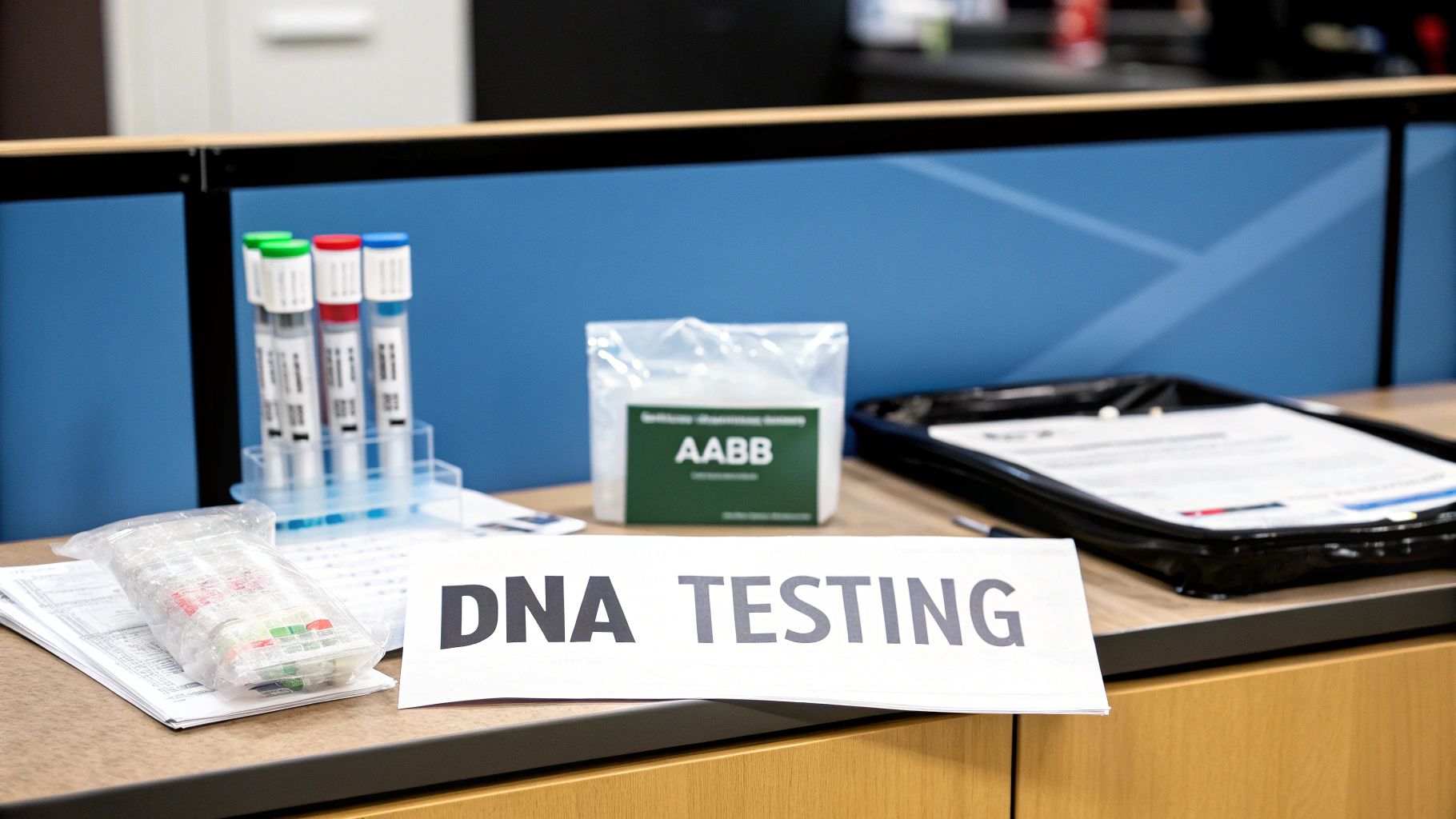
This is where you will hear the term "chain of custody." Think of it as a security seal for the DNA sample. It's a formal documentation process that tracks the sample from the moment it's collected until the results are delivered to the court, proving it was never tampered with, switched, or contaminated.
The Collection Process and Lab Requirements
The actual collection is simple and painless—just a quick cheek swab for the mother, the child, and the alleged father. But to maintain that crucial chain of custody, the test must be performed at a lab accredited by the AABB (Association for the Advancement of Blood & Biotherapies).
This accreditation is the gold standard that tells the judge the facility meets rigorous standards for accuracy and legal admissibility.
Here's what this process typically involves:
- Scheduling: All parties will be scheduled to provide their samples at an approved facility. This is not optional.
- Identification: Everyone getting tested must bring a government-issued photo ID to the appointment. Without it, the test cannot proceed.
- Witnessed Collection: A neutral, third-party lab technician will witness the collection of each sample to prevent any possibility of fraud or mix-ups.
Because genetic test results contain sensitive patient data, any digital processing must meet strict security standards. Ensuring the lab uses HIPAA compliant electronic signatures is crucial for protecting everyone's privacy.
Who Pays and How Long Does It Take
Cost is a common concern for parents. A judge will typically order the parties to split the cost of the test upfront, which can range from $300 to $700.
However, the court often revisits this in the final order. If the man is confirmed to be the father, it’s common for the judge to require him to reimburse the mother for her share of the testing costs.
After the samples are collected, the wait for results usually takes a few weeks. The AABB-accredited lab will send the certified results directly to the court and to the attorneys involved. This direct communication is the final link in the chain of custody, delivering the scientific certainty needed to move your case forward.
Turning Test Results into a Final Court Order

Once the DNA test results are in, the next step is turning that scientific answer into a legally binding court order. While a lab report provides clarity, a final order from a Texas judge provides the stability your child needs for the future. This is where all the pieces come together to define your family’s legal path forward.
The court's next actions depend entirely on what the results show. The case will follow one of two very distinct paths, each with life-altering legal consequences.
When Paternity is Confirmed
If the DNA test comes back with a 99% or greater probability that the man is the biological father, the judge will issue an Order Adjudicating Parentage. This document makes it official—he is legally the child’s father, with all the rights and responsibilities that come with it.
This order is the legal foundation for everything that follows. Once paternity is established, the court can finally address the critical issues that likely started the lawsuit in the first place:
- Conservatorship: This is what Texas calls legal custody. The judge will typically name the parents as Joint Managing Conservators, which means they share the rights and duties of raising their child.
- Possession and Access: The court will create a detailed possession schedule (often called a visitation schedule) that spells out exactly when the child will be with each parent, ensuring consistency for the child.
- Child Support: With legal paternity confirmed, the court will calculate and order child support based on the Texas Child Support Guidelines. This includes monthly support payments as well as medical and dental support for the child.
When Paternity is Excluded
On the other hand, if the DNA results show the man is not the biological father, the legal outcome is just as clear. The judge will sign an order declaring he is not the father, and the case will be dismissed.
This means he has no legal rights to the child and no legal obligations. He cannot be ordered to pay child support, and any temporary support orders that were in place will be terminated.
The need for court-ordered testing is often highlighted by the financial and emotional toll of paternity fraud. While non-paternity rates are low in the general population, they increase dramatically in disputed cases. One analysis of 5,000 court-ordered tests found a staggering 48% of men were not the father, showing just how critical testing is to get to the truth. You can explore the global statistics on paternity fraud to see the full scope of this issue.
Next Steps: Moving Forward with Confidence
The final court order is more than just a piece of paper; it’s the official rulebook for your co-parenting relationship. It provides enforceable guidelines that protect the child’s right to a relationship with both parents and their right to financial support.
This final order is legally enforceable. If one parent doesn't follow the possession schedule or fails to pay child support, the other can take them back to court. Our attorneys are experienced in these matters; you can learn more in our guide to Texas child support enforcement. The court’s order provides the security and clarity your child needs to thrive.
If you need help with a child custody or visitation case in Texas, our experienced attorneys can guide you every step of the way. Contact The Law Office of Bryan Fagan, PLLC today for a free consultation.