Skip to content
You may be reading this in the quiet after a 2:00 a.m. feeding, with a sleeping baby on your chest and a hard question in your mind. If the relationship with the other parent is breaking down, what happens now?
That fear can hit fast for mothers and fathers alike. A mother may be recovering from delivery and wondering who gets to make decisions for a baby this young. A father may be looking at his phone, staring at newborn photos, and asking whether he has any legal rights yet, especially if the parents were never married.
Texas family law uses words that can feel distant from real life, such as conservatorship and possession and access. For a child under three, though, the primary focus is much more practical. Courts look closely at safety, bonding, daily care, and whether a parenting plan fits the rhythm of an infant's life.
Conservatorship works like the decision-making part of parenting. It covers major choices such as medical care and other important issues affecting a child's upbringing. Possession and access deals with time and contact. For a newborn or young toddler, those two ideas often need to be handled with extra care because babies do not adjust to change the way older children do.
That is one reason infant cases deserve their own discussion. Texas does not treat a two-month-old the same way it treats a ten-year-old, and parents should not expect a one-size-fits-all schedule to fit a baby's feeding, sleeping, and bonding needs.
If you are trying to understand infant custody rules in Texas, you are not expected to know the system already. You need a clear starting point, a workable plan, and a way to protect both your child and your place in your child's life.
Bringing Your Newborn Home to an Uncertain Future
A new baby changes everything. Even parents in stable relationships feel overwhelmed by feeding schedules, naps, doctor visits, and the constant responsibility of caring for someone so small.
When the relationship between parents is strained, that normal stress can turn into panic. You might be asking whether the other parent can take the baby, whether you have to allow overnights, whether a judge will favor one parent, or whether waiting too long will hurt your case.
What Texas is really asking
For an infant, Texas courts aren't looking at custody as a scoreboard between adults. They're looking at what arrangement supports the baby's daily life.
That means judges often care about questions like these:
- Who has been doing the hands-on care such as feeding, diapering, bathing, and soothing the baby to sleep
- What routine already exists for naps, bedtime, and medical care
- Which home can provide consistency during a stage when even small disruptions can feel big to a child
- Whether each parent can personally care for the baby instead of relying too heavily on others
Infants don't need a theoretical parenting plan. They need a workable one.
A simple way to think about conservatorship
Parents often hear “custody” and think only about time. Texas uses a different framework.
A helpful analogy is this. Conservatorship is who gets the steering wheel on major decisions. Possession and access is the driving schedule, meaning when the child is with each parent. In infant cases, both pieces matter, but the schedule usually needs extra care because babies don't handle abrupt transitions the same way older children do.
That's why understanding how custody works for infants in Texas starts with one reassuring truth. The law does recognize that babies are different.
How Texas Law Views Custody for an Infant
Texas doesn't technically call it custody. The law uses conservatorship. That matters because it shifts the conversation away from labels and toward parental rights, duties, and the child's daily needs.
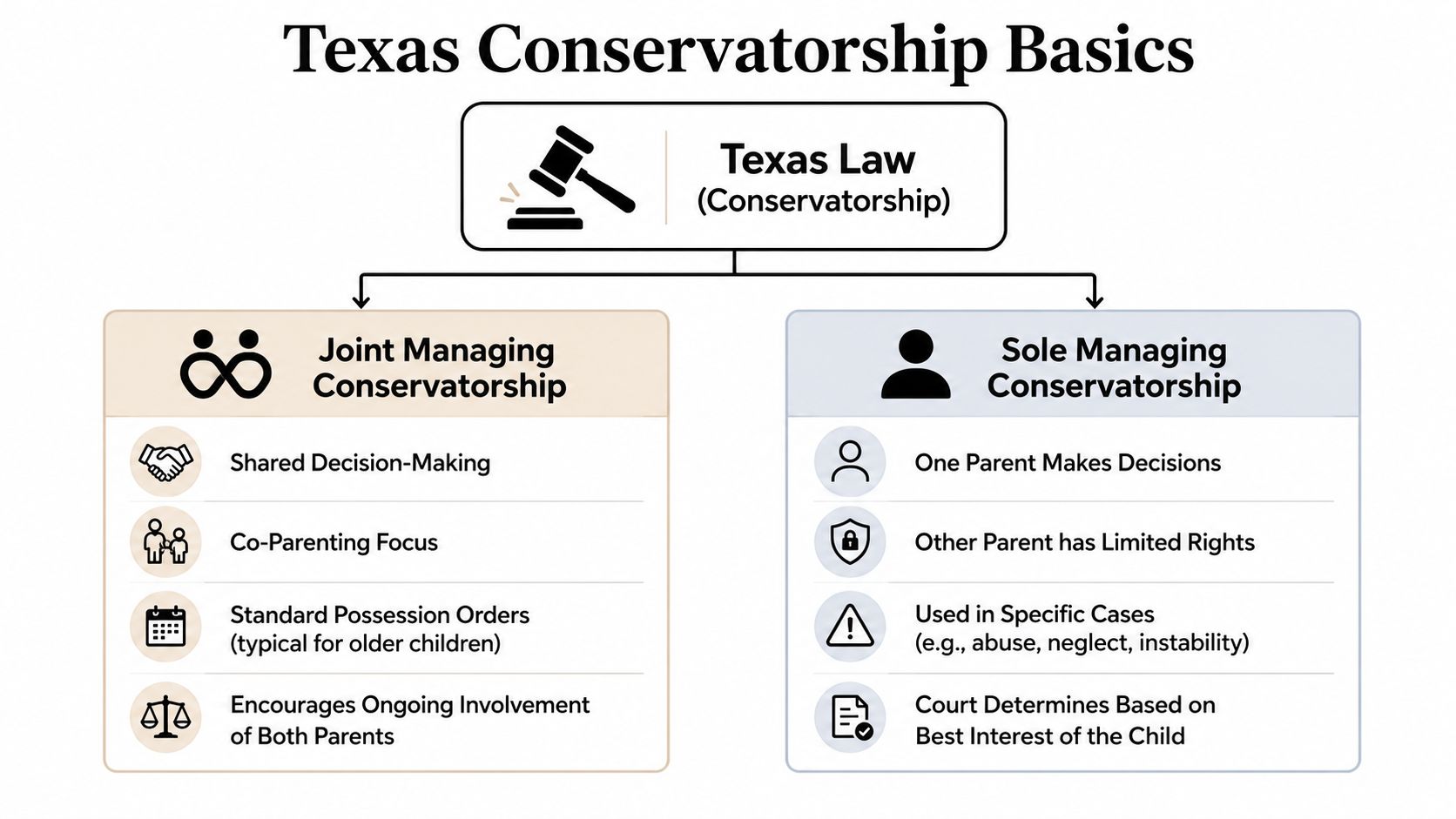
Under Texas law, parents are generally presumed to be joint managing conservators unless that arrangement would harm the child's physical health or emotional well-being, according to Texas conservatorship and visitation guidance from Texas Access. But that presumption does not mean equal parenting time. In practice, one parent is often given the right to determine the child's primary residence, while the other parent has possession and access and may owe child support.
Joint versus sole in plain English
Here's the simplest way to separate the two:
| Type | What it usually means |
|---|---|
| Joint Managing Conservatorship | Both parents share important decision-making rights |
| Sole Managing Conservatorship | One parent has the main decision-making authority |
For many worried parents, the biggest misunderstanding is this: joint doesn't mean a baby automatically spends the same amount of time in both homes. A court can keep both parents legally involved while still deciding that one parent should handle most day-to-day infant care.
Why infant cases feel different
With an older child, a judge may have more room to apply a routine schedule. With a baby, the court often gets much more specific.
The focus tends to stay on caregiving capacity. Can a parent keep up with feeding, sleeping, bathing, and safety? Can that parent respond to a baby's health needs? Is there a concern about substance abuse or another issue that affects safe care? Those are the kinds of infant-centered questions Texas decision-makers may weigh.
If you want a deeper look at how courts evaluate best-interest issues more broadly, this explanation of Texas custody and the Holley factors can help connect the bigger legal picture to your own case.
Practical rule: Don't argue your case as “I deserve equal rights.” Frame it as “Here is how I meet this baby's daily needs safely and consistently.”
That shift matters. Judges don't award infant arrangements based on slogans. They look for stability, caregiving history, and a plan that makes sense for a very young child.
Paternity Your First and Most Critical Step
For unmarried parents, this is often the issue that changes everything.
A father doesn't automatically have parental rights until paternity is established, and legal custody can only be created by a court order. Texas Law Help also notes that without a court order, each parent is free to take the child from the other at any time, which can make infant disputes feel chaotic and unsafe. You can review that rule in this Texas child custody overview for unmarried parents and families.

Why this matters for both parents
If you're a father, paternity is the doorway to enforceable rights. Without it, you may feel like you're parenting in the shadows. You can help, visit when allowed, and buy what the baby needs, but you don't have a court-backed right to conservatorship or possession.
If you're a mother, establishing paternity creates a legal structure that can support your child. It allows the court to address conservatorship, possession, and child support in one enforceable order.
This isn't just paperwork. It's the legal foundation under the entire case.
Two very different situations
Parents often compare these two paths:
Voluntary cooperation
If both parents agree on parentage, they may be able to move forward more smoothly through the legal process.Disputed parentage
If one parent contests paternity or refuses to cooperate, the court can step in to decide the issue before setting rights and responsibilities.
A more detailed discussion of that process is available in this guide to establishing paternity for custody in Texas.
Here's a short video that helps explain the issue in practical terms:
The danger of waiting
Parents sometimes tell themselves they'll “sort it out later.” With an infant, later can arrive fast.
A few common problems show up when families wait:
- Access becomes unpredictable because one parent can suddenly stop allowing contact
- Support stays informal and hard to enforce
- Conflict grows because there's no clear rulebook
- The baby's routine suffers while adults argue over control
If you're unsure where you stand, getting legal parentage and court orders in place is usually the most stabilizing first move you can make.
Why Infant Possession Schedules Are Different
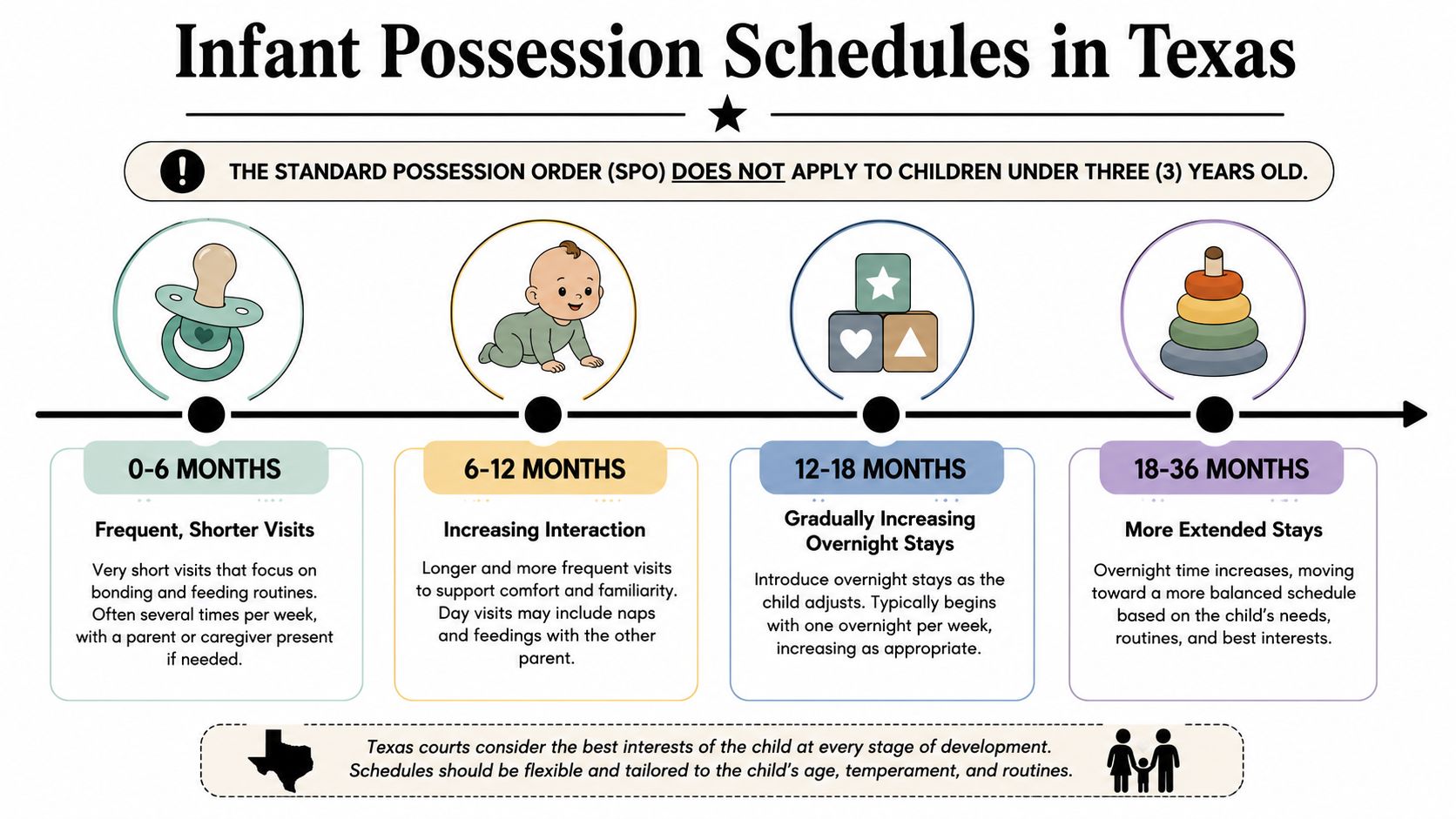
This is the part many parents don't hear early enough. For infants and children under age three, Texas courts do not apply the Standard Possession Order presumption. Instead, judges use a best-interest analysis that looks at the child's developmental stage, historical caregiving, need for consistent care, the parents' ability to personally care for the child, and the distance between homes. Texas infant custody guidance also notes that phased-in orders are used most commonly for children under 3 in this discussion of how Texas courts decide custody of babies and toddlers.
Why the usual schedule doesn't fit a baby
The standard schedule used for many older children assumes the child can handle longer stretches away from one parent, regular weekend exchanges, and a rhythm built around school.
A newborn or young toddler lives in a different world. The child may still be forming feeding habits, sleep patterns, and attachment routines. A possession plan that looks balanced on paper can still be a poor fit if it disrupts the baby's stability.
A good infant schedule isn't about dividing time neatly. It's about building connection without sacrificing routine.
What phased-in orders mean
A phased-in order is exactly what it sounds like. Parenting time starts in a more structured form, then gradually changes as the child grows and adjusts.
That may mean a court supports shorter, more frequent periods at first, then expands time as the child gets older and better able to handle transitions. The details depend on the family, the homes, the caregiving history, and the baby's needs.
Here's a simple comparison:
| Child's stage | What courts often look for |
|---|---|
| Very young infant | Shorter, predictable contact and strong routine protection |
| Older baby | More flexibility if the child is adjusting well |
| Approaching age 3 | A broader schedule may become more workable |
If you want practical examples of what specific plans can look like, this resource on a possession schedule for infants in Texas may help.
Questions parents should ask when building a schedule
Instead of asking only “How much time do I get,” ask these:
Can the baby handle the transitions?
Frequent exchanges may help bonding in some cases, but too much disruption can also be hard on a very young child.Who has been doing the daily care?
Courts often care about what has already been working in real life.Are both parents personally available?
A parenting plan should reflect who is providing care.How far apart do the parents live?
Distance affects whether short, frequent visits are realistic.
In other words, how custody works for infants in Texas is highly customized. That can feel frustrating if you want a quick answer, but it also gives parents room to ask for a plan that fits the child instead of forcing the child into a generic plan.
Navigating the Texas Infant Custody Process
Once you understand the legal ideas, the next worry is usually practical. What takes place in court?
The process often moves in a series of steps, and knowing that sequence can lower the stress. Texas' most common custody structure is Joint Managing Conservatorship, and child support usually follows percentage guidelines tied to the paying parent's net monthly income. The guideline amounts are 20% for one child, 25% for two, 30% for three, 35% for four, and 40% for five or more children, with a guideline cap on monthly net resources of $9,200 as of 2024, according to this Texas family law breakdown on conservatorship and child support guidelines.
A typical path through the case
Most infant custody matters follow a pattern like this:
A case is filed
This is the formal request asking the court to set rights, duties, possession, and often support.Temporary orders may be requested
These are short-term rules that create stability while the case is pending. For a baby, this can be one of the most important stages because it sets the early routine.Information is gathered
Parents exchange documents, records, and other information relevant to the child's care.Mediation may be used
Many families resolve at least part of the dispute by agreement instead of trial.A final order is entered
If parents can't agree, a judge decides.
What story the court needs to hear
In an infant case, your evidence should tell a simple, credible story. It should show that you are attentive, stable, cooperative when possible, and focused on the child instead of revenge.
That story often includes:
- Daily caregiving records such as feeding, bathing, bedtime, and doctor visits
- Communication history that shows you're trying to work around the baby's needs
- A realistic parenting plan rather than a rigid demand
- Financial information so support can be addressed properly
Judges often respond well to parents who sound organized, child-focused, and practical.
Temporary orders can shape the whole case
Parents sometimes underestimate temporary orders because they aren't final. In reality, they can set the tone for months.
If you need immediate structure, ask early about temporary relief. That may include a parenting schedule, decision-making rules, and support. For a family with an infant, early structure often reduces conflict because both parents know what the expectations are while the case moves forward.
How to Build a Strong Case for Custody
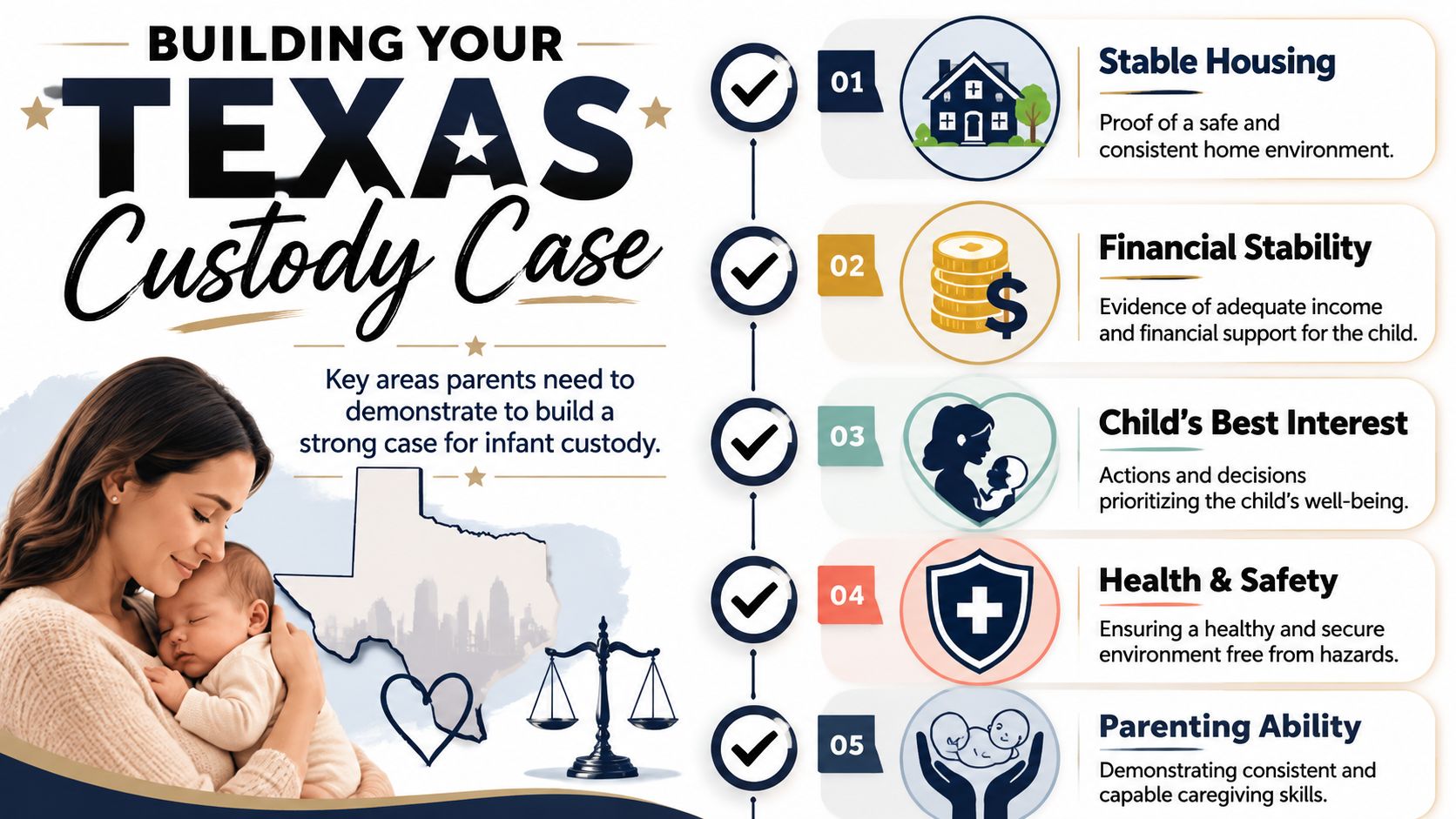
You do not build a strong infant custody case by trying to look perfect. You build it by showing, piece by piece, that you understand your baby's needs and can meet them consistently.
For children under three, courts often look closely at the small routines adults sometimes take for granted. A newborn or young toddler cannot explain hunger, fatigue, or stress. The adults' habits become the evidence. Your job is to make those habits visible.
Show the pattern of care
A judge is trying to answer a practical question: what daily life looks safest and most stable for this baby right now? Clear records help answer that question.
Useful proof often includes:
- A care journal with feedings, naps, diaper changes, medicine, pediatric visits, and nighttime wake-ups
- Calendar entries showing who handled appointments, daycare drop-offs, or in-home care
- Messages and emails that show you are communicating about the baby's schedule and needs
- Photos or short videos of ordinary caregiving, such as bottle feeding, tummy time, bedtime, or attending medical visits
- Witnesses who have personally seen you care for the baby, including relatives, childcare providers, or medical professionals
Make your plan fit an infant, not an older child
This point matters more than many parents expect.
A strong case for a baby is different from a strong case for a school-age child. For an infant, courts often want to see that you understand bonding, feeding schedules, sleep routines, and the fact that long separations may be harder on a very young child than shorter, more frequent contact. A realistic phased-in schedule often carries more weight than a rigid demand for a pattern that works better for a six-year-old.
If you are asking for possession, explain how your proposed schedule matches the child's age. If you are breastfeeding, pumping, using formula, or transitioning between methods, spell out how exchanges can happen without disrupting feeding. If the baby has reflux, therapy appointments, or special sleep instructions, include that too. Specifics make your plan feel grounded and credible.
Cover the safety basics
Infant cases can turn on ordinary details because babies depend on adults for everything.
Helpful proof may include:
- A safe sleep setup and basic baby supplies in your home
- Reliable transportation for medical care and exchanges
- A childcare plan for work hours, with names, schedules, and backup options
- Information about other caregivers who will regularly watch the baby
If relatives, babysitters, or nannies will help care for your child, use the same caution a court would want to see from you. A nanny background check guide can help you evaluate caregivers before you present that plan in court.
Your conduct matters too
Judges notice whether a parent acts like a problem-solver or a gatekeeper.
That does not mean you must accept unsafe behavior. It means you should communicate in a way that stays focused on the baby. Keep your messages calm. Offer practical solutions. Confirm feedings, nap needs, medicine instructions, and exchange details in writing. If the other parent is difficult, your steady communication can still help show the court that you are putting the child first.
Get help quickly if the risk is serious
Some situations need immediate legal action, especially with a child under three.
Seek prompt legal advice if the other parent is threatening to leave with the baby, blocking all contact, exposing the child to family violence, serious substance abuse, or dangerous neglect, or trying to relocate before a court can set rules. In cases like these, speed matters as much as documentation. The Law Office of Bryan Fagan, PLLC handles Texas custody, visitation, paternity, support, and emergency custody matters for families who need court orders that create structure fast.
Answers to Common Texas Infant Custody Questions
A lot of parents reach this stage with the same fear. You have a baby under three, the future feels unstable, and you need straight answers more than legal jargon. Here are the questions parents ask most often, and what they usually mean in real life.
Do mothers automatically get custody of infants in Texas
No. Texas courts do not start with a rule that the mother gets custody because the child is a newborn or toddler.
For babies and children under three, the court looks closely at the child's daily life. Who handles feedings. Who knows the nap routine. Who can get the baby to medical appointments. Who can offer steady, hands-on care. The judge is trying to build a schedule around a very young child's real needs, much like a pediatrician looks at the whole child instead of relying on one assumption.
That is good news for either parent who has been consistently involved. The court is supposed to examine facts, caregiving history, stability, and the child's developmental stage, not old stereotypes.
Can a father get equal time with a baby
He can get significant parenting time, and in some cases parents do reach very balanced arrangements. With infants, though, the question is usually about pacing.
A schedule for a six-month-old often works more like a gradual training plan than a switch flipped overnight. Short, frequent visits may come first. Longer blocks can follow as the child grows, forms secure routines in both homes, and handles transitions better. That does not make one parent less important. It reflects that babies under three often need a plan built in stages.
If you are a father worried that bonding time will be delayed, focus on showing the court how you can provide calm, direct care now. Feedings, diapering, soothing, bedtime routines, and attending doctor visits all matter.
What if there is no court order yet
This is often where parents feel the most exposed.
Without a court order, both uncertainty and conflict can grow fast. One parent may change the routine without warning. Another may promise access, then cancel it. With an infant, even a few days of confusion can feel huge because the child's schedule is so constant and so fragile.
If there is no order, start creating structure right away. Keep a written record of when you cared for the baby, what the routine looks like, and what communication has happened with the other parent. If access is being blocked, or if you are worried about safety, relocation, or total instability, talk to a lawyer promptly about requesting temporary orders.
What should I do first if I'm scared and overwhelmed
Start with the next clear step, not all ten steps at once.
Write down the baby's current routine. Save texts and emails. Keep a calendar of your parenting time and your attempts to stay involved. Gather medical information, daycare details, and anything else that shows you know your child's day-to-day needs. If paternity has not been legally established, address that immediately because legal rights often depend on that step.
If the situation feels urgent, ask about temporary orders. Those orders can create rules for possession, communication, and decision-making while the case is pending.
Strong infant custody cases are usually built by parents who stay child-focused, organized, and steady under stress.
Key takeaway
Infant custody cases in Texas are different from custody cases involving older children. For children under three, courts often need more customized schedules, more attention to bonding, and more focus on the baby's routine and developmental needs.
You do not need to know everything today. You do need a plan. If you stay organized, protect your child's routine, and get legal help when needed, you have a path forward.
If you need help with a child custody or visitation case in Texas, the attorneys at The Law Office of Bryan Fagan, PLLC handle custody, visitation, paternity, support, and emergency custody matters for Texas families.