
When you’re holding a newborn and trying to make sense of separation papers, a custody schedule can feel painfully out of place. Most parents don’t look at a baby asleep on their chest and think about pickup times, holiday language, or court orders. They think about feeding, sleep, bonding, and how to keep life from feeling even more unsettled.
That’s why a possession schedule for infants texas families can live with has to start in the right place. Not with winning. Not with rigid formulas. With the baby.
I’ve seen the same fear from mothers, fathers, grandparents, and caregivers. “If we put this in writing, will it hurt my child?” Usually, the better question is this: “How do we build a plan that protects my child’s routine and also protects the parent-child relationship?” Texas law gives room for that, especially with very young children.
If you're trying to picture what an infant schedule might look like in daily life, these visitation schedule examples can help you think b…net/blog/visitation-schedule-examples/) can help you think beyond abstract legal language and into real routines.
Your Infant's First Custody Schedule A Compassionate Start
A first infant possession schedule often begins in a place of grief and love at the same time. One parent may be recovering physically. The other may be terrified that limited early time will turn into a weak bond later. Both can be acting out of love, even when they’re speaking from fear.
That’s why the best early schedules are usually calm, specific, and realistic.
What worried parents usually need to hear first
Your baby does not need a perfect family situation to be secure. Your baby needs predictable care, safe transitions, and adults who understand that infant development moves fast.
A good plan usually answers practical questions such as:
- Who has handled day-to-day care so far
- How feeding works right now
- Whether the baby is nursing, bottle-feeding, or both
- How far apart the parents live
- What each parent’s work schedule really looks like
- How exchanges can happen with the least disruption
When parents skip those details, conflict usually follows. When they slow down and build around the baby’s routine, the schedule tends to feel much less threatening.
A strong infant schedule doesn’t separate a child from a parent. It creates a safe path for the child to know both parents over time.
What a healthy starting point looks like
For infants, the earliest schedule is often less about equal blocks of time and more about steady contact. Courts and lawyers who work in this area know that a baby’s needs at a few weeks old are different from a toddler’s needs many months later.
That’s why many workable plans begin with shorter visits, more repetition, and a built-in path for growth. Parents often feel relief when they realize the order doesn’t have to lock them into one rigid pattern forever.
The point is stability. The point is bonding. The point is giving your child a foundation that can stretch as your child grows.
Why Texas Law Treats Infants Under Three Differently
Texas does not treat a newborn the same way it treats a school-age child. That isn’t favoritism. It’s common sense built into the law.

Under Texas Family Code §153.251(d), the Standard Possession Order, often called the SPO, does not carry a legal presumption of being in the best interest of children under three years old. Texas courts instead use Texas Family Code §153.254 to craft customized schedules based on the child’s age, emotional needs, parental availability, and pre-separation caregiving history, as explained by TexasLawHelp’s discussion of child visitation and possession orders.
Plain-English terms every parent should know
Best interests of the child means the judge focuses on what helps the child thrive, not what feels most fair to the adults.
Joint Managing Conservatorship usually means both parents share important decision-making rights for the child. It does not automatically mean the child spends equal time with each parent.
Possession order is the court order that sets the parenting-time schedule. In everyday language, this is the calendar for when each parent has the child.
If you’ve heard old phrases like the “tender years” idea, it helps to understand how modern Texas law approaches those concerns. This overview of the tender years doctrine gives useful context for why very young children often need a different schedule than older children.
Why judges avoid one-size-fits-all schedules for babies
The standard schedule was built with older children in mind. Babies don’t live by school calendars. They live by feeding windows, naps, sleep rhythms, attachment patterns, and sensory overload.
That matters in court.
A judge looking at an infant case usually wants to know:
- How established the baby’s routine is
- Whether one parent has been the main day-to-day caregiver
- How the baby handles separation
- Whether breastfeeding or pumping affects time away
- How quickly and safely the other parent can build regular care routines
- Whether the parents can communicate without turning every handoff into a dispute
The developmental reason behind the law
Infants need repeated, predictable contact. They also need low-disruption care. Those two goals can pull against each other.
For example, a parent who hasn’t had much solo caregiving time may need more frequent contact to build confidence and attachment. At the same time, the baby may not handle long separations well, especially in the earliest months. A customized infant order tries to honor both realities.
Practical rule: For babies, courts usually care more about consistency than about making the calendar look mathematically balanced.
That’s the heart of most infant cases. The court isn’t trying to shut a parent out. The court is trying to protect development while giving the parent-child relationship room to grow.
What this means for mothers and fathers
Mothers often worry that asking for a developmentally appropriate schedule will be painted as gatekeeping. Fathers often worry that a gradual schedule will become permanent. Both fears are understandable.
The answer is usually in the drafting.
A well-written infant order can recognize current realities without freezing them in place. It can say, in effect, “The baby is here now, and this is how we move forward.” That approach usually works better than arguing over whether a newborn should follow a schedule built for a child with a backpack and a school calendar.
Building Your Infant's Possession Schedule Age by Age
The most useful infant schedule is usually a step-up plan. That means the order starts where the baby is developmentally and then expands over time.
Here’s a visual overview before we break it down.
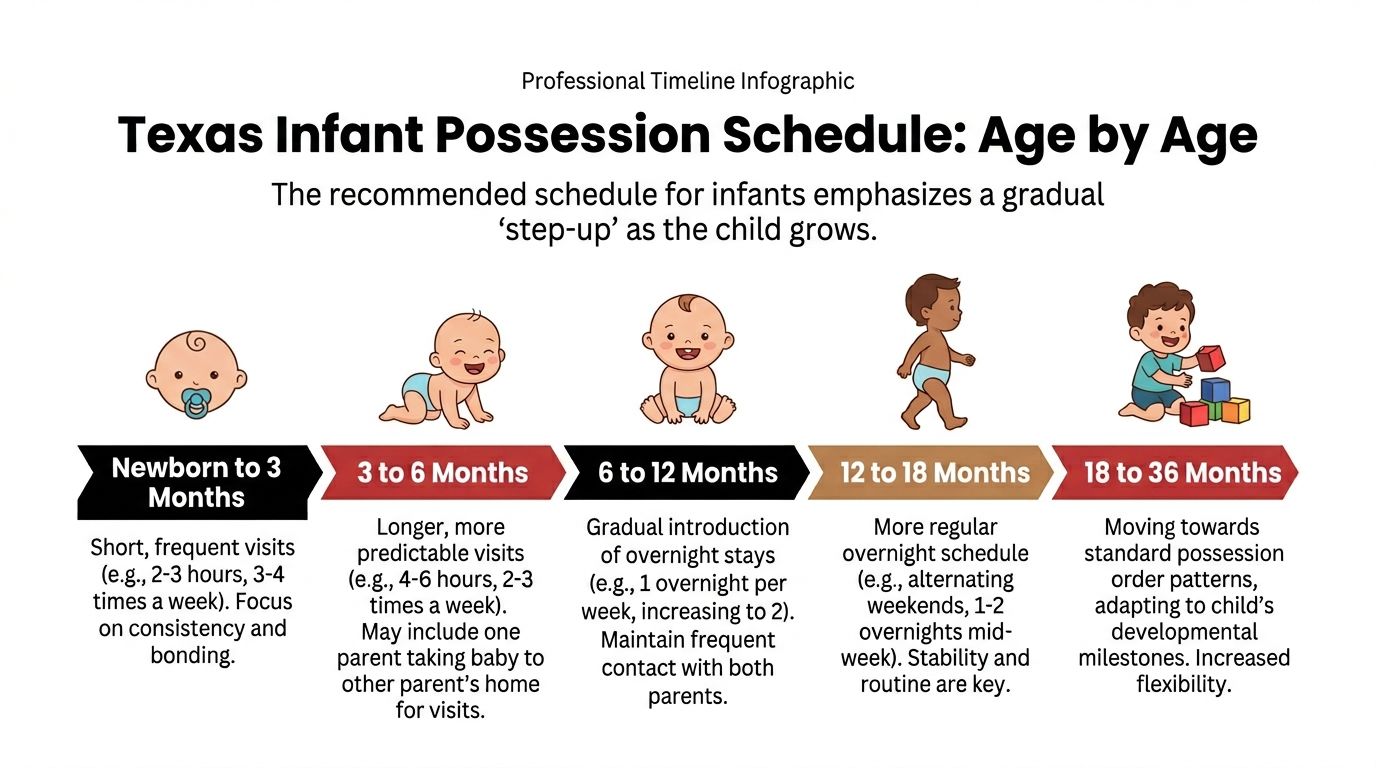
Texas courts often approve a graduated plan for infants, such as 2 to 4 hours of weekly possession for the first 3 to 6 months, then an evening visit and one weekend day by 6 to 12 months, and then full weekends after 18 months. About 70 to 80% of mediated infant schedules succeed without litigation, and non-primary parents who follow the steps reach an expanded schedule similar to the SPO in 85% of cases within 18 months, according to this guide to infant and toddler possession schedules in Texas.
Sample Texas Infant Step-Up Possession Schedule
| Infant Age | Typical Possession for Non-Primary Parent | Key Considerations |
|---|---|---|
| 0 to 6 months | Short, frequent visits | Feeding schedule, recovery from birth, bonding, low-disruption exchanges |
| 6 to 12 months | Longer daytime visits, possible evening visit, one weekend day | Nap consistency, comfort with both homes, gradual transition |
| 12 to 24 months | More regular day periods and overnights, often moving toward weekend structure | Sleep stability, separation tolerance, clear routines, caregiver consistency |
Newborn to 6 months
At this stage, less is often more. Long visits can be hard on a very young baby if feeding, sleep, and soothing routines aren’t settled.
A common workable pattern includes short daytime periods several times each week. If the baby is nursing, parents often do better with a schedule that keeps visits regular and close to feeding routines. If the baby takes bottles, that may allow a bit more flexibility, but flexibility is not the same as “ready for a full weekend.”
What tends to work:
- Frequent contact: Several short visits often help bonding more than one long block.
- Predictable timing: Similar days and times each week reduce stress for everyone.
- Low-conflict exchanges: Calm handoffs matter. Babies absorb tension even when they can’t explain it.
- Detailed care notes: Feeding, naps, and medications should travel with the child, not stay in one parent’s head.
What usually doesn’t work:
- Using the schedule to test loyalty
- Last-minute changes every week
- Pushing overnights before the baby is handling routine changes well
- Vague language like “reasonable visitation”
Some parents find it helpful to compare proposed schedules with broad developmental milestones. This guide to the key stages of child development by age can help you think through what changes are normal as your baby moves from newborn rhythms to more structured patterns.
6 to 12 months
This is often the stage where parents start arguing because the baby seems “older,” but the child still isn’t ready for a traditional possession pattern.
By now, many babies have more predictable naps, feeding routines, and stronger familiarity with faces and places. That can support longer daytime periods and sometimes an evening visit. In some families, this is also when overnight discussions begin.
That doesn’t mean every infant should start overnight possession at the same age. The better question is whether the child can handle it well.
Look at things such as:
- How the baby sleeps in different settings
- Whether each parent can manage bedtime and wake-up routines
- How transitions affect the child the next day
- Whether both parents are using similar care practices
- How far apart the homes are
Here’s a practical discussion that many parents find helpful when thinking through possession options and court expectations.
12 to 24 months
Toddlers still need routine, but they’re usually better able to move between homes if the parents have built a strong pattern early.
Many step-up plans move toward fuller weekends during this period. The child may also tolerate midweek periods better, depending on daycare, naps, and travel time. If the parents have followed the early steps well, this stage often feels less like a fight and more like the next natural progression.
The best toddler schedules don’t ask, “Can we force the standard order now?” They ask, “Has this child shown readiness for longer stretches away from the primary routine?”
What judges tend to respect
Judges usually respond well to schedules that are concrete and child-centered. That means a proposal should connect the calendar to the child’s developmental needs, not just to what one parent prefers.
A persuasive infant proposal often includes:
- A clear starting schedule with exact days, times, and exchange locations.
- Defined step-up triggers such as age ranges, weaning, or demonstrated success with prior visits.
- Communication rules for health updates, feeding changes, and emergencies.
- A backup plan for missed visits or temporary disruptions.
- Language for review so the schedule can grow without a full-scale war every few months.
A few age-based examples parents actually use
Not every family needs the same plan, but these examples reflect the types of schedules courts often consider reasonable.
Example for 0 to 6 months
The non-primary parent has several short visits each week, usually daytime, with exchanges built around feeding and naps. If breastfeeding is involved, the order may address pumped milk and storage without making the baby the center of an argument.
Example for 6 to 12 months
The non-primary parent has one evening period each week and one longer daytime period on a weekend. If the child is doing well, the order may include language for adding an overnight later.
Example for 12 to 24 months
The child begins following a more regular weekend pattern, with the possibility of added midweek time if the routine remains stable and travel is manageable.
What makes a step-up schedule succeed
Success usually depends less on the paper itself and more on whether the adults can carry it out consistently.
Parents who do well with infant schedules usually:
- Show up on time
- Keep supplies ready
- Avoid arguing at exchanges
- Document concerns calmly
- Let the child’s adjustment guide the next step
Parents who struggle often try to use the schedule to gain an advantage. Babies don’t benefit from that. The court won’t either.
Navigating Special Considerations and Common Hurdles
A possession order can look neat on paper and still fall apart in real life. Infant cases usually turn on the details that parents didn’t think to discuss early enough.

Breastfeeding and pumping
Breastfeeding is often one of the first pressure points. One parent may say nursing means no separation. The other may hear that as exclusion.
Neither extreme helps.
A smarter approach is to build the schedule around actual feeding realities. If the child is exclusively nursing, shorter and more frequent visits may make sense at first. If pumping is possible, the order should spell out practical details such as transport, storage, and return of supplies.
Good language is specific. It says what happens. It doesn’t leave each exchange open to debate.
Daycare and handoff problems
Daycare can reduce conflict or create it. It depends on the order.
If daycare is part of the routine, parents should define:
- Who can pick up
- What identification the daycare needs
- How late pickup is handled
- Who gets notified about illness
- How schedule changes are shared
When parents skip these points, one missed pickup can turn into an accusation of interference.
If a handoff location creates repeated conflict, change the logistics before the conflict becomes the story in court.
Health updates and emergency planning
Infants get sick. Medications change. Sleep goes sideways. That’s normal.
What isn’t helpful is making every cough sound like a custody emergency. Parents need a communication method they’ll use. A parenting app, email thread, or shared calendar can help create one record for doctor visits, prescriptions, and feeding updates.
For families trying to think ahead about backup care, sudden illness, or last-minute disruptions, this expert guide for child care emergencies offers practical planning ideas that fit well with co-parenting reality.
Long-distance parenting
Distance changes everything with infants. Travel time can eat up the child’s energy and patience before the visit even starts.
When one parent lives farther away, a child-focused plan usually does one of two things. It either keeps visits shorter and closer until the child is older, or it groups time more strategically once the child can handle longer transitions.
Long-distance cases need extra precision about:
- Exchange locations
- Who drives and when
- What happens if weather or illness interferes
- Virtual contact between in-person visits
- How holiday and summer provisions interact with infant needs
Military families and deployment
Military families face a separate layer of uncertainty. Temporary duty, deployment, and interstate moves can make a standard infant plan unworkable unless the order addresses them directly.
A frequently overlooked issue is virtual parenting time. According to Custody X Change’s Texas visitation schedule resource, 35% of Texas military custody cases involve infants, and 22% result in emergency modifications due to a lack of virtual visitation protocols. That same source notes that HB 4123, effective September 2025, mandates courts consider deployment durations under 9 months for temporary virtual access in infant cases.
That matters because service members often hear, “We’ll figure it out later.” Later is where enforcement problems begin.
A military-friendly infant order should address:
- How video contact will happen during deployment
- How missed in-person time may be handled after return
- Who gets notice of temporary relocation
- How the child will be reintroduced after a long absence
What works and what usually backfires
Here’s the short version from real-world practice.
| Works well | Usually backfires |
|---|---|
| Specific exchange details | “We’ll be flexible” with no written process |
| Child-focused communication | Using texts to relitigate the breakup |
| Gradual expansion of time | Demanding a full older-child schedule too early |
| Shared records for health and routines | One parent withholding updates |
| Backup language for disruptions | Treating every problem as contempt from day one |
The families who do best are not always the ones who agree on everything. They’re the ones who build enough structure that they don’t have to fight over every small decision.
Drafting Your Agreement and Preparing for Court
A good infant schedule can still fail if the order is vague. In this scenario, many parents lose ground. They spend weeks negotiating the spirit of the plan and then write it down in language that invites conflict.
For infant cases, precision isn’t cold. It’s protective.
What the order should say clearly
At a minimum, the order should spell out:
- Exact days and start times
- Exact end times
- Exchange location
- Who transports the child
- What happens if the child is ill
- How holiday schedules interact with the step-up plan
- How and when the schedule expands
- How notice must be given for elections or changes
Those details matter even more in Texas possession orders because technical drafting mistakes often trigger conflict. According to Texas Access’s explanation of the standard possession order and parenting time, failing to give the required April 1 notice for summer possession elections triggers a default 30-day period and sparks 35% of motions to enforce, while unresolved holiday conflicts lead to emergency orders in 20% of cases.
Mediation often gives parents better control
If parents can reach an agreement in mediation, they usually have more room to design something that fits the baby instead of arguing inside a rigid courtroom frame.
That’s especially true with infants because the best schedule is often more nuanced than a judge can create in a short hearing. Mediation can allow parents to work through practical points such as feeding transitions, travel burdens, and how to build toward overnights.
Still, mediation only works if the final language is tight. “Reasonable visitation” is one of the most expensive phrases in family law because it sounds peaceful and often creates future battles.
Drafting insight: If two people can read a sentence and honestly reach different conclusions, the order needs work.
If you have to present your plan to a judge
Judges usually want a proposal that feels organized and grounded in the child’s routine.
That means bringing more than opinions. Bring a calendar. Bring feeding information. Bring daycare details. Bring a clean explanation of who has handled what and why your proposed step-up schedule supports the child’s development.
A stronger court presentation usually does three things:
- Explains the child’s current routine
- Shows how the schedule preserves meaningful contact with both parents
- Builds in future growth without putting the child through unnecessary disruption
For fathers, that often means showing readiness, consistency, and practical involvement. For mothers, that often means showing that the proposed limits are development-driven, not gatekeeping. For grandparents or caregivers, it means tying your request closely to the child’s existing stability and needs.
The language should age well
An infant order should not read like a permanent newborn plan. It should read like a roadmap.
That’s the difference between an order that causes another fight in six months and one that carries the family forward with less friction.
Life After the Order Modification and Enforcement
The best infant orders are built to change. Your baby won’t stay a baby for long, and the law expects possession schedules to evolve with the child.

Modification is part of the process
A parent often comes back to court because the original schedule no longer fits. That can happen when the child ages into overnights, a parent relocates, work hours change, daycare changes, or the original step-up language turns out to be unclear.
Texas law allows modification when the legal standard is met. In practice, the focus stays on the same core question: what arrangement now serves the child best?
If you’re trying to understand the paperwork side of that process, these Texas custody modification forms can help you see what a modification path may involve.
Enforcement matters too
Some parents assume they should wait and “see if it gets better” when the other parent keeps missing visits or withholding the child. Sometimes patience is wise. Sometimes delay makes a bad pattern harder to fix.
Enforcement is the legal process for asking the court to address violations of the order. The stronger your written order and your documentation, the stronger your enforcement position usually is.
Helpful habits include:
- Keep a clean calendar of missed or denied periods
- Save messages without editorial comments
- Track exchange problems by date and time
- Stay polite in writing
- Follow the order yourself
Key takeaway
A possession schedule for infants texas courts approve usually has three traits. It fits the child’s developmental stage, it uses precise language, and it leaves room for growth.
Parents often feel pressure to choose between protecting routine and protecting the parent-child bond. A thoughtful infant order aims to do both. It starts small when needed, expands with the child, and gives the family a structure they can follow.
If you need help with a child custody or visitation case in Texas, our experienced attorneys can guide you every step of the way. Contact The Law Office of Bryan Fagan, PLLC today for a free consultation.
If you need guidance on creating, modifying, or enforcing an infant possession order, Law Office of Bryan Fagan, PLLC can help you understand your options and build a plan centered on your child’s best interests. Whether you’re a mother, father, grandparent, or caregiver, the right legal advice can make this process clearer and less overwhelming. Contact the firm today for a free consultation.