
When your child's future is on the line, understanding your rights matters most.
You may be here because your ex just got remarried. Maybe you saw wedding photos online, or your child mentioned a new stepmom or stepdad at pickup. Maybe you're the parent who remarried, and now you're worried that your former spouse will use that change against you in court.
Those reactions are normal. Remarriage can stir up fear, jealousy, hope, relief, and a hundred practical questions all at once. Parents often ask the same thing in different words: what happens to custody when a parent remarries in Texas?
The short answer is reassuring. In Texas, remarriage by itself does not automatically change custody or visitation. A court order stays in place unless a judge changes it. What matters is whether the remarriage brought along a legally significant change that affects the child's life in a meaningful way.
That difference matters. A wedding is a life change. But not every life change is a legal reason to rewrite conservatorship or possession. Texas courts look past the ring and focus on the child's daily reality: the home, the people in it, the routines, the safety, and the stability.
A New Ring a New Beginning and New Custody Worries
A remarriage can feel like a fresh start for one parent and a threat to the other. That's especially true when children are already adjusting to divorce, two homes, and a parenting schedule that took a lot of effort to build.
One common scenario goes like this. A father learns that his child's mother remarried and immediately worries that the new husband will start making parenting decisions. Another parent remarries and fears her ex will accuse her of putting the children second. Both parents are reacting to a major family change, but neither concern means the custody order automatically changes.
Texas law doesn't treat remarriage like flipping a switch. The court doesn't reopen a case just because someone updated their marital status. The existing order still controls who has rights, who has duties, and when the child goes from one home to the other.
A marriage certificate can change a household. It does not change a custody order on its own.
That's where many parents get tripped up. They confuse a change in lifestyle with a material and substantial change in circumstances. Those are not the same thing.
A lifestyle change might mean a parent now lives with a spouse, shares bills, or creates a blended household. A legally significant change is something deeper. It affects the child's stability, safety, schooling, emotional health, or the practical operation of the current order.
The question a judge cares about
A Texas judge usually isn't asking, “Did someone remarry?”
The judge is asking questions like these:
- Has the child's home become more stable or less stable
- Has a new adult created safety concerns
- Has the family moved far enough to disrupt the current schedule
- Has the child's routine changed in a way that helps or hurts
- Does the existing order still fit the child's real life
If you keep that lens in mind, the rest of this topic gets much easier to understand.
Understanding the Foundation of Your Texas Custody Order
Before you can tell whether remarriage matters, it helps to know what your order governs. In Texas, people often say “custody,” but court orders usually break that idea into separate parts.
Conservatorship means decision-making rights
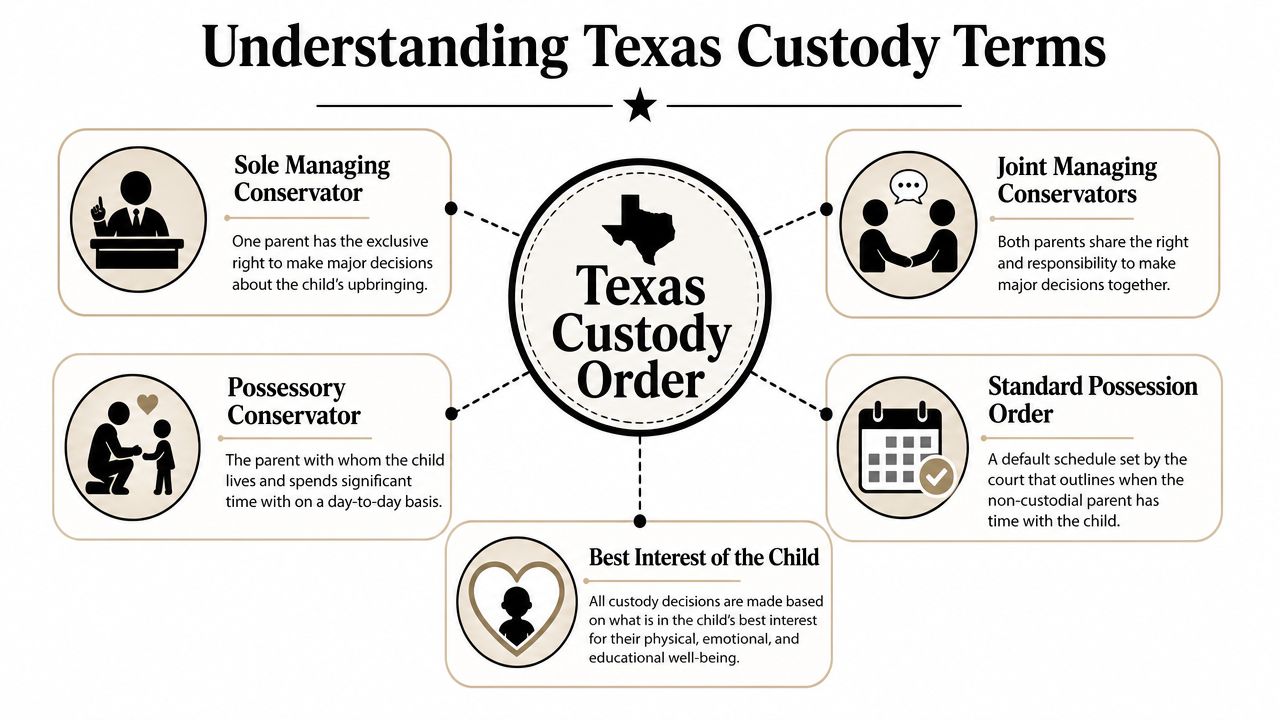
Conservatorship is the legal term for parental rights and duties. Think of it as the decision-making side of custody.
In many Texas cases, parents are named Joint Managing Conservators. That usually means both parents keep important rights involving the child, even if one parent has the exclusive right to decide the child's primary residence. Joint doesn't always mean equal time. It usually means shared legal responsibility in some form.
Sometimes one parent is named a Sole Managing Conservator. That means one parent has a larger share of the decision-making power because the facts of the case justify it. The other parent may still have rights, but not the same level of authority.
Possession and access means the schedule
Possession and access is the practical side of custody. In plain English, it means when each parent has the child and how visitation works.
Many families operate under a Standard Possession Order, which is a Texas schedule framework for parenting time. Some families follow custom schedules instead because of distance, school needs, work hours, or the child's age.
A useful way to think about it is this:
| Part of the order | What it controls |
|---|---|
| Conservatorship | Who makes major decisions |
| Possession and access | When the child is with each parent |
| Support obligations | Who pays financial support and how related duties are handled |
Best interest of the child is the guiding rule
The phrase best interest of the child can sound vague, but the idea is simple. The court wants an arrangement that supports the child's safety, emotional well-being, development, and stability.
That's why judges look at the child's lived experience, not the parents' labels. A parent can be newly married, newly single, wealthy, struggling, organized, or chaotic. The legal question is still whether the child is doing well and whether a change would help.
Practical rule: Your order is the roadmap. Remarriage only matters if it changes the road conditions for the child.
For mothers and fathers alike, this is important. If you're worried about your ex's new marriage, focus on facts that affect the child. If you remarried and want to protect your parenting rights, focus on showing consistency, safety, and cooperation.
When Remarriage Becomes a Reason for Custody Modification
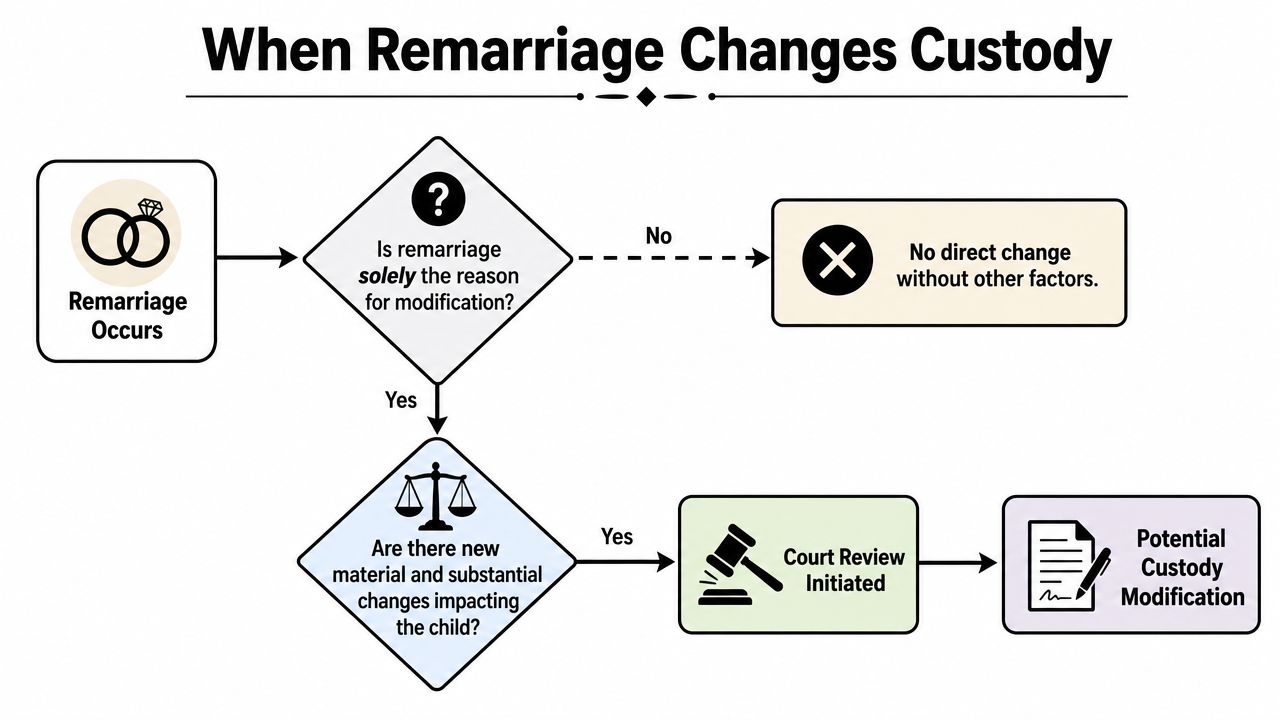
This is the heart of the issue. In Texas, a parent's remarriage does not automatically change custody or visitation: the existing court order remains in force until a judge modifies it, and modification generally requires a showing of a material and substantial change in circumstances plus a best-interest finding for the child, as explained in this discussion of Texas remarriage and custody modification standards.
A lifestyle change is not always a legal change
A parent gets married, moves into a nice home, and the child now has a stepfamily. That may be a major personal event, but it does not automatically justify a court fight.
A judge usually wants to see more than “things are different now.” The key is whether the difference is substantial enough to affect the child in a way the law cares about.
Here's a simple comparison:
| Situation | Likely legal impact |
|---|---|
| Parent remarries and keeps the same stable schedule | Usually not enough by itself |
| Parent remarries and relocates in a way that disrupts the order | May support modification |
| New spouse creates serious safety concerns in the home | May support modification |
| New marriage improves housing and routine but causes no conflict with the order | May not require any court change |
What tends to matter more than the wedding
The strongest modification cases usually involve changes tied to the child's daily life.
For example:
- Relocation issues: If remarriage leads to a move that makes exchanges harder, changes schools, or strains the current possession schedule, the court may need to revisit the order.
- Safety concerns: A stepparent with violent behavior, substance abuse problems, or a criminal background can raise real concerns if those facts affect the child's well-being.
- Household instability: Constant conflict, frequent moves, lack of supervision, or chaos in the new home can become legally relevant.
- Meaningful improvement: Sometimes remarriage creates a more stable home, better routines, or more support for the child. That can matter too, but a court still looks closely at whether a formal change is necessary.
This video gives a helpful overview of how family courts tend to approach custody questions after major life changes.
What usually does not work
Parents often lose credibility when they focus on resentment instead of evidence.
These arguments usually fall flat on their own:
- I don't like the new spouse
- My child calls the stepparent by a nickname
- My ex moved on too quickly
- Their household does things differently than mine
If you're thinking about filing, it helps to learn how courts evaluate a substantial change in circumstances in Texas custody cases. That standard is where many cases are won or lost.
What a Texas Judge Actually Looks At in a Remarriage Case
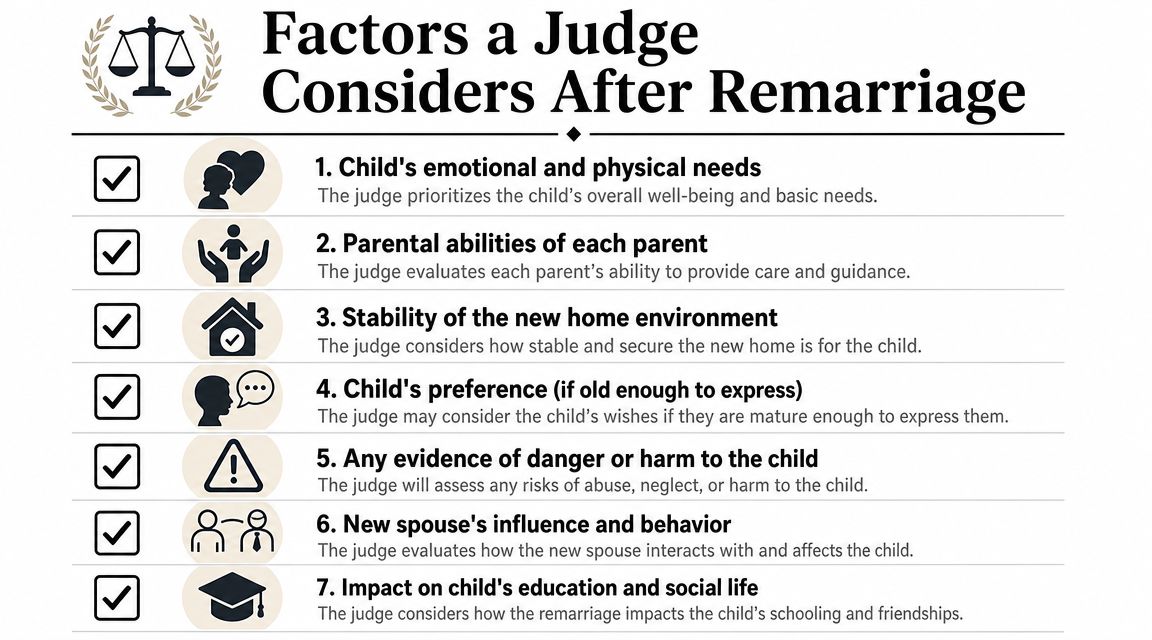
Once a remarriage case reaches court, judges move away from emotion very quickly. They focus on evidence. They want to know what has changed, how it affects the child, and whether changing the order would improve the child's situation.
The home matters more than appearances
Modern custody law pays more attention to the child's real environment than to old assumptions about one parent “winning” custody. One historical marker of that shift is that shared physical custody in the United States rose from 13% before 1985 to 34% in 2010 to 2014, according to Demographic Research on shared physical custody trends. In practice, that means judges are often looking closely at how a child functions across households, not solely at a parent's relationship status.
A judge may consider questions such as:
- Is the new home calm and predictable
- Does the child have appropriate supervision
- Is the child thriving at school
- Are exchanges becoming more difficult
- Is the child showing stress, fear, or withdrawal
Evidence that helps and evidence that hurts
Not every concern carries equal weight. A parent who shows up with organized, child-focused evidence is in a much stronger position than a parent who only brings anger.
Helpful evidence may include:
- School records that show attendance changes, behavior concerns, or academic struggles after the remarriage-related transition
- Medical or counseling records if they are relevant and lawfully available
- Messages or calendars showing repeated schedule breakdowns
- Witness testimony from people with firsthand knowledge of the child's routine
- Documents related to safety concerns if a new household member poses a real risk
Weak evidence usually looks different:
- Social media jealousy
- Speculation about the new spouse
- General complaints with no tie to the child
- Old grievances from the divorce that never went away
Judges usually care less about whether a parent remarried and more about whether the child's world became safer, steadier, or more difficult.
The child's perspective can matter
In some cases, a child's wishes may be considered, depending on age and maturity. That does not mean the child gets to choose custody like selecting a team. It means the court may listen to the child's perspective as one piece of a larger picture.
Parents should be careful here. Coaching a child, interrogating them, or asking them to take sides often backfires. A calm, child-centered approach helps much more than pressure.
The Legal Role of a Stepparent in Texas
One of the biggest misunderstandings after remarriage is the stepparent's legal status. Many blended families function well because a stepparent helps with rides, homework, meals, and daily care. But everyday involvement is not the same as legal authority.
What a stepparent does not get automatically
A new spouse does not automatically become a legal parent because of the marriage. A stepparent does not receive conservatorship by joining the household.
That means a stepparent generally does not gain automatic authority to make major legal decisions about the child. In many families, the biological parent handles school, medical, and legal paperwork unless there is specific authorization in place.
This can surprise people because real family life often moves faster than legal paperwork. A stepparent may be the person taking the child to practice or sitting through a school meeting, but that practical role does not rewrite the court order.
Why this matters in custody disputes
This point matters for both sides.
If your ex remarries, it's understandable to worry that the new spouse will take over. In most cases, that fear is larger than the legal reality. The court order still controls parental rights. A new spouse does not step into your legal shoes.
If you are the remarried parent, it helps to set expectations inside the home. Stepparents can be caring, supportive adults without becoming substitute legal parents. That boundary often reduces conflict and helps children feel less pressure.
A healthy stepparent role usually supports the child's routine. It doesn't replace the child's legal parents.
The only formal path to full parental status
If a family wants a stepparent to become a legal parent, that usually requires a formal legal process such as stepparent adoption. That is a much bigger step than remarriage and often involves major legal issues tied to the other biological parent's rights.
For parents who want a deeper look at this issue, this guide on stepparent custody rights in Texas is a useful starting point.
How Remarriage Affects Child Support and Finances
Remarriage often changes household budgets, but parents are often surprised by what Texas does and does not count.

The new spouse's paycheck usually is not the target
For child support, Texas generally excludes the new spouse's income from the calculation. A remarriage matters only indirectly if it creates a legally relevant financial shift, such as a material and substantial change in resources or the addition of new dependents from the new marriage which may affect the obligor's guideline percentage, as discussed in this explanation of Texas remarriage and child support issues.
In plain English, child support remains the responsibility of the child's biological parents. A court does not look at a wealthy new spouse and decide the support amount should rise or fall because that person entered the picture.
What can change indirectly
That doesn't mean remarriage has no financial effect at all. It can matter indirectly when the new family structure changes the legal and practical picture.
Examples include:
- New children in the remarriage who may affect how guideline support is reviewed
- A meaningful change in resources that supports a request to modify support
- New scheduling pressures that may overlap with support and possession issues in the same case
If you and your spouse are trying to organize a blended household budget without creating more conflict, practical planning helps. Some couples use shared budgeting systems or outside tools to reduce friction. A plain-language resource like Koru on managing money together can help couples talk through expenses, priorities, and household expectations before money stress spills into parenting conflict.
What parents should do before asking for a change
Before filing anything, gather clean financial information. That usually means income records, proof of expenses that matter legally, and documentation of any new dependents.
If support may need to change, reviewing the process for how to modify child support in Texas can help you understand the paperwork and timing. The Law Office of Bryan Fagan, PLLC handles support modification matters as one option for parents who need formal court relief tied to changed circumstances.
Protecting Your Child Your Rights and Your Future
By the time remarriage enters the picture, most parents are already tired. They've been through the divorce, the adjustment, the schedule changes, and the emotional strain of learning to co-parent. It's easy to react fast when a new spouse arrives.
A better approach is to slow down and separate what feels upsetting from what is legally important. That doesn't mean your instincts are wrong. It means your strongest move is to pair those instincts with evidence and a child-focused strategy.
Key takeaways that matter most
- Remarriage alone does not rewrite your order. The existing order controls until a judge changes it.
- The legal standard is higher than a lifestyle change. Courts look for a material and substantial change tied to the child's life.
- Judges focus on the child's actual environment. Stability, safety, routine, and well-being matter more than appearances.
- Stepparents do not gain automatic custody rights just because of the marriage.
- Child support usually does not directly include the new spouse's income, though remarriage can affect strategy in indirect ways.
Next steps that usually help
Some parents need a courtroom. Others need better documentation and a calmer plan. Start with the basics.
Read your current order carefully
Many conflicts begin because one parent assumes the order changed when it didn't.Document facts, not suspicions
Keep records of missed exchanges, school issues, unsafe incidents, or major routine changes.Protect your child from adult conflict
Don't ask your child to report on the new marriage or choose sides.Try practical communication when it's safe
Sometimes a direct, respectful conversation solves scheduling issues before they become legal issues.Get legal advice early if safety or stability is at risk
If the child's home environment changed in a serious way, waiting can make the problem harder to fix.
If you're asking what happens to custody when a parent remarries in Texas, the answer usually comes down to this: courts care less about the marriage itself and more about what that marriage changed for the child.
If you need help with a child custody or visitation case in Texas, our experienced attorneys can guide you every step of the way. Contact The Law Office of Bryan Fagan, PLLC today for a free consultation.