
When your child’s future is on the line, understanding your rights matters most. In Texas, establishing paternity isn't just paperwork; it’s the official recognition of a father's relationship to his child. This single legal step unlocks a lifetime of security, stability, and connection. It’s the foundation for a father’s parental rights and a child’s access to benefits that can shape their entire life.
Why Paternity Is a Critical First Step for Your Child
Think of establishing paternity as more than a legal formality—it's an act of love and responsibility that builds a secure foundation for your child. It officially and legally links a child to their father, creating a relationship that benefits everyone involved. For parents navigating their roles, especially when unmarried, this process brings much-needed clarity by defining legal rights and duties under the Texas Family Code.
This legal recognition is the gateway to securing your child’s well-being in countless ways. It ensures your child can access essential resources tied to their father, which is a fundamental part of their security.
The Benefits for Your Child
The most profound impact of establishing paternity is on the child. A legally recognized father-child relationship opens the door to tangible, life-altering benefits. These advantages aren't just for today; they extend throughout your child's life, providing both a safety net and a sense of identity.
Here are some of the key benefits for a child:
- Access to Health Insurance: A child can be added to their father's health insurance plan, making sure they get necessary medical care without financial strain.
- Inheritance Rights: Legal paternity gives a child the right to inherit from their father's estate, securing their financial future.
- Government Benefits: It makes a child eligible for Social Security survivor benefits or veterans' benefits if the father passes away or becomes disabled.
- Medical History: Knowing the medical history from both sides of the family is vital for diagnosing and treating potential health conditions down the road.
What Paternity Means for Parents
For parents, establishing paternity clarifies roles and creates a solid, enforceable framework for co-parenting. It empowers both mothers and fathers by cementing their legal standing.
For a father, it's the key that unlocks his right to seek custody (conservatorship) and visitation (possession and access). Without it, a father has no legal claim to see his child or take part in major life decisions. For a mother, it’s the necessary first step to legally request and enforce child support, ensuring the child gets financial help from both parents.
Beyond the legal formalities, understanding the bigger picture of fatherhood can be a game-changer. Establishing paternity is a fundamental step, but there's a lot more to being a dad. For some great general advice, check out these 101 things soon-to-be dads need to know about pregnancy, birth, postpartum, and being a new dad.
As society’s view of fatherhood evolves, the importance of a father's legal recognition is more acknowledged than ever. In the United States, about 50-60% of new fathers now take paid paternity leave, a trend that really highlights how crucial formal paternity is for securing parental rights and benefits.
The Two Paths to Establishing Paternity in Texas
When it comes to legally establishing a child's father in Texas, the law gives you two very different routes. Which one you take really boils down to your family's specific situation and, most importantly, whether both parents are on the same page. Getting a handle on both options is the first real step toward making a solid decision for your child's future.
The journey to legal fatherhood can either be a simple, cooperative process or one that needs the formal structure of the court system. One path is built on mutual agreement; the other is designed to cut through uncertainty or resolve a dispute.
This infographic breaks down the decision-making process pretty clearly.
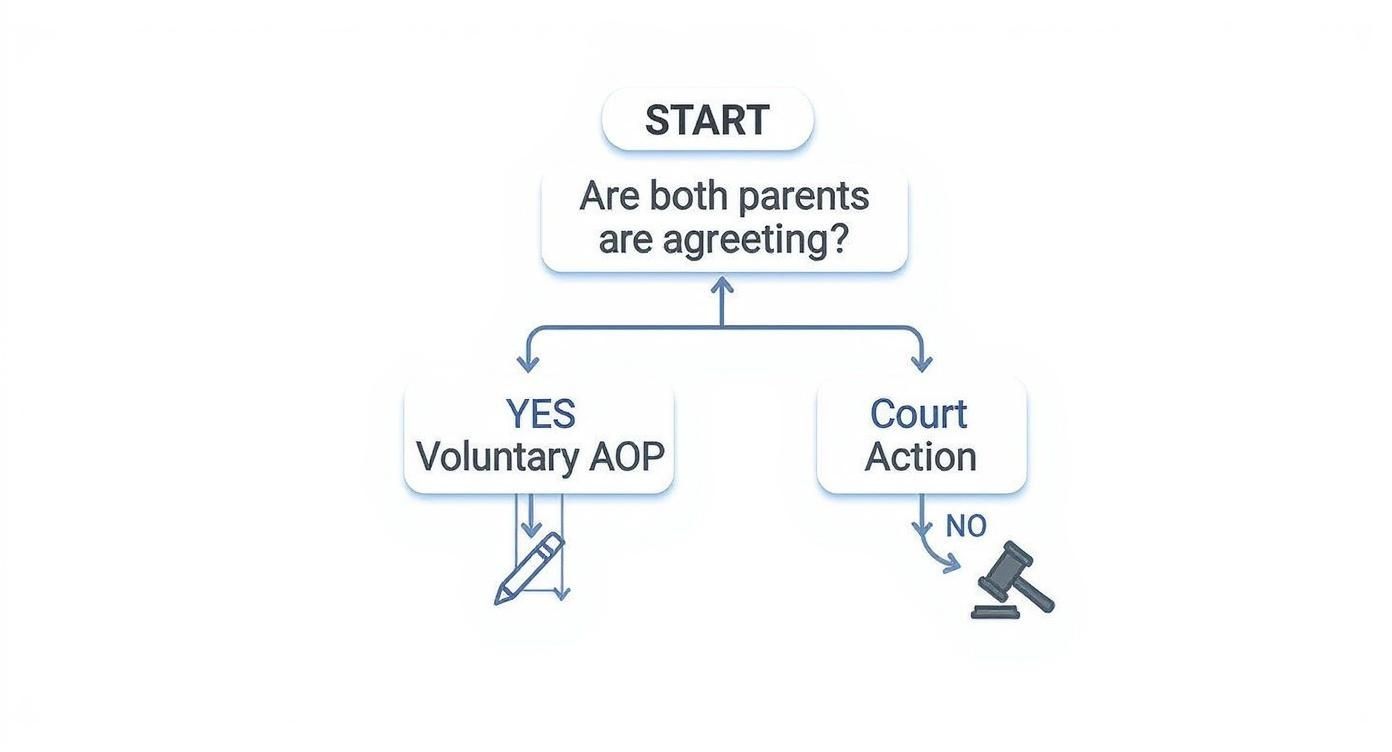
As you can see, it all starts with one question: do both parents agree? That single factor will point you toward either a straightforward administrative form or a formal lawsuit.
The Voluntary Path: Acknowledgment Of Paternity
If you're unmarried parents who are in total agreement about who the biological father is, the most direct way forward is by signing a legal form called the Acknowledgment of Paternity (AOP). It’s a sworn statement where both the mother and the man identifying as the father confirm his parentage.
This document is usually available right at the hospital after the child is born. Don't worry if you miss that window; you can also get one later from the Texas Vital Statistics Unit. Signing the AOP isn't just paperwork—it’s a major legal step. It carries the same weight as a court order and officially makes the man the child's legal father.
Because this document is so powerful, you have to be absolutely certain before you sign. Once it's signed and filed, it becomes the legal truth. It grants the father parental rights and also saddles him with responsibilities, like the duty to pay child support.
A huge misconception we see all the time is that just putting a dad’s name on the birth certificate makes him the legal father. For unmarried parents in Texas, it’s the signed Acknowledgment of Paternity that truly solidifies the father-child relationship in the eyes of the law, not just the birth certificate.
The Involuntary Path: Suit To Adjudicate Parentage
So, what happens if parents disagree, one parent is completely out of the picture, or there's genuine doubt about who the father is? For these messy situations, Texas law has a formal court process called a Suit to Adjudicate Parentage.
This is the "involuntary" route because it doesn't hinge on agreement. The mother, a man who believes he's the father, or even another party like the Office of the Attorney General can kickstart this legal action.
Filing this suit basically asks a judge to step in and make an official call on the child’s parentage. This process typically unfolds in a few key stages:
- Filing a Petition: One person files a formal request with the court to get the paternity question answered.
- Serving the Other Party: The other parent (now called the respondent) has to be legally notified that a lawsuit has been filed.
- Genetic Testing: If paternity is disputed—and it usually is in these cases—the judge will almost certainly order DNA testing. It's just a simple, painless cheek swab, but the results are scientifically rock-solid.
- Court Hearing: The judge looks at all the evidence, especially the DNA test results, and then issues a final Order Adjudicating Parentage.
This court order legally establishes who the child's father is, period. Once that's settled, the court can move on to creating orders for custody, visitation, and child support, with every decision guided by the best interest of the child. This legal principle means the court prioritizes the child's physical and emotional well-being above all else. This path provides a final, binding answer when cooperation just isn't happening, making sure every child has the security of a legally recognized father.
Here is a side-by-side look at how these two paths compare.
Voluntary vs. Involuntary Paternity Establishment in Texas
| Feature | Voluntary (Acknowledgment of Paternity) | Involuntary (Suit to Adjudicate Parentage) |
|---|---|---|
| Who It's For | Unmarried parents who 100% agree on the biological father. | Parents who disagree, when one parent is absent, or when there is uncertainty about the father's identity. |
| Process | Signing a legal form (the AOP), often at the hospital. No court is required. | Filing a lawsuit, serving the other party, potential DNA testing, and a court hearing before a judge. |
| Key Document | Acknowledgment of Paternity (AOP) form. | Order Adjudicating Parentage signed by a judge. |
| Cost | Minimal to none. Usually just a small filing fee with Vital Statistics. | Can be expensive, involving court filing fees, service fees, potential DNA testing costs, and attorney's fees. |
| Timeline | Can be completed in a single day. | Can take several months to over a year, depending on case complexity and court schedules. |
| Legal Effect | Has the full force and effect of a court order. Legally establishes all parental rights and duties. | A court order that legally establishes parentage and is often followed immediately by orders for custody, visitation, and support. |
Understanding these differences is key. The voluntary path is simple and collaborative, but it requires complete certainty and agreement. The involuntary path is a necessary tool for resolving disputes and ensuring that every child's parentage is legally defined, even when the situation is complicated.
Using the Acknowledgment of Paternity Form Correctly
When both parents are on the same page, the Acknowledgment of Paternity (AOP) form is the simplest, most straightforward way to establish legal fatherhood in Texas. But don't let the simple paperwork fool you—this is a powerful legal document with consequences that last a lifetime. Before you sign, you need to understand every single step and what it means for your rights and your child’s future.
At its core, the AOP is a sworn statement from both parents confirming the man is the child’s biological father. Once it’s signed, notarized, and filed with the Texas Vital Statistics Unit, it carries the same legal weight as a judge's court order.

Key Requirements for a Valid AOP
To make sure an Acknowledgment of Paternity is legally solid, Texas law has a few requirements that are absolutely non-negotiable. If you miss one of these, the whole document could be invalid, creating a legal mess you'll have to clean up later.
- Valid Photo Identification: Both the mother and father must show a valid, government-issued photo ID. This is a strict rule designed to verify who is signing this critical document.
- Witnessed or Notarized Signatures: Just signing the form isn’t enough. Your signatures have to be witnessed and certified, usually by a notary public. Most hospitals have certified staff on hand to handle this right after the child is born.
- No Duress or Coercion: Both parents have to sign the AOP willingly. Any signature that was forced or pressured can be challenged—and potentially overturned—in court.
Think of it this way: the state wants to be absolutely certain that both parents know what they’re signing and are entering this legal relationship freely.
By signing an AOP, you are giving up significant legal rights. The biggest one? The right to ask a court for genetic (DNA) testing to confirm or deny paternity. Once the AOP is finalized, you can't just change your mind and ask for a DNA test because you're having second thoughts.
Understanding the Rights You Waive
Signing an Acknowledgment of Paternity is a serious deal because it permanently settles the question of who the legal father is. When you put your name on that line, you are legally waiving certain rights—forever. It's vital to know exactly what you're giving up.
The main right you lose is the right to genetic testing. By signing, you are declaring under penalty of perjury that the man is the biological father. The court will take your word for it, and you forfeit any chance to use a DNA test to challenge that statement later on. This applies to both the mother and the father.
This finality is meant to create stability for the child. However, if there is any doubt at all about who the biological father is, you should not sign the AOP. The right move in that situation is to go to court and get a DNA test through a Suit to Adjudicate Parentage. It’s far better to clear up any uncertainty now than to face a much tougher legal fight down the road. The process can also be more complicated if the father passed away before the child was born; you can learn more about acknowledging paternity on a birth certificate when the father is deceased in our detailed guide.
The 60-Day Rescission Period
Texas law does offer a very short "oops" window after an AOP is signed. It's called the rescission period. During this time, either parent who signed the form has the right to cancel, or "rescind," it.
To do this, you must file a Rescission of Acknowledgment of Paternity form with the Vital Statistics Unit. The catch? You have to do it before the 60-day deadline is up. That clock starts ticking the day the AOP is filed.
Once those 60 days have passed, trying to challenge the AOP becomes incredibly difficult. It's only possible in very rare situations, like proving there was fraud, duress, or a major factual mistake. This is a high legal bar to clear, and there’s no guarantee of success. For all practical purposes, after 60 days, the AOP is permanent.
Navigating Paternity Through the Court System
When parents can't agree and just sign a form, the Texas court system provides a clear path to get answers about fatherhood. Filing a Suit to Adjudicate Parentage might sound intimidating, but it’s really just the formal process for asking a judge to legally determine a child's father. This is the route you have to take when cooperation isn't an option, and it creates a binding order that settles the question once and for all.
This court action is often necessary when one parent disputes who the father is, a potential father wants to claim his rights but the mother won't cooperate, or a mother needs to establish paternity to get a child support order. It's the court's way of making sure every child has a legally recognized father.

The Role of Genetic Testing in Court
In almost every contested paternity case, the single most important piece of evidence for the judge is a genetic test. It’s simple: when there's a disagreement, a Texas court will almost always order DNA testing for the mother, the child, and the man believed to be the father. This isn't some dramatic TV show moment—it's just a quick and painless cheek swab done at a certified lab.
The science here is the undisputed gold standard. DNA paternity tests are incredibly reliable, with an accuracy rate that typically exceeds 99.9%. It’s why courts lean on them so heavily. In fact, a 2021 nationwide study in Sweden revealed that incorrectly established paternities were as low as 1.7%, which just goes to show how precise modern testing is. You can read more about these findings on paternity accuracy.
Once the lab completes the test, the results go straight to the court. A report showing a 99% or higher probability of paternity creates a legal presumption that the man is the father, and that’s a very tough thing to argue against.
Understanding the Presumption of Paternity
There are situations where Texas law automatically assumes a man is a child's father, even without an AOP or a DNA test. This is called the presumption of paternity. The classic example is when a man is married to the child's mother when the baby is born. The law also presumes paternity if the child is born within 300 days after the marriage ends.
This legal presumption is powerful, but it’s not set in stone. It can be challenged. If another man believes he's the biological father, or if the presumed father has good reason to doubt it, he has to take legal action. The only way to overcome this presumption is by filing a Suit to Adjudicate Parentage and bringing definitive evidence—like a DNA test—to the court.
It's crucial to act quickly if you need to challenge a presumption of paternity. Texas law sets deadlines for disputing fatherhood, and missing them can result in a man being legally and financially responsible for a child who is not biologically his.
What to Expect During the Court Process
Filing a paternity suit moves through several key stages. It all starts when one person files a petition with the court. After that, the other party has to be formally "served" with the lawsuit papers, which is just the official way of notifying them. From there, the court might issue temporary orders to set some ground rules for things like visitation or financial support while the case is pending.
Eventually, the case will make its way to a final hearing. This is where the judge will look at all the evidence, including any genetic test results, and listen to what both parents have to say. Based on everything presented, the judge will issue a final Order Adjudicating Parentage.
This court order is the final word. It legally declares who the father is, and it becomes the foundation for every other order related to the child. As soon as that order is signed, the court can get to work creating a parenting plan that covers custody, visitation, and child support—always with the best interest of the child as the guiding principle. The initial steps are quite similar to other family law cases, and you can get a good feel for the process from our guide on how to file for custody in Texas.
What Happens After Paternity Is Established
Getting a court order that officially establishes paternity isn’t the finish line—it’s the starting block. Once a judge legally recognizes a man as a child’s father, the next critical phase begins: building a stable, predictable, and legally enforceable parenting plan.
This is where the court steps in to create a clear framework for your co-parenting relationship. From this point forward, every decision is guided by one core principle: the best interest of the child.
So, after a judge signs the Order Adjudicating Parentage, the real work starts. The focus immediately shifts to the nuts and bolts of custody, visitation schedules, and financial support. These orders give your child the structure they need to thrive and provide both parents with a clear roadmap of their rights and responsibilities.
Creating a Custody and Visitation Plan
In Texas, the default custody arrangement is called Joint Managing Conservatorship. It’s a legal term that means both parents are expected to share in the rights and duties of raising their child. It reflects the belief that having both parents involved is usually what is best for a child.
This doesn't automatically mean a 50/50 split of physical time, but it does mean both parents will almost always have a say in the big decisions affecting the child's life, including:
- Making choices about the child's education
- Consenting to non-emergency medical or dental care
- Deciding on the child's moral and religious upbringing
The court will then map out a possession schedule, which is the detailed calendar outlining exactly when the child will be with each parent. For most families, Texas courts start with the Standard Possession Order (SPO) as a template. The SPO provides a consistent schedule for weekends, holidays, and summer breaks, all designed to give both parents predictable and meaningful time with their child.
The "best interest of the child" is the guiding star for every decision a Texas judge makes in a custody case. This isn't just a vague idea; it's a legal standard that requires the court to consider the child's physical and emotional well-being above all else. Factors like each parent's ability to care for the child, the stability of each home, and the child’s specific needs are all carefully weighed.
Calculating and Ordering Child Support
With legal fatherhood confirmed, the court will also address the child's financial needs by issuing a child support order. This is a legal obligation for the non-primary parent—the one who the child doesn't live with most of the time—to contribute financially to the costs of raising the child.
Texas uses specific guidelines laid out in the Texas Family Code to figure out the right amount of child support. The calculation is based on a percentage of the paying parent’s net monthly income, and that percentage changes depending on how many children the parent is responsible for supporting.
For example, the guideline amount is:
- 20% of net resources for one child
- 25% of net resources for two children
- 30% of net resources for three children
These guidelines are presumed to be in the child's best interest. However, a judge has the discretion to adjust the amount up or down based on specific circumstances, like a child having special needs or extraordinary medical expenses.
Once ordered, these payments are typically managed through a centralized state system. Our guide on the Texas Child Support Disbursement Unit explains exactly how that process works. This system ensures that support payments are consistent, trackable, and reliable for the parent receiving them.
Ultimately, establishing paternity is the legal key that unlocks this entire comprehensive plan. It transforms an informal parent-child relationship into one with defined rights, clear responsibilities, and a stable structure built to protect your child’s future.
Key Takeaway: Your Next Steps
Navigating paternity can feel overwhelming, but you have clear options. Establishing paternity is the legal bedrock for your child's security and your rights as a parent. It's the critical link that opens the door to financial support, health insurance, and a father’s right to be involved in their child's life.
Your Options at a Glance
You’re looking at one of two paths, and the right one for you depends entirely on a single question: are both parents on the same page?
- If you both agree: The Acknowledgment of Paternity (AOP) is your most straightforward option. It’s a voluntary, sworn statement that seems simple but carries immense legal weight. Just remember, signing it means you give up the right to genetic testing, and you only have a 60-day window to reverse that decision.
- If you don't agree: A Suit to Adjudicate Parentage is the formal court process you'll need to follow. This route involves court-ordered DNA testing to get a conclusive answer, which resolves any disputes and ends with a judge's final order.
Here’s the single most important thing to remember: Paternity is the key that unlocks everything else. A judge cannot legally order custody (conservatorship), visitation schedules, or child support until a legal father has been officially established. Don't let uncertainty hang in the air—taking action now provides the stability your child deserves.
If you need help with a child custody or visitation case in Texas, our experienced attorneys can guide you every step of the way. Contact The Law Office of Bryan Fagan, PLLC today for a free consultation.
Texas Paternity: Your Questions Answered
When you're dealing with paternity, a lot of specific, real-world questions pop up. It’s natural. Unique circumstances are the norm, not the exception. Here are some of the most common questions we hear from parents trying to get clarity on the process.
Can I Establish Paternity if the Other Parent Lives in Another State?
Yes, absolutely. It happens all the time. Family law cases that cross state lines are common, and there are specific laws in place to handle them. The key piece of legislation here is the Uniform Interstate Family Support Act (UIFSA), a federal law every state has adopted. It helps sort out which state has the legal authority, or jurisdiction, to handle a paternity and child support case.
As a general rule, the case belongs in the child's home state—which is usually where the child has lived for the last six months. So, even if the father lives in Oklahoma or Louisiana, a Texas court can still order him to participate in genetic testing and can legally establish him as the father. An experienced attorney can help you file the right paperwork to make sure the other parent is properly notified, no matter where they live.
What if I Signed an AOP but Now Have Doubts?
This is a really tough spot to be in, and the law is incredibly strict on this point. Once you sign an Acknowledgment of Paternity (AOP), a clock starts ticking. You have a very brief 60-day window to file a formal rescission to cancel it. After those 60 days are up, trying to overturn the AOP becomes an uphill battle. It's extremely difficult.
To challenge it after the 60-day mark, you'd have to go to court and prove there was fraud, duress, or a major mistake of fact involved when you signed. In some situations, a legal concept called paternity by estoppel might come into play. This means if a man has acted as the child's father, built a strong parent-child relationship, and supported the child, a court might stop him from denying paternity later—even if a DNA test proves he isn't the biological father. The court does this to protect the child’s emotional and financial stability.
Does Establishing Paternity Automatically Give the Father 50/50 Custody?
No, it doesn't. This is one of the biggest misconceptions out there.
Establishing paternity is the essential first step. It gives a father the legal right to stand up in court and ask for custody and visitation. But it absolutely does not guarantee a 50/50 schedule or any other specific arrangement.
In Texas, all decisions about custody (legally called conservatorship) and visitation (possession) are made separately, and they all come down to one single standard: the best interest of the child. While Texas courts strongly favor arrangements where both parents are actively involved, a 50/50 schedule is not the default. A judge will look at a whole range of factors to create a possession schedule that best supports that specific child's well-being and stability.
If you need help with a child custody or visitation case in Texas, our experienced attorneys can guide you every step of the way. Contact The Law Office of Bryan Fagan, PLLC today for a free consultation.