
When your child’s future is on the line, understanding your rights matters most. Facing a custody case can feel overwhelming, and the legal terms alone can be confusing. Let's clear up one of the biggest terms right away: in Texas, what most people call "joint custody" is legally known as Joint Managing Conservatorship.
This is the state's preferred arrangement, and for good reason. It’s built on a simple, powerful belief: your child deserves to have both parents actively involved in their life, making the big decisions together. It’s not about winning or losing; it’s about creating a stable, loving foundation for your child through co-parenting.
How Texas Determines Custody: The "Best Interest of the Child"

It’s easy to get lost in the legal process, but Texas law starts from a place that should give you some peace of mind. Under the Texas Family Code, courts presume it’s in a child’s “best interest” to have frequent and continuing contact with both parents. This principle is the bedrock of Joint Managing Conservatorship.
Think of it like being co-captains of your child's team. Even if you live in separate homes, you’re still calling the big plays together—things like where your child goes to school, what doctor they see, and other major decisions impacting their well-being. This teamwork fosters the kind of cooperation and stability kids need to thrive, especially after a divorce or separation.
The Core Principles of Joint Managing Conservatorship
To really understand how joint custody works in Texas, you just need to grasp two main parts. The first is that shared responsibility for making those big-picture life decisions. This doesn't mean you have to agree on every little detail, but it does ensure you both have a say in your child’s future.
The second part is the possession schedule, which is simply the legal term for the calendar that outlines when your child lives with each parent. So many parents believe joint custody automatically means a 50/50 split of time, but that’s one of the biggest myths out there. While a 50/50 schedule is certainly an option, it's not a given. The real goal is to create a predictable and stable routine that works for your family, whether that's a standard schedule or one you customize together.
To cut through the noise, let's break down what joint custody really is—and isn't—under Texas law.
Joint Custody at a Glance: What It Is vs. What It Isn't
| Common Misconception | The Texas Reality (Joint Managing Conservatorship) |
|---|---|
| "It means a 50/50 possession schedule." | Not necessarily. The schedule is based on the child's best interest and can be a Standard Possession Order (like first, third, and fifth weekends) or customized. |
| "The parent who has the kids more makes all decisions." | Decision-making rights (like for school and medical care) are typically shared between both parents, regardless of the possession schedule. |
| "Neither parent will have to pay child support." | This is false. Child support is almost always ordered and is calculated based on state guidelines, not the custody label. |
| "It means we have to agree on every single thing." | It means you must confer on major decisions. Day-to-day choices are usually made by the parent who has the child at that time. |
This table should help clear up some of the most common points of confusion we hear from parents every day.
The core idea behind Joint Managing Conservatorship is to move away from a "winner-take-all" mindset. Instead, it promotes a partnership where both parents are empowered to contribute meaningfully to their child's upbringing, which is a model gaining traction globally.
This shared parenting model isn't just a Texas thing; it reflects a much broader international shift. In fact, joint physical custody has seen huge growth across Europe over the last two decades. Its use has nearly doubled as more places recognize just how beneficial it is to keep both parents deeply involved. You can explore more about this global trend and its impact on families.
At the end of the day, Texas law starts with the belief that your child will do best when both parents are active, loving, and present in their life. By naming you both as Joint Managing Conservators, the court provides a legal framework to build a successful co-parenting relationship from.
Understanding Your Parental Rights and Duties
When a Texas court names you and your co-parent as Joint Managing Conservators, it means you're both still in the driver's seat. This isn't just about visitation schedules; it's about sharing the fundamental rights and duties that come with raising a child. This is where the “managing” part of the title becomes real, giving you both a meaningful say in your child’s life, no matter where they lay their head at night.
Getting a handle on how to share these responsibilities is the secret to making co-parenting work. Instead of getting lost in the dense language of the Texas Family Code, it’s much easier to think about these parental rights in three simple buckets.
Decisions You Must Make Together
Some decisions are just too big for one parent to make alone. These are the foundational choices that will shape your child's future, and Texas law expects you to tackle them as a team. You have to confer and agree before anyone moves forward.
Here are a few common examples of these "must-agree" decisions:
- Changing Schools: Deciding which school district or specific campus your child will attend.
- Non-Emergency Medical Procedures: Agreeing on significant, non-urgent treatments, like getting braces or having elective surgery.
- Psychological or Psychiatric Care: Consenting to therapy, counseling, or other mental health services for your child.
This framework encourages communication and ensures one parent can’t unilaterally make a life-altering choice without the other's input. It's designed to keep you both involved in the big picture.
Decisions You Can Each Make Independently
While you might be co-captains of the ship, you don't need to consult on every single detail of daily life. The law recognizes that parenting has to be practical. Both of you have the right to make independent decisions when the child is in your care, which prevents unnecessary conflict over day-to-day matters.
These independent rights typically include:
- Directing the child's daily activities and supervising their routine during your possession time.
- Consenting to routine medical and dental care, like a standard check-up or teeth cleaning.
- Disciplining the child in a reasonable, non-physical way.
This balance is key. It lets you be an effective parent during your time while still requiring collaboration on the major issues that affect your child long-term.
Who Is The "Primary" Parent?
In almost every Joint Managing Conservatorship, the court will name one of you as the “primary” parent. This parent gets the exclusive right to decide where the child lives, usually within a certain geographic area. Because the child has a primary residence with this parent, they are also the one who typically receives child support payments.
It is absolutely crucial for both mothers and fathers to understand this: the "primary" designation does not make the other parent less important. The non-primary parent keeps nearly all other parental rights and has an equal voice in those major, joint decisions we just discussed.
Think of the primary designation as giving one parent the "tie-breaking" vote on the child's home address. It’s a logistical tool courts use to create stability, not a judgment on who is the better parent. Both of you remain absolutely vital to your child's life.
This structure gives the child a clear home base for school and community life while making sure both parents stay deeply involved as authority figures. If you want to dive deeper into the nuts and bolts of parental decision-making, you can learn more about what joint legal custody entails in our detailed guide. Understanding who decides what is the first step toward preventing future arguments and building a cooperative co-parenting relationship.
Creating a Workable Possession and Visitation Schedule
Once you’ve figured out how to share parental rights, the next big question is a practical one: When will the kids actually be with each of you? In Texas law, this is called the possession schedule. Think of it as the family calendar that brings stability and predictability back into your child’s life. Knowing what to expect helps everyone, especially your child, adjust to the new rhythm of family life.
Texas courts have a default schedule they lean on because they believe it serves a child’s best interests in most situations. It's called the Texas Standard Possession Order (SPO). You can think of it as the starting point for your custody arrangement—a clear, consistent routine that’s been time-tested in thousands of family law cases across the state.
This schedule is built on the foundation of how you and your co-parent make decisions for your child.
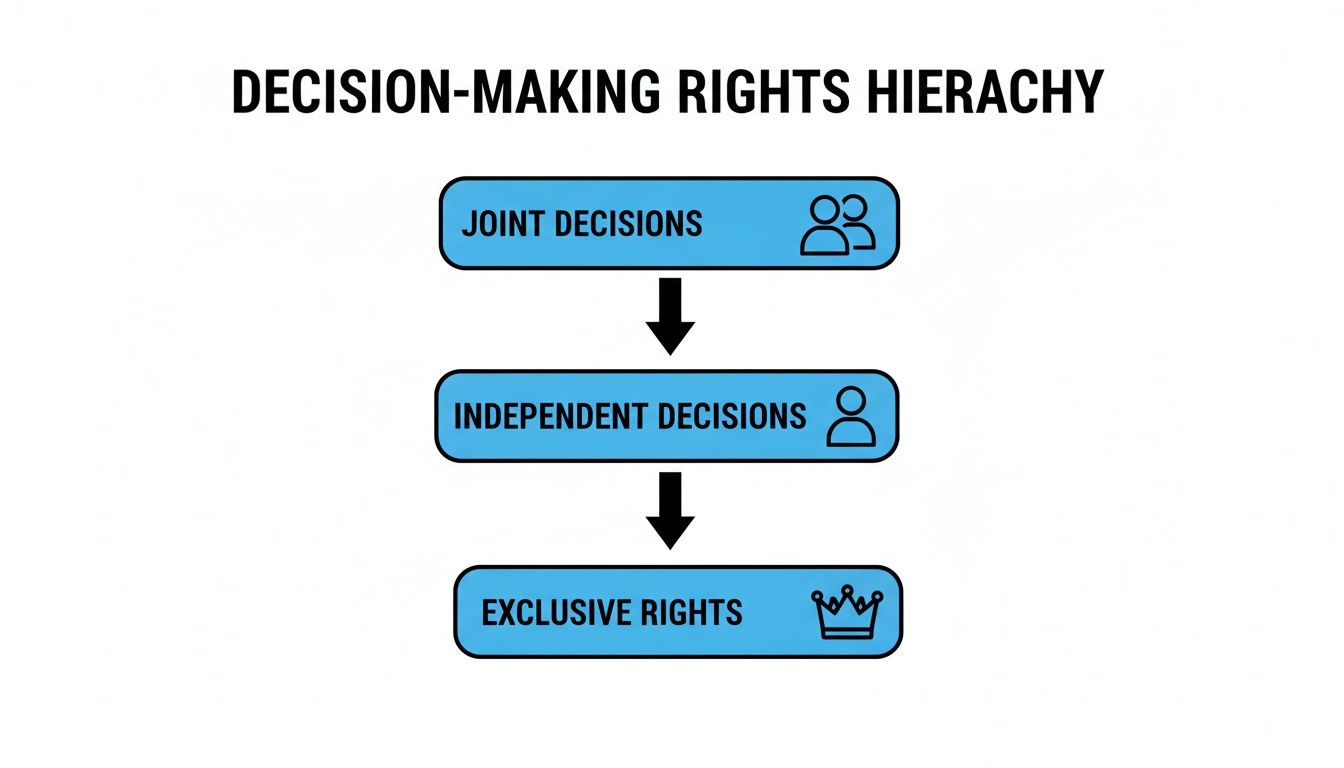
As you can see, major decisions often require teamwork, but the day-to-day calls fall to the parent who has the child at that moment. That's why having a predictable schedule is so crucial for smooth co-parenting.
The Texas Standard Possession Order Explained
The SPO is designed to give both parents regular and meaningful time with their child. For parents living less than 100 miles apart, it typically gives the non-primary parent possession on the first, third, and fifth weekends of a month. It also splits up major holidays and carves out an extended period of time in the summer, usually 30 days.
Here’s a quick rundown:
- Weekend Possession: The non-primary parent usually gets the kids from the time school lets out on Friday until school starts back up on Monday morning (or Sunday evening, depending on what works best).
- Holiday Schedules: Big holidays like Thanksgiving and Christmas are typically alternated each year. This ensures both parents get to build those special holiday memories with their child every other year.
- Summer Vacation: The SPO gives the non-primary parent at least 30 days with the child during the summer break. This time can be taken all at once or broken into a couple of different periods.
When parents live more than 100 miles apart, the SPO adapts. The non-primary parent might get fewer weekend visits but often receives more time during school holidays and a longer, 42-day possession period in the summer. It’s a practical adjustment that acknowledges the headaches of long-distance travel while still protecting that vital parent-child bond. For a deeper dive, our firm offers a detailed guide on understanding child visitation and Standard Possession Orders in Texas.
The table below gives a clearer picture of how some of the most important dates are divided under a typical SPO.
Standard Possession Order Key Dates and Holidays
| Holiday / Period | Non-Primary Parent's Possession | Primary Parent's Possession |
|---|---|---|
| Thanksgiving | Even-numbered years | Odd-numbered years |
| Christmas / Winter Break | Odd-numbered years (first half of break) | Even-numbered years (first half of break) |
| Child's Birthday | A few hours on the birthday in even years | Possession of the child for the full day, minus the other parent's time |
| Spring Break | Alternates annually (often even years) | Alternates annually (often odd years) |
| Summer Vacation | 30 days (under 100 miles) or 42 days (over 100 miles) | The remainder of the summer, outside of the other parent's designated time |
This structure is the court's default for a reason—it provides a clear, reliable framework that many families have used successfully.
Can You Create a Custom Schedule?
Yes, absolutely. While the SPO is the default, it's not your only option. You and your co-parent know your family’s unique rhythm better than anyone, and Texas law actually encourages parents to craft their own possession schedule if they can agree. This flexibility is one of the most empowering parts of making joint custody work.
A custom schedule lets you work around unique job demands, your child’s jam-packed extracurricular calendar, and whatever else makes your family tick. A judge will almost always approve a schedule you both agree on, as long as it's in the child’s best interest.
More and more families are choosing schedules that create a more even split of time, like a 50/50 possession schedule. These can come in a few different flavors:
- Alternating Weeks: This one is simple. The child spends one full week with Parent A, then the next full week with Parent B. It’s easy to track and cuts down on the number of handoffs.
- The 2-2-5-5 Schedule: With this setup, the child is with Parent A for two days, Parent B for two days, then back with Parent A for five days, and then Parent B for five days. It sounds complex, but it creates consistency by giving each parent the same weekends.
Whether you stick with the standard order or design your own, the goal is always the same: create a stable, loving environment where your child can thrive with both parents deeply involved in their life.
Building Your Co-Parenting Rulebook: The Parenting Plan
If the possession schedule tells you when your child is with each parent, think of the Parenting Plan as the detailed rulebook that answers the how. It’s a legally binding document that lays out the ground rules for your co-parenting relationship, covering everything from communication protocols to travel arrangements.
The real goal here is to get ahead of future arguments. By working together now to create a thoughtful framework, you can solve potential disagreements before they even start. It’s an empowering process that puts you and your co-parent back in the driver's seat, building a resilient foundation for your family’s future.

What Goes into a Strong Parenting Plan
A solid parenting plan digs much deeper than just who gets the kids on what weekend. It gets into the real-life situations you’ll face as you raise your child from two separate homes. The more detail you can agree on now, the fewer gray areas you'll have to argue about later.
Every strong Parenting Plan should cover these essential elements:
- Communication Protocols: How will you two talk about the kids? Will it be through text, email, or a dedicated co-parenting app? Setting these boundaries early prevents a lot of headaches.
- Extracurricular Activities: Who signs the child up for soccer? How will you split the cost of uniforms and fees? Who handles transportation to practices and games?
- Travel Rules: Do you need to give the other parent a heads-up before an out-of-state trip? How much notice is required for a vacation? Ironing this out now prevents last-minute drama.
- Introducing New Partners: This is a big one. Many plans include specific guidelines on when and how a new significant other can be introduced to the children, ensuring the transition is as smooth and respectful as possible.
Your Parenting Plan is a living document tailored to your family's specific circumstances. It’s not a one-size-fits-all template but a carefully crafted agreement that reflects your shared values and commitment to your child's well-being.
Why Proactive Planning Matters
Taking the time to build a detailed Parenting Plan is one of the best investments you can make in your child’s post-divorce life. It turns abstract legal rights into concrete, day-to-day guidelines that everyone can actually follow. This clarity is a lifesaver, especially when emotions are running high.
A well-written plan gives you a clear roadmap for resolving disputes. Instead of getting into a heated argument about a decision, you can just refer back to the rules you both already agreed on. This not only cuts down on conflict but also models healthy problem-solving for your kids. For parents who need a place to start, reviewing a parenting plan template can provide a helpful checklist of topics to cover.
Ultimately, a strong Parenting Plan does more than just list legal obligations; it sets the stage for a cooperative and successful co-parenting relationship. By planning thoughtfully now, you're creating a more peaceful and predictable future for the people who matter most: your children.
How Child Support Works in a Joint Custody Arrangement
When parents start navigating joint custody, one of the most common—and potentially damaging—myths is that it wipes out the need for child support. That’s just not how it works in Texas. Think of it this way: custody and child support are two separate legal duties that are closely linked. A child support order is a standard part of nearly every Joint Managing Conservatorship agreement.
The whole point of child support is to make sure your child’s financial needs are met consistently, no matter which parent’s house they are sleeping at on a given night.
To keep things clear, Texas law sets up specific roles. One parent is named the obligor—this is the parent who pays child support each month. The other is the obligee, who receives those funds and uses them for the child's benefit. Usually, the parent who doesn't have the exclusive right to decide where the child lives is the obligor, making the primary parent the obligee.
How Texas Calculates Child Support
The state has a straightforward formula for calculating support, which helps take a lot of the guesswork and potential conflict out of the equation. The calculation is based on the paying parent's (the obligor's) net monthly resources. This includes almost all income—wages, salary, commissions, bonuses—after taxes and the child's health insurance premiums are taken out.
The Texas Family Code provides guideline percentages based on how many children are involved:
- One Child: 20% of the obligor's net resources
- Two Children: 25% of the obligor's net resources
- Three Children: 30% of the obligor's net resources
- Four Children: 35% of the obligor's net resources
- Five or More Children: 40% of the obligor's net resources
These percentages are generally considered to be in the child's best interest. For a real-world example, if an obligor has one child and takes home $5,000 a month after taxes and insurance, their guideline child support payment would be $1,000 per month (20% of $5,000).
While the guidelines are the starting point, a judge can order a different amount if the family's specific situation calls for it. The child's best interest is always the top priority. This might happen if a child has special needs that require more financial support.
Covering Healthcare and Other Expenses
Beyond the monthly check, parents also share the responsibility for other essential costs. A court order will almost always require one parent to provide health insurance for the child. It's common for the obligor to be ordered to handle this, and the cost of that premium is deducted from their income before child support is calculated.
Clear financial orders like these help reinforce the stability that joint custody aims to create. In fact, these shared arrangements have a measurable impact. A comprehensive study found that joint custody laws led to an 11 percentage point reduction in fathers moving out of state, as these shared duties anchor parents more firmly. The research also shows that kids in these shared setups do just as well in school and emotionally as kids in two-parent households. You can discover more insights about these family stability findings and what they mean for families. At the end of the day, it all comes back to ensuring a child's needs are met consistently by both parents.
Steps to Modify or Enforce Your Custody Order
Your final custody order is meant to be a roadmap for the future, but life rarely follows a straight line. Jobs change, kids grow up, and what worked for a five-year-old might feel completely wrong for a teenager. Thankfully, Texas law understands this. The system is built with the understanding that families evolve, which is why there are clear legal paths for both changing and enforcing your order.
It’s a reassuring thought: if the current arrangement isn’t working anymore, or if one parent just isn’t holding up their end of the deal, you aren’t stuck. You have powerful legal tools available to protect your child’s stability and your own parental rights.
Modifying Your Custody Order
To get a judge to change an existing custody, visitation, or child support order, you have to clear two specific legal hurdles. First, you must prove there’s been a “material and substantial change in circumstances” since the last order was signed. Second, you have to show that the change you’re asking for is in the child's best interest.
This standard exists for a reason—it stops parents from running back to court over every minor disagreement or scheduling squabble. The change has to be significant.
A “material and substantial change” isn’t a small tweak in routine. It’s a major life event that fundamentally alters the family’s situation, making the current order unworkable or no longer good for the child.
So, what counts as a major change? Here are a few real-world examples that often justify a modification:
- A Parent Relocates: One parent is planning a long-distance move, making the current possession schedule physically impossible to follow.
- A Parent's Lifestyle Changes: A parent develops a substance abuse problem or starts living in a way that could put the child in danger.
- A Teenager Has a Say: A child over the age of 12 clearly explains to the judge a well-thought-out desire to change which parent they primarily live with.
- A Major Shift in Income: One parent gets a huge promotion or loses their job, which could mean the child support amount needs to be recalculated.
If the court agrees that a significant change has happened and your proposed new plan is best for your child, it will issue a brand-new order that reflects your family’s current reality.
Enforcing Your Order When a Parent Fails to Comply
A court order isn’t a suggestion—it’s the law. When one parent consistently ignores the terms of your possession schedule or violates another part of the order, you can take them back to court to enforce it. This is a critical part of how joint custody works, ensuring one parent can’t just decide to do whatever they want.
Common violations that might lead to an enforcement action include things like:
- Consistently bringing the child home late from visits.
- Flat-out refusing to let the other parent have their court-ordered time.
- Making a big decision about the child (like changing their school) without consulting the other parent as the order requires.
The process usually starts by filing a Motion for Enforcement with the court. This legal document lays out, in detail, exactly how and when the other parent broke the rules.
If the judge finds the other parent in contempt of court for violating the order, the consequences can be serious. A judge has the authority to order makeup visitation time, force the non-compliant parent to pay your attorney’s fees, and, in more extreme cases, even issue fines or jail time. This sends a clear message that court orders must be respected and that your child’s routine is worth protecting.
Key Takeaways and Next Steps
Navigating a custody case is challenging, but understanding the law is the first step toward empowering yourself. Concepts like Joint Managing Conservatorship, possession schedules, and parenting plans aren't just legal jargon. They are the practical tools you will use to build a stable, predictable, and loving life for your children after a separation.
Ultimately, Texas law is built on a simple, family-focused idea: children do best when both parents are deeply involved in their lives. A well-crafted custody order isn't just a piece of paper for the court file; it's the roadmap your family will follow. Knowing how it all works gives you the power to advocate for the consistency and security your child deserves.
If you need help with a child custody or visitation case in Texas, our experienced attorneys can guide you every step of the way. Contact The Law Office of Bryan Fagan, PLLC today for a free consultation.