
When your child’s future is on the line, understanding your rights as a father matters most. For many dads in Texas, the drive to protect your child leads to one of the toughest questions a parent can face: How can I get sole custody? The answer is yes, a father can get what Texas law calls Sole Managing Conservatorship. But it’s a high bar to clear. You must prove to a court that giving you this exclusive authority is truly in your child's best interest, which almost always means showing that the other parent’s behavior would harm the child's physical or emotional well-being.
Understanding Custody in Texas: What "Sole Custody" Really Means

Navigating a custody dispute can feel overwhelming, but clarity empowers you to make the best decisions for your family. For many fathers facing difficult circumstances, the phrase “sole custody” represents safety and stability. In the language of Texas law, this is called Sole Managing Conservatorship—a legal arrangement that gives one parent the exclusive right to make most of the major decisions for their child.
This is a significant departure from the standard arrangement in Texas, which is Joint Managing Conservatorship. It's critical to understand the difference.
Sole Managing Conservatorship vs. Joint Managing Conservatorship
Under a Joint Managing Conservatorship, both parents share the rights and duties of raising their child. While one parent is typically named the "primary" parent who determines the child's residence, both parents are expected to make decisions together on important matters like education, medical care, and other major life choices. This is the default arrangement because Texas law presumes that having both parents actively involved is what’s best for a child.
Sole Managing Conservatorship is entirely different. The parent with this authority has the final say on key decisions without needing the other parent's consent. These exclusive rights typically include:
- Deciding the child's primary residence without geographic restrictions.
- Making all decisions about the child's education.
- Consenting to medical, dental, and psychological treatment.
- Receiving child support payments on behalf of the child.
So, what happens to the other parent? They are usually named the Possessory Conservator and given a possession schedule, which is the court-ordered calendar outlining their visitation time. Their decision-making power is limited, but their right to see their child is still protected—unless a court finds that even supervised visitation would be unsafe.
The "Best Interest of the Child" Standard
Every single decision a Texas family court makes is guided by one core principle: the “best interest of the child.” This isn't just a phrase; it's the legal standard embedded in Texas Family Code Chapter 153 that judges must apply in every custody ruling.
A judge won't grant sole custody to a father simply because he asks for it. The court needs to see compelling, factual evidence showing that appointing the other parent as a joint conservator would actively harm the child’s physical health or emotional development.
To determine what’s in a child’s best interest, a judge considers a set of factors, often called the "Holley Factors." These cover everything from the child's emotional and physical needs to any potential danger—now or in the future. They also weigh each parent’s abilities and the stability of the home they can provide. For any dad seeking sole custody, your entire case must be built around proving that this arrangement is the only one that truly protects your child.
The First Step: Establishing Paternity to Secure Your Parental Rights

Before a Texas court will even consider your request for sole custody, a fundamental question must be answered: Are you the child’s legal father? This may seem obvious, but it is the absolute bedrock of your case.
Without legal paternity, you have no legal standing to request custody, visitation, or the right to make decisions for your child. It’s the key that unlocks the courthouse doors.
For fathers who were married to the mother when the child was born, Texas law automatically presumes you are the father. But for unmarried fathers, that legal bond must be intentionally created. While having your name on the birth certificate is a positive step, it often isn't enough on its own in a contested custody battle. To protect your rights, you must be proactive.
Two Paths to Legal Fatherhood in Texas
The most direct path for unmarried parents is to sign an Acknowledgment of Paternity (AOP). This is a sworn legal document, usually available at the hospital after the baby is born, though it can be completed later. Once filed with the Texas Vital Statistics Unit, it carries the full weight of a court order, officially establishing you as the child's legal father.
If the mother is unwilling to sign the AOP, or if there is any doubt about parentage, your next step is to file a Suit to Adjudicate Parentage with the family court. This is a formal legal action asking a judge to declare you as the father. The court will almost always order genetic (DNA) testing to confirm the biological relationship. Once the results are confirmed, the judge issues an order that permanently establishes your paternity.
Establishing your legal rights is not just a procedural step; it is the most empowering action you can take. It transforms you from a biological father into a legal parent with the authority to fight for your child's best interests in court.
Why This Step Is Not Optional
If you skip this step, you have zero enforceable parental rights. You cannot legally demand a possession schedule, have a say in your child's schooling or medical care, or prevent the mother from moving out of state with your child.
For any father asking how can I get sole custody, the journey begins here. Establishing paternity gives you the legal standing to walk into court and make your case, proving why you are the parent best suited to provide a safe, stable, and nurturing home. To learn more about this critical first step, you can find more guidance on establishing paternity in Texas.
Grounds for a Father to Win Sole Custody in Texas
It’s important to understand that Texas courts start with the presumption that children benefit most when both parents are involved. That’s why Joint Managing Conservatorship is the default arrangement in nearly every custody case.
To convince a judge to depart from that standard and grant you Sole Managing Conservatorship, you must do more than prove you're a wonderful dad. You have to demonstrate, with clear and convincing evidence, that giving the other parent joint custody rights would actively harm your child.
This is a high legal standard. Your personal disagreements or differences in parenting styles won't be enough. The court needs to see specific, provable behaviors that endanger your child’s physical or emotional well-being, as defined by the Texas Family Code. Understanding these specific grounds is the first step toward building a strong case to protect your child.
Family Violence, Abuse, or Neglect
The most direct path to winning sole custody is proving a history of family violence, abuse, or neglect. A judge’s primary concern is the safety of a child, and these allegations are taken with the utmost seriousness.
- Family Violence: This includes not only physical assault but also any act intended to cause physical harm, injury, or sexual assault, and even threats that place a family member in fear of such acts. A criminal conviction is powerful evidence, but it isn't required. Police reports, protective orders, photos, and witness testimony can all help establish the facts for the court.
- Child Abuse or Neglect: If Child Protective Services (CPS) has investigated and found evidence of abuse or neglect by the other parent, this will be a significant factor. This can include physical harm, emotional abuse, failure to properly supervise the child, or knowingly placing them in dangerous situations.
The court's foremost duty is to protect the child. A credible history of violence or neglect is one of the most compelling reasons a judge will limit a parent's rights and award sole managing conservatorship.
Severe Substance Abuse
A parent’s drug or alcohol use becomes a critical issue when it directly threatens a child’s safety. The court is not concerned with a parent having an occasional drink. The focus is on a pattern of substance abuse that impairs their judgment and creates a dangerous environment.
Examples include a parent who drives with the child after drinking, leaves illegal drugs accessible to a child, or is so frequently intoxicated that they cannot provide basic care. This is the type of behavior that puts a child at risk, but you must prove it with evidence such as:
- Official Records: DUI convictions or other drug-related arrests are solid evidence.
- Witness Testimony: Credible individuals who have firsthand knowledge of the substance abuse and its impact can be very persuasive.
- Court-Ordered Testing: If you present enough evidence to raise a serious concern, a judge can order drug and alcohol testing.
If you can show the court that the other parent's substance abuse is a direct threat, you have a strong argument for why sole custody is necessary to ensure your child has a safe and stable home.
The court's decision isn't about punishing the other parent; it's about protecting the child. The central question is always: Does this parent's behavior create an environment that is physically or emotionally harmful for the child?
Extreme Parental Alienation or Interference
Texas law expects parents to support and encourage a healthy relationship between their child and the other parent. However, sometimes one parent actively works to destroy that bond. This is known as parental alienation.
This behavior is far more than just being difficult or uncooperative. It is a persistent campaign to turn the child against the other parent. Examples include making constant false allegations, systematically interfering with a visitation schedule, or manipulating a child into fearing or rejecting their other parent.
If you can document a severe and ongoing pattern of this behavior, a court may recognize it as emotionally damaging to your child. A judge might conclude that the alienating parent is incapable of acting in the child's best interests, which could be a deciding factor in your case to become the sole managing conservator in Texas.
How to Build a Compelling Case with Strong Evidence
Your word alone, no matter how sincere, is not enough to win a sole custody case in Texas. While you know in your heart why this is the right decision for your child, a judge can only act on the evidence presented in court. This means your most important task is to build a solid, organized case that proves granting you sole managing conservatorship is in your child's best interest.
This process is not about attacking the other parent. It is about methodically creating a clear, factual picture for the court that demonstrates the risks your child faces. A judge needs to see a distinct pattern of behavior or specific circumstances that make joint custody unsafe or unstable. Every piece of evidence you gather must support that conclusion.
Documenting Everything: The Foundation of Your Case
The most powerful evidence is often found in official records from neutral third parties. These documents tell a story on their own and provide a factual timeline a judge can rely on. Your first step should be to collect any official paperwork that records the other parent's dangerous, unstable, or neglectful behavior.
Start by gathering records like these:
- Police Reports: If you have ever had to call law enforcement due to domestic disputes, violence, or for welfare checks, obtain certified copies of those reports.
- CPS Records: If Child Protective Services has been involved, their investigative records are invaluable, even if the case was ultimately closed.
- Criminal History: Obtain records of any arrests or convictions, such as for DUIs, drug possession, or assault, as they can illustrate poor judgment and potential danger.
- Medical and School Records: These can reveal a pattern of neglect, such as missed doctor’s appointments, failure to seek necessary medical care, or a history of unexcused absences and tardiness from school.
These documents form the backbone of your case, providing the judge with a factual foundation.
Digital Communications: The Story in Their Own Words
Much of our communication today happens via text, email, and social media. These digital trails can offer a raw, unfiltered look into the other parent's actions, mindset, and priorities. Texas courts regularly consider this type of evidence.
Be strategic in what you save. You are looking for specific proof of:
- Threats, harassment, or abusive language.
- Admissions of drug or alcohol abuse.
- Evidence of neglect (e.g., texts showing they left the child unsupervised).
- Proof of instability, such as frequent job losses or sudden moves.
- Parental alienation, where they actively try to turn the child against you.
It is absolutely critical to organize these communications chronologically. A single angry text might be explained away, but a six-month pattern of abusive messages tells a story that is impossible for a judge to ignore.
Preserve this evidence correctly by taking clear screenshots that show the date, time, and sender. Do not crop or alter them. This digital paper trail can be one of your most persuasive tools.
The Power of Witness Testimony
Sometimes, the most compelling evidence comes from people who have personally observed the other parent’s behavior. A credible, neutral witness can confirm your claims and provide the judge with an objective perspective that carries significant weight.
Potential witnesses could include:
- Teachers or School Counselors: They can testify about the child’s emotional state, sudden behavioral changes, or a parent's lack of involvement.
- Therapists or Doctors: A child's counselor can often speak to the emotional impact of a parent's actions.
- Family, Friends, or Neighbors: While the court understands these witnesses may have a personal connection, their testimony is powerful if they can describe specific events they personally witnessed—such as seeing the other parent drive drunk with the child or hearing violent arguments.
The key is to find people who can testify to specific facts, not just their opinions. "I saw her leave the five-year-old home alone on three separate occasions" is far more powerful than "I think she's a bad mom." For more strategies, check out our guide on how to prove the best interest of the child in Texas.
How Evidence Shapes the Outcome
Gathering the right mix of evidence transforms a hopeful claim into a winning legal strategy. Each piece serves a unique purpose, from establishing a pattern of dangerous behavior with police reports to revealing the other parent's mindset through their own text messages. A judge will consider the totality of the evidence when making a final decision.
| Types of Evidence and Their Impact in a Custody Case |
| :— | :— | :— | :— |
| Type of Evidence | Examples | What It Can Prove | Potential Impact |
| Official Records | Police reports, CPS files, criminal records, school attendance records | A documented history of violence, neglect, substance abuse, or instability. | High Impact: Considered objective and difficult to dispute. Forms the factual basis of the case. |
| Digital Communications | Text messages, emails, social media posts, voicemails | Harassment, threats, admissions of fault, parental alienation, instability. | High Impact: Provides a direct, unfiltered look into the other parent's words and actions. |
| Witness Testimony | Teachers, therapists, neighbors, family members, daycare providers | Corroboration of neglect, abuse, or substance abuse; impact on the child's well-being. | Medium to High Impact: Credibility depends on the witness's neutrality. Expert witnesses are highly persuasive. |
| Financial Records | Bank statements, pay stubs, tax returns | Financial instability, funding of an addiction, failure to provide for the child. | Medium Impact: Shows an inability to provide a stable environment or prioritize the child's needs. |
| Photographs & Videos | Photos of unsafe living conditions, videos of intoxicated behavior | Unsafe environment, neglect, erratic behavior that endangers the child. | Medium Impact: Visual evidence can be powerful but may require context from testimony. |
Ultimately, a strong case is built on a variety of credible sources that all point to the same conclusion: that sole custody is necessary to protect your child.
Navigating the Texas Family Court Process: A Step-by-Step Guide
The legal system can feel intimidating, but understanding the process empowers you to remain focused and proactive. When you are fighting for sole custody, knowing the path ahead makes all the difference. Let's walk through the key stages of a Texas custody case, from filing the first document to receiving a final order from the judge.
The journey begins when you file an Original Petition in a Suit Affecting the Parent-Child Relationship. This is the formal document that officially opens your custody case with the court. It identifies the parents and child and clearly states what you are asking the court to do—in this case, to appoint you as the Sole Managing Conservator.
Once filed, you must legally notify the other parent of the lawsuit. This is called service, and it must be done by a neutral third party, like a sheriff, constable, or private process server. This critical step ensures the other parent has a fair opportunity to respond.
The Role of Temporary Orders and Mediation
Few families can wait months for a final trial to establish stability. That is why one of the most important early stages is the Temporary Orders Hearing. At this hearing, a judge makes short-term decisions that will remain in place while the case moves forward. These orders can establish a temporary possession schedule, order child support, and determine who makes immediate decisions for the child.
These orders are a crucial milestone. They create a temporary "status quo" that gives your child much-needed consistency during a stressful time. A positive outcome here can also set a favorable tone for the rest of your case.
Before you go to a final trial, the court will almost always require you to attend mediation. This is a confidential process where you and the other parent sit down with a neutral mediator to try and reach an agreement. It is your best opportunity to resolve disputes outside of the courtroom, giving you more control over the final outcome. Many cases are settled in mediation, saving everyone time, money, and emotional strain.
Preparing for the Final Hearing
If mediation does not result in a full agreement, your case will proceed toward a final hearing or trial. This is where all the evidence you have gathered will be presented to the judge. You and your attorney will use documents, messages, and witness testimony to prove that awarding you sole custody is in your child's best interest.
This flowchart illustrates the core components of building your case for that final hearing.
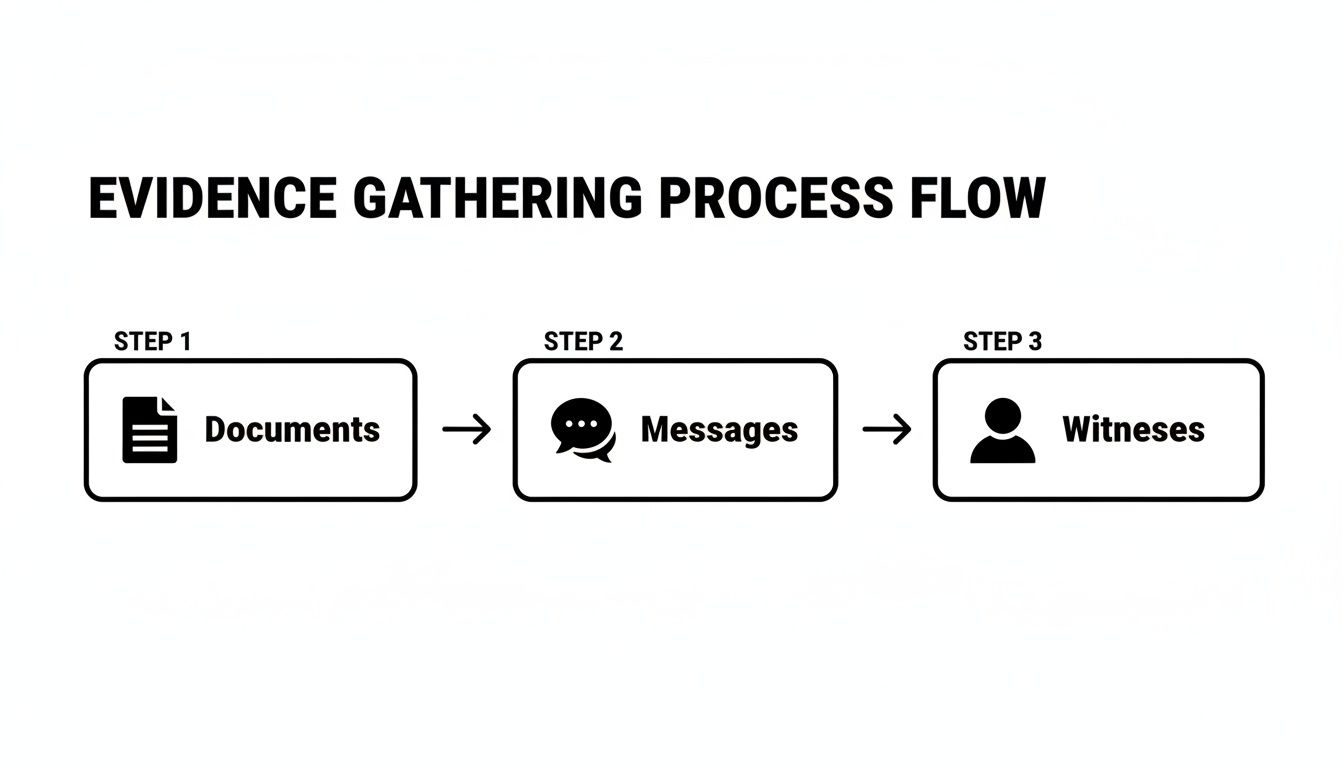
As you can see, a strong case is not built on a single piece of evidence. It relies on a combination of official documents, direct communications, and human testimony to paint a complete and credible picture for the court.
While statistics show that fathers face an uphill battle in custody cases, with the U.S. rate for sole custody awards around 18.3%, don't let that discourage you. Global norms are shifting, and the rise of joint physical custody in Europe—reaching 13% for children aged 11-15 by 2021—shows that courts are increasingly recognizing the vital role of engaged fathers. You can learn more about these evolving global family structures.
The court process is methodical and requires patience and preparation. Each step, from filing the initial petition to presenting your evidence at trial, is a building block in your effort to protect your child's future.
Key Takeaways and Next Steps
Deciding to pursue sole custody is a monumental step, one you are likely taking out of deep love and genuine concern for your child's safety and well-being. It is a path that demands courage, preparation, and a solid legal strategy.
Your Next Steps
You can begin strengthening your position today with these immediate actions:
- Consult with an Experienced Attorney: A family law attorney can evaluate the facts of your case, explain your legal options, and help you create a plan. Understanding the legal landscape, including potential costs like how much is a lawyer consultation fee, is the first step.
- Start Documenting Everything: Keep a detailed journal. Log every relevant interaction, missed visit, and concerning behavior with dates, times, and specific details.
- Organize Your Evidence: Begin collecting and organizing any texts, emails, photos, or official reports that support your concerns about the other parent's fitness.
- Remain the Stable Parent: Above all, continue to be the consistent, reliable, and loving parent your child needs. Your actions will speak volumes.
This process can feel overwhelming, but remember that every step you take and every piece of evidence you gather is a move toward securing a safe and stable future for your child. You are not alone in this fight.
If you need help with a child custody or visitation case in Texas, our experienced attorneys can guide you every step of the way. Contact The Law Office of Bryan Fagan, PLLC today for a free consultation.
Frequently Asked Questions About Fathers and Sole Custody
Pursuing sole custody is a major decision, and it’s natural to have many questions. Here are clear, straightforward answers to some of the most common concerns we hear from fathers.
Does Texas Law Favor Mothers Over Fathers?
No. This is one of the most persistent myths in family law. The Texas Family Code is explicitly gender-neutral. A judge is legally prohibited from basing a custody decision on whether a parent is the mother or the father. Every ruling must be based solely on the best interest of the child. The court will evaluate factors like which parent can provide a stable, safe home and who has been the primary caregiver.
How Much Does It Cost to Fight for Sole Custody?
There is no single answer, as the cost can vary significantly based on the complexity of your case and the level of conflict with the other parent. A highly contested case that proceeds to trial will cost substantially more than one that is resolved through mediation. An initial consultation with an attorney can provide a clearer understanding of the potential financial investment required.
Securing a formal custody order also provides financial stability. Custodial fathers in the U.S. receive full child support payments at rates similar to mothers—43% versus 46%. A court order ensures this support is consistent and legally enforceable. You can discover more insights about child support statistics to better understand this important aspect.
What Happens If We Live in Different States?
Custody disputes that cross state lines are more complex and are governed by a federal law called the Uniform Child Custody Jurisdiction and Enforcement Act (UCCJEA). This act establishes rules to determine which state has the authority (or "jurisdiction") to make custody decisions. Generally, jurisdiction lies with the child's "home state"—the state where they have lived for the six months prior to the case being filed. These situations require an attorney with specific experience in interstate custody laws.
Can a Custody Order Be Changed Later?
Yes. Texas courts recognize that circumstances change as children grow. A custody order can be modified if you can prove two things:
- There has been a material and substantial change in circumstances since the existing order was made.
- Modifying the order is in the child's best interest.
This allows court orders to adapt to your family's evolving needs, ensuring the arrangement always serves your child's well-being.
If you need help with a child custody or visitation case in Texas, our experienced attorneys can guide you every step of the way. Contact The Law Office of Bryan Fagan, PLLC today for a free consultation.