
When your relationship with your child is on the line, everything else fades into the background. It's heartbreaking to feel your child pulling away, but when you realize the other parent is the one creating that distance, the feeling can be isolating and deeply unfair. You are not alone in this struggle, and understanding your rights is the first step toward protecting your family.
This painful experience has a name: parental alienation. It’s a serious concern within the Texas family court system, and you have options to fight back.
What Is Parental Alienation in Texas?
Parental alienation isn't just about co-parents disagreeing or having a bad day. It’s a deliberate pattern of behavior—a campaign of manipulation designed to poison your child’s perception of you and systematically dismantle the loving bond you’ve worked so hard to build. The alienating parent slowly and methodically poisons the well of your relationship with toxic words and actions until your child becomes reluctant to connect with you.
How Texas Law Views Parental Alienation
In every single custody case, Texas law is guided by one core principle: the best interest of the child. This standard, laid out in the Texas Family Code, is the North Star for every decision a judge makes about custody (known as “conservatorship”) and visitation (“possession schedules”).
Alienating behaviors fly directly in the face of this principle.
A Texas court will always prioritize a child's right to have a healthy, loving relationship with both fit parents. Any action that tries to undermine that bond is seen as profoundly harmful to a child’s emotional and psychological well-being.
Parental alienation is a form of emotional abuse that aims to turn a child against a parent without any legitimate justification. It is a direct attack on the parent-child relationship, and Texas courts take it very seriously.
Recognizing this pattern is the first, most crucial step toward reclaiming your relationship. It’s vital to understand that you are not powerless here. The Texas Family Code provides a legal framework to fight back against these destructive behaviors and protect your parental rights. You do not have to walk this painful road alone.
Recognizing the Warning Signs of Alienation

It can be tough to know if you're dealing with normal co-parenting bumps or something more destructive. Disagreements happen. But parental alienation isn’t just a bad week or a heated argument—it’s a consistent, deliberate campaign to poison your relationship with your child. Knowing what to look for is the first step toward protecting your child and your rights. The signs usually show up in the other parent's behaviors and, heartbreakingly, in the changes you see in your child.
Behaviors of an Alienating Parent
An alienating parent often works to paint themselves as the “good” parent while casting you as the villain. This isn't a single angry comment; it’s a pattern of intentional actions designed to interfere with your bond.
Keep an eye out for these specific tactics:
- Constant Criticism: They badmouth you, your family, or your new life in front of the kids, often sharing inappropriate details about your divorce or finances.
- Interfering with Communication: Your calls suddenly go unanswered. Messages are never passed along. They conveniently "forget" to let you speak with your child at agreed-upon times.
- Sabotaging Your Time: They consistently schedule "can't-miss" activities during your court-ordered possession schedule (your designated time with your child), making it nearly impossible for your child to see you without feeling guilty.
- Creating Loyalty Binds: This is a classic move where the child is forced to choose sides, with statements like, "If you really loved me, you wouldn't want to go to your dad's house this weekend."
- Withholding Information: You’re left in the dark about parent-teacher conferences, doctor’s appointments, or soccer games, effectively shutting you out of your child’s life.
These aren't just examples of poor co-parenting. In Texas, these actions go against the spirit of a Joint Managing Conservatorship, a legal arrangement where both parents are expected to actively support the child’s relationship with the other parent.
Alienating Tactics vs. Healthy Co-Parenting
Sorting through what’s normal and what’s harmful can be confusing. Here’s a quick comparison to help you tell the difference between typical co-parenting friction and the alienating tactics that Texas family courts take very seriously.
| Alienating Behavior | Healthy Co-Parenting Example |
|---|---|
| Blocks calls and texts from you to the child. | Encourages the child to call you to say goodnight. |
| Tells the child adult details about the divorce to blame you. | Keeps adult issues between the adults, telling the child, "That's for Mom and Dad to discuss." |
| Schedules fun activities during your possession time. | Checks with you before scheduling activities that might conflict with your time. |
| Refuses to share information about school or medical appointments. | Uses a shared calendar or co-parenting app to keep you informed of all important events. |
| Makes the child feel guilty for enjoying their time with you. | Asks the child positive questions like, "Did you have a good time with your Mom?" |
This table highlights a key difference: healthy co-parenting is about putting the child's needs first, while alienation is about one parent's need to control the narrative.
Changes in Your Child’s Behavior
Perhaps the most painful part of this is seeing the change in your child. A child who was once loving and affectionate might become distant, angry, or fearful for reasons that make no sense. Their feelings often seem completely out of proportion to any actual experience they’ve had with you.
Heartbreaking signs to look for include:
- Unjustified Criticism: Your child suddenly criticizes you for things that seem trivial or untrue, often repeating the exact phrases the other parent uses.
- Lack of Ambivalence: Healthy relationships have shades of gray. An alienated child sees things in black and white: one parent is all good, and the targeted parent is all bad.
- Borrowed Scenarios: They might tell stories about things you supposedly did, describing them vividly, when you know they are repeating a story they were told, not something they experienced.
- Absolute Support for the Alienator: The child reflexively defends the alienating parent on every issue, showing a level of loyalty that feels unnatural and rehearsed.
- Absence of Guilt: They might be cruel or disrespectful toward you without showing any remorse, a shocking departure from the child you know.
- Rejection of Your Extended Family: The negativity often spreads to grandparents, aunts, uncles, and cousins who they used to adore.
Documenting these behaviors isn’t about building a case against your child; it’s about protecting them. Keeping a detailed, dated journal of these incidents is how you provide the concrete evidence a Texas court needs to see the whole story.
How Texas Law Addresses Parental Alienation
Navigating the Texas legal system can feel overwhelming, but understanding how the law sees parental alienation is the first step toward reclaiming your power. The good news is, you don't have to be a legal scholar to get it. While you won’t find the exact phrase “parental alienation” written into the Texas Family Code, the destructive behaviors that define it are absolutely on the court's radar.
The "Best Interest of the Child" Standard
The cornerstone of all Texas custody cases is the best interest of the child. This principle, found in Chapter 153 of the Texas Family Code, is the lens through which a judge evaluates everything. A parent who actively works to damage their child’s relationship with the other parent is, by definition, not acting in that child’s best interest.
A court considers many factors to determine what's best for a child, including:
- The emotional and physical needs of the child now and in the future.
- Any emotional and physical danger to the child.
- The parental abilities of each individual.
- The stability of the home.
- Any acts or omissions by a parent that indicate the parent-child relationship is not a proper one.
Alienating behaviors directly contradict these factors, especially when it comes to a child's emotional needs and the stability they get from having two healthy parental relationships.
Joint Managing Conservatorship and Parental Duties
In Texas, the law starts with the assumption that a Joint Managing Conservatorship is what’s best for the child. This is a legal arrangement where both parents share the rights and responsibilities of raising their child. It’s built on the idea that both parents will work together and support the child's bond with the other parent.
When a parent engages in alienating behaviors, they are failing to uphold their fundamental duties as a joint managing conservator. A judge can see this failure as a serious breach of parental responsibility.
This legal framework is crucial. An alienating parent isn't just hurting your feelings; they are violating the spirit—and often the letter—of Texas custody law.
A "Material and Substantial Change"
To formally ask a court to step in, you generally need to show that there has been a “material and substantial change in circumstances” since the last custody order was signed. A documented pattern of severe parental alienation is often considered exactly that. This provides the legal grounds needed to file a Petition to Modify the Parent-Child Relationship, the formal tool used to request changes to custody, visitation, or access.
The complexity of these cases is significant. Research from organizations like the SAFE Alliance shows that when mothers reported abuse, they lost custody 28% of the time, while fathers who reported abuse lost custody 12% of the time. You can learn more about these findings on safateaustin.org. These statistics highlight why skilled legal representation is essential to ensure your story is told effectively.
Gathering Evidence to Build Your Case
When you walk into a Texas family courtroom, your story matters. But it's the hard evidence that gives your story power. For a judge to grasp the damage of parental alienation, they need clear, organized, and compelling proof. Building this case is about turning your painful experiences into a factual record a court can act on.
Documenting Digital and Written Communications
These days, much of the story is told through our phones and keyboards. Text messages, emails, and social media posts can offer a direct window into the other parent's actions.
Start gathering and organizing any communication that shows:
- Disparaging Remarks: Save any messages where the other parent insults you, your family, or your parenting.
- Interference with Your Time: Keep a record of every text or email where the other parent denies your court-ordered possession or books conflicting activities during your parenting time.
- Blocking Communication: Take screenshots if your calls or texts to your child are suddenly blocked or consistently ignored without a good reason.
Organize these communications chronologically in a secure folder. This creates a timeline that makes it easy for a judge to see a consistent, harmful pattern.
Keeping a Detailed Factual Journal
Your personal journal might be the most important piece of evidence you create. This isn't a diary for venting frustrations—it's a logbook for facts.
For each entry, include:
- Date and Time: Precision is everything.
- What Happened: Describe the event objectively. Instead of "He was a jerk," write, "Received a call from my child. Heard the other parent in the background saying, 'Tell him you don't want to talk anymore.'"
- Your Child's Statements: Write down troubling things your child says verbatim, especially if the words sound rehearsed or too adult for them. For example, "Mommy says you don't pay enough child support, and that's why we can't afford nice things."
- Witnesses: Note anyone else who was there and saw the behavior or its aftermath.
Key Takeaway: A factual, unemotional journal that documents a pattern over time is far more persuasive in court than a single, emotional outburst.
For a deeper dive into building a rock-solid case, check out our guide on how to prove parental alienation in court.
The Importance of Third-Party Evidence
Sometimes, the most powerful proof comes from neutral third parties who have seen the changes in your child firsthand.
Consider reaching out to:
- Teachers and School Counselors: Have they noticed a sudden drop in grades, behavioral problems, or heard troubling comments from your child about you?
- Coaches and Extracurricular Leaders: A coach might notice your child is suddenly withdrawn or that the other parent makes negative comments about you.
- Therapists or Counselors: If your child is seeing a therapist, that professional (with the proper legal procedures) can offer critical insight.
Gathering all this evidence takes time, but it is the foundation of any strong legal case.
Your Legal Options and Remedies in Texas
Discovering that your co-parent is turning your child against you is a gut-wrenching experience. But in Texas, you are not without options. The law gives you specific pathways to fight back, protect your parental rights, and shield your child from further emotional harm.
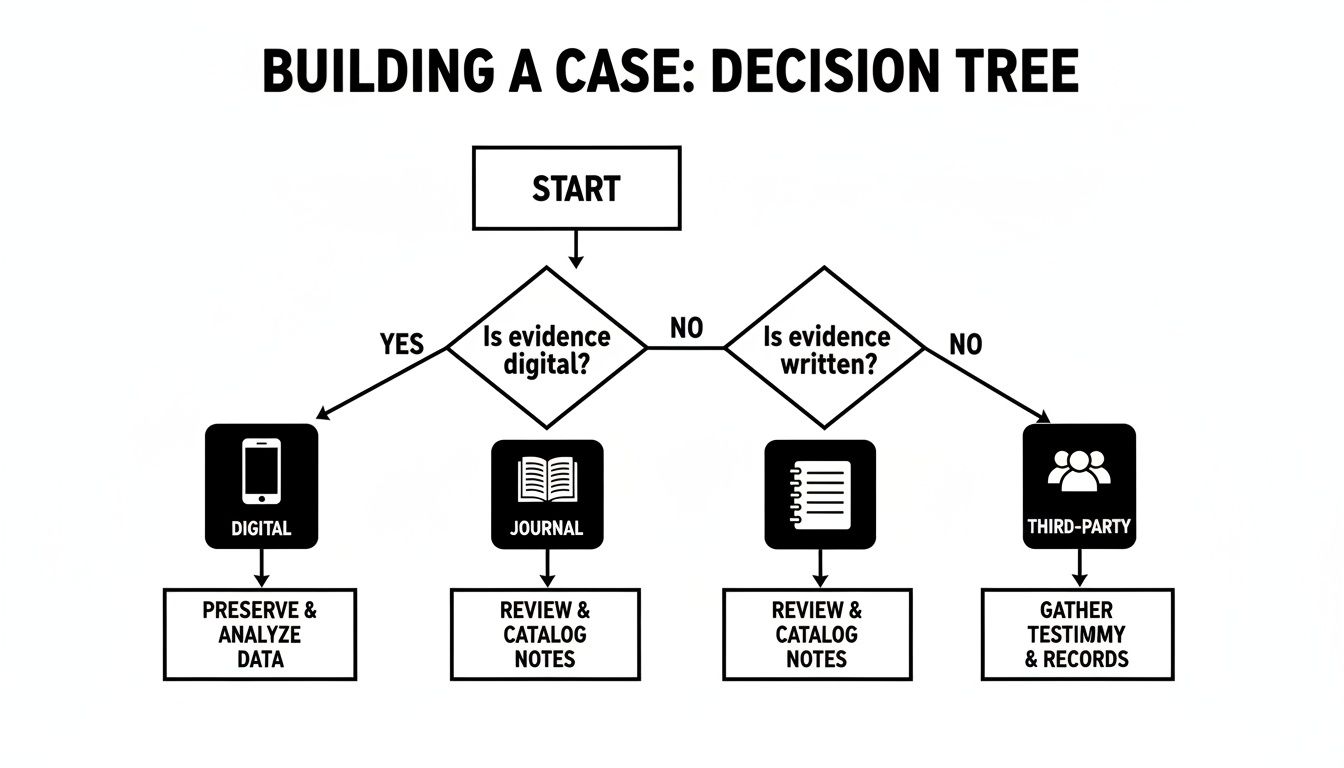
Think of building your case like constructing a three-legged stool: you need digital proof, your own detailed notes, and observations from others. By systematically gathering evidence from each category, you paint a clear, undeniable picture for the judge.
Filing a Petition to Modify Custody
Your primary legal tool is the Petition to Modify the Parent-Child Relationship. This is a formal request asking a Texas court to change your current custody order. You must prove there’s been a material and substantial change in circumstances since your last order, and a documented pattern of severe parental alienation meets this standard. Filing this petition allows a judge to step in and start fixing things. For a deeper dive, check out our guide on how to win a custody modification case.
Effectively presenting your case is also vital. Honing your skills in writing persuasive legal briefs can be a game-changer.
Court-Ordered Remedies for Alienation
Once you're in front of a judge, they have a toolkit to address parental alienation in Texas. The right tool depends on the severity of the alienation. A judge’s number one job is to act in the best interest of the child, and these remedies are designed to get the family back to a healthy place.
Common court-ordered solutions include:
- Reunification Therapy: This is a specialized therapy designed to rebuild a damaged parent-child relationship. A judge can order both parents and the child to participate.
- Appointing an Amicus Attorney: In high-conflict cases, a judge can appoint an amicus attorney. This lawyer’s only client is the child. They investigate everything and tell the court what they believe is best for the child.
- Issuing Injunctions: This is a direct order from the court forbidding the other parent from specific actions, like badmouthing you to the child or blocking your calls.
- Supervised Visitation: In extreme situations, a judge might order the alienating parent’s time with the child to be supervised by a neutral third party to ensure the child’s emotional safety.
While going to court is tough, these programs can work. One small evaluation of a Texas reunification program showed a 96.4% reconnection rate. It’s vital to have an open conversation with your attorney about the financial and emotional costs before you push for a specific remedy.
Emergency Actions and Temporary Orders
What if the damage is happening right now? In severe cases, you might be able to get a Temporary Restraining Order (TRO). A TRO is an emergency order a judge can issue quickly to stop the other parent from harmful actions like moving away or cutting off your contact. A TRO is a short-term fix, usually followed by a hearing for temporary orders that can set rules for custody and visitation while your case moves forward.
Next Steps: Protecting Your Child and Your Rights
When you're caught in the emotional storm of parental alienation, the best response is a calm, strategic one that keeps your child's well-being front and center. You can't control the other parent's actions, but you can control your own. Your consistent, loving presence is the most powerful antidote to the poison of alienation.
This journey is about protecting your rights and, more importantly, your child's future. The key is to remain a stable, reliable, and loving parent, even when things feel frustrating and deeply unfair.
An Actionable Plan
First, keep recognizing and documenting everything methodically. That detailed journal, those saved text messages, and the emails you’ve archived—they create the factual foundation your case needs. This is the evidence that shows a judge a clear pattern of behavior they can act on. If you need a refresher, check out our guide on how to prepare for custody hearing.
Second, get familiar with your legal options under the Texas Family Code. The law gives you tools, like filing a Petition to Modify your custody order or seeking court-ordered remedies like reunification therapy. You are not powerless here.
As part of your strategy, it's also wise to consider professional family therapy services, which can be incredibly helpful for everyone involved in rebuilding healthy relationships.
Key Takeaway: Your Child Needs You
Parental alienation isn't just a family problem; it's a widespread issue with devastating long-term consequences. A multi-country survey revealed that a staggering 35.5% of U.S. parents reported being targets of alienating behaviors. The lasting harm—from emotional disorders to impaired adult relationships—is precisely why Texas courts take this so seriously when deciding what's in a child's best interest. You can learn more about these research findings and what they mean for families.
Your most important job is to remain the calm in your child’s storm. Be the parent they can count on, the one who shows up, listens, and loves them unconditionally, no matter what they might say or do under the other parent’s influence.
By combining meticulous documentation with a proactive legal strategy, you can protect that sacred parent-child bond. You don't have to figure this out alone. Getting expert legal guidance can help you build a personalized plan that asserts your rights and puts your child on the path to healing.
If you need help with a child custody or visitation case in Texas, our experienced attorneys can guide you every step of the way. Contact The Law Office of Bryan Fagan, PLLC today for a free consultation.
Common Questions About Parental Alienation in Texas
When you're dealing with parental alienation, it’s natural to have a million questions. The path forward can feel uncertain, but getting clear on your rights and how Texas law works is the first step toward regaining your footing. Here are straightforward answers to some of the most pressing concerns we hear from parents.
Can You Lose Custody if Accused of Alienation?
Yes, absolutely. If a judge determines that you have intentionally sabotaged your child's relationship with the other parent, they can rule that your behavior is not in the best interest of the child. In the eyes of the Texas Family Code, this is a very serious finding.
A ruling like this can lead to major changes to your custody order. A judge has the power to:
- Drastically reduce your possession schedule (visitation time).
- Change your legal status from a Joint Managing Conservator (with decision-making rights) to a Possessory Conservator (with visitation only).
- Order that all your time with your child must be supervised to protect their emotional health.
Will a Texas Judge Order Reunification Therapy?
Yes. When alienation has fractured the parent-child bond, reunification therapy is one of the most common tools Texas courts use. It is a specialized form of counseling designed to repair the relationship in a safe, therapeutic setting. If a judge believes it's a critical step toward healing and serving the child's best interest, they can order both parents and the child to participate.
How Much Does It Cost to Fight an Alienation Case?
There’s no single price tag—the cost can vary widely. It depends on the complexity of your case, the level of conflict between you and the other parent, and whether you need to bring in expert witnesses like a child custody evaluator. A case that you can settle through mediation will cost significantly less than one that goes to a drawn-out trial. It's crucial to have a frank conversation with your attorney about the potential costs and the strategy that makes the most sense for your situation.
If you need help with a child custody or visitation case in Texas, our experienced attorneys can guide you every step of the way. Contact The Law Office of Bryan Fagan, PLLC today for a free consultation.