
When your child’s future is on the line, understanding your rights and responsibilities as a parent is the most important first step. In Texas, establishing paternity is the legal process of identifying a child’s father when the parents are not married. It's a critical step that secures a child's future and a father's rights, providing the foundation for a lifetime of support and connection.
You can accomplish this in one of two ways: voluntarily, by signing an Acknowledgment of Paternity (AOP) form—often done right at the hospital—or through a court process called a Petition to Adjudicate Parentage if you and the other parent do not agree or if there is uncertainty.
Why Establishing Paternity Is Crucial for Your Child

For a child, establishing paternity isn’t just about putting a name on a birth certificate; it’s the legal cornerstone that provides the emotional, financial, and legal security they deserve. It opens the door to a lifetime of benefits and protections every child is entitled to.
- Financial Support: This is a key benefit. It legally obligates the father to provide child support, ensuring the child's basic needs for housing, food, and care are consistently met.
- Health and Life Insurance: The child can be legally added to the father's health and life insurance policies, safeguarding their well-being.
- Inheritance Rights: A legally recognized child has the right to inherit property, assets, and other benefits from their father.
- Government Benefits: It also grants access to Social Security or veterans' benefits if the father passes away or becomes disabled.
What Paternity Means for a Father
For a father, legally establishing paternity solidifies your role and secures your rights in your child's life. Here is a hard truth: without this legal link, you may have no enforceable right to see your child or weigh in on major life decisions, no matter your biological connection.
Once paternity is established, you gain the legal standing to ask a court for conservatorship (the right to make decisions about schooling and healthcare) and a possession schedule (the legal term for visitation). This is the key to protecting your relationship and guaranteeing you can be an active, involved parent.
Many people think paternity is just about child support. It’s not. It's the legal cornerstone for a father’s rights and a child’s security. It confirms your legal status, allowing you to fully participate in your child's life.
The Two Paths to Establishing Paternity in Texas
Understanding your options is the first step toward making the best decision for your family. Texas law provides two main avenues for establishing legal fatherhood, each designed for different family situations.
- Voluntary Acknowledgment of Paternity (AOP): This is the simplest and most common route for parents who are in complete agreement about the child's biological father. It is done by signing a legal form.
- Court-Ordered Adjudication of Parentage: This is the path you'll take when parents can't agree, or when there's genuine uncertainty about parentage that might require DNA testing.
This guide will walk you through both paths, helping you understand which one makes sense for your family.
The Acknowledgment of Paternity (AOP): The Voluntary Path
For many unmarried parents in Texas, the simplest route to establishing legal fatherhood is the Acknowledgment of Paternity (AOP). Think of it as a legally binding affidavit signed when both parents are in complete agreement about who the child's biological father is. It’s a powerful, straightforward form that serves as a voluntary declaration.
This form is usually presented to parents right in the hospital, not long after the child is born. This isn’t by accident. Texas has specific hospital-based programs designed to make this crucial first step as seamless as possible for new families.
How Does the AOP Work at the Hospital?
Most hospitals in Texas have staff, often called paternity clerks, who are trained to walk you through the AOP paperwork. They'll explain the legal weight of the document, witness your signatures, and handle filing it correctly with the Texas Vital Statistics Unit.
This in-hospital process is incredibly effective. Establishing paternity early often paves the way for better legal outcomes, like faster recognition of parental rights and a quicker setup for child support.
Signing an AOP is a significant legal step. It officially makes the man the child's legal father, giving him all the rights and responsibilities that come with parenthood under the Texas Family Code. This means he has the right to ask for custody and visitation, and he also takes on the legal duty to provide financial support.
What if the Mother Is Married to Someone Else?
Texas law has a built-in assumption: a child born during a marriage is presumed to be the husband's child. This man is called the "presumed father." If the mother is married to someone who isn't the biological father, an AOP alone won't work.
In this specific scenario, you’ll need a second form: the Denial of Paternity (DOP). The presumed father—the husband—must sign the DOP, formally stating that he is not the biological father. Once the DOP is signed by the husband and the AOP is signed by the biological father and mother, the path is cleared for the biological father to be legally recognized. Without that DOP, the husband remains the legal father in the eyes of the law.
Before You Sign, Take a Moment
The AOP is designed for simplicity, but its consequences are permanent and life-altering. Both parents need to be 100% certain about the child's paternity before putting pen to paper. If there is any doubt at all, even a tiny one, do not sign the form. The much smarter move is to wait and seek a court-ordered DNA test for a definitive answer.
Signing the Acknowledgment of Paternity isn't just paperwork; it’s a lifetime commitment. It’s a wonderfully positive step when both parents are certain, but it can create a world of legal trouble if it’s signed under pressure or with lingering doubts.
Once signed and filed, the AOP carries the same legal weight as a court order. It becomes the solid legal foundation for any future court actions related to conservatorship (custody) and child support. The process gets even more intricate in unique situations, like when a father passes away before the child is born, and our firm has provided guidance on acknowledging paternity in such sensitive cases.
Comparing Paternity Methods: AOP vs. Court Order
To help you decide which path is right for your family, let's break down the two primary methods for establishing paternity in Texas. While the AOP is a great option for parents who are in complete agreement, a court order is necessary when there are disagreements or legal complexities.
| Feature | Acknowledgment of Paternity (AOP) | Court Order (Adjudication of Parentage) |
|---|---|---|
| Process | Voluntary form signed by both parents, often at the hospital. | Formal lawsuit filed with the court, known as a Petition to Adjudicate Parentage. |
| When to Use | When both parents are 100% certain and in full agreement about paternity. | When there is any doubt, disagreement, or a need for court intervention. |
| Speed | Very fast. Can be completed and filed within days of birth. | Slower process, involving court dates, discovery, and potential hearings. |
| Cost | Minimal to no cost, just filing fees. | Involves court costs, attorney fees, and potential fees for DNA testing. |
| DNA Testing | Not required. Based entirely on the parents' agreement. | The court will order genetic (DNA) testing to confirm paternity. |
| Involves a Judge? | No, it's an administrative process handled by the Vital Statistics Unit. | Yes, a judge makes the final ruling and signs a legally binding order. |
| Finality | Legally binding, but has a 60-day window to be rescinded. Very difficult to challenge after that. | Final and legally binding once the judge signs the order. |
Choosing between an AOP and a court order depends entirely on your specific circumstances. An AOP offers speed and simplicity for parents who are on the same page, while a court order provides certainty and resolves disputes through a formal legal process.
Can You Change Your Mind After Signing an AOP?
What happens if you sign the AOP and then start having second thoughts? Texas law gives you a very narrow window to reverse it. You have just 60 days from the date the AOP is filed with the Vital Statistics Unit to file a Rescission of the Acknowledgment of Paternity.
Once that 60-day clock runs out, challenging the AOP becomes extremely difficult. You would have to take the matter to court and prove that you signed the form because of fraud, duress, or a material mistake of fact. That is a very high legal bar to clear, which just highlights how important it is to be absolutely sure before you sign.
How Paternity Is Decided in Court
While the voluntary Acknowledgment of Paternity (AOP) is a wonderful tool for parents who see eye-to-eye, life isn’t always that straightforward. Sometimes, disagreements, lingering doubts, or complicated family dynamics make a simple signature impossible. When that happens, the Texas court system provides a clear, structured path forward to protect everyone’s rights—especially the child’s.
This legal process is formally known as a Petition to Adjudicate Parentage. Filing this petition means you are asking a family court judge to step in and make a final, legally binding decision about who a child’s father is. It’s the necessary next step when cooperation breaks down and you need legal certainty.
Common Reasons to Go to Court
Filing a lawsuit might sound intimidating, but it’s often the most responsible and effective way to sort out paternity disputes. The real goal isn’t to create conflict, but to achieve clarity for your child's future.
You might need to file a Petition to Adjudicate Parentage in several common scenarios:
- Disagreement on Paternity: One parent believes a certain man is the father, but he either denies it or refuses to sign the AOP.
- Genuine Uncertainty: The mother or the potential father has real doubts and wants a DNA test to confirm the biological relationship before taking on legal rights and responsibilities.
- A Non-Cooperative Parent: One parent is simply unwilling to participate in the AOP process for personal reasons, making a court order the only way to move things forward.
- Combined Legal Needs: You need to establish paternity and address child support, custody (conservatorship), and visitation (possession schedules) all at once. A court order can handle all of these issues in a single, comprehensive legal action.
This decision tree shows the two main paths for establishing paternity in Texas, depending on whether parents are in agreement.
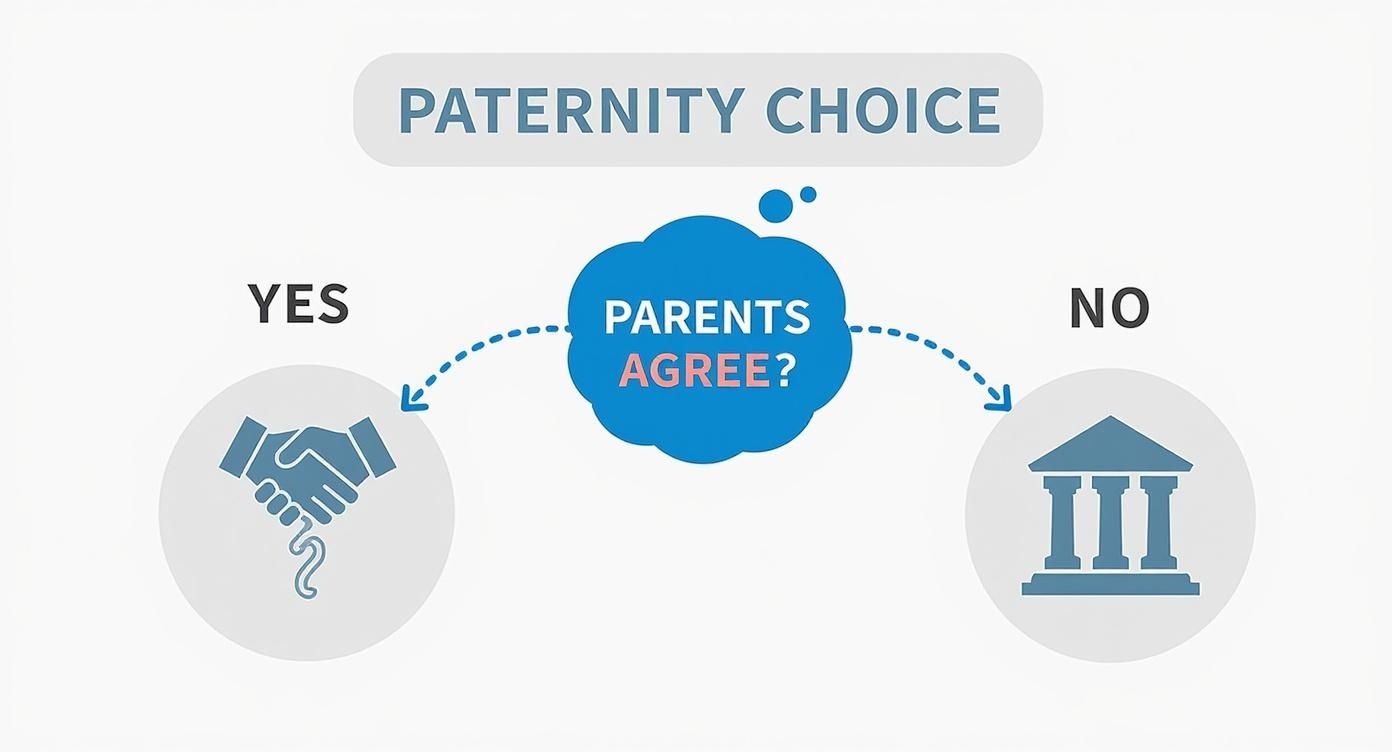
As the infographic illustrates, the path diverges significantly when parents can’t agree. That fork in the road leads directly to the courthouse to ensure a fair and definitive legal outcome for everyone involved.
What to Expect from the Court Process
Filing a Petition to Adjudicate Parentage kicks off what’s known as a Suit Affecting the Parent-Child Relationship (SAPCR). This is the standard type of family law case in Texas that deals with any and all issues involving children. While the exact steps can vary, the process generally follows a predictable path.
First, one parent (the Petitioner) files the petition with the court and has the other parent (the Respondent) formally served with the lawsuit papers. The Respondent then has a specific deadline to file a legal response, called an Answer.
From there, the court will likely order the mother, child, and alleged father to submit to genetic testing. If the test confirms paternity with 99% or greater probability, the law creates a presumption of fatherhood that is very difficult to challenge.
Once paternity is legally established, the judge can then make orders for child support, medical support, custody, and visitation. These decisions are always guided by the best interest of the child, a legal standard that prioritizes the child’s physical and emotional well-being above everything else. If you're facing this, it’s crucial to understand how to file for custody in Texas as part of the overall paternity action. The court will create a final, enforceable order that lays out the rights and duties of both parents, providing a clear roadmap for your co-parenting future.
When agreement isn't possible, the court process isn't about punishment—it's about protection. It ensures that a child’s right to support and a father's right to a relationship are legally secured based on facts, not just feelings or disagreements.
The Role of DNA Testing in Paternity Cases

When there is any question about who a child's biological father is, the emotional weight and uncertainty can be staggering. Thankfully, modern science provides a clear path forward. In Texas paternity suits, genetic testing—what we all know as a DNA test—is the gold standard for clearing up doubts and building the legal foundation your child needs.
The process is simple and painless. It usually just involves a gentle swab of the inside of the cheek for the mother, the child, and the man believed to be the father. Those samples are sent to an accredited lab, and the results are incredibly accurate.
How a DNA Test is Ordered
In a court case, either parent can ask the judge to order genetic testing, and the judge will almost always grant that request. The court’s main job is to determine the child’s parentage with complete certainty before making major decisions about their future. A DNA test replaces arguments with scientific fact, which is always in the best interest of the child.
The Texas Family Code is very specific: if a test shows a 99% or higher probability that the man is the father, it creates a legal presumption of paternity. This is incredibly powerful evidence in court and is almost impossible to argue against.
Once that presumption is in place, the burden of proof shifts, meaning the man would have to present compelling evidence to prove he is not the father—a nearly impossible task.
Key Steps in a Court-Ordered Paternity Case
| Step | What Happens | Key Consideration |
|---|---|---|
| Petition is Filed | One parent files a "Petition to Adjudicate Parentage" with the court. | This officially starts the legal process and establishes the court's jurisdiction. |
| Respondent is Served | The other parent (the respondent) is formally notified of the lawsuit. | The respondent has a specific deadline to file an answer with the court. |
| Temporary Orders | The judge may issue temporary orders for custody, visitation, and support. | This provides stability for the child while the case is ongoing. |
| Genetic Testing Ordered | The judge orders the mother, child, and alleged father to submit to DNA testing. | Refusing to comply has serious legal consequences. |
| Mediation/Settlement | Parents attempt to reach an agreement on all issues with a neutral mediator. | This is a required step in most Texas counties before you can go to a final trial. |
| Final Hearing | If no agreement is reached, a judge hears evidence and makes a final ruling. | The judge will issue a Final Order establishing paternity, custody, and support. |
What if Someone Refuses to Test?
Refusing a court order for genetic testing is a serious legal misstep with major consequences. If someone fails to show up for their scheduled test, the court has several powerful options:
- Find the person in contempt of court, which can lead to fines or even jail time.
- Enter a default judgment, meaning the judge can declare the man the legal father by default, simply because he refused to cooperate.
- Order the uncooperative party to pay the other parent's attorney's fees.
Trying to dodge a DNA test is a losing game. The court's job is to protect the child, and it won't let one person's reluctance get in the way of establishing legal parentage.
What Happens After Paternity Is Established

Successfully establishing paternity is a huge milestone, but it's really the starting line, not the finish. Once a judge signs an order officially naming the legal father, the court will then create a comprehensive parenting plan that lays out the rights and responsibilities for both parents. This isn't just a piece of paper; it's the rulebook for your co-parenting relationship, and every decision is guided by one single principle: the best interest of the child.
From Parentage to a Practical Parenting Plan
That court order translates legal status into the day-to-day realities of raising a child from two separate homes. To understand how, it helps to know a few key Texas legal terms:
- Conservatorship: This is what most people call custody. It defines each parent's legal rights and duties, like making decisions about the child’s schooling, healthcare, and religious upbringing.
- Possession and Access: This is the court’s term for the visitation schedule. It’s a detailed calendar spelling out exactly when the child will be with each parent, covering everything from regular weekends to holidays and summer break.
- Child Support: This covers the financial side of things. It ensures the child’s needs are met through monthly support payments and arrangements for health insurance.
The judge will combine all these elements into a single, enforceable order that becomes the roadmap for your co-parenting journey.
Joint Managing Conservatorship: The Texas Standard
In Texas, courts begin with the belief that having both parents actively involved is what’s best for a child. Because of this, courts almost always name parents as Joint Managing Conservators.
"Joint" doesn't automatically mean a 50/50 split of time. It means both parents share the rights and responsibilities of raising their child. Even in a joint setup, one parent is usually named the "primary" parent, who has the exclusive right to decide where the child lives and receives child support payments. The other parent is still a joint managing conservator with decision-making rights, a set visitation schedule, and the obligation to pay child support. This structure is designed to foster cooperation and keep both parents deeply involved in their child's life.
The ultimate goal of a Texas custody order is to create stability and ensure both parents remain central figures in their child's life. Joint Managing Conservatorship is the legal framework that builds that cooperative foundation, making sure you both have a say in the big decisions.
Child Support and Financial Duties
Once paternity is established, the father's legal duty to financially support his child is officially enforceable. The court will issue a child support order based on the Texas Child Support Guidelines. For one child, the guideline amount is 20% of the non-primary parent's net resources. The order will also require one or both parents to provide health and dental insurance. Payments are managed through the Texas Child Support Disbursement Unit, which processes and keeps a record of every payment. You can learn more about how this system works in our detailed guide.
Research shows a link between parental involvement, economic status, and paternity establishment, suggesting that fathers who feel financially prepared are more likely to establish paternity voluntarily.
Key Takeaways: Next Steps for Your Family
Taking the right legal steps now is what secures your child's future. Establishing paternity isn't just paperwork; it’s the first move that unlocks everything else—from financial support and health insurance to the priceless emotional security that comes from having a legally recognized parent.
- For Parents in Agreement: The Acknowledgment of Paternity (AOP) is a simple, effective tool. Be 100% certain before you sign.
- For Parents Who Disagree: The Petition to Adjudicate Parentage provides a clear, court-managed path to get definitive answers through DNA testing and establish legal rights and duties.
- Paternity is the First Step: Once paternity is established, a court will create orders for conservatorship (custody), possession schedules (visitation), and child support.
- The Child's Best Interest is Key: Every decision a Texas court makes is based on what is best for the child’s physical and emotional well-being.
- You Don't Have to Do This Alone: The legal process can be complex. An experienced family law attorney can guide you, protect your rights, and help you build a stable future for your child.
Making smart, informed decisions right now creates the stability your child needs and deserves. Whether you are a mother seeking support or a father fighting for your parental rights, getting trusted legal guidance is the best way to move forward with confidence.
If you need help with a child custody or visitation case in Texas, our experienced attorneys can guide you every step of the way. Contact The Law Office of Bryan Fagan, PLLC today for a free consultation.