Skip to content
When your child’s safety is on the line, every second counts. If you believe your child is in immediate physical or emotional danger, Texas law provides a powerful tool: an emergency custody order. This isn't for settling everyday parenting disagreements; it's a legal shield for true crises where waiting for a standard hearing would leave your child in harm's way.
That gut feeling telling you something is terribly wrong is a powerful instinct. We understand the fear and uncertainty you're facing. Turning that fear into a focused plan to protect your child is the first and most critical step.

To get a judge to intervene, you have to meet a high legal standard. You must convince the court there is a “clear and present danger” to your child’s physical health or emotional well-being. This is done by filing for a Temporary Restraining Order (TRO) with Extraordinary Relief, backed by a sworn statement—called an affidavit—that details the facts of the emergency.
What Does Imminent Harm Actually Look Like in Texas?
So, what does a court consider a genuine emergency? These are not minor parenting disputes but severe situations that threaten a child's fundamental well-being. Think of things like:
- Family Violence or Abuse: Any physical, sexual, or emotional abuse aimed at the child or happening in their presence.
- Serious Substance Abuse: A parent's drug or alcohol problem makes them incapable of providing safe and stable care for the child.
- Credible Threats of Abduction: A parent has threatened to take the child out of the state or country without permission, or has a history of doing so.
- Extreme Neglect: Failure to provide basic necessities like food, shelter, or critical medical care.
- Dangerous Environments: Exposing the child to criminal activity, hazardous living conditions, or other dangerous individuals.
Sometimes, the danger is internal. If you're worried about a child's behaviors, such as self-harm, it's critical to get help with understanding and addressing self-harm, as this can absolutely signal an immediate risk.
An emergency order creates an immediate zone of safety. It's designed to be a temporary shield, giving the court time to gather more information while ensuring the child is protected from further harm.
It's crucial to understand the difference between a real crisis and a frustrating co-parenting issue. The table below breaks down what typically justifies an emergency order versus what needs to be handled through a standard modification.
When Is an Emergency Custody Order Necessary in Texas?
| Situation Justifying Emergency Action (Imminent Harm) | Situation That Typically Does Not Qualify (Requires Standard Modification) |
|---|---|
| Physical, sexual, or emotional abuse directed at the child. | Disagreements over parenting styles or discipline methods. |
| A parent's drug or alcohol abuse that endangers the child. | Arguments about bedtimes, screen time, or diet. |
| A credible threat to abduct the child and leave the state or country. | Disputes over which parent will take the child on vacation. |
| Severe neglect, such as failing to provide food, shelter, or necessary medical care. | Disagreements over school choices or extracurricular activities. |
| Exposing the child to a dangerous individual or criminal activity. | A parent introducing a new romantic partner the other parent dislikes. |
| A parent's sudden and severe mental health crisis that makes them unable to care for the child. | General frustration with the other parent's communication or scheduling habits. |
Ultimately, the key is demonstrating that the danger is both severe and immediate. If the situation involves family violence, learning more about a Texas Emergency Protective Order can also provide critical context for your options.
Legal Grounds for Emergency Custody Orders in Texas
When you decide to file for emergency custody, you're asking a Texas judge to take immediate and drastic action to protect your child. To have any chance of success, your situation has to meet a very specific legal standard. It isn’t enough to just be worried or to disagree with the other parent's choices; you have to prove your child is facing a “clear and present danger” of physical or emotional harm.
This legal bar is set incredibly high for a reason: the court is being asked to upend a child’s life without even hearing from the other parent first. Understanding what situations actually meet this standard is the first step in building a case that convinces a judge to intervene right away.
Defining Imminent Harm Under the Texas Family Code
The Texas Family Code doesn't mince words about what counts as an emergency. A judge needs to see evidence of a situation so dangerous that waiting for a standard hearing would put the child at risk. We're not talking about minor disagreements here—we're talking about serious threats to a child's basic well-being.
In our experience, these are the most common grounds that justify an emergency order:
- Recent Substance Abuse: This isn't about a parent having a beer on the weekend. This is about drug or alcohol use that is recent, ongoing, and directly makes them unable to safely care for the child. Think a recent DUI with the child in the car, drug paraphernalia left out in the home, or a credible witness who has seen them intoxicated while on parenting duty.
- Exposure to Family Violence: A child doesn't have to be the one getting hit to be a victim of family violence. If a parent is abusive toward their new partner, you, or anyone else in the home, the chaos and trauma are considered an immediate emotional danger to the child.
- Risk of Parental Kidnapping: This is a clear-cut emergency. If a parent has made credible threats to grab the kids and run, or has a history of doing it, a judge will take that very seriously. Evidence could be anything from threatening texts to suddenly selling all their belongings, quitting their job, or pulling the child from school without warning.
- Severe Neglect or Unsafe Conditions: This covers a parent's failure to provide the absolute basics, like food, shelter, proper supervision, or essential medical care. It also includes exposing a child to a dangerous living situation, like a home with no running water, known criminals coming and going, or active drug use.
The Power of an Ex Parte Order
In these kinds of urgent situations, the court can issue what’s called an ex parte order. "Ex parte" is just a legal term for "from one party." It lets a judge grant your request based only on the evidence you provide, without the other parent being there or even knowing about it yet.
This is a powerful legal tool reserved for true crises. The goal of an ex parte order is to put an immediate shield of protection around your child until a full hearing can be set, where both parents finally get to tell their side of the story.
Because it's so one-sided, a judge will only sign off on an ex parte order if your sworn statement—your affidavit—paints a crystal-clear picture of immediate harm. That affidavit has to be packed with specific facts: dates, times, locations, and detailed descriptions of what happened. It has to leave no doubt in the judge's mind that the danger is real and it's happening now.
Under Texas Family Code §262.101, judges can issue these emergency orders if a child is at risk of abuse, neglect, or being taken. Once an order is granted, the law requires a hearing to be held within 14 days. State court statistics show that over 15,000 temporary orders are issued each year in family courts, with many starting as emergency filings like this. You can discover more insights about Texas family court statistics to get a better sense of the numbers. Just remember, this first order is only temporary. It's designed to hold things over until a more comprehensive hearing where the judge will decide what happens next.
Gathering Evidence That Proves Imminent Danger
Your word as a parent is powerful, but when you walk into a courtroom seeking emergency custody, it's compelling evidence that gets a judge to act. You can't just tell the court your child is in danger; you have to show them. This feels like a monumental task when you're already stressed and worried, but it’s really about methodically building a case that leaves no room for doubt.
This is where you shift from a state of fear to a position of strength. Vague statements like "he's unstable" or "the house is unsafe" won't cut it. A judge needs hard facts to justify an order that takes a child away from a parent, even temporarily. Your mission is to present a clear, fact-based story that demonstrates a clear and present danger.
Creating a Compelling Timeline of Events
Context is everything to a judge. While a single terrifying incident is serious, a pattern of dangerous behavior is often what truly convinces them to intervene. Start by creating a detailed timeline of events. It doesn't need to be fancy—a simple notebook or a document on your computer works perfectly.
For each incident, jot down these key details:
- The Date and Time: Be as precise as you can.
- The Location: Where did this happen?
- Who Was Present: List everyone who saw or heard what occurred.
- A Factual Description: This is crucial. Stick to what actually happened. Instead of saying "he was acting crazy," write "he was yelling, slurring his words, and punched a hole in the kitchen wall."
This timeline will become the backbone of your sworn statement (your affidavit) and is an invaluable tool for your attorney. It takes a chaotic string of events and organizes them into a logical narrative of escalating risk that a judge can easily understand and act upon.
Preserving Digital Communications
So much of our lives happens in text messages, social media DMs, and emails. These digital breadcrumbs can be some of the most powerful evidence you have, showing the other parent's state of mind in their own words.
But you have to preserve them correctly. Just having them on your phone isn't enough—phones get lost, broken, or wiped. Take screenshots of any threatening, unhinged, or incriminating messages. Make sure the screenshot captures the sender's name or number and the date and time stamp. Then, back them up immediately to a secure cloud drive or email them to yourself and your attorney.
Evidence isn't just about proving a single event. It’s about painting a picture for the judge of the toxic environment your child is trapped in. A string of harassing texts sent at 3 a.m. can demonstrate a parent's instability more effectively than hours of testimony ever could.
Gathering Official Reports and Documents
When you can bring in official documents from a neutral third party, their impact is huge. Judges see these records as objective and unbiased, which gives them significant weight. If you have any of the following, they need to be front and center in your evidence file:
- Police Reports: If you ever had to call law enforcement for a domestic disturbance, violence, or concerns about the other parent's behavior, get a copy of that report. The officer’s narrative provides an impartial account.
- CPS Records: Has Child Protective Services ever been involved? Reports from their investigations can be a goldmine of information, often containing detailed findings about a child's living conditions and safety.
- Medical Records: If your child has suffered any injuries—even bruises you thought were minor at the time—due to the other parent's actions or neglect, medical records are vital proof.
These documents are critical for showing a pattern of behavior that makes a parent unfit. If you want to dig deeper into what kind of evidence makes the biggest impact, our guide on how to prove a parent is unfit offers more strategies and real-world examples.
The Impact of Witness Statements
Sometimes, the most powerful proof comes from other people who have seen the danger with their own eyes. A sworn statement from a credible third party, called an affidavit, can be a complete game-changer. These aren't just informal letters; they are signed under penalty of perjury, which tells the court the person is serious.
Think about who has witnessed the behavior that's putting your child at risk. It could be:
- A teacher or school counselor who has noticed your child is withdrawn, anxious, or coming to school hungry.
- A grandparent or friend who has seen the other parent intoxicated while they were supposed to be watching the child.
- A therapist or doctor who can speak to the emotional trauma or physical harm your child has endured.
These individuals provide an objective voice that backs up your story. When someone is willing to put their name on a formal, sworn document, it sends a powerful message to the court about the gravity of the situation.
Steps to File for Emergency Custody in Texas
When your child is in danger, the last thing you need is a mountain of confusing legal paperwork. Filing for emergency custody in Texas can feel overwhelming, but it’s a process designed for moments exactly like this. Think of this section as your roadmap—we’ll walk you through each step so you can focus on protecting your child.
The very first legal step is filing a Petition for a Temporary Restraining Order (TRO) with Extraordinary Relief. This is the formal document that kicks off the process and tells the judge exactly what you're asking for and why. It's your official request for the court to step in and shield your child from imminent harm.
Alongside that petition, you’ll submit an affidavit, which is arguably the most important piece of the puzzle. An affidavit is simply your story, told under oath. It’s a sworn, written statement where you lay out the facts, using the timeline and evidence you’ve gathered to paint a clear picture of why your child is unsafe. A powerful affidavit is specific, factual, and leaves no room for doubt about the urgency of the situation.
The Core Documents and Their Purpose
Getting a handle on what each document does can make the process feel much more manageable. You're not just filling out forms; you're building a legal case to protect your child.
Here are the key pieces you’ll need for an emergency filing:
- Petition: This document officially starts the lawsuit. It names you as the petitioner and the other parent as the respondent, formally asking the court to intervene.
- Affidavit: This is your sworn testimony on paper. You must sign it in front of a notary. Be sure to detail every fact supporting your claim of imminent danger—include dates, times, specific actions, and any direct quotes you can remember.
- Proposed Temporary Restraining Order: You’ll also give the judge a proposed order to sign. This document spells out the specific protections you need, like ordering the other parent to stay away from the child or giving you the sole right to decide where the child lives for the time being.
Together, these documents tell the whole story. The petition opens the door, the affidavit presents your evidence, and the proposed order gives the judge a clear, immediate action to take.
To help you stay organized, here's a checklist of the essential documents and steps for a successful emergency custody filing.
Emergency Custody Filing Checklist
| Action Item | Document Needed | Key Purpose |
|---|---|---|
| Initiate the Case | Petition for a TRO with Extraordinary Relief | Formally starts the lawsuit and tells the court what you are requesting. |
| Present Your Evidence | Sworn Affidavit | Provides the detailed, factual account of the danger to your child, signed under oath. |
| Define the Protections | Proposed Temporary Restraining Order | Outlines the specific actions you want the judge to order for immediate protection. |
| File with the Court | Stamped copies from the District Clerk | Officially enters your case into the court system and assigns a case number. |
| Serve the Other Parent | Proof of Service from a process server | Legally notifies the other parent of the lawsuit and the upcoming hearing date. |
Following this checklist ensures you have all your bases covered, giving your request the best possible chance of being granted quickly.
Where and How to File Your Emergency Petition
Once your paperwork is ready, you’ll file it with the District Clerk's office in the county where your child lives or where your last custody case was handled. The clerk will stamp your documents, assign a case number, and officially log your lawsuit.
From there, your attorney will take the petition and affidavit directly to a judge for review. This is usually done ex parte, which means the other parent isn't present. The judge will read your affidavit and decide if the situation you've described meets the high legal standard of "clear and present danger." If they agree, they'll sign the TRO.
But a signed TRO isn't the final word—it's just the beginning. It grants immediate but temporary protection, usually for up to 14 days. Most importantly, it sets a court hearing within that 14-day window where both you and the other parent will appear before the judge.
The moment a judge signs your TRO, a clock starts ticking. You now have a legal order, but it has no power until the other parent is officially notified of it. This critical next step is called 'service.'
The strength of your affidavit comes from how well you organize your proof. This flowchart breaks down the simple, three-step process we recommend for gathering your evidence.
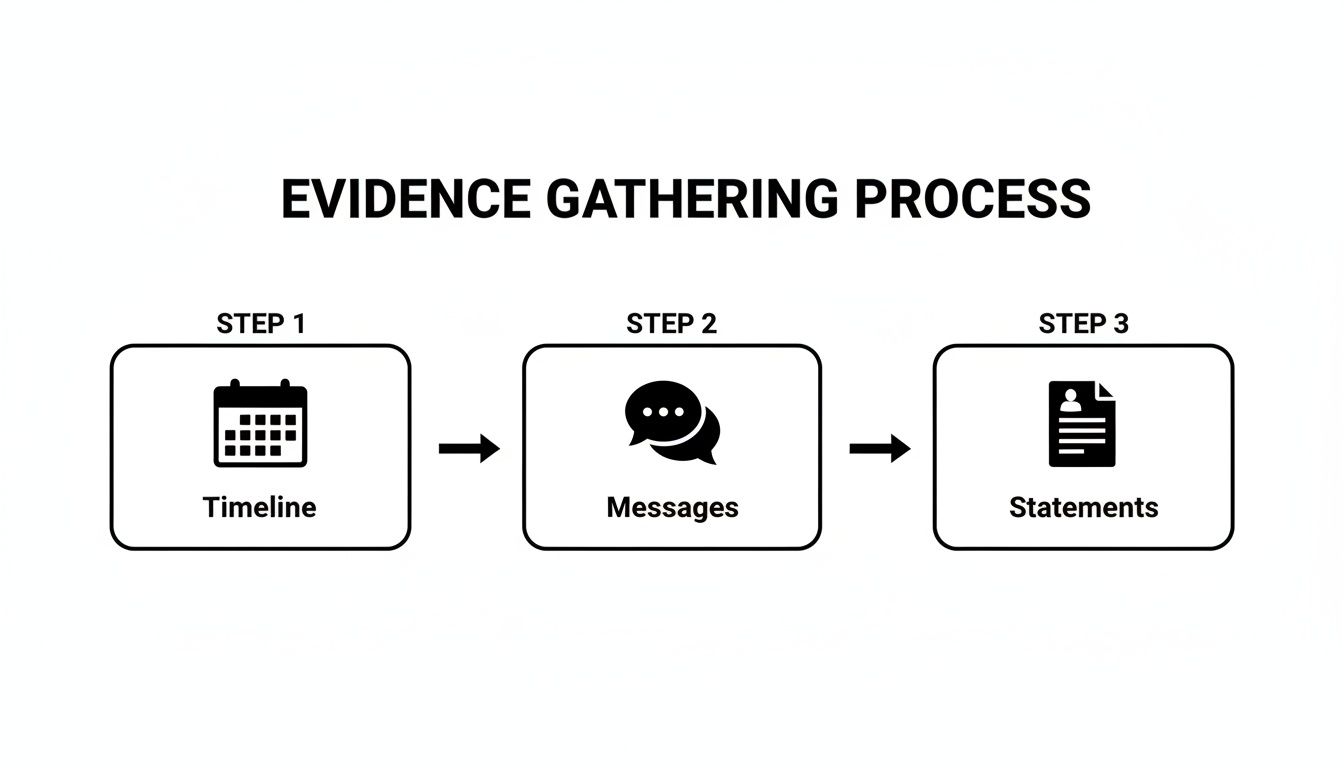
As you can see, a strong case is built by creating a clear timeline, saving direct messages, and collecting official statements or reports.
Ensuring Proper Legal Notice
For the TRO to be legally binding, the other parent must be personally served with the lawsuit papers by a constable, sheriff, or private process server. This isn't optional; it's a fundamental requirement of due process. Service guarantees the other parent is formally aware of the case, the allegations, and the hearing date. Without proper service, your case can't move forward.
When putting your legal documents together, a professional presentation matters. You can find essential fax cover letter templates for legal documents to ensure your filings are complete, which is useful if you need to send documents securely to your legal team. It can also be empowering to understand the technical side of the process, and learning how to write a court motion offers great insight into how lawyers communicate with the court.
What to Expect at Your Emergency Custody Hearing
Walking into a courtroom for your child’s emergency hearing is nerve-wracking. We've seen countless parents do it, and the anxiety is palpable. But being prepared can make all the difference, transforming that fear into confidence.
This hearing is typically scheduled within 14 days of the judge signing your initial order. It's a critical moment. The goal isn’t to decide the final, long-term custody arrangement, but to determine if the immediate protections you secured should stay in place for now.

This is the first time the judge will hear from both sides of the story. The other parent has been served, they know what you’ve alleged, and they will absolutely have their chance to respond. Your job is to remain calm, stay focused on the facts, and prove that your child is still at risk of immediate harm.
The Purpose and Structure of the Hearing
Think of this hearing as a focused check-in. The judge has already read your sworn affidavit and granted a Temporary Restraining Order (TRO) based solely on your side of the story. Now, they need to decide if those emergency measures should be converted into Temporary Orders, which will last until your case reaches a final resolution.
These hearings move fast and are very concise. The judge is going to zero in on a few key questions:
- Is there still a clear and present danger to the child?
- What evidence supports the claims of immediate harm?
- What is in the best interest of the child right now?
That last point—the "best interest of the child"—is the North Star for every Texas custody case. It means the judge’s decision will be based on one thing and one thing only: what promotes your child's physical and emotional well-being.
Presenting Your Case Effectively
Your testimony is your chance to speak directly to the judge. The key is to be clear, credible, and stick to the point. Rely on the facts you already laid out in your affidavit and resist the urge to get pulled into emotional outbursts or personal attacks on the other parent.
Let your evidence do the heavy lifting. This is where you present the police reports, text messages, photos, and any witness statements you've gathered. As you present each piece, explain what it shows and how it directly connects to the immediate danger your child is facing.
A common mistake we see parents make is getting sidetracked by old arguments or unrelated co-parenting frustrations. You have to keep your testimony laser-focused on the specific events that created this emergency. The judge needs to understand why your child is unsafe today.
For example, threats of international parental abduction are a serious concern that courts act on swiftly. In 2023, the U.S. Department of State managed 721 active international parental abduction cases, successfully returning 205 children to the United States. This data highlights just how critical timely legal action is, especially for Texas families facing these kinds of abduction risks. You can learn more about these international child abduction statistics from the State Department.
Managing Your Expectations
It's absolutely vital to understand that this hearing is not the final trial. You won't be resolving every single aspect of your custody dispute here. The judge isn't going to establish a long-term possession schedule or finalize a joint managing conservatorship arrangement at this stage.
The goal is singular: keep your child safe. If the judge agrees that the danger is real and ongoing, they will issue Temporary Orders that might include:
- Granting you the exclusive right to decide where the child lives.
- Ordering the other parent to have no contact or only supervised visitation.
- Requiring the other parent to attend counseling, drug testing, or anger management classes.
These orders are designed to create a stable, protected environment for your child while the broader issues of your custody case are worked out through mediation or further court proceedings. Preparing for this hearing with a clear head and well-organized evidence gives you the best possible chance to advocate for your child's safety and well-being.
Next Steps: From Emergency Orders to Long-Term Stability
Getting an emergency custody order is a huge first step, but it’s important to remember it's a temporary shield, not a permanent fix. You’ve successfully gotten your child out of immediate danger. Now, the real work begins: shifting the focus toward creating a safe, predictable future. That initial victory in court is the jumping-off point for formally modifying your long-term custody arrangement.
The evidence and testimony from the emergency hearing don’t just disappear; they set the stage for what comes next. The judge will start looking at how to build a more permanent structure that truly serves your child’s best interests for the long haul.
Building Your Child's New Normal
This next phase is all about turning that temporary relief into a new, stable reality. It involves creating a new possession schedule, which is just the Texas legal term for a detailed calendar that outlines when your child will be with each parent. Think of it as the blueprint for your child’s new routine. The facts you brought to light in the emergency hearing will be front and center as the court shapes this new schedule.
The court will also hammer out the final legal rights and responsibilities for each parent. The standard in Texas is a joint managing conservatorship, where both parents share the responsibility of making big decisions. But if your emergency filing proved one parent's behavior is a danger to your child, the judge has the power to limit their rights to ensure the child is protected.
You’ve already taken the brave and necessary first step. The legal process ahead is designed to convert that immediate protection into a durable, court-ordered plan that fosters your child's safety and well-being for years to come.
It's a move from crisis management to foundation-building. You're no longer just reacting—you're proactively creating the secure future your child deserves.
Key Takeaway: Your Questions Answered
When you're in a crisis, your head is probably swimming with questions. It's completely normal. Below, we've answered some of the most common concerns we hear from parents who need to act fast to keep their child safe.
How Much Does It Cost to File an Emergency Order?
This is a big one, and the honest answer is: it depends. The total cost will be a combination of court filing fees, the cost to have the other parent officially served with the lawsuit, and attorney fees. We can give you a much clearer estimate once we talk and understand your specific situation. If you're worried about the court fees, you may be able to file a ‘Statement of Inability to Afford Payment of Court Costs’, which asks the judge to waive those expenses.
How Long Does an Emergency Custody Order Last?
The first order you’ll likely get is a Temporary Restraining Order (TRO). Think of it as an immediate, short-term fix. It’s typically only good for 14 days. The main job of that TRO is to put protections in place right now and get a court hearing scheduled within that two-week window. At that hearing, the judge will hear from both you and the other parent and will likely issue new temporary orders that stay in place until your case is fully resolved.
Can I File for Emergency Custody if I Don't Have a Court Order Yet?
Yes, absolutely. This is a very common scenario. If you don't have an existing custody order, you'll file an original custody lawsuit—what Texas law calls a Suit Affecting the Parent-Child Relationship (SAPCR)—and include your request for emergency orders right along with it. This approach lets you tackle both the immediate crisis and the long-term custody plan in a single, streamlined legal action.
What Happens if the Judge Denies My Initial Request?
Don't panic. If a judge denies your ex parte request (the one you file without the other parent present), it doesn't mean your case is weak or that you've lost. It simply means the judge wasn't convinced there was enough evidence to take action without hearing from the other parent first. Your case will then move forward to a standard temporary orders hearing where both of you will have the chance to present your side of the story. A judge denying your initial ex parte request isn't the end of the road. It just means they want to hear both sides of the story before making a decision. Your case is far from over.
If you need help with a child custody or visitation case in Texas, our experienced attorneys can guide you every step of the way. Contact The Law Office of Bryan Fagan, PLLC today for a free consultation.