
When your family’s safety is on the line, every second counts. A Texas Emergency Protective Order (EPO) is a critical legal tool designed to provide immediate protection from assault, stalking, or harassment. It's an urgent court order that can be put in place fast to create a safe distance between you and the person causing harm, giving you the breathing room you need to protect your children and plan your next steps.
Understanding Your First Line of Defense

Feeling overwhelmed and scared is completely normal when your family’s safety is at risk. The legal system can seem intimidating, but you have powerful options available to protect your children and yourself. A Texas emergency protective order, often called a Magistrate's Order of Emergency Protection (MOEP), is a civil court order issued by a judge that sets clear, legally enforceable boundaries.
This order is typically requested by law enforcement right after an arrest for an offense involving family violence. Its main purpose is to act as a shield, giving you and your family a crucial "cooling-off" period. It provides the space and peace of mind you need to plan your next steps without the fear of immediate harm.
Comparing Your Legal Safety Options
Navigating legal protections can be confusing, especially when you're under stress. It helps to understand the key differences between the types of orders available in Texas. Think of them as escalating levels of protection, each one serving a distinct purpose on your path toward long-term safety.
Types of Protective Orders in Texas at a Glance
Here’s a quick breakdown to help you see how these orders fit together. While an EPO is the fastest, it's often the first step toward more lasting solutions.
| Order Type | Who Issues It | How Long It Lasts | Typical Scenario |
|---|---|---|---|
| Emergency Protective Order (EPO/MOEP) | A Magistrate Judge (usually after an arrest) | 31-91 days | An immediate response after a family violence arrest to ensure the victim's safety. |
| Temporary Ex Parte Order | A Civil Court Judge | Up to 20 days | The first step in a civil lawsuit for a protective order, issued without the other party present. |
| Final Protective Order | A Civil Court Judge | Up to 2 years (or longer) | The result of a court hearing where both sides present evidence, providing long-term protection. |
Each order builds on the last, offering a structured legal path from immediate crisis intervention to sustained security for your family.
The Role and Reach of Protective Orders in Texas
These orders are not rare; they are a vital and frequently used part of the justice system designed to shield families. The sheer number of orders issued highlights just how pressing the need for these protections is across the state.
From 2021 to 2023, Texas courts issued an estimated 162,497 protective orders. In Fiscal Year 2021 alone, emergency orders made up a staggering 71% of all reported protective orders, showing just how critical they are as a first response in urgent situations.
Major cities like Harris County see intense demand, issuing over 39,270 of these emergency orders during that period—representing 32% of the statewide total.
A protective order does more than just create physical distance; it sends a clear message that threats and violence will not be tolerated. It is your legal right to feel safe in your own home and to ensure your children grow up in a peaceful environment.
Securing Your Broader Safety Plan
While a legal order is a powerful tool, it's just one part of a larger safety strategy. Once you have an EPO in place, it’s smart to think about other security measures.
For instance, if you're worried about the restrained person showing up at your job, exploring a dedicated workplace violence prevention plan could be a critical next step. Taking a proactive approach to all areas of your life reinforces the protections the court has granted and helps you regain a sense of control. This is about building layers of security for you and your children.
When You Can Request an Emergency Protective Order
When you’re worried about your child's immediate safety, knowing when and how to act can feel completely overwhelming. A Texas emergency protective order (EPO) isn't just for worst-case scenarios; it’s a powerful legal shield available when specific, credible threats arise. Understanding if your situation qualifies is the very first step toward getting your family the protection it needs.
An EPO is most often triggered by an act of family violence. That term has a specific legal definition in the Texas Family Code, and it’s much broader than just physical assault. It includes any act meant to cause physical harm, injury, or sexual assault, and importantly, a credible threat that puts a family member in genuine fear of those things.
This means you don't have to wait for someone to actually lay a hand on you to seek help. The law recognizes that fear and intimidation are legitimate forms of harm.
Defining Family Violence in Real-Life Terms
So, what does "family violence" actually look like for parents trying to navigate a tense situation? It can show up in many ways, and a judge will always look at the entire context of your relationship.
Here are a few practical scenarios that often meet the legal threshold for an emergency protective order:
- Violent Outbursts: A parent physically shoves, hits, or restrains the other during a heated argument, especially during a custody exchange.
- Credible Threats: You get text messages or voicemails with specific threats of harm, like, "If you don't let me see the kids, you're going to regret it."
- Stalking Behavior: The other parent repeatedly shows up uninvited at your home, your workplace, or your child's school, causing you to fear for your safety.
- Property Destruction: In a fit of rage, a parent destroys your personal belongings or punches a hole in the wall in front of you or the children.
Understanding the dynamics of these situations, like recognizing signs of narcissistic abuse, can help you connect the dots and see if the behavior you're experiencing is part of a larger pattern of control that warrants legal intervention.
The Critical Role of Law Enforcement
In many cases, the path to an EPO starts with a call to the police. When law enforcement responds to a family violence call and makes an arrest, the system is designed to act quickly to protect the victim.
After an arrest for an offense involving family violence, stalking, or certain sexual offenses, the police or the prosecutor can request an EPO directly from a magistrate judge on your behalf. This is the most common way these orders are issued.
This process is nearly automatic after a family violence arrest in Texas. The magistrate can issue the order right then and there—often before the arrested person is even released on bond. The goal is to ensure a protective shield is in place before there’s any chance for retaliation.
The sharp rise in family violence incidents underscores just how critical these immediate protections are. Texas saw 254,339 reported family violence offenses in 2022, a significant jump from prior years, with assaults making up over 93% of these cases. These stark numbers, detailed in the TCFV 2022 Honoring Texas Victims Report, highlight why an immediate EPO is so vital for shielding parents and children from further harm.
What if There Hasn't Been an Arrest?
You still have options. If family violence has occurred but for whatever reason no arrest was made, you can file a civil lawsuit to request what’s called a Temporary Ex Parte Protective Order. It serves a very similar immediate purpose.
This is a crucial point for parents who may be dealing with threats or stalking that haven't escalated to police action yet. An experienced family law attorney can guide you through filing the necessary paperwork and presenting your case to a judge. This is often an essential step when also seeking an emergency custody order in Texas to protect your child.
Navigating the Process of Getting an EPO
When your family’s safety is on the line, knowing exactly what to do next can bring a sense of control to an otherwise chaotic situation. The path to getting a Texas emergency protective order can feel intimidating, but it’s a structured process designed for swift protection. Let's walk through it together, step-by-step, to make the legal side of things feel more manageable.
Often, the most direct way to get an EPO is through law enforcement. When police respond to a family violence call and make an arrest, they can ask a magistrate judge for an EPO on your behalf. This is a powerful, immediate move that happens fast—sometimes before the abuser is even released on bond. The whole point is to put a legal shield in place right away.
This flowchart shows the common reasons people seek a Texas emergency protective order.
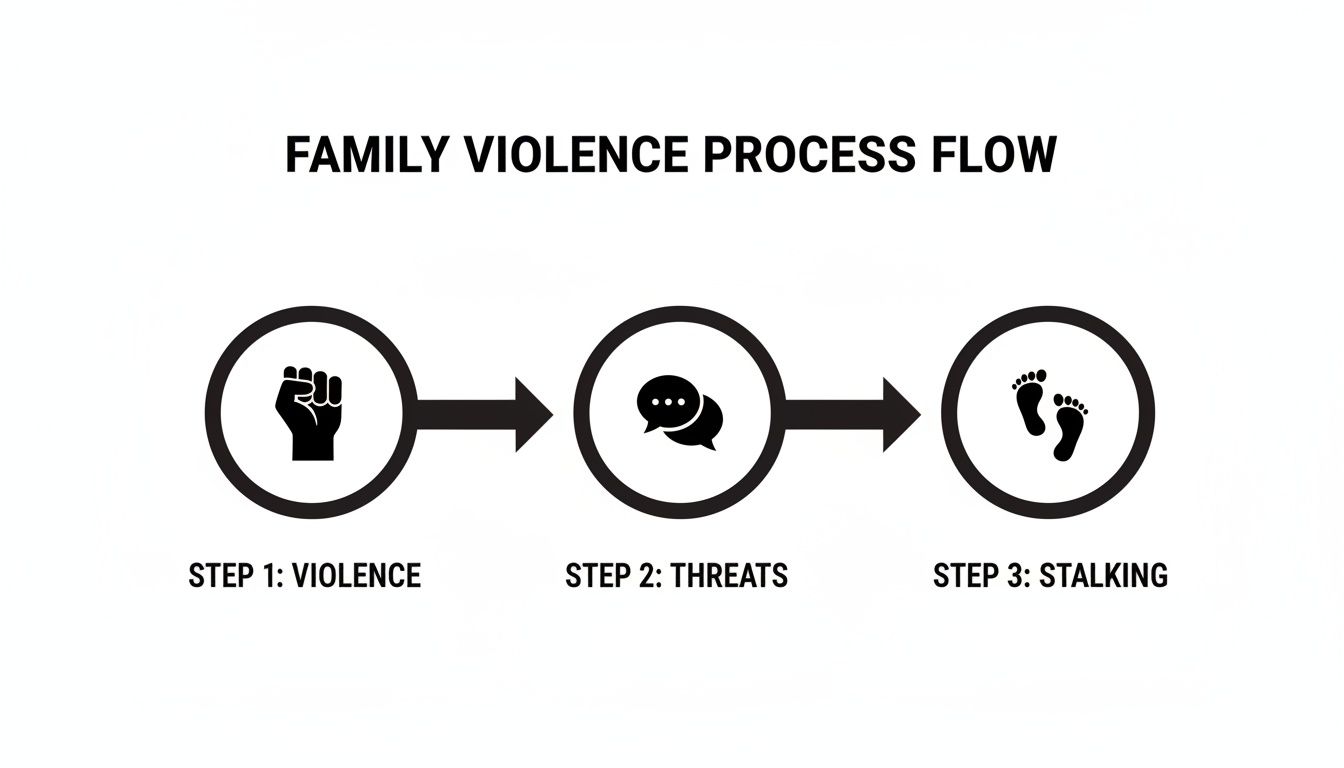
As you can see, family violence isn't always a single event. It can be a pattern of behavior, from physical assault to threats and stalking. All of these are valid grounds for an order.
Taking Action When No Arrest is Made
What happens if the police came but didn't arrest anyone? Or what if the threats have been more subtle, like relentless stalking or menacing text messages? You still have a powerful legal option. In these cases, you can proactively file for a Temporary Ex Parte Protective Order in civil court.
This involves you, as the applicant, filing a sworn application with the court. The term "ex parte" just means the judge hears your side of the story first, without the other person present, to decide if there’s a clear and present danger of family violence. If the judge agrees, they’ll issue a temporary order to protect you and your kids until a full hearing can be scheduled.
Building Your Case with a Sworn Affidavit
The heart of your application is your sworn affidavit. This is your formal, written testimony to the court, and it needs to be clear, detailed, and persuasive. Think of it less as a form and more as your opportunity to tell your story in a way that shows the immediate need for protection.
Your affidavit should paint a clear picture. Include:
- Specific Dates and Times: Detail every incident of violence, threats, or stalking you can remember.
- Direct Quotes: If you got threatening texts or emails, quote them word-for-word.
- Descriptions of Harm: Describe any physical injuries, but also the emotional distress or fear you felt.
- Witness Information: If anyone else saw or heard what happened, include their names.
Writing this document can be emotionally draining, but its importance can't be overstated. For more advice on how to structure a legal document like this, our guide on how to write a court motion offers tips on clarity and focus that apply here, too.
Gathering Your Evidence for the Hearing
While your affidavit is vital, solid evidence makes your case even stronger. Judges need to see tangible proof of the danger you're in. Start collecting anything you have that helps tell the full story.
Think about what you can gather:
- Photographs: Pictures of injuries, damaged property, or even the other person showing up where they shouldn’t be.
- Digital Communication: Screenshots of text messages, emails, or social media messages that contain threats or harassment.
- Police Reports: If you've called the police before, even without an arrest, get copies of those reports.
- Witness Statements: A written statement from a friend, neighbor, or family member who witnessed the abuse or saw the aftermath can be incredibly persuasive.
The judge in an ex parte hearing is looking for credible evidence of a clear and present danger. Your job is to provide a detailed, honest account backed by as much proof as possible to show why immediate protection is necessary for your family.
This initial hearing is usually quick and to the point. The judge will review your application, affidavit, and any evidence you’ve brought. If they find that family violence has occurred and is likely to happen again, they will grant the temporary order. This order provides immediate relief and sets a date for a full hearing, typically within 20 days, where the other person will have a chance to respond.
Understanding What an EPO Can and Cannot Do
When you’re in the middle of a family crisis, a Texas emergency protective order (EPO) feels like a lifeline. It's an incredibly powerful legal tool, but knowing its specific powers—and just as importantly, its limitations—is key to using it effectively as part of a larger safety plan for you and your kids.
Think of an EPO as the first critical step in building a wall of protection, not the final solution. It creates immediate, legally enforceable rules designed to stop further family violence by setting clear boundaries. These aren't just suggestions; they are direct court orders with serious consequences if violated.
Protections an EPO Can Provide
A judge issuing an EPO has one primary goal: to keep you and your family safe. They can impose several strict conditions to stop harmful behaviors and create the physical and emotional distance you need to breathe again.
Some of the most common protections a judge can order include:
- No More Violence: The core of the order is a command not to commit any future acts of family violence. This includes threats, harassment, and any intimidating behavior toward you or your family members.
- Cutting Off Communication: The judge can completely ban all forms of contact—that means no calls, texts, emails, or even messages through social media. This prohibition often extends to communicating through friends or family members.
- Creating Stay-Away Zones: The EPO will almost always forbid the abuser from coming within a certain distance of specific locations, such as your home, your workplace, and your children's school or daycare.
- Firearm Restrictions: Under Texas law, a person subject to an emergency protective order is legally prohibited from possessing a firearm. This isn't optional; it's a mandatory safety measure.
These conditions are tailored to your specific situation to create a "cooling-off" period, giving you the space to plan your next moves without being in constant fear.
How an EPO Impacts Child Custody
For parents, the biggest question is always, "What about the kids?" This is where an EPO becomes a vital tool in a child custody case, as it can directly and immediately impact who has the children and when.
A judge can use the order to:
- Grant You Temporary Possession: An EPO can give you the exclusive, temporary right to decide where the children live. In legal terms, this can establish you as the temporary conservator, putting you in charge of their day-to-day care and safety.
- Set a Safe Possession Schedule: The order can suspend the other parent's regular visitation entirely or, if appropriate, set up a highly structured and safe plan for them to see the children, like requiring supervised visits. The child's best interest is always the court's top priority.
This immediate action not only protects your children but can also set a precedent for future custody arrangements as your case progresses. It's a powerful first step in showing the court what's needed for a stable and safe environment.
What an EPO Cannot Do
It's just as important to have realistic expectations and understand what an EPO is not designed to accomplish. An EPO is a temporary shield, not a final resolution to your family law case.
An EPO is designed for immediate safety, not for long-term legal changes. It's a critical emergency response, but it won't resolve the underlying family law matters permanently.
Here’s a look at some things a Texas emergency protective order can't do on its own:
Powers and Limitations of a Texas EPO
This table gives a quick overview of what an EPO can and cannot legally accomplish. It's a tool for immediate safety, but the bigger issues require a separate family law case.
| What an EPO Can Do | What an EPO Cannot Do |
|---|---|
| Prohibit further violence, threats, or harassment. | Finalize a divorce or legally end a marriage. |
| Restrict all communication with the protected person. | Permanently divide community property or debts. |
| Order the abuser to stay away from specific locations. | Establish a permanent child support order. |
| Prohibit the possession of firearms. | Create a final, permanent child custody order (like a joint managing conservatorship). |
| Temporarily grant one parent exclusive possession of the children. | Resolve long-term legal issues that belong in a divorce or custody lawsuit. |
| Set a temporary, safe visitation schedule (like supervised visits). | Serve as a substitute for a full civil lawsuit. |
These bigger issues—divorce, property division, and permanent custody—must be handled through a separate divorce or child custody lawsuit. However, the evidence presented and the findings from your EPO hearing can significantly influence how those future proceedings unfold.
For more on how temporary orders function in civil family law cases, you can read our guide on the Texas temporary restraining order, which serves a similar but distinct purpose.
Your Next Steps After the Order is Issued
Getting a Texas emergency protective order granted can feel like the first deep breath you’ve taken in a long time. That signed paper from the court brings an overwhelming sense of relief. But it's important to remember that this order is the first step, not the final destination. Knowing what comes next is key to turning this immediate protection into a long-term plan for your family's safety.

The first thing to know is your order is effective the moment the magistrate signs it. It’s legally binding right away. From there, law enforcement takes over. A sheriff's deputy or constable will formally "serve" the restrained person with a copy of the order, making sure they understand every single rule and the serious legal consequences if they choose to violate them. You don't have to handle this part; the system is set up to do it for you.
How Your Order Becomes Enforceable Everywhere
Once the order is served, it gets entered into the Texas Crime Information Center (TCIC) database. Think of this as a statewide system that every law enforcement officer in Texas can access instantly. It means if you're in a different county and have to call 911 because of a violation, the responding officer can pull up your order and see its exact conditions on the spot.
This system got a major upgrade with the passage of "Monica’s Law" in 2019, leading to the creation of a centralized public database. The launch of Texas's Protective Order Registry in September 2020 was a game-changer for sharing this critical safety information. Courts are now required to report new orders within 24 hours, and the registry has grown to over 40,000 entries. This change closed dangerous information gaps and gives police immediate, life-saving access to your order's details. You can find more insights on this vital registry at the Texas District & County Attorneys Association website.
What to Do if the Order is Violated
Even with a court order, a violation is a very real possibility. Your safety plan needs a clear, rehearsed answer to the question: "What do I do if they break the rules?" In Texas, violating an emergency protective order is a Class A Misdemeanor, a criminal offense that can lead to jail time and hefty fines.
If a violation happens, your response needs to be quick and decisive:
- Call 911 Immediately: Don't second-guess yourself. If the person shows up, calls you, texts you, or breaks the order in any other way, call the police. Tell the dispatcher you have an active protective order and what just happened.
- Document Everything: Keep a detailed log of every single violation. Note the date, time, location, what happened, and if anyone else saw it. Save screenshots of texts, emails, and call logs. This evidence is gold for the criminal case and your future family law case.
- Inform Your Attorney: As soon as you are safe, contact your family law attorney. They need to know about every violation to advise you on your next legal moves and how this behavior will impact your long-term custody strategy.
Your safety is the absolute priority. Do not engage with the person violating the order. Your job is to call law enforcement, report the violation, and preserve the proof. Let the police handle the rest.
Transitioning from Emergency Relief to Long-Term Security
An EPO is a temporary shield. It typically lasts between 31 and 91 days, giving you critical breathing room to plan your next steps. It is not a permanent fix. The most important legal step you'll take next is to transition this temporary protection into a Final Protective Order.
A Final Protective Order can last for up to two years—and in some cases, even longer. Getting one is a different process than the EPO. It requires a full court hearing where both sides can present evidence and testify. This is where all the evidence you’ve been gathering—police reports, photos, text messages, and your log of any violations—becomes absolutely essential.
An experienced family law attorney is your biggest asset here. We can help you file the correct application, organize your evidence into a compelling story for the judge, and frame your case around the best interests of the child. The goal is to build on the safety the EPO provided to create a stable, predictable future for your family with a clear, long-term possession schedule and rules that protect your peace of mind.
Common Questions About Texas Protective Orders
When you’re trying to protect your family, the questions and what-ifs can feel overwhelming. Getting clear, straightforward answers is the first step toward taking back control. We’ve tackled some of the most common concerns we hear from parents dealing with Texas emergency protective orders to give you the clarity you need to move forward.
How Much Does It Cost to Get a Protective Order?
Let’s get this one out of the way first: in Texas, your safety isn't something you have to pay for. There are absolutely no filing fees or service costs for someone applying for a protective order. The law makes sure that financial worries will never be a barrier to getting the protection you need. It’s a fundamental right.
Now, while you aren't legally required to hire an attorney, trying to navigate this process alone can be incredibly difficult. An experienced family law attorney does a lot more than just fill out paperwork. We build a compelling case, make sure the order includes every necessary protection for your children, and tie it directly into your long-term custody goals.
Can a Man Get a Protective Order Against a Woman?
Yes, absolutely. Texas law is gender-neutral and designed to protect all victims of family violence. The court’s focus is entirely on the actions that took place—whether there was violence, a credible threat, or stalking—not on who did what to whom.
Fathers, husbands, and male partners have the exact same right to seek and obtain an emergency protective order as anyone else. If you are a man experiencing family violence, the law is here to protect you and your children just the same.
What Happens if My Child is Listed on the Order?
Including your child as a protected person on the order is one of the most critical steps you can take for their safety. As soon as a child is named, all the protective conditions of the order extend directly to them.
This means the restrained person is legally forbidden from:
- Committing violence or making threats against the child.
- Coming within a certain distance of the child's school, daycare, or your home.
- Communicating with the child, either directly or through someone else.
Just as importantly, the order will often name you as the temporary managing conservator. This gives you the sole legal authority to make immediate decisions for your child’s welfare and establishes a safe possession schedule. Depending on the situation, this could mean supervised visitation or no contact at all. It's a powerful tool for ensuring your child's physical and emotional well-being during a crisis.
Will an EPO Show Up on a Background Check?
Yes, it will. An active Emergency Protective Order is a public court record. It gets entered into the statewide Texas Crime Information Center (TCIC) database, making it immediately accessible to all law enforcement officers. It will almost certainly appear on any comprehensive background check.
For the person named as the abuser, this comes with serious consequences, including the temporary loss of their right to legally own a firearm. This is exactly why having strong evidence and skilled legal representation is crucial—whether you're the one seeking protection or the one defending against an order.
The public nature of the order is part of what makes it so effective, but it also highlights just how serious these proceedings are.
If you need help with a child custody or visitation case in Texas, our experienced attorneys can guide you every step of the way. Contact The Law Office of Bryan Fagan, PLLC today for a free consultation.