
When your child’s future is on the line, understanding your rights is the first step toward peace of mind. The thought of starting the child support process can feel overwhelming, but it's a structured path designed to protect your child's right to financial stability. Whether you're a mom, dad, or grandparent stepping in, Texas law gives you a clear way forward.
Securing child support is about so much more than just covering daily bills. It’s about making sure every part of your child's life is provided for, including:
- A stable and safe home
- Consistent access to healthcare and dental coverage
- School supplies, extracurriculars, and other educational needs
- Nutritious food and proper clothing
Here's an important point many parents don't realize: in Texas, child support is a legal right that belongs to the child, not the parent. The entire system is built around a single guiding principle: the “best interests of the child.” This means every decision a judge makes—from custody to financial support—has to prioritize what’s best for that child’s emotional and physical well-being.
That’s why a handshake deal or a verbal agreement for support just won’t cut it. They are completely unenforceable and leave you with zero protection if the payments suddenly stop. A formal court order is the only way to make child support a legal, binding obligation.
If you’re not sure where to start, you’re not alone. According to the U.S. Census Bureau, around 21.9 million children have a parent living somewhere else, but only about half of custodial parents have a legal child support agreement in place. This formal system is a powerful resource that too many families don't use.
So, how does it actually work? This chart breaks down the three foundational stages of getting a child support order in Texas.
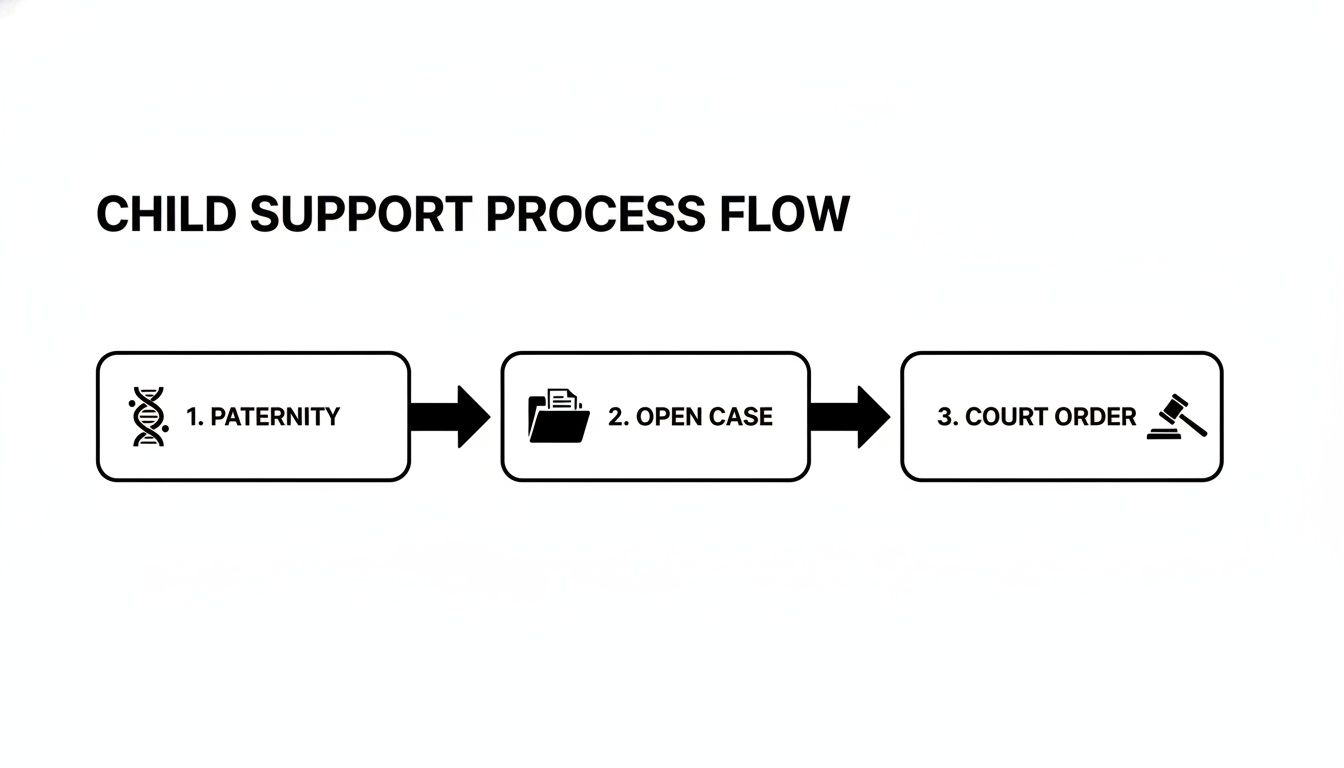
As you can see, each step builds on the one before it, creating a solid legal foundation that makes your child support case enforceable and secure for the long haul.
Your Initial Roadmap to Texas Child Support
Before you dive deep into the legal filings, it helps to have a clear picture of your first few moves. Think of this table as your starting checklist—the essential actions that get the ball rolling and set your case up for success.
| Action Item | Why It's Important | Where to Start |
|---|---|---|
| Establish Paternity | This is the non-negotiable legal foundation. Without it, you can't get a court order for support. | If parents were unmarried, an Acknowledgement of Paternity (AOP) form or a court-ordered DNA test is needed. |
| Gather Financial Documents | You'll need proof of income (for both parents) and a list of your child's expenses to calculate support correctly. | Collect pay stubs, tax returns, and receipts for healthcare, daycare, and other major child-related costs. |
| Open a Case | You must formally start a legal case to get a court order. You can't enforce a verbal promise. | You can file a "Suit Affecting the Parent-Child Relationship" (SAPCR) at your local courthouse or apply for services through the Office of the Attorney General. |
Getting these initial steps right is crucial. They provide the court with the information it needs to issue an order that is fair, accurate, and, most importantly, serves the best interests of your child.
Step 1: Establishing Paternity
Before a single dollar of child support can be ordered in Texas, the court has to answer one fundamental question: who is the child’s legal father? This isn’t just a piece of paperwork; it’s the legal foundation for everything that comes next. The process is called establishing paternity, and it’s the non-negotiable first step to securing financial support for your child.

If the parents were married, Texas law automatically presumes the husband is the father. But for unmarried parents, that legal link has to be intentionally created. It’s a profound action that benefits everyone involved, not just the parent seeking support.
For the child, establishing paternity opens the door to inheriting from their father, accessing crucial family medical history, and qualifying for benefits like Social Security. For a father, it solidifies his legal right to build a relationship with his child, including the ability to ask the court for custody and a possession schedule (what most people call visitation).
Two Paths to Establishing Legal Fatherhood
In Texas, you generally have two ways to legally establish who a child's father is. The route you take usually comes down to whether both parents are on the same page.
- Voluntary Acknowledgment of Paternity (AOP): This is the simplest path forward. The AOP is a legal form that unmarried parents can sign—often at the hospital right after the baby is born—to voluntarily name the biological father. Once it's filed with the Texas Vital Statistics Unit, it carries the full weight of a court order.
- Court Order: If there's any doubt about who the father is, or if one parent simply won't cooperate, either parent can file a lawsuit known as a Suit to Adjudicate Parentage. This formal court process legally determines the child's father once and for all.
While signing an AOP is straightforward, it’s a powerful legal document with lasting consequences. It's absolutely critical that both parents are 100% certain of the child's paternity before putting pen to paper.
The decision to sign an Acknowledgment of Paternity should never be taken lightly. Once signed and filed, you have a very limited time to rescind it. After that window closes, it becomes incredibly difficult—and sometimes impossible—to challenge, even if DNA testing later proves otherwise.
What Happens When Paternity Is Disputed
Life isn't always neat and tidy. It’s common for questions or disagreements to pop up about who a child’s father is, and the Texas Family Code has a clear roadmap for these situations.
If a mother files a suit to establish paternity and the alleged father denies it—or if a man files and the mother disputes his claim—the court can order genetic testing. You probably know it as a DNA test. In fact, judges almost always order one when paternity is in question.
The process itself is quick and painless, usually just a simple cheek swab. If the alleged father refuses to show up for court-ordered testing, the judge doesn't just throw up their hands. They can hold him in contempt of court or even issue a default judgment naming him as the legal father. The court's number one goal here is to get a clear answer for the child.
Once the DNA results are back and paternity is confirmed, the court will issue a final order establishing parentage. This order is the key that unlocks the door to everything else: child support, medical support, custody arrangements (called joint managing conservatorship in Texas), and visitation rights. To see how this process works from start to finish, you can learn more about how to establish paternity in Texas in our detailed guide. It’s the one step that makes all the others possible.
Step 2: How Texas Calculates Child Support Payments

Once paternity is established, the next question on every parent’s mind is, “So, how much is child support going to be?” Luckily, Texas doesn’t leave this to guesswork or courtroom drama. The state uses a clear, percentage-based formula to keep calculations consistent and predictable for families across the state.
This whole process is designed to be fair, focusing on what the child needs and what the paying parent can reasonably contribute. The court starts by identifying which parent will be making the payments—known in legal terms as the obligor. This is almost always the parent who the child doesn't primarily live with (the non-primary parent).
Understanding Net Monthly Resources
The entire Texas child support calculation comes down to one key figure: the obligor's net monthly resources. This is a lot more than just their take-home pay from a single job. The Texas Family Code defines "resources" very broadly to get a full and accurate financial picture.
This includes just about all income and benefits flowing to that parent, such as:
- Wages, salary, commissions, bonuses, and overtime pay
- Income from self-employment or a business
- Money earned from rental properties
- Retirement benefits, pensions, and Social Security
- Unemployment and disability benefits
- Even gifts, prizes, and alimony received
To get from gross resources to net resources, the court subtracts a few specific things. These include federal income taxes (calculated for a single person claiming one exemption), Social Security taxes, Medicare taxes, and the amount the parent pays for the child's health insurance premiums. Whatever is left over is the net monthly resource figure used in the final calculation.
It's important to know that as of 2023, the law applies the standard percentages to net monthly resources up to $9,200. If the obligor earns more than this cap, a judge has the discretion to order additional support, but only if the child’s proven needs justify a higher amount.
The Guideline Percentage Formula
After the court lands on that final net monthly resource number, it applies a standard percentage. This percentage is based on how many children are involved in the current case. It’s a straightforward approach that provides a solid baseline for support orders.
Here is the standard breakdown a Texas court will use:
Texas Standard Child Support Guideline Percentages
| Number of Children | Percentage of Net Resources |
|---|---|
| 1 Child | 20% |
| 2 Children | 25% |
| 3 Children | 30% |
| 4 Children | 35% |
| 5 Children | 40% |
| 6+ Children | Not less than 40% |
So, what does this look like in the real world? If an obligor has one child before the court and their net monthly resources are $4,000, the guideline child support would be $800 per month ($4,000 x 20%). In the eyes of the court, this amount is presumed to be in the "best interest of the child."
Handling Real-World Complexities
While the formula itself is simple, family finances rarely are. The Texas Family Code is written to account for several common scenarios that can make the math a bit more complicated.
What if the paying parent has other kids?
If the obligor is legally responsible for supporting other children from a different relationship, the percentages are adjusted downward. This is done to ensure all of their children are treated fairly. An attorney can help calculate the specific credits that apply in these situations.
What about self-employed parents?
For business owners, freelancers, or independent contractors, figuring out net resources can get tricky. A court will scrutinize business income and expenses to make sure personal bills aren't being hidden as business deductions to artificially lower their reported income.
What if a parent is intentionally unemployed?
A judge won't let a parent dodge their financial duty by quitting their job or choosing to take a much lower-paying one. In cases of intentional unemployment or underemployment, the court can calculate child support based on that parent’s earning potential. They'll look at past work history, skills, and local job market data to determine what that parent should be earning.
A common misconception is that medical and dental support are baked into the base child support payment. In Texas, they are separate obligations. The court will order one or both parents to provide health and dental insurance for the child and will also divide the cost of out-of-pocket medical expenses, like co-pays and deductibles.
Getting a handle on how Texas determines child support can remove a lot of the uncertainty from the process. While the guidelines provide a strong framework, every family’s situation has its own unique details. The best thing you can do is come prepared with a clear grasp of your financial picture to ensure the final order is fair and truly serves your child’s best interests.
Step 3: Filing Your Case and Navigating the Legal Process
You've done the math, gathered your documents, and you understand how child support should work in Texas. Now, it's time to take action. This is the part where you officially start the legal process to turn those calculations into a court order—the only way to make child support a legal, enforceable obligation for your child.

Here in Texas, you have two main roads you can go down to get this done. Each path has its own timeline, costs, and level of control. Your choice will really depend on your specific situation, your relationship with the other parent, and whether you need personalized legal guidance through this maze.
Your Two Main Options for Filing
Deciding how to file is one of the most important first steps you'll take. Will you go through a state agency or hire someone to be in your corner? Let's break down the difference.
-
The Office of the Attorney General (OAG): The OAG's Child Support Division is a fantastic resource, offering services for free or at a very low cost. They can help with everything from establishing paternity to locating the other parent and getting a support order. But here's the trade-off: speed and personal attention. OAG attorneys represent the State of Texas, not you. Their caseloads are massive, which often means long delays and a one-size-fits-all approach that might not fit your family's unique needs.
-
Hiring a Private Family Law Attorney: The other route is to hire an attorney to file a Suit Affecting the Parent-Child Relationship (SAPCR) on your behalf. A SAPCR (we pronounce it “sap-sir”) is the official lawsuit that asks a judge to make orders about custody, visitation, and support. This gives you a dedicated advocate whose only job is to represent your interests and your child's best interests. Your lawyer can offer strategic advice, move your case along much faster, and tailor arguments to your family's specific circumstances. In this process, good communication is non-negotiable. Many modern firms are even using tools like AI phone answering services for family lawyers to make sure they're more responsive to clients during this critical time.
Key Takeaway: While the OAG is a valuable public service, a private attorney is your advocate. They provide personalized representation focused solely on your goals and work to secure an outcome that protects your family's unique needs.
What to Expect After You File
Filing the initial petition is just the starting pistol. A few crucial steps have to happen before a judge signs a final order, and each one is designed to make sure the process is fair for everyone.
First, after the SAPCR is filed with the court, the other parent has to be formally notified. We call this service of process, and it’s a constitutional requirement. You can't just hand them the papers yourself. A neutral third party—like a sheriff, constable, or private process server—must deliver the documents to ensure they have a chance to respond.
Then comes the financial disclosure phase. Both parents will be required to swap financial information—think pay stubs, tax returns, and bank statements. This is the "show your cards" moment where the court gets the full picture needed to accurately calculate child support based on state guidelines. Honesty here isn't just the best policy; it's required.
Securing Immediate Support with Temporary Orders
The full legal process can take months, but your kids’ needs don’t stop. That's why Texas courts can issue temporary orders early in a case. These are real, legally binding court orders that set up a temporary plan for custody, visitation, and child support payments while the rest of the case moves forward.
Getting temporary orders in place can provide immediate financial relief and, just as importantly, create stability for your child right away. Your attorney can request a hearing for temporary orders shortly after filing the SAPCR, making sure your child is supported from the very beginning of the journey.
Enforcing and Modifying a Child Support Order
Getting that final child support order in hand feels like a huge victory. It represents stability and a clear path forward for your child's financial well-being. But as any parent knows, life rarely sticks to a script. What happens when the payments stop coming? Or when a major life event—like a job loss or a promotion—makes the current amount unfair or impossible?
This is where you’ll run into two critical legal concepts: enforcement and modification. A Texas court order isn’t just a friendly suggestion; it’s a legally binding directive. When one parent ignores it, the court has powerful tools to step in. At the same time, the law is realistic. It understands that circumstances change, and it provides a way to adjust the order to match your family's new reality.
When Payments Stop: The Power of Enforcement
It’s one of the most stressful situations a parent can face: you’ve budgeted based on the court-ordered child support, and the money simply doesn't show up. The good news is, Texas law doesn't mess around when it comes to compelling a non-paying parent to meet their obligation.
You can file an enforcement action with the court. This legal filing lays out exactly when payments were missed and calculates the total amount owed, including any interest that has piled up on the unpaid balance (known as "arrears"). From there, a judge has several serious tools they can use to collect the money your child is owed:
- Wage Withholding: This is the go-to method. A judge sends an order straight to the other parent's employer, who then automatically deducts the child support from their paycheck.
- Property Liens: A lien can be placed on the non-paying parent’s property—think houses, cars, or land. This blocks them from selling the asset until the child support debt is cleared.
- License Suspension: The court can order the suspension of all sorts of licenses, including driver's licenses, professional licenses (for doctors or plumbers), and even recreational ones like hunting and fishing licenses.
- Contempt of Court: If a judge finds that the parent is willfully refusing to pay, they can hold them in contempt. This can lead to hefty fines and, in serious cases, jail time.
These aren't just punishments. They are designed to ensure your child gets the financial support they are legally entitled to. For a deeper dive into this process, check out our detailed guide on how to enforce child support in Texas.
When Life Changes: The Need for a Modification
Just as the law has a plan for when payments stop, it also has a process for when the order itself no longer fits. You or the other parent can ask the court to modify the child support amount—either up or down—but you have to prove there has been a “material and substantial change” in circumstances since the judge signed the last order.
This is a high legal bar, and for good reason. It prevents parents from running back to court for every minor pay bump or temporary setback. The change has to be significant and likely to last.
Proving a "material and substantial change" is the absolute key to any modification case. It’s not enough to tell the judge that things are different; you have to back it up with clear evidence showing how a major life event has fundamentally shifted the financial landscape for the child or a parent.
So, what counts? Here are a few common scenarios that might justify a modification:
- The paying parent loses their job involuntarily.
- The paying parent gets a major promotion or a significant salary increase.
- The child's needs change, like a new medical diagnosis that requires expensive, ongoing care.
- The custody schedule changes, and the child now spends much more time with the paying parent.
Life is unpredictable, but whether you need to enforce a current order or modify it to reflect a new reality, the legal system has pathways to help you make sure your child’s needs are always met. For more information on how payments are handled, you can learn about the Texas Child Support Disbursement Unit.
Common Questions About Texas Child Support
When your child’s financial security is on the line, you’re bound to have questions. We’ve guided thousands of parents through this process, and a few key questions always come up.
Can I Get Child Support if We Were Never Married?
Yes, absolutely. A parent’s marital status has zero impact on their legal duty to financially support their child. In Texas, the core of the matter is parentage, not marriage.
For unmarried parents, the first step is always to legally establish paternity. This can be done voluntarily if both parents agree and sign an Acknowledgment of Paternity (AOP). If there's a dispute, a court can order genetic testing. Once paternity is legally confirmed, the court can issue orders for child support, medical support, and a possession schedule, just like it would in a divorce.
What if the Other Parent Is Hiding Income or Refuses to Work?
This is a frustrating situation, but Texas courts have seen these tactics before and know how to handle them. If a parent is voluntarily unemployed or underemployed just to avoid paying child support, a judge won't just look at their current paycheck.
Instead, the court has the authority to order support based on their earning potential. A judge will look at their past work history, skills, and qualifications to determine what they should be earning and calculate support from that number. If you suspect a parent is actively hiding income, an experienced attorney can use legal tools like discovery to formally request financial records and uncover their true financial picture.
One crucial point: Child support and visitation (possession and access) are separate court orders. A parent cannot legally stop paying support because they're being denied visitation, and the other parent cannot withhold visitation if support payments are late. The only proper solution is to file an enforcement action with the court.
How Long Does Child Support Last in Texas?
In most cases, the obligation to pay child support continues until the child turns 18 or graduates from high school, whichever happens last. But there are a few exceptions that can change this timeline. The support obligation can end earlier if the child becomes legally emancipated, gets married, or passes away. On the other hand, for a child with a proven disability, the court can order child support to continue indefinitely to ensure they have the resources they need well into adulthood.
Next Steps: Protecting Your Child's Future
Navigating the child support system can feel like a marathon, but by getting informed, you've already taken the most important step. Securing a formal child support order is one of the most powerful and protective things you can do as a parent. It creates predictability, stability, and the legal muscle you need to make sure your child’s needs are met consistently.
Key Takeaways
- Establish Paternity: This is the legal bedrock for any support order. No paternity, no support.
- Gather Your Financials: Paperwork is power. Solid proof is what leads to fair and accurate calculations.
- File the Right Lawsuit: A handshake agreement won't hold up. Only a court order is truly enforceable.
- Know the Texas Guidelines: Understand how the law calculates the support amount so there are no surprises.
Your child has a legal right to be financially supported by both parents. A court order isn't just about money changing hands—it's about enforcing that right so your child has every opportunity to succeed. You don't have to navigate this alone.
If you need help with a child custody or visitation case in Texas, our experienced attorneys can guide you every step of the way. Contact The Law Office of Bryan Fagan, PLLC today for a free consultation.