
When your child’s future is on the line, understanding your rights matters most. Seeking sole custody in Texas means you're asking a court to grant you Sole Managing Conservatorship, which gives you the exclusive right to make the big decisions for your child. This isn't a common path; Texas law reserves it for specific situations where it's proven to be in the child's absolute best interest.
What Sole Custody Actually Means in Texas
When parents in Texas talk about "sole custody," they're usually referring to a specific legal arrangement called Sole Managing Conservatorship (SMC). The term might sound like legal jargon, but what it boils down to is simple: one parent is given the exclusive authority to make most of the major decisions in a child's life.
This is a significant departure from the norm. Texas law starts with the presumption that Joint Managing Conservatorship (JMC) is what's best for a child. In plain English, this means the court believes both parents should share the rights and responsibilities of raising their child, even if one parent decides where the child lives most of the time. The court's default setting is to keep both parents deeply involved. Our guide on joint custody vs. sole custody breaks down the differences in more detail.
When you petition for sole custody, you're asking the court to overturn that presumption. You have to bring compelling evidence showing that giving one parent all the decision-making power is necessary to protect your child's physical and emotional well-being.
The Power of Decision-Making Authority
Being named the Sole Managing Conservator isn't just a title—it grants you a specific set of exclusive rights that are normally shared in a joint custody setup. These powers, laid out in the Texas Family Code, directly shape your child's day-to-day life and their future.
Key rights of a Sole Managing Conservator include:
- Deciding where the child lives without any geographic restrictions (unless the judge orders otherwise).
- Making all decisions about the child’s education, from picking their school to approving special programs.
- Consenting to all medical, dental, and psychological care for the child.
- Receiving and managing child support payments for the child's benefit.
In short, you become the primary decision-maker for every major part of your child’s upbringing. The other parent is typically named the Possessory Conservator. They still have the right to visitation (a possession schedule) but lose the legal authority to weigh in on these core life decisions.
To help clarify the differences, here’s a breakdown of how these rights are divided in both arrangements.
Sole vs Joint Custody Key Differences in Texas
This table illustrates the fundamental shift in parental power between a Sole Managing Conservatorship (SMC) and a Joint Managing Conservatorship (JMC). While a JMC emphasizes shared responsibility, an SMC consolidates critical decision-making authority with one parent for the child's protection.
| Parental Right or Duty | Sole Managing Conservatorship (SMC) | Joint Managing Conservatorship (JMC) |
|---|---|---|
| Determine Child's Residence | Exclusive right, often without geographic limits | Exclusive right typically given to one parent, often with a geographic restriction |
| Educational Decisions | Exclusive right held by the SMC parent | Usually shared by both parents, or exclusive to one by agreement/order |
| Medical/Dental/Psychological Consent | Exclusive right held by the SMC parent | Shared by both parents, or exclusive to one by agreement/order |
| Child Support | SMC parent receives payments from the Possessory Conservator | The parent who establishes the child's residence typically receives payments |
| Access to Records | Both parents have a right to access medical and school records | Both parents have a right to access medical and school records |
Understanding this table is key. It shows that even as a Possessory Conservator in an SMC arrangement, a parent doesn't lose all connection—they still have the right to be informed. However, the power to decide is what truly separates these two legal structures.
Understanding the High Legal Standard
It’s crucial to set realistic expectations right from the start. Texas courts don't hand out sole custody orders easily. The entire legal system is built on the belief that having both parents involved is beneficial for a child's development, and the statistics back this up.
A parent fighting for sole custody has to prove more than just being the "better" parent. You must prove that a joint arrangement would actually be harmful to the child or would not be in their best interest.
To win sole custody, you have to show that a joint conservatorship would be damaging to your child's well-being. This is a much higher legal bar to clear than simply showing you're a great parent. This high standard exists for a good reason: to make sure a child isn't deprived of a relationship with a fit parent unless there is a very compelling reason to do so.
How Texas Determines Custody
https://www.youtube.com/embed/oaB-1d2nK-w
In a Texas family court, every decision is guided by one principle: the best interests of the child. The law presumes that keeping both parents actively involved is best, which is why Joint Managing Conservatorship is the standard arrangement.
If you’re seeking sole custody, your biggest challenge is to convince a judge that this standard arrangement would actually be harmful to your child. You must provide clear and convincing evidence that a joint setup would jeopardize your child’s physical or emotional well-being. This is a high bar to clear. It’s not about proving you’re the "better" parent. The court needs to see real, concrete evidence that the other parent's actions or environment actively endangers your child. Your entire case will rise or fall on your ability to demonstrate that harm.
When Is Sole Custody Justified?
A judge won't strip a parent of their fundamental rights over minor disagreements on things like bedtime or screen time. The situations that warrant sole custody are serious and directly related to protecting a child from genuine harm. The legal framework for these decisions comes directly from the Texas Family Code, Chapter 153.
Here are the most common grounds that can justify a sole custody order:
- Family Violence or Child Abuse: This is the most compelling reason. If there's a credible history of physical, sexual, or emotional abuse toward the child or another family member, the court will act decisively to protect the child.
- Substance Abuse: This involves chronic or severe drug or alcohol abuse that impairs a parent's ability to safely care for a child. Evidence like DUIs, failed drug tests, or firsthand witness testimony is critical here.
- Extreme Conflict and Inability to Co-Parent: When the conflict between parents is so toxic that they cannot make joint decisions without creating chaos for the child, a judge might decide that one parent needs the final say to bring stability.
- Child Neglect: This is about a consistent failure to provide for a child’s most basic needs—food, shelter, medical care, or adequate supervision—to the point where it endangers their health and safety.
- Prolonged Absence or Abandonment: If a parent has been voluntarily out of the child's life for a long time with no real effort to stay involved, the court may formalize the single-parent reality that already exists.
This infographic really boils down the court's thought process when weighing joint versus sole custody.
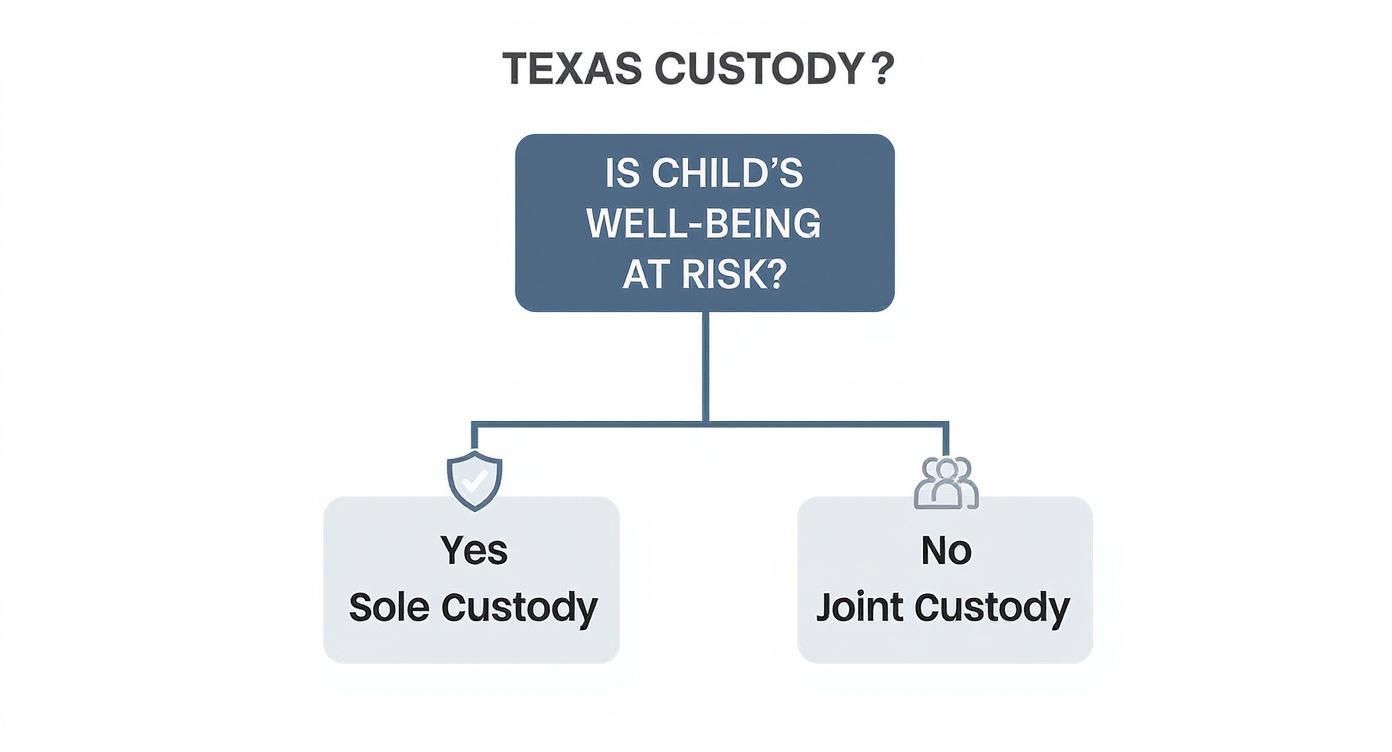
As you can see, the path to sole custody always starts by proving a real, tangible risk to your child. It shifts the entire conversation from parental disagreements to child protection.
Proving Your Case with the Holley Factors
So, how does a judge actually decide what's in a child's "best interest"? In Texas, they use a set of guidelines called the "Holley Factors." Think of them less as a checklist and more as a lens through which the judge evaluates the entire family situation.
Your goal is to build your case around these factors. You need to present clear evidence showing how the other parent's behavior negatively impacts your child’s emotional and physical health, their need for stability, and their future.
For example, you could address the "stability of the home" factor by documenting the other parent's frequent moves or constant job-hopping. To address "parental abilities," you might show your consistent involvement in your child's doctor's appointments and school meetings. These factors give you a roadmap for the kind of evidence you need to gather.
If you want to do a deeper dive, you can learn more about understanding Texas custody and the Holley Factors.
Ultimately, meeting the legal standard comes down to building a persuasive story backed by solid proof. The judge must be convinced that granting you sole custody isn't about punishing the other parent—it's a necessary step to ensure your child can grow up in a safe, stable, and supportive home.
Gathering Evidence to Build Your Case

When you walk into a Texas courtroom seeking sole custody, your words carry weight, but your proof is what truly matters. A strong case isn't built on accusations or opinions; it's built on a solid foundation of credible evidence. The goal is to paint a clear, factual picture for the judge, showing them why granting you sole managing conservatorship is the only option that serves your child's best interests.
This part can feel overwhelming, but it’s really about being methodical. You’re not just collecting random papers; you're piecing together a story the court can follow. Every piece of evidence should connect the other parent's behavior directly to a potential risk for your child.
What Kinds of Evidence Are Compelling?
Judges need to see tangible proof that goes far beyond a "he said, she said" argument. You want to focus on official records, documented communication, and firsthand accounts from neutral parties. Think of it as building a case with undeniable facts.
Some of the most powerful evidence you can present includes:
- Official Reports: Police reports from domestic violence calls, Child Protective Services (CPS) investigation files, and criminal background checks are incredibly persuasive. These are official documents, and they carry serious weight in court.
- Medical and School Records: These can reveal a pattern of neglect. Think missed doctor’s appointments, chronic absenteeism from school, or records that document any physical or emotional harm your child has suffered.
- Digital Communication: Text messages, emails, and even social media posts can be a goldmine. A text containing threats, admitting to substance abuse, or showing a blatant lack of concern for your child's needs can be a game-changer for your case.
- Financial Records: Bank statements or credit card receipts showing large sums spent on alcohol, drugs, or gambling instead of on the child’s needs can highlight instability and irresponsible behavior.
It is absolutely vital to organize all of this evidence chronologically. A well-structured timeline helps the judge connect the dots and see the patterns of behavior you're trying to prove.
Identifying and Preparing Witnesses
While documents are the backbone of your case, the right witness testimony can bring the facts to life. A good witness gives the court a firsthand perspective on the other parent’s conduct and how it directly affects your child. But let me be clear: the quality of your witnesses is far more important than the quantity.
A credible witness is almost always someone who is neutral and has personally seen the behaviors you're concerned about.
The most effective witnesses are often professionals who have interacted with your child. A teacher who has noticed your child coming to school hungry, a counselor who has heard your child express fear, or a pediatrician who has treated unexplained injuries can provide powerful, unbiased testimony.
Family and friends can testify, of course, but the court may see their statements as biased. If you use them, make sure their testimony is locked on specific events they personally saw or heard—not just their general opinion of the other parent. Preparing them simply means reviewing the facts and helping them understand they can only testify about what they know firsthand.
Weaving Your Evidence into a Clear Narrative
Once you've collected your documents and lined up your witnesses, the final step is pulling it all together. Your attorney will help you structure this evidence to tell a coherent story that aligns with the "best interest of the child" standard. This story needs to clearly show how the other parent's actions create an environment that is physically or emotionally harmful.
The key is to show, not just tell. Instead of saying the other parent is "unfit," you present evidence of their 3 DUIs. Instead of claiming they're neglectful, you provide school records showing 30 absences. For more specific guidance on this, our detailed article on how to prove a parent is unfit in a Texas custody case is a great resource.
Building a case for sole custody is a deliberate, meticulous process. It takes patience and a firm commitment to the facts. With the right evidence and a clear strategy, you can confidently advocate for the safety and stability your child deserves.
How New Laws Can Help Your Custody Case

When your child's safety is at risk due to family violence, the legal process shouldn't add to your burden. In the past, many parents faced two separate court battles: one for a protective order and another for child custody. This meant presenting the same painful evidence in two different courtrooms, a process that was both emotionally draining and inefficient.
Thankfully, recent changes in Texas law have created a much more direct path for parents in these difficult situations. This is a critical development for anyone trying to get sole custody in Texas because of a history of domestic abuse.
What Has Changed for Texas Parents
The biggest shift comes from new Texas family law reforms that changed how courts handle protective orders. Previously, these were often handled in a separate civil court, disconnected from the family law case. New legislation now allows these two critical legal actions to be combined into a single, unified case.
This is a game-changer for parents who need immediate protection. Recent Texas family law reforms enacted in 2025, particularly Senate Bill 1559, have transformed how courts handle protective orders. Now, these orders can be directly integrated into an ongoing divorce or custody case. This means judges can evaluate evidence of abuse and issue protective measures without forcing victims to file separate petitions in different courts. For domestic violence survivors seeking sole custody, this streamlined approach accelerates access to protection and builds a much stronger evidentiary record. You can learn more about major 2025 Texas family law changes and how they impact families like yours.
This consolidation means your family court judge can hear all the evidence related to family violence and issue a protective order as part of your main custody proceeding. It connects the dots for the court, drawing a clear, undeniable line between the abuse and the need for sole managing conservatorship.
The Practical Impact on Your Custody Case
So, what does this new, integrated process actually mean for you and your child? It gives you several key advantages that can significantly strengthen your case for sole custody.
- Efficiency: You no longer have to start from scratch in two different courts. The evidence you use to get a protective order is the exact same evidence the judge will use when deciding custody.
- Consistency: With one judge hearing every aspect of your case, you get a consistent ruling. The judge who grants the protective order will have a complete picture of the family violence when they make the final custody decision.
- Stronger Evidence: Under the Texas Family Code, a finding of family violence creates a legal presumption that naming the abusive parent as a joint managing conservator is not in the child's best interest. Securing a protective order within your custody case makes this connection impossible for the court to ignore.
This legal shift allows you to focus all your energy on one comprehensive case, building a powerful argument that puts your child’s safety first.
By integrating the protective order process into your custody suit, you create a direct and legally powerful link between the other parent's dangerous behavior and the need to protect your child through a sole custody arrangement.
Ultimately, this reform provides a faster, clearer, and more effective pathway to safety for Texas families. It recognizes that custody and family violence are deeply intertwined and must be handled with the seriousness they deserve. By using this new legal tool, you can build a much more compelling case for why you need the exclusive authority to make decisions that will keep your child safe.
Understanding Child Support and Financial Stability
When a judge grants sole managing conservatorship, it's not just about who makes the decisions—it fundamentally changes the financial responsibilities of raising a child. This isn't just about winning custody; it's about making sure your child has the financial support they need to thrive.
How child support works in Texas is a massive piece of this puzzle. Just as important, though, is your own financial stability. The court looks at a parent's ability to provide a safe and secure home as a core part of the child's best interest. Your financial situation will absolutely be part of the big picture the judge considers.
How Texas Calculates Child Support
In Texas, child support is almost always paid by the non-custodial parent (the Possessory Conservator) to the parent with sole custody (the Sole Managing Conservator). The calculation starts with a percentage of the paying parent’s net monthly resources—that’s their income from wages, salary, and commissions after taxes and the child's health insurance premiums are taken out.
The percentages are straightforward and scale with the number of children:
- 1 Child: 20% of net resources
- 2 Children: 25% of net resources
- 3 Children: 30% of net resources
These guidelines are the standard, but the financial landscape for Texas families has been changing.
Recent Changes to the Child Support Cap
You need to know about a recent update to Texas law that directly impacts how much child support can be ordered. Effective September 1, 2023, the Texas legislature increased the child support cap on net monthly resources from $9,200 to $11,700. That’s a huge 27% increase.
This becomes critical in sole custody cases because your financial resources and the other parent's ability to contribute can sway a judge's decision. You can discover more about Texas family code changes to see exactly how this might play out in your own situation.
So what does this mean in real life? Before, if the paying parent earned $15,000 a month, child support was calculated only on the first $9,200 of that income. Now, that calculation applies to the first $11,700, which can lead to a much higher monthly support payment.
The "Soft Cap" and Proving Your Child's Needs
While that $11,700 figure is the legal cap, Texas law treats it as a "soft cap." This is an incredibly important detail, especially if your child has unique needs or the other parent is a very high earner.
A judge has the discretion to order child support payments above the cap, but only if you can prove your child's needs justify a higher amount. This is where meticulous documentation becomes your best friend.
To get a judge to go above the cap, you have to bring concrete evidence of your child's actual, proven needs. We're talking about invoices for specialized medical care, receipts for private school tuition, tutoring costs, or expensive extracurriculars that are part of the child's established lifestyle.
The court will look at the life your child is accustomed to and their specific requirements. Your job is to show that the standard guideline support would fall short of meeting these needs and that the other parent has the financial capacity to pay more.
Why Your Financial Stability Matters
While the other parent's income drives the child support calculation, your own financial footing is just as vital in a sole custody fight. A judge needs to see that you can provide a stable home environment. This doesn't mean you have to be rich. It means you can consistently meet your child's basic needs.
A court will always look favorably on a parent who can show:
- Steady Employment: A consistent work history shows reliability.
- Responsible Budgeting: Can you manage your income to cover housing, food, and other necessities? Show it.
- A Safe Home: Proof of a stable living situation is non-negotiable, whether you rent or own.
Your ability to provide a secure foundation is one of the most powerful arguments you can make. It tells the court that granting you sole custody isn't a risk—it's a decision that promotes your child's long-term well-being.
Key Takeaways and Your Next Steps
Deciding to seek sole custody is a monumental choice. It speaks volumes about your commitment to your child's safety and well-being. It's a tough path, and feeling overwhelmed right now is completely normal. What really matters is taking focused, deliberate action to build the strongest case you possibly can for your child's future.

This journey requires more than just conviction—it demands strategy and solid evidence. The Texas court system is built on facts, and your ability to present a clear, documented case is everything. Every single step you take from this moment on can contribute to building the stable, secure home your child deserves.
A Clear Path Forward
While every family's situation is unique, the foundational steps for pursuing sole custody in Texas are consistent. Zeroing in on these core actions will help you move forward with clarity and purpose, turning your valid concerns into a compelling legal argument.
Here’s what you should prioritize starting today:
- Document Everything Meticulously: Start a detailed log or journal now. Record every single incident of concern, no matter how small it seems. Note the date, time, location, and anyone who witnessed it. Save threatening texts, angry emails, and concerning social media posts. This detailed record isn't just your story; it's the hard evidence that will support your case in court.
- Consult an Experienced Attorney: You do not have to do this alone. An experienced family law attorney can look at the specifics of your case, lay out your legal options, and map out a strategy tailored to your family's needs. This is the single most important step you can take to protect your rights and your child.
- Keep Your Child’s Best Interests Central: Every decision you make, every action you take, and every piece of evidence you gather must tie back to the "best interest of the child" standard. This legal principle should be your compass, guiding you through the entire process and reminding you of what truly matters.
The legal road to sole custody is demanding, but you have the power to advocate for your child's safety and future. By documenting everything and seeking expert legal guidance, you are taking control of a difficult situation and working toward a positive outcome.
Your child is depending on you to be their staunchest advocate. Taking these deliberate steps will not only strengthen your case but also empower you to face the challenges ahead with confidence.
If you need help with a child custody or visitation case in Texas, our experienced attorneys can guide you every step of the way. Contact The Law Office of Bryan Fagan, PLLC today for a free consultation.