
When your child’s future is on the line, the chaos of a separation can feel overwhelming. The single most important thing is creating stability, and fast. In Texas, understanding your rights matters most, and the first step toward that stability is often securing a temporary custody order. This isn't about winning or losing; it's about asking a judge for a clear, enforceable set of rules for possession, decision-making, and support while your family navigates this transition.
Your First Step Toward Stability: Understanding Temporary Custody

When a family is going through a major change, the uncertainty is often the hardest part for everyone—especially the children. A Temporary Custody Order is a legal roadmap that provides much-needed structure and clarity right when you need it most. It's not the final decision, but a short-term solution a judge puts in place to create a calm and predictable environment for your child.
Think of it as the foundational agreement that addresses your child's immediate needs. This court order will stay in effect until you and the other parent can reach a final agreement or until the court makes a final ruling after a trial.
How Texas Determines Custody: The "Best Interest of the Child"
The number one goal here is to keep the child’s life as stable as possible during a divorce or custody dispute. A Texas judge will look at everything through one lens: what is in the “best interest of the child.” This is the legal standard from the Texas Family Code that guides every single decision a judge makes about your family. It means the court will consider a child’s emotional and physical safety, their needs, and the ability of each parent to provide a stable home.
Specifically, a temporary order will establish a few key things:
- Conservatorship: This legal term simply refers to the rights and duties of a parent. The order will likely name both parents as “Joint Managing Conservators,” which means you share the responsibility of raising your child. However, the order will also name a primary parent who has the exclusive right to decide where the child lives.
- Possession Schedules: The order lays out a clear, black-and-white calendar for when each parent has the child. In Texas, this often follows the Texas Standard Possession Order, which provides a consistent schedule for weekends and holidays. However, this can be customized to fit a family's unique situation.
- Child Support: It establishes temporary child support and medical support. This ensures the child's financial needs are met from the start, so there's no gap in providing for them while the legal process unfolds.
These orders provide an immediate dose of normalcy. They answer the questions that keep you up at night: Where will my child sleep on a school night? Who makes the call if they get sick? How are we splitting up the holidays this year? Having this structure in place reduces conflict and lets everyone, especially your child, breathe a little easier.
Seeking temporary orders is a proactive step in any Texas custody case. It’s about protecting your child from the emotional fallout of a parental separation. By setting clear rules from the beginning, you create a safe and predictable environment where they can feel secure during a difficult time.
When You Might Need a Temporary Custody Order
How do you know if your family’s situation has crossed the line from difficult to legally urgent? Knowing when to ask for the court’s help is the first step in protecting your child. A temporary custody order becomes essential when your child’s current living arrangement is unstable, unsafe, or simply not working.
Many parents find themselves needing these orders right in the middle of the initial chaos of a separation. One day you’re a family unit, and the next, there are no rules. That uncertainty—where the child will sleep tonight, who’s handling school drop-off, who makes the decisions—can be incredibly damaging. A temporary order is designed to replace that chaos with a clear, court-enforced plan.
Common Scenarios That Call for Court Action
Some situations are immediate red flags that signal a judge needs to step in. While every family’s story is different, certain circumstances almost always justify filing for temporary orders to keep a child safe and secure.
These often include:
- Concerns about substance abuse: If a parent's drug or alcohol use is putting the child at risk, a court can step in. This could mean ordering supervised visitation or even mandatory drug testing.
- Threats of relocation: Do you have a real fear that the other parent is about to move the child out of state without your permission? A temporary order can establish a geographic restriction, keeping the child in the county or a nearby area.
- Instances of family violence: Any form of family violence is an emergency. The court can issue protective orders alongside custody orders to keep the child and the victim safe.
- Neglect or instability: Sometimes the danger isn't one dramatic event but a pattern of instability. This could look like a parent leaving a young child unsupervised, consistently failing to get them to school, or living in a home that isn't safe.
The number of families dealing with these issues is significant. In the United States, roughly 13 million custodial parents are navigating life after a separation. For a closer look at the data, you can discover more insights about child custody trends here. This is exactly why Texas law provides a straightforward path for parents to create stability with temporary orders.
The "Best Interest of the Child" Standard
In every single decision, a Texas court is guided by one core principle: the "best interest of the child." This isn't just a saying; it's the legal standard woven throughout the Texas Family Code.
When a judge weighs what's in a child's best interest, they look at a whole range of factors—the child’s physical and emotional well-being, any potential danger, the stability of each parent's home, and the child's unique needs. When you ask for a temporary order, you must frame your entire request around how your plan serves those best interests.
A judge’s primary goal is to create the safest, most stable environment possible for the child during a tough time. You're essentially showing the court how your requests for custody, visitation, and support directly build that stability.
Standard Hearings vs. Emergency Actions
It’s critical to understand the difference between a standard temporary order and a more urgent emergency order. Most cases will move forward with a standard temporary orders hearing, which gives both parents a chance to present their evidence and arguments before a judge makes a decision.
But in situations where a child is in immediate physical or emotional danger, Texas law has a faster track: an emergency action. This is often handled through a Temporary Restraining Order (TRO) with an "ex parte" provision, which means a judge can grant it without the other parent being present or notified beforehand. These are reserved for the most severe circumstances, like credible threats of abduction or documented family violence. To get a better handle on this urgent process, you can check out our guide on how to file for emergency custody in Texas. Knowing which path fits your situation is key to taking swift, effective action.
Navigating the Texas Legal Process for Temporary Custody
Starting a court case can feel like you're staring up at a mountain, but knowing the path forward makes the entire journey more manageable. When you decide to seek temporary custody, you’re kicking off a structured legal process designed to bring immediate clarity and stability to your child’s life.
Let’s walk through what that process actually looks like.
Your first move is filing what’s called an Original Petition in a Suit Affecting the Parent-Child Relationship, or SAPCR for short. This is the formal document that officially opens your case with the court. It lays out the basic facts for the judge: who the parents and child are, and what you are asking the court to do about custody, visitation, and support.
Right alongside that petition, you'll file a Motion for Temporary Orders. This is your specific request for the judge to create the temporary rules we've been talking about. Think of the SAPCR as opening the main conversation, and the motion as scheduling an urgent meeting to set some ground rules while the case is pending.
Getting the Paperwork Filed and Notifying the Other Parent
Once your documents are drafted, they have to be officially filed with the district clerk in the county where your child lives. As you move through this process, understanding how to file court documents correctly is a critical part of making sure your request is properly considered. Proper filing is what gets your case on the judge's radar in the first place.
After filing comes the next crucial step: service of process. This isn't as simple as handing the papers to the other parent yourself. "Service" is the formal, legal way of notifying them that a lawsuit has been filed. A neutral third party—like a constable, sheriff, or private process server—must officially deliver the documents. This step is legally required to ensure the other parent has a fair chance to respond and participate.
A common question we get is, "How long does this take?" While every court's docket is different, Texas law pushes for these hearings to happen quickly. A temporary orders hearing is typically set within a few weeks of filing because the goal is to address the immediate needs of the child without unnecessary delay.
This infographic gives you a simple visual of the different paths a custody order can take.
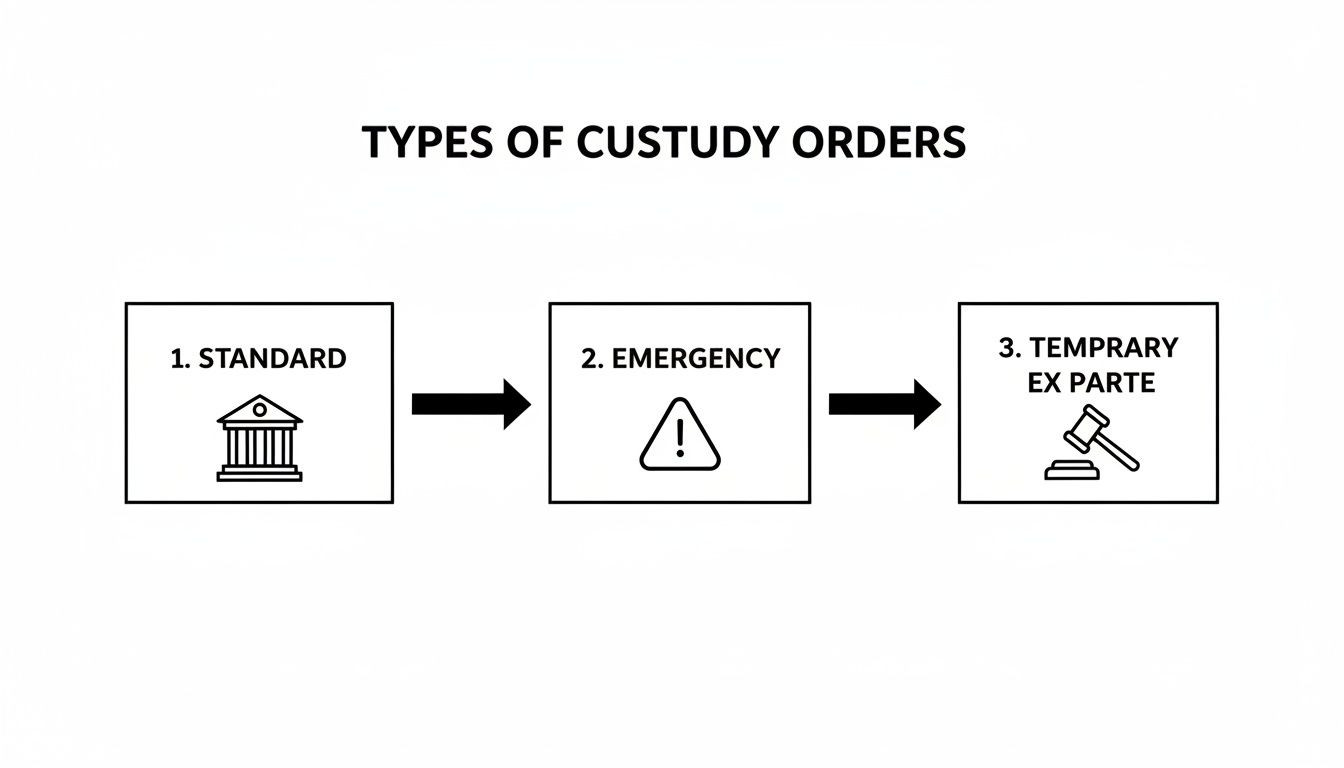
As the graphic shows, most cases follow a standard courthouse process. But for situations that pose an immediate risk to a child, a much faster emergency path exists.
To help you keep track of the essential paperwork, here’s a breakdown of the key documents you'll need to get your temporary custody case started.
Key Documents for Filing Temporary Custody in Texas
| Document Name | Purpose | Key Information Required |
|---|---|---|
| Original Petition in a SAPCR | This is the main lawsuit document. It officially opens your case with the court. | Full names and addresses of both parents and the child; child's date of birth; your relationship to the child. |
| Motion for Temporary Orders | This document specifically asks the judge to set temporary rules for custody, visitation, and support. | The specific orders you are requesting (e.g., who the child lives with, visitation schedule, child support amount). |
| Civil Case Information Sheet | A standard form used by the court clerk to categorize your case for administrative purposes. | Basic case details like the parties involved and the type of lawsuit being filed. |
| Affidavit/Declaration | A sworn statement you sign under oath, outlining the facts that support your request for temporary orders. | A detailed, factual account of why the temporary orders are necessary for the child’s well-being. |
Having these documents prepared correctly is the foundation of a strong start to your case.
From Filing to a Hearing: A Realistic Timeline
The time between filing your case and your temporary orders hearing is a critical window for preparation. You can't just file and wait. Here’s a general idea of what to expect:
- Filing: The day your petition is officially filed with the court clerk. This starts the clock.
- Service: This usually takes a few days to a week, though it can take longer if the other parent is difficult to locate.
- Answer: The other parent typically has around 20 days to file a formal "Answer" with the court after being served.
- Hearing Date: Your attorney will work to get a hearing date set as soon as possible. Most Texas courts will hear temporary orders within two to four weeks from the date the request is filed.
This timeline is just a framework; every case is different. The most important thing is to use this time wisely to gather your evidence and prepare your arguments. The goal is simple: walk into that first hearing prepared, confident, and focused on what truly matters—your child's best interests.
How to Prepare for Your Temporary Orders Hearing
Your temporary orders hearing is a significant moment in your custody case. The decisions a judge makes here will shape your family’s reality for the next several months and can set the tone for the final outcome. Walking into that courtroom prepared can make all the difference.
This isn't about courtroom drama; it's about presenting clear, compelling evidence that shows why your requests are truly in your child’s best interests.

Think about it from the judge's perspective: they have a very limited amount of time to get a snapshot of your family and make huge decisions. Your job is to make that snapshot as clear and factual as possible. You need to show, not just tell, the judge why you are the parent who can provide a stable, safe, and loving home.
Gathering Evidence That Matters
Judges are persuaded by facts, not feelings. While your emotions are completely valid, the courtroom is a place for evidence. Strong, organized proof is what will carry the day. Your goal is to collect documentation that paints a clear picture of your child's life and each parent's behavior.
Here's the kind of evidence Texas judges often find most persuasive:
- Communication Records: Sift through text messages and emails. You're looking for conversations that show a lack of cooperation, threatening language, or admissions of poor behavior from the other parent. On the flip side, your own calm, child-focused communication can be powerful evidence in your favor.
- School and Medical Records: A child's attendance records, report cards, and notes from teachers can speak volumes about their stability (or lack thereof). Medical records are crucial if there are health concerns or issues of neglect.
- Financial Documents: Come ready with pay stubs, tax returns, and proof of expenses related to your child. This isn't just paperwork—it's essential for determining child support.
- Photos and Videos: A picture really can be worth a thousand words. Photos of your home, your child's room, or short videos of you and your child sharing a happy moment can help a judge visualize the stable environment you provide.
The key here is organization. Don't just show up with a phone full of screenshots. Print everything out, organize it chronologically in a binder, and have it ready. A well-prepared binder shows the judge you are serious, organized, and respectful of the court's time.
The Power of Witness Testimony
Sometimes, the best evidence comes from someone else's perspective. A credible witness can give the court an objective view of your parenting or back up your concerns about the other parent.
But not just anyone makes a good witness. You should focus on people who have personally and recently observed the things you want the judge to know.
Consider people like:
- Family members who have seen your day-to-day parenting up close.
- Teachers or daycare providers who can speak to your child's well-being and your involvement at school.
- Neighbors or friends who have witnessed specific events or behaviors firsthand.
Discuss potential witnesses with your attorney well in advance. They can help you figure out who would be most effective and prepare them for what to expect when they testify.
Your Demeanor in the Courtroom
How you present yourself in court is just as important as the evidence you bring. The judge is constantly observing both parents to gauge their temperament, credibility, and focus. Your goal is to come across as a calm, reasonable, and child-centered parent.
Dress professionally—think job interview. Speak clearly and respectfully to everyone, including the judge, the opposing attorney, and even the other parent. Avoid emotional outbursts, eye-rolling, or interrupting. When you are focused and composed, your testimony becomes that much more credible. You're showing the judge that you can handle stress and conflict maturely, which is a vital parenting skill.
And a quick technical note: if your case involves documents that aren't in English, understanding how to translate legal documents is critical. You'll need professionally translated and certified documents to avoid any delays with the evidence you present.
Your temporary orders hearing is your first real opportunity to establish a foundation for your child's future. By gathering strong evidence, selecting credible witnesses, and presenting yourself as a stable and loving parent, you can confidently make your case for the orders that will best protect your child.
Understanding Your Texas Temporary Custody Order
After the emotional storm of a court hearing, that signed order from the judge can feel like the finish line. In reality, it’s the starting line for your new day-to-day life. This document isn't just paper—it's the official, legally binding rulebook for how you and the other parent will raise your child while the case is ongoing. Understanding every line is non-negotiable for protecting your rights and giving your child the stability they desperately need.
So when you get that temporary order, take a deep breath and read it. Then read it again. This document will dictate your life for the next few months, so you must know exactly what it says, what it means, and what’s expected of you.

Key Components of a Temporary Order
A Texas temporary order is usually broken down into several major sections that cover the fundamentals of raising a child between two homes. While the details can change from case to case, your order will clearly define these terms and responsibilities for each parent.
These pieces all work together to build a complete framework for your child's care.
- Conservatorship: This is about your legal rights and duties as a parent—who gets to make the big decisions.
- Possession and Access: This is the calendar. It’s the specific schedule detailing when your child will be with you and when they'll be with the other parent.
- Child Support: This section lays out the financial side of things, from monthly support payments to who covers health insurance.
Let's unpack what each of these really means for you and your family.
Demystifying Conservatorship and the Primary Parent
In Texas, the default setup is called Joint Managing Conservatorship. It sounds more complicated than it is. The goal is simple: keep both parents deeply involved in their child’s life. It means you and the other parent will share the rights and responsibilities of making major decisions for your child.
But even when it's a "joint" arrangement, one parent is almost always designated as the primary conservator. This is the parent who has the exclusive right to decide where the child lives, usually within a certain geographic area. The other parent is named the possessory conservator and will follow a set visitation schedule.
The judge’s decision on who becomes the primary parent is guided by one single principle: the “best interest of the child.” They’ll weigh all the evidence from the hearing—from witness testimony to how you handled yourself in the courtroom—to figure out which parent is best equipped to provide the most stable and nurturing home base while the case proceeds.
Understanding Your Possession Schedule
The Possession Schedule is the heart of the order. It's the nuts and bolts of when each parent has the right to have the child. For many Texas families, this schedule will be the Standard Possession Order (SPO).
The SPO is the default calendar laid out in the Texas Family Code, designed to provide consistency.
- The non-primary parent usually has the child on the first, third, and fifth weekends of a month.
- It splits up major holidays, like Thanksgiving and Christmas, alternating them each year.
- It also gives the non-primary parent a solid chunk of time during the summer break.
Of course, a judge can—and often will—tweak this schedule to fit a family's real-life situation. For instance, if parents live more than 100 miles apart, a modified SPO is used. If a parent works nights or has an unconventional job, the judge might create a custom calendar to make sure both parents get meaningful time with their child.
Financial Obligations and Other Important Details
Finally, the temporary order will set clear financial rules to make sure the child’s needs are covered. This includes establishing a temporary child support amount, which is calculated using a formula based on the paying parent's income and how many children are involved.
The order will also dictate who has to provide the child’s health insurance and how out-of-pocket medical bills will be split. It's also very common for these orders to include a geographic restriction. This prevents the primary parent from moving the child out of a specific county (or adjoining counties) without getting permission from the court or the other parent first. This isn't about punishment; it's about ensuring the other parent can maintain a strong, consistent relationship with their child.
Next Steps: Critical Mistakes to Avoid After Temporary Orders
Getting temporary orders in place can feel like a huge relief, but the hard work is just beginning. How you conduct yourself from this point forward can either solidify your position or unravel your case before the final hearing.
One of the quickest ways parents get into trouble is by treating the court order like a suggestion instead of a legally binding command. A court order isn't optional. Even seemingly small slip-ups, like being consistently late for exchanges or making a decision without the other parent's input, can paint you as uncooperative in the judge's eyes. Your credibility is everything.
Keeping Your Case on Solid Ground
In today's world, your social media can be a goldmine of evidence for the other side. Venting about your ex, complaining about the court process, or posting pictures from a late night out can be used against you. The best advice? Stay off social media, or at the very least, keep your posts neutral and child-focused. Don't give them ammunition.
Poor communication with your own attorney is another common pitfall. Your lawyer is your advocate, but they can't defend you effectively with only half the story. Be honest, provide documents when they ask, and keep them in the loop. The more they know, the better they can prepare for what’s coming.
The goal now is simple: demonstrate unwavering stability. Show the court you can follow the rules and co-parent effectively, even when it's hard. Every action you take is building the foundation for your final custody order.
Temporary custody is a crucial tool, especially when a child's safety is on the line. In Texas, courts often look to place children with relatives—like grandparents or aunts and uncles—when a parent is temporarily unable to provide care. This approach aligns with a broader focus on kinship placement; you can learn more about national foster care statistics to see the bigger picture.
The Path to a Final Order
With temporary orders set, the case shifts into a new gear. The focus is now on gathering information and working toward a permanent resolution, which usually happens through either a settlement or a full trial.
Here’s what you can generally expect:
- Mediation: Most Texas judges will order you and the other parent to mediation. It’s a confidential meeting with a neutral third-party mediator whose job is to help you find common ground and reach a final agreement.
- Discovery: This is the formal process of exchanging information. It involves answering written questions under oath, providing financial documents, and potentially giving testimony in a deposition.
- Trial Prep: If mediation doesn't lead to an agreement, your lawyer will start preparing for a final trial. This is where a judge will hear evidence from both sides and make the final, binding decisions for your family.
This road can feel long, but every step is designed to give the court a complete picture before making a permanent ruling.
Answering Your Top Questions About Temporary Custody
Navigating the legal system brings up a million questions, and it’s completely normal to feel unsure about what’s next. Let's tackle some of the most common worries parents have when seeking temporary custody in Texas.
How Long Does a Temporary Custody Order Last?
A temporary custody order is the rulebook for your family while the main custody case is still playing out. It stays in full effect until the day a judge signs a final, permanent order.
Depending on the complexity of your case and the court's calendar, this could be anywhere from a few months to, in some contentious cases, over a year. The key is to treat this temporary order as the law of the land for the foreseeable future.
Can We Change a Temporary Custody Order?
Yes, but it's not easy, and judges prefer not to do it often. To modify a temporary order, you must prove to the court that there has been a “material and substantial change” in the circumstances of the child or one of the parents since the original order was made.
A word of caution: judges value stability for children, so they don't take these requests lightly. The change has to be significant enough to convince the court that altering the current arrangement is truly what’s best for the child.
Does the Parent Who Gets Temporary Custody Usually Win in the End?
While nothing is ever guaranteed in family law, the outcome of the temporary orders hearing is often a strong indicator. The parent who is named the primary conservator in the temporary order gets a crucial opportunity to establish a positive “status quo.”
By creating a stable, loving, and predictable home for the child, that parent can show the judge that the current arrangement is working and is in the child’s best interests. That real-world track record can be incredibly persuasive when it's time to make the final decision on custody.
If you need help with a child custody or visitation case in Texas, our experienced attorneys can guide you every step of the way. Contact The Law Office of Bryan Fagan, PLLC today for a free consultation.