
When your child’s future is on the line, understanding your rights matters most. Winning a custody battle in Texas isn’t about “beating” the other parent. It’s about showing a judge, with clear and convincing proof, that you can provide the most stable, loving, and supportive home for your child. This process can feel emotional, but it's a strategic, child-focused journey grounded in Texas law and solid evidence.
Navigating Your Texas Custody Case with Confidence

Facing a custody dispute is daunting, and every decision feels like it carries the weight of the world. Our goal with this guide is to cut through the legal jargon and overwhelming emotions, giving you a clear, actionable path forward. We're going to shift your focus from conflict to preparation. With the right documentation and a smart approach, you can build a powerful case that protects your parental rights and, most importantly, secures your child’s future.
This road is tough, but you aren't without options or legal protections. Let’s walk through them together, starting with the core concepts that drive every custody decision in a Texas courtroom.
Understanding the Language of Texas Custody
Before you can build a winning strategy, you need to speak the language the judge uses. The Texas Family Code has its own vocabulary for custody matters. Knowing these terms is the first step toward taking control of your case.
- Conservatorship: This is what most people mean by "custody." In plain English, it lays out a parent's legal rights and responsibilities to make big decisions for a child, like those about their education or non-emergency healthcare.
- Possession and Access: This is the legal term for the visitation schedule. It details the specific days and times each parent will have the child in their care.
- Best Interest of the Child: This is the single most important legal standard in any Texas custody case. Every decision a judge makes must put the child’s physical and emotional well-being above everything else.
The court isn't focused on what’s fair to you or the other parent. The judge’s only job is to determine what will create a safe, stable, and nurturing life for your child. Every piece of evidence and every argument you make must be presented through that lens.
Here in Texas, the legal system strongly prefers arrangements that keep both parents actively involved in their child's life. That's why understanding a term like Joint Managing Conservatorship is so critical. This is the most common outcome, where both parents share the right to make decisions for their child, even if one parent is the one who determines where the child lives primarily.
How Texas Courts Determine Custody
To build a case that truly serves your child, you have to understand the rulebook judges follow. Every decision a Texas court makes in a custody case is filtered through a specific legal lens. If you align your strategy with these standards, you are already on the path to a better outcome.
Everything comes down to one powerful principle: the best interest of the child. This is the absolute cornerstone of Texas Family Code Chapter 153. It’s the only standard the judge will use. Your personal wishes or your history with the other parent—while important to you—are secondary to what the evidence shows will provide the safest, most stable, and most nurturing environment for your child.
Joint Managing Conservatorship: The Texas Standard
In Texas, the law starts with a simple assumption: it’s almost always in a child’s best interest for both parents to stay deeply involved in their lives. This is why courts default to what’s called a Joint Managing Conservatorship (JMC).
A JMC doesn't automatically mean a 50/50 split of physical time. Think of it more as shared parental authority. It means both parents have a say in the big decisions, including things like:
- Education: Which school district the child attends.
- Healthcare: Non-emergency medical and dental care.
- Mental Health: Consent for psychological or psychiatric treatment.
- Religion: Decisions about religious upbringing.
Even in a JMC, one parent is usually named the "primary" parent. This parent has the exclusive right to decide where the child lives (often within a certain geographic area). The other parent is known as the possessory conservator and has a set visitation schedule. To get a better handle on this role, you can learn more about the specific duties of a possessory conservator in Texas.
The conservatorship structure is critical in defining who holds the power to make key decisions. To help you visualize the difference, here’s a breakdown of the two main types of custody arrangements.
Comparing Joint vs. Sole Managing Conservatorship
| Key Aspect | Joint Managing Conservatorship (JMC) | Sole Managing Conservatorship (SMC) |
|---|---|---|
| Decision-Making | Shared rights and duties. Parents must consult each other on major decisions (medical, educational, etc.). | One parent has the exclusive right to make most major decisions without consulting the other. |
| Primary Residence | One parent is typically designated the "primary" to establish the child's residence. | The sole managing conservator establishes the child's residence. |
| Presumption | The legal default in Texas. Courts presume this is in the child's best interest. | Not presumed. Awarded only when JMC would harm the child's well-being. |
| When It's Used | In the vast majority of cases where both parents are deemed fit and capable of co-parenting. | Reserved for serious situations like family violence, substance abuse, neglect, or extreme conflict. |
| Parental Access | The non-primary parent is a "possessory conservator" with a standard possession schedule. | The other parent is typically a "possessory conservator" and may have supervised visitation. |
Understanding this distinction is key. A JMC is designed to foster cooperation, while an SMC is a protective measure used only when co-parenting would be dangerous or detrimental to the child.
When Sole Managing Conservatorship Is Awarded
While JMC is the starting point, a judge can award Sole Managing Conservatorship (SMC) if they believe appointing both parents would not be in the child's best interest. This is a very high legal bar to meet. An SMC gives one parent the exclusive power to make most of the big decisions without needing the other parent's input.
Courts don't hand out SMCs lightly. They are typically reserved for cases with a documented history of:
- Family violence or domestic abuse
- Child neglect or endangerment
- Serious, untreated substance abuse
- Extreme conflict that makes joint decisions physically or emotionally harmful for the child
Simply disagreeing with your ex, even if the disagreements are frequent and intense, usually isn't enough to justify an SMC. You must bring clear and convincing evidence that shows joint decision-making would actively harm the child.
When courts weigh these factors, they are keenly aware of how family conflict can ripple through a child's life. The "best interest" standard requires a deep understanding of the impact of divorce on a child's mental health, and judges use this knowledge to shield children from further harm.
The Holley Factors: What Judges Actually Look For
So, how does a judge figure out what's in a child's "best interest"? They use a specific set of guidelines that came out of a landmark Texas case called Holley v. Adams. We call them the Holley Factors. These are the practical, real-world criteria a court will use to look at your family's situation.
Thinking through these factors is the best way to prepare your case.
- The Child’s Needs: What are your child's specific emotional, physical, and developmental needs right now? Is one parent better equipped to meet those needs?
- Parental Abilities: Which parent has consistently demonstrated the skills to be a good parent? Who handles the day-to-day responsibilities of parenting?
- Stability of the Home: Which home environment offers more stability, routine, and predictability for the child?
- Acts or Omissions: Is there any behavior by either parent—past or present—that could negatively impact the child?
- Child’s Preference: If a child is 12 or older, the judge can interview them to hear their wishes. It’s a factor, but it's rarely the deciding factor.
Your job is to build your story around these points. Instead of just claiming you're the "better parent," show it. Provide a calendar proving you've handled every doctor's appointment (meeting physical needs) or a report card showing your child is thriving in their current school (providing stability). This is how you translate your everyday parenting into a powerful legal argument.
How to Build a Powerful Evidence-Based Case
When you step into a Texas courtroom, your words matter, but your documented actions speak with undeniable authority. Winning a custody battle isn’t about dramatic gestures; it's about methodically proving your consistent, stable, and loving presence in your child’s life.
Judges make decisions based on facts and proof, not just on who tells a better story on the witness stand. The parent who is organized, meticulous, and can back up their claims with tangible evidence starts with a massive advantage. Your daily actions as a parent are your most powerful evidence—the goal is to transform that dedication into a compelling story the court can easily understand.
Start with a Parenting Journal
One of the simplest yet most effective tools you can use is a parenting journal. This isn't a diary for your feelings; it's a factual log of your parental involvement. A well-kept journal creates a detailed timeline that highlights your consistency and can subtly point out the other parent's shortcomings without you having to make unsupported accusations.
Grab a simple calendar or a dedicated notebook and start documenting everything. Be specific with dates, times, and brief, factual details.
- Appointments: Log every doctor, dentist, and therapy appointment you schedule and attend. Note the reason for the visit and any important outcomes.
- School Involvement: Record every parent-teacher conference, email exchange with teachers, and school event you participate in. Did you help with homework for an hour last night? Write it down.
- Extracurriculars: Document who takes the child to soccer practice, music lessons, or playdates. Who pays the fees? Who volunteers to bring snacks?
- Communication: Keep a factual record of your interactions with the other parent. Stick to the facts: missed visitations, consistently late drop-offs, or important conversations about your child’s needs.
A well-organized calendar showing you handle every doctor's visit and attend every school play speaks volumes more than just saying you're the "involved parent." This is how you show, not just tell, the judge about your commitment.
Gathering Compelling Physical Evidence
Beyond your journal, start collecting physical and digital proof that supports your case. Think of yourself as a detective building a case file on your own good parenting. The more organized you are from the start, the easier it will be for your attorney to present a powerful, convincing argument.
This infographic gives you a bird's-eye view of how a court processes custody information to reach a final decision.
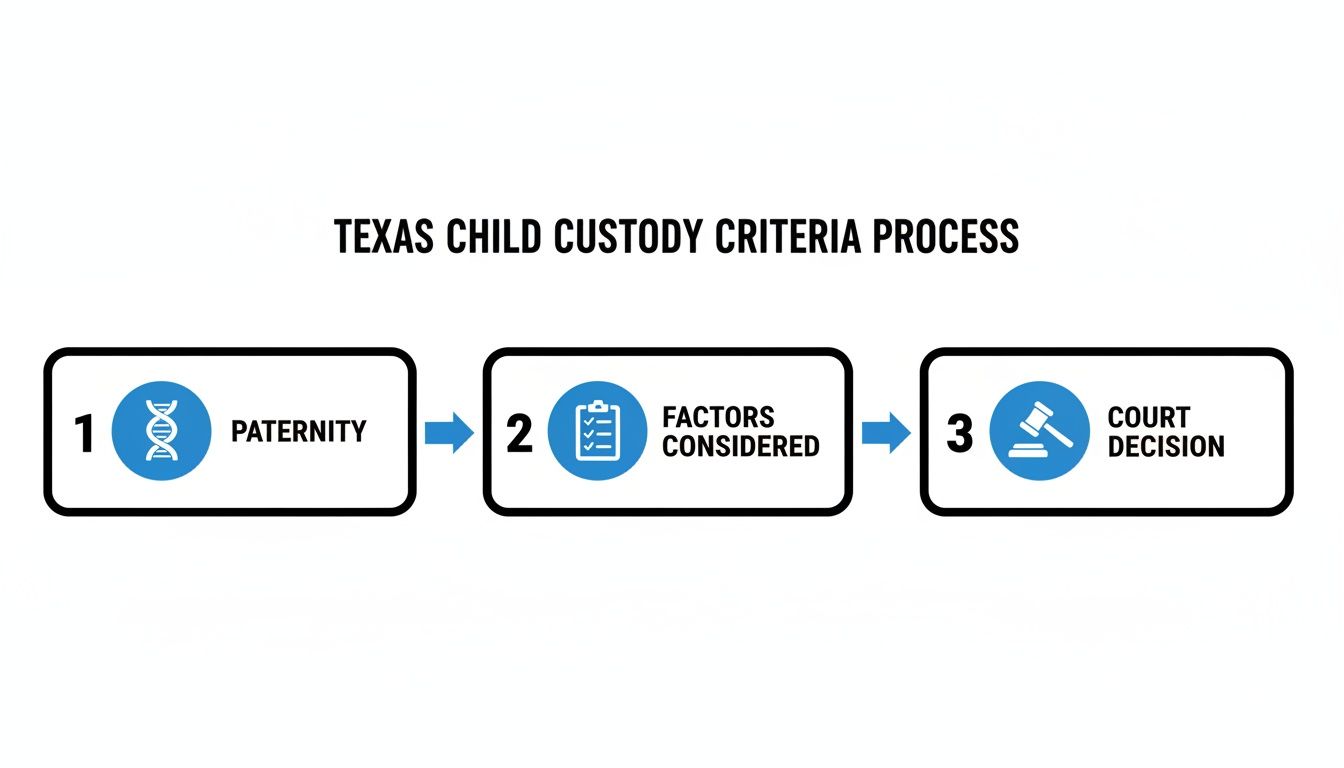
As you can see, every piece of evidence you gather is designed to inform the court’s decision-making process, directly tying back to the legal factors that matter most.
What Types of Evidence Resonate with Judges?
Judges are looking for objective evidence that paints a clear picture of each parent’s capabilities and the child's day-to-day life. From our experience, some of the most persuasive forms of evidence include:
-
Communication Records: Save every relevant text message and email between you and the other parent. These records can demonstrate your cooperative attitude or, conversely, highlight the other parent's unreasonable behavior. Make sure you preserve them in a format that's admissible in court.
-
Photographs and Videos: A picture is truly worth a thousand words. Photos of your clean and safe home, your child’s dedicated study area, or videos of you and your child engaging in positive activities can be incredibly effective at humanizing your case.
-
School and Medical Records: Official documents are hard to dispute. Report cards, attendance records, and notes from doctors or therapists can verify your deep involvement and your child's well-being while in your care. If some crucial documents are in a foreign language, understanding the nuances of legal translation is critical. You can find helpful tips for translating legal documents to ensure your evidence is properly presented and admissible.
-
Witness Testimony: Think about neutral third parties who have witnessed your parenting firsthand. Teachers, coaches, daycare providers, and neighbors can provide credible testimony about your stability and involvement. An unbiased perspective often carries significant weight with a judge.
Everything you collect should directly tie back to the "best interest of the child" standard. Each piece of proof should help answer the question: "Why is my home the best environment for this child to thrive?" To dive deeper into this crucial legal standard, our firm has put together a detailed guide on how to prove the best interest of the child in Texas. Combining a strong factual case with a clear understanding of the law is the key to protecting your family's future.
Choosing Your Path to Resolution
The term "custody battle" probably conjures up images of a tense, dramatic courtroom trial. While that can happen, it's not the reality for most Texas families. The road to a final custody order has a few different forks, and understanding your options is the first step toward making smart decisions that protect your child, your finances, and your sanity.
Before we dive into the specifics, it's important to know that most cases never actually make it to a final trial. In fact, a staggering 85–90% of child custody cases in major Texas markets get resolved without a judge banging a gavel at the end.
What does that tell you? It means that parents who put in the work early—gathering evidence and negotiating thoughtfully—are taking the same path as the overwhelming majority of families. Judges much prefer durable, workable agreements created by the parents themselves, and these statistics prove it. You can discover more insights about family law statistics on Clio.com to better understand these trends.
Mediation: The Preferred First Step
Long before you'd ever see the inside of a courtroom for a trial, most Texas courts will order you and the other parent to attend mediation. Think of it as a structured, confidential negotiation session guided by a neutral third-party mediator.
Mediation isn't about winning or losing. The mediator has zero power to make a ruling or force a decision on you. Their one and only job is to get a productive conversation going and help you both find common ground. It's the preferred route for some very good reasons:
- You Keep Control: In mediation, you and the other parent call the shots. In a courtroom, a judge makes those calls for you.
- It's More Cost-Effective: A successful mediation will almost always be significantly cheaper than fighting it out in a contested hearing or trial.
- It’s Less Hostile: The whole process is designed to be cooperative, which can go a long way in preserving a functional co-parenting relationship for your child's benefit.
- It’s Completely Confidential: What is said in mediation, stays in mediation. This allows everyone to speak freely without worrying that their words will be twisted and used against them later in court.
A successful mediation ends with a document called a Mediated Settlement Agreement (MSA). Once both parents sign it, this agreement is binding and a judge typically cannot change it. It becomes the blueprint for your final custody order.
Getting the most out of this process comes down to one thing: preparation. We've put together a guide packed with powerful child custody mediation tips to help you walk into that room with a clear strategy and a confident mindset.
When Litigation Becomes Necessary
What happens if you and the other parent just can't see eye to eye, even with a mediator's help? That's when your case moves down the litigation path. This is the more formal, court-driven process where a judge will ultimately make the decisions for your family.
Litigation usually kicks off with a Temporary Orders Hearing. You can think of this as a mini-trial that happens near the start of your case to establish the rules of the road while the case is pending. The judge will hear limited evidence and testimony to decide temporary issues like who determines the child's residence, what the visitation schedule will look like, and how much child support will be paid.
While these orders aren't permanent, they are incredibly important because they set the tone—and the status quo—for the rest of the case.
If your case still doesn't settle, it will be scheduled for a Final Trial. This is the showdown most people imagine. At trial, both sides will present all their evidence, call witnesses to testify, and make their final arguments to the judge. The judge then issues a final, binding order based on what they believe is in the best interest of the child.
A final word of advice here: how you present yourself is just as crucial as the evidence you bring. The judge isn't just evaluating facts; they are evaluating you as a parent. Showing up as a calm, reasonable, and child-focused person can make all the difference.
Handling High-Conflict Custody Issues

Not every custody dispute is calm and cooperative. When issues like domestic violence, substance abuse, or parental alienation are on the table, the entire dynamic changes.
At this point, the court's priority isn't just about crafting a fair parenting plan—it's about protecting a child from harm. Your strategy must shift to proving a clear and immediate risk to your child's physical or emotional well-being. This isn't the time for subtle hints or vague accusations. You need concrete, undeniable evidence.
Addressing Allegations of Harm
When a child’s safety is at stake, judges act fast. But they are also trained to see through attempts to use serious accusations as a tactic to gain an advantage. That’s why your claims must be backed by credible, solid proof.
These allegations fundamentally alter how a case is handled. For instance, concerns over domestic violence pop up in roughly 10–20% of custody cases, and parental alienation is a factor in about 15% of contested disputes. Proving these claims isn't easy. You'll need documented evidence—like police reports and medical records—and credible witnesses to convince a judge to limit the other parent’s access. For a deeper dive into these numbers, you can read more about these custody statistics on Wifitalents.com.
To build a compelling case, zero in on gathering these types of proof:
- Police Reports and Protective Orders: An official police report is one of the most powerful pieces of evidence you can have. If you already have a protective order, it creates a legal presumption that giving the other parent joint managing conservatorship is not in the child's best interest.
- Expert Evaluations: A judge has the authority to order psychological evaluations for the parents or a comprehensive custody evaluation for the entire family. The findings from these neutral, third-party experts carry significant weight in court.
- Witness Testimony: Don't underestimate the power of a credible witness. Testimony from teachers, counselors, or even family members who have personally seen the concerning behavior can be crucial in corroborating your claims.
In high-conflict cases, the court's primary duty is to shield the child from harm. Proving that the other parent’s behavior actively endangers your child’s well-being is the fastest path to securing protective measures like supervised visitation.
Special Circumstances for Military Families and Grandparents
The standard rules of a Texas custody case can shift dramatically when unique family dynamics are involved. Military service and the rights of grandparents, in particular, bring their own specific legal frameworks into play.
Rights of Military Parents
If you’re a parent serving in the armed forces, a deployment or out-of-state assignment does not mean you automatically surrender your parental rights. The Servicemembers Civil Relief Act (SCRA) is a federal law that provides critical protections, like the ability to pause court proceedings if your military duties materially affect your ability to participate.
Under Texas law, you also have the right to designate a trusted person—such as a current spouse, a grandparent, or a stepparent—to temporarily exercise your possession rights while you're deployed. This is a vital tool for ensuring your child maintains a strong connection with your side of the family during your absence.
When Grandparents Can Seek Custody
In Texas, grandparents don't have an automatic right to custody or visitation. However, they can petition the court for conservatorship if they can prove the child's current living situation presents a serious risk of physical or emotional harm.
This is an extremely high bar to clear. A grandparent has to show more than just being a better caregiver. They must provide solid evidence of parental neglect, abuse, substance use, or an extremely unstable home environment. If you're a grandparent facing this battle, documenting every instance of potential danger is the absolute first—and most critical—step.
Key Takeaways and Next Steps
The road ahead in a custody case can feel uncertain, but you can build a stronger, more stable future for your child by taking control right now with knowledge and a smart strategy. Winning a custody case isn't about scoring points or escalating conflict. It’s about clearly and consistently demonstrating your loving, stable presence in your child’s life.
Let's boil it down to what really moves the needle:
- Always Focus on the Child. Every action you take and every piece of evidence you gather must be framed around your child's best interests. This isn't just a legal phrase; it's the only standard a Texas court cares about.
- Document Everything. Your daily dedication—the school pickups, the doctor’s visits, the homework help—can feel invisible. A detailed parenting journal and organized evidence turn that hard work into a powerful legal story.
- Prepare for Mediation. The vast majority of cases get resolved here. Walking into mediation with a clear, well-supported strategy gives you control over the outcome, rather than leaving it up to a judge.
- Partner with an Experienced Attorney. You shouldn't navigate the Texas Family Code alone. A skilled advocate is your guide, ensuring your rights are protected every step of the way.
It’s worth noting that courts are more open than ever to shared parenting arrangements. Over the last decade, we've seen a steady rise in joint custody awards, and today, fathers now represent about 20% of all custodial parents. This trend sends a clear message: consistent, documented caregiving is what truly matters, whether you're a mother or a father. You can read the full research about child custody trends on Privin.net to see the data for yourself.
Common Questions We Hear About Texas Custody Cases
When you're fighting for your child, it’s natural to feel like you’re drowning in questions. The uncertainty can be overwhelming. Below, we've tackled some of the most frequent questions we hear from parents just trying to find their footing in the Texas custody process.
How Much Is This Custody Battle Going to Cost Me?
There’s no one-size-fits-all answer here—the cost of a custody battle in Texas can vary widely. If you and the other parent are mostly on the same page and can work things out in a single mediation session, it might be surprisingly affordable.
But if you’re in a high-conflict situation heading for a full-blown trial with expert witnesses and multiple court hearings, the costs can climb. The best advice is to invest your time and energy into preparation and mediation early on. Resolving disputes before they hit the courtroom almost always saves parents a massive amount of time, money, and stress.
Can My Child Tell the Judge Who They Want to Live With?
This is probably one of the biggest myths in Texas custody law. Yes, once a child turns 12, they have the right to speak privately with the judge and state their preference.
But here's the critical part: that preference is not the final word. A judge will absolutely listen and take it into consideration, but it's just one piece of a much larger puzzle. The court's decision will always come down to the child's overall best interest. A child’s wish won’t ever trump hard evidence of an unsafe or unstable home.
The Bottom Line: While a child’s voice is heard after age 12, it doesn't decide the case. The judge is legally bound to the "best interest of the child" standard, which weighs everything from stability and safety to each parent’s ability to provide for the child's needs.
How Do I Actually Prove I'm the More Stable Parent?
Winning a custody case often boils down to showing you’re the stable choice, but you can't just say it—you have to prove it with concrete evidence. A judge needs to see, not just hear, that your home is the one offering consistency and security.
Here’s how to build your case with real proof:
- Show Your Financial Footing: Don't just talk about your job. Bring pay stubs, bank statements, or anything that documents your steady employment and reliable income.
- Paint a Picture of Your Home: A judge won't visit, so bring the home to them. Clear photos or even a short video walkthrough of your clean, safe house can be powerful. Make sure to include your child's bedroom and places where they play or do homework.
- Document Your Routines: Don't just say you have a schedule; write it down. A simple daily chart showing mealtimes, homework sessions, and bedtime routines demonstrates the structure you provide.
- Bring in Backup: Third-party testimony is gold. Ask teachers, coaches, daycare providers, or trusted neighbors to provide statements or be ready to testify. Hearing from others about your reliability and involvement in your child's life speaks volumes.
If you need help with a child custody or visitation case in Texas, our experienced attorneys can guide you every step of the way. Contact The Law Office of Bryan Fagan, PLLC today for a free consultation.