
When your child’s future is on the line, understanding your rights matters most. Navigating a divorce or separation is an emotional journey, and the legal terms that come with custody decisions can feel overwhelming. But here's the good news: Texas law provides a solid, structured foundation to help families like yours find stability and clarity.
At the heart of every custody decision is one guiding principle: the best interest of the child. This isn't just a phrase; it's the legal standard woven throughout Texas Family Code Chapter 153. It requires a court to consider everything—a child's emotional needs, their physical safety, their need for a stable home, and the critical importance of having a strong relationship with both parents.
When you hear someone mention a "standard custody agreement in Texas," what they're really talking about is the state's go-to parenting plan, known officially as the Texas Standard Possession Order (SPO). Think of it as the court's default roadmap for how parents will share time with their kids when they can't create a custom schedule on their own. It's designed to be predictable, keeping both parents in the picture and giving your child a stable routine.
How Texas Determines Custody: The Core Concepts
To make the best decisions for your family, it helps to understand a few key terms. These are the building blocks of any custody order in Texas.
- Conservatorship: This is what Texas calls "custody." It’s not just about where your child sleeps; it’s about your legal right and responsibility to make important decisions for them—things like school, medical care, and religious upbringing.
- Joint Managing Conservatorship (JMC): This is the default arrangement in Texas, and for good reason. It means both parents share the rights and duties of raising their child. Courts start with the presumption that JMC is best for kids because it encourages co-parenting and keeps both parents involved. Usually, one parent is named the "primary" conservator, which gives them the right to decide where the child lives.
- Possession and Access: This refers to the actual time each parent physically spends with the child. The Standard Possession Order (SPO) is the detailed calendar that lays out exactly when those visits happen, covering everything from weekends and holidays to summer break.
Getting a handle on these concepts empowers you to advocate for your child effectively. Whether you're working toward a peaceful parenting plan or preparing for court, knowing the legal framework is the first step toward a positive outcome for your family. For parents searching for legal help in the state, understanding how professionals use tools like law firm SEO in Texas can provide insight into how local attorneys connect with families in need.
Decoding the Texas Standard Possession Order
When you’re trying to figure out your family's next steps, one of the biggest sources of stress is not knowing when you'll see your child. The Texas Standard Possession Order (SPO) is the state’s answer to that uncertainty. Don't think of it as a cold, rigid set of rules; instead, see it as a predictable roadmap designed to make sure kids get consistent, quality time with both parents.
At its core, the standard custody agreement in Texas establishes what’s called a Joint Managing Conservatorship. This is the starting point for almost every case in our state because the law presumes that kids do best when both parents are actively involved in the big decisions—things like their education, non-emergency medical care, and religious upbringing.
But even when parents share decision-making, their day-to-day roles are different. One parent is usually named the primary managing conservator. This is the parent who has the exclusive right to say where the child lives (usually within a certain geographic area) and is the one who receives child support payments.
The other parent is the possessory conservator. They have a well-defined visitation schedule and are usually the parent who pays child support. The SPO is basically the calendar that maps out this schedule, giving everyone a reliable plan for weekends, holidays, and summer breaks.
The Two Parent Roles Explained
Understanding the difference between the primary and possessory conservator is key to knowing how a standard Texas custody agreement works in real life.
- Primary Managing Conservator: This is what most people think of as the "custodial" parent. They provide the child's main home, manage the day-to-day care, and receive child support to help with the costs of raising the child.
- Possessory Conservator: Often called the "non-custodial" parent, this parent has the right to have the child with them according to the schedule in the SPO. Their role is every bit as important, providing love, guidance, and support during their time together.
One of the biggest myths is that the "primary" parent has more power or is somehow more important. The Texas Family Code is very clear: both parents are essential to a child's healthy development. The SPO is just a tool to create a stable, predictable routine when parents are living in two different homes.
The Legal Default for Texas Families
When parents just can't agree on a parenting schedule, the Standard Possession Order becomes the court's go-to plan. This framework has been a bedrock of Texas family law for years, giving judges and families a solid starting point. While there's a growing push for customized, collaborative parenting plans, the SPO is still the legal fallback.
It's also interesting to see how parenting time often shakes out in practice, even though the law itself is gender-neutral. In Texas, fathers currently get about 33% of parenting time on average, which is right in line with the national average of 35%. This data really shows why it's so important to understand the standard schedule and be ready to advocate for what truly works best for your child. You can find more insights into Texas divorce and custody statistics on familylaw-tx.com.
Ultimately, the whole point of the SPO is to create stability and cut down on conflict. By providing a clear, court-ordered schedule, it eliminates the need for endless back-and-forth negotiations and lets parents focus on what really matters—raising a happy, healthy kid. You and the other parent are always free to agree to a different schedule, but the SPO gives you a firm foundation to fall back on, ensuring your child’s time with each parent is protected.
Mapping Out the Standard Possession Schedule
When you're trying to figure out life across two homes, the biggest question is usually the most basic: "When will I see my kids?" The possession schedule is the roadmap that answers that question, giving your child the consistency and predictability they desperately need during a time of change. For most Texas families, this roadmap is called the Standard Possession Order (SPO), and it lays out the co-parenting calendar in black and white.
You've probably heard of the most common part of the SPO—the "first, third, and fifth weekends" rule. It's the predictable rhythm that becomes the backbone of your new normal. This rule means the non-primary parent (or possessory conservator) has the kids on the first, third, and fifth weekends of a month, ensuring both parents get consistent, quality time.
But let's be realistic—life doesn't always happen next door. The Texas Family Code gets this, recognizing that distance is a huge factor in what's practical for a family. That's why the standard schedule changes in some pretty significant ways if you and your co-parent live more than 100 miles apart.
This timeline below shows you the typical journey of a custody case, from the day you file paperwork to the day you get a final order like the SPO.
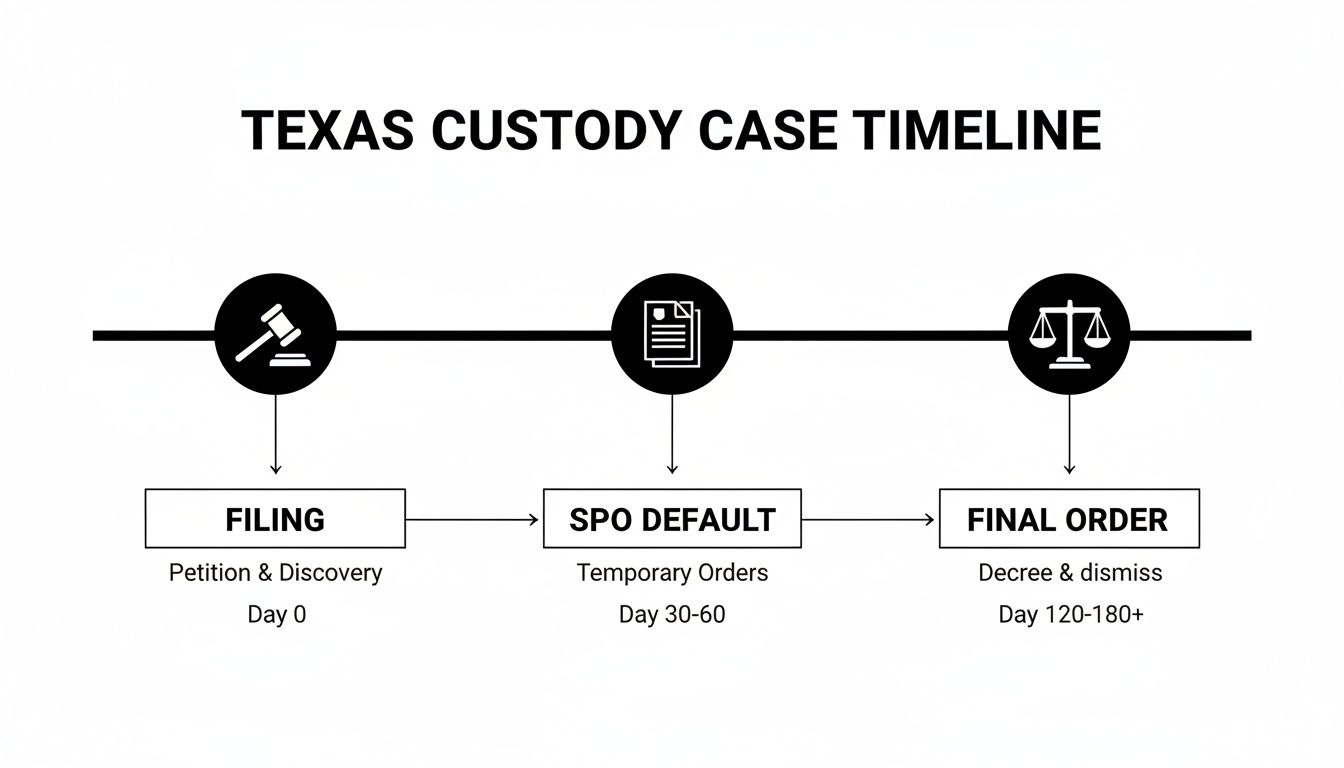
It’s a good reminder that while the Standard Possession Order is the default for a reason, getting there is a formal legal process. The goal is to create a clear, enforceable plan that everyone can rely on.
How Distance Changes the Schedule
That 100-mile line in the sand is what really alters the standard schedule. Living closer makes frequent contact, like midweek visits, possible. But when you live farther apart, the schedule has to adapt to focus on longer, less frequent visits to cut down on the travel stress for your child.
To make it simple, let’s look at how the schedule shifts based on that 100-mile difference.
SPO Schedule Comparison Under 100 Miles vs Over 100 Miles
| Possession Time | Parents Live Under 100 Miles Apart | Parents Live Over 100 Miles Apart |
|---|---|---|
| Weekends | First, third, and fifth weekends of the month. | One weekend a month of their choice (with proper notice). |
| Midweek Visit | Usually one evening per week (like every Thursday) during the school year. | No midweek visit due to the travel burden. |
| Spring Break | Alternates between parents every year. | The non-primary parent gets the child every Spring Break. |
| Summer | 30 days of possession, usually in one or two blocks of time. | 42 days of possession, usually in one or two blocks of time. |
As you can see, the law tries to adapt to the reality of your family's geography. The goal is always to create a schedule that actually works for everyone, especially the kids. For a much deeper dive, check out our detailed guide on understanding child visitation and Standard Possession Orders in Texas.
This structure shows how the court prioritizes what's practical and in the child's best interest.
Holidays and Summer Vacation
Big holidays get special treatment to make sure both parents have a chance to create those important memories with their kids. The SPO lays out a fair, alternating schedule for the major holidays so there's no confusion.
- Thanksgiving: You’ll alternate every year. The non-primary parent has the kids in odd-numbered years, while the primary parent gets them in even-numbered years.
- Christmas/Winter Break: This long break is split right down the middle. In even-numbered years, the non-primary parent gets the first half of the break (ending at noon on December 28th). In odd-numbered years, they get the second half.
Summer vacation is another huge opportunity for bonding. For parents living under 100 miles apart, the non-primary parent gets 30 days of possession time. If you're over 100 miles apart, that time is extended to 42 days to make the travel worthwhile.
Just a heads-up: notice is everything. The non-primary parent has to give written notice to the other parent by April 1st each year to lock in their preferred summer dates. If you miss that deadline, a default schedule (usually the entire month of July) automatically kicks in.
This whole structured approach is designed to take the guesswork and conflict out of co-parenting. It gives you a clear, reliable framework so you and your child can plan for—and actually look forward to—your time together.
Understanding Your Parental Rights and Duties
When your child’s future is on the line, nothing matters more than understanding your rights. A Texas custody agreement is far more than just a calendar—it's the legal framework defining your authority to make critical decisions for your child. It’s the rulebook that clarifies who has the final say on everything from doctor's visits to school enrollment, making sure both parents have a clear, defined role.
Under the Texas Family Code, courts start with a strong legal presumption of Joint Managing Conservatorship. This is a plain-English way of saying the court believes it's in your child's best interest for both parents to share the rights and responsibilities of raising them. Think of it less like a 50/50 split of time and more like a partnership in parenting.
Shared Rights in a Joint Managing Conservatorship
In nearly every standard custody order, both parents are given a core set of shared rights. These are the fundamental duties and privileges that empower you to stay actively involved in your child’s life, no matter who is the "primary" parent.
These shared rights almost always include:
- The right to get information from the other parent about the child's health, education, and general well-being.
- The right to talk with the other parent before making a major decision about the child.
- The right to access your child's medical, dental, psychological, and school records.
- The right to consult with your child's doctor, dentist, or psychologist.
- The right to attend school activities, like parent-teacher conferences and sporting events.
These shared duties are designed to keep communication open and encourage collaborative co-parenting. You can dive deeper into this topic in our complete guide on how Joint Managing Conservatorship works in Texas.
Exclusive Rights of the Primary Parent
While many rights are shared, some key decisions have to be assigned to one parent to prevent gridlock and create stability for the child. The parent named the primary managing conservator is usually given these exclusive, tie-breaking rights.
The most important of these is the exclusive right to designate the child's primary residence. This right anchors the child in a specific geographic area—often a county or even a particular school district—giving them a stable home base.
Other rights frequently given exclusively to the primary parent include:
- The right to consent to non-emergency medical and dental care.
- The right to consent to psychological and psychiatric treatment.
- The right to make decisions about the child’s education.
This structure doesn't sideline the other parent. It just creates a clear, final decision-maker to prevent endless arguments over both everyday issues and major life choices.
The Best Interest of the Child Standard
Every single decision a judge makes about your parental rights is guided by one powerful principle: the best interest of the child. This is the legal standard, found in Texas Family Code Chapter 153, that forces the court to put your child’s emotional and physical well-being above everything else. A judge will look at dozens of factors, from the child's specific needs to each parent's ability to provide a safe home, and any history of family violence or conflict.
Recent laws have tried to clarify parental rights even further to cut down on disputes. For example, some updates have given parents explicit power to choose and enroll their child in school, which has always been a major point of conflict. These kinds of changes show a commitment to strengthening parental roles while keeping children protected. You can find more details about recent Texas family code changes on thetxattorneys.com. When you remember that every right and duty in your order is rooted in this "best interest" standard, it helps you frame negotiations in a way that truly focuses on what's best for your child.
How Child Support Works with a Standard Custody Agreement
When you're sorting out a custody agreement, it's easy to get laser-focused on the visitation schedule. But your child's financial well-being is just as crucial as their emotional stability. A standard custody agreement in Texas doesn't just map out who has the kids and when; it also sets up a clear plan for how both parents will financially support them.
The good news? Texas law provides a straightforward, percentage-based system to make child support predictable and fair for everyone involved.
Typically, the parent who has visitation time (the possessory conservator) pays child support to the parent the child lives with most of the time (the primary managing conservator). The amount is calculated based on the paying parent’s net monthly resources—think wages, salary, commissions, and other income—after taxes and the child's health insurance premiums are taken out.
The Texas Child Support Formula
The state guidelines are designed to be clear and consistent. The formula uses a set percentage of the paying parent's net monthly resources, and that percentage goes up depending on the number of children covered by the order.
Here’s a quick breakdown of how it usually works:
- One Child: 20% of net resources
- Two Children: 25% of net resources
- Three Children: 30% of net resources
- Four Children: 35% of net resources
- Five or More Children: 40% of net resources
These numbers can be adjusted if the paying parent is already legally obligated to support other children. To make sure payments are consistent and on time, they are usually handled through an income withholding order, which automatically deducts the support amount from the parent's paycheck. If you want to dive deeper into this, you can learn more about how an income withholding order works in our detailed article.
Health Insurance and Medical Expenses
Beyond the monthly check, a standard custody agreement also spells out who handles health and dental insurance. The court will order one or both parents to provide coverage for the child. Usually, the parent who can get insurance at a reasonable cost through their job is ordered to maintain the policy.
What about costs that insurance doesn't cover? Things like co-pays, deductibles, and other out-of-pocket medical and dental expenses are typically split 50/50 between the parents. This setup ensures that unexpected healthcare needs don't turn into a point of conflict and that both parents are contributing to their child's health and wellness.
Steps to Modify or Enforce Your Texas Custody Order
Life doesn’t stop moving just because a judge signs a custody order. As kids get older, parents find new jobs, and families evolve, the standard custody agreement that made sense last year might feel completely unworkable today. Thankfully, Texas law understands this. It provides clear pathways for both updating and enforcing your order when life happens.
Think of your court order as more than just paper—it’s a legally binding tool designed to create stability for your child and protect your rights as a parent. Knowing how to use that tool when things change, or when the other parent simply isn't playing by the rules, is absolutely essential.
How to Modify a Custody Order
Life is full of curveballs. Maybe you landed a dream job offer in another city, your child developed new needs that demand a different schedule, or the other parent’s life has changed in a major way. When these kinds of shifts happen, you can go back to court and ask to change, or modify, the custody order.
To get a judge to agree, you have to prove two key things:
- There has been a material and substantial change in the circumstances of the child or one of the parents.
- Changing the order is in the best interest of the child.
The phrase “material and substantial change” isn’t just legal jargon. It means the change is a big deal—something significant that directly impacts your child's life. A simple disagreement over pickup times won't cut it. We're talking about major events that make the old order impractical or no longer good for your child.
For instance, a parent moving for a new job, a big shift in income, or even a new family dynamic could all fit the bill. The goal is to show the judge that the old arrangement just doesn't serve your child’s needs anymore.
What to Do When Your Order Is Violated
It’s one of the most frustrating and heartbreaking experiences for a parent: the other co-parent just decides not to follow the court-ordered schedule. Maybe they’re always late for drop-offs, they keep denying you your weekend time, or they flat-out refuse to bring the child back. These violations chip away at the very stability the order was meant to create.
When this happens, you have the right to file an enforcement action with the court. This is a formal legal step where you ask a judge to compel the other parent to follow the standard custody agreement. It is critical to document every single violation—write down dates, times, what happened, and who was there. Your evidence is everything.
A judge has a powerful toolkit for dealing with a non-compliant parent. They can:
- Order the other parent to pay fines or even cover your attorney's fees.
- Grant you make-up parenting time to compensate for the days you lost.
- In more serious cases, hold the other parent in contempt of court, which can lead to jail time.
Filing an enforcement action isn't about starting a fight; it's about holding the other parent accountable and sending a clear message that the court's order must be taken seriously. You have rights, and your order is there to make sure they're protected.
Common Questions About Texas Custody Agreements
Going through a custody case brings up a ton of questions. As lawyers who work with Texas families every day, we know that getting clear, straight-talk answers can cut down on the stress and help you make the right calls for your kids.
Here are a few of the questions we hear most often.
Can We Create Our Own Custody Schedule?
Absolutely. In fact, Texas courts would much rather see parents work together to create a custom possession schedule that actually fits their family’s life. The Standard Possession Order is really just a default plan; if you and the other parent can agree on a schedule that’s in your child’s best interest, a judge will almost always sign off on it.
When you collaborate, you can build a schedule around things like your specific work hours, your child’s sports or extracurriculars, and even your family’s holiday traditions. That kind of flexibility usually leads to a much more practical and less stressful co-parenting relationship down the road.
What About Custody for a Child Under Three?
This is a great question because the standard schedule, with its longer periods away from one parent, just isn't a good fit for infants and toddlers. For children under the age of three, Texas courts create specialized possession plans often called "stepped-up" orders.
These plans start with shorter, more frequent visits for the non-primary parent. Then, as the child gets older, the duration of those visits gradually increases. This approach is all about fostering a strong, secure bond with both parents while respecting the unique developmental needs of very young children.
When Can My Child Choose Who to Live With?
This is probably the single biggest myth in all of Texas family law. The short answer is: a child never gets to make the final decision about where they live.
Here’s how it actually works. Under the Texas Family Code, a child who is 12 years of age or older has the right to talk to the judge in private (in their chambers) and express their preference. The judge will listen carefully and give the child's wishes serious weight, but the ultimate decision is always based on the child's overall best interest—which includes a lot more than just what the child wants at that moment.
Key Takeaways and Next Steps
Navigating a custody agreement can feel like a complex puzzle, but you don't have to solve it alone. Remember these key points:
- Best Interest of the Child: This is the guiding star for every custody decision in Texas.
- The SPO is a Default: The Standard Possession Order is a solid foundation, but you and the other parent are encouraged to create a custom plan that works for your unique family.
- Know Your Rights: Understanding terms like Joint Managing Conservatorship and the difference between primary and possessory conservators empowers you to advocate for your child.
- Orders Can Change: Life evolves, and so can your custody order. Modification and enforcement are legal tools available to you when circumstances change.
If you need help with a child custody or visitation case in Texas, our experienced attorneys can guide you every step of the way. Contact The Law Office of Bryan Fagan, PLLC today for a free consultation at https://texascustodylawyer.net.